Jio Platforms IPO: 8 Things Every Investor Should Know Before Applying

By
Arihant Team
Jio Platforms’ ₹30,213 crore IPO is attracting massive investor interest, but is it worth applying for? Explore 8 key things about its financials, valuation, growth potential and risks before making your decision.
In This Article
- Introduction
- 1. Jio IPO Dates, Price Band and Minimum Investment
- 2. Why are big investors showing so much interest?
- 3. Where will Jio spend the ₹30,213 Crore?
- 4. What does the Jio IPO mean for Reliance Shareholders?
- 5. How did Jio turn cheap internet into a profitable business?
- 6. Where will Jio's next phase of growth come from?
- 7. Is Jio's IPO Valuation justified?
- 8. What are the biggest risks?
- Investor Takeaway: Should You Consider the Jio IPO?
Introduction
In 2016, Jio did something that seemed almost absurd: it made mobile data so cheap that millions of Indians began using the internet like never before. Suddenly it wasn’t just the tech-savvy crowd. Your autorickshaw driver could be online, your grandmother could video-call relatives, and even your uncle in a village could access the internet on his phone. What once felt like a luxury was fast becoming a part of everyday life.
A decade later, the company is back with a different kind of disruption of a ₹30,213 crore IPO that could make history as India's biggest-ever public issue.
The excitement is hard to miss.
Jio’s IPO was subscribed 3.16 times on day one, with investors rushing to get a piece of the company that changed how India connects to the internet.
We’re not surprised!
But popularity and profitability aren't the same thing. You need to know how does Jio make money, at proposed valuation, does the price leave enough room for your money to grow, what could go wrong?
So before jumping the bandwagon, here are 8 things you should know before applying.
Open a free account today
Invest in tomorrow with just one click
1. Jio IPO Dates, Price Band and Minimum Investment
Before getting into the business, here are the essential IPO details.
Retail investors can apply for a minimum of 12 shares, requiring ₹13,428 at the upper price band. Shares are expected to be allotted on October 26, with trading beginning on October 28.
2. Why are big investors showing so much interest?
Even before the IPO opened to retail investors, Jio attracted extraordinary demand from large institutions.
Its anchor investor portion, worth ₹8,110 crore, received bids worth approximately ₹2.5 lakh crore. That means institutional investors wanted over 30 times the shares available to them.
Major names included BlackRock, Fidelity, GIC and the Abu Dhabi Investment Authority, alongside leading Indian mutual funds.
However, strong institutional demand does not automatically mean the shares will deliver strong returns after listing. Investors still need to assess whether Jio's earnings justify its valuation.
3. Where will Jio spend the ₹30,213 Crore?
Unlike IPOs where existing shareholders sell their stakes, Jio's IPO is a 100% fresh issue. That means the money raised will go to the company, primarily to reduce debt.
Of the total ₹30,213 crore, approximately ₹27,500 crore, or 91%, is earmarked for repaying certain borrowings of Reliance Jio Infocomm, its telecom operating arm.
As of June 2026, Reliance Jio Infocomm had borrowings of approximately ₹61,372 crore. The planned repayment could bring this down to around ₹33,872 crore. This matters because lower borrowings can reduce future interest expenses, allowing Jio to retain more of its operating profits.
But even after repaying these loans, Jio will continue to have significant deferred spectrum payment obligations.
So, while the IPO strengthens Jio's balance sheet, it does not eliminate every financial obligation associated with running its telecom network.
4. What does the Jio IPO mean for Reliance Shareholders?
There’s a special quota for eligible Reliance shareholders (and even a separate quota for Jio Platform employees).
₹2,500 crore of the Jio IPO is reserved for Reliance Industries shareholders who held at least one RIL share on October 14, 2026. However, this reservation does not mean shareholders receive free Jio shares or guaranteed allotment. They must still apply and pay the applicable IPO price.
5. How did Jio turn cheap internet into a profitable business?
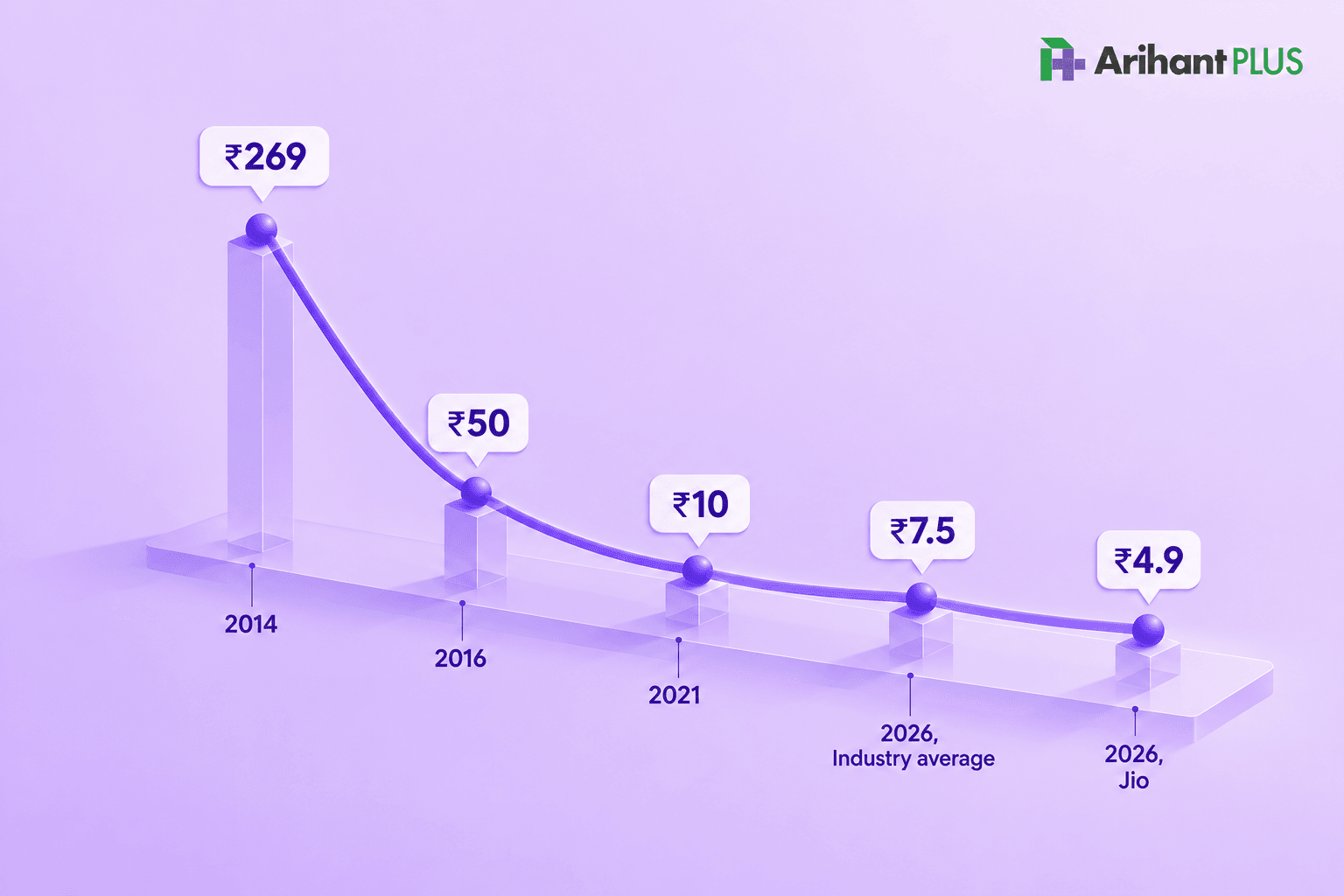
In 2014, mobile data in India cost around ₹269 per GB, according to TRAI. When Jio entered the market in 2016, it offered data at ₹50 per GB, triggering a price war that transformed internet access in India.
A decade later, industry data prices average just ₹7.5 per GB, while Jio's average is approximately ₹4.9.
Yet, low prices haven't come at the cost of profitability. With 53.3 crore customers and nearly 60% of India's wireless data traffic, Jio reported an EBITDA margin of 53.3% in June 2026, up from roughly 50% three years earlier.
For investors, the opportunity is now shifting from adding new subscribers to earning more from existing ones, making monetisation the next important growth driver.
6. Where will Jio's next phase of growth come from?
At the IPO press conference, Akash Ambani outlined three growth opportunities for Jio.
Mobile subscribers: Jio aims to add 34 crore customers over five years, including 10 crore people who currently lack mobile connectivity.
Home broadband: The company plans to grow its home internet connections from 2.86 crore to 10 crore, supported by JioFiber and JioAirFiber.
- Global technology: Jio wants to commercialise its in-house telecom technology by supplying network solutions to international operators, creating a revenue stream beyond Indian subscribers.
Jio has already filed 7,220 patent applications across technologies including 4G, 5G and 6G. Akash Ambani believes 6G could largely be introduced through software upgrades, potentially reducing the need for another massive infrastructure investment.
7. Is Jio's IPO Valuation justified?
At the upper price band, Jio is valued at approximately ₹10.3 lakh crore.
Its price to earnings ratio is around 34 times FY26 earnings, compared with approximately 37.5 times for Bharti Airtel on the comparison used here.
On the surface, Jio appears slightly cheaper. But valuation alone does not tell the complete story.
ARPU is the average monthly revenue earned per customer.
Airtel currently earns more per customer and generates better returns on capital. For Jio, narrowing this gap presents a significant opportunity.
With 53.3 crore subscribers, even a ₹10 increase in monthly ARPU could theoretically add nearly ₹6,400 crore in annual revenue, assuming subscriber numbers remain stable.
For investors, the real test is whether Jio can translate its massive customer base into higher revenue and profits without a proportionate increase in costs.
8. What are the biggest risks?
Jio's scale and profitability are established, but its future returns are not guaranteed. 3 risks deserve particular attention.
High capital requirements: Telecom infrastructure demands continuous investment, while Jio's spectrum payment obligations remain substantial.
Lower returns on capital: Jio's ROCE stands at 10.8%, compared with Airtel's 19%. Improving capital efficiency will be important to justify its valuation.
- Unproven growth businesses: Broadband expansion and global technology licensing offer potential, but their long-term profitability remains uncertain.
Competition from other telecom operators, satellite internet providers and changing regulations could also influence future growth.

Investor Takeaway: Should You Consider the Jio IPO?
Jio is not asking the market to bet on an untested idea. It is already profitable, plans to use most of its IPO proceeds to reduce debt, and has identified three major avenues for future growth.
The real test is execution: improving returns on capital, expanding broadband revenue and turning its telecom technology into a global business.
The minimum retail investment is ₹13,428 for 12 shares, with IPO bidding closing on October 23, 2026.
Jio has transformed India's digital connectivity by making mobile internet affordable at an unprecedented scale.
Its next phase will depend on how effectively it converts that scale into stronger earnings and shareholder returns.
Related Topics

Jio Platforms IPO Opens 21Oct: Can a Telecom Network Carry Tech Valuation?

Subway Plans ₹600 Crore IPO: What You Need to Know About EverBrands India
Moneyview IPO 2026: From Digital Lending to a ₹1,092 Cr Public Listing


Rentomojo, Karamtara, LCC - 6 IPO Listings Today: Gains, Losses & Key Highlights


NSE IPO 2026: Price Band, GMP, Financials, Risks and Key Highlights


Kanohar Electricals IPO Review 2026: Risks, Strengths and Financials


Horizon Industrial Parks IPO: Details, Financials, Strengths and Risks



Dhoot Transmission IPO: A ₹3,067 Crore Bet on India's Electric Future


























Important IPO terms all investors should understand before investing
Meesho IPO Opens on 3Dec - Is this ₹5,421 crores IPO worth investing?

10 Things to Know About Sudeep Pharma IPO: Date, Price, GMP & Complete Review




Canara Robeco AMC IPO: Should You Apply for MF Giant’s Public Debut?






Smartworks Coworking Spaces Limited IPO: 10 Key Things to Know Before Investing

Travel Food Services Limited IPO: 10 Key Things to Know Before Investing


Ellenbarrie Industrial Gases Limited IPO: 10 Key Things to Know Before Investing



HDB Financial Services Limited IPO: 10 Key Things to Know Before Investing

Sambhv Steel Tubes Limited IPO: 10 Key Things to Know Before Investing

Indogulf Cropsciences Limited IPO: 10 Key Things to Know Before Investing



Prostarm Info Systems Limited IPO: 10 Key Things to Know Before Investing


Aegis Vopak Terminals Ltd IPO: 10 Key Things to Know Before Investing

Schloss Bangalore Limited IPO: 10 Key Things to Know Before Investing


Belrise Industries Limited IPO: 10 Key Things to Know Before Investing


Hexaware’s Billion Dollar Markets Hits in Bear Market: Should You Invest?