



Kanohar Electricals IPO Review 2026: Risks, Strengths and Financials

By
Arihant Team
A 50 year old transformer maker from Meerut is heading to the market with a ₹1,055.74 crore IPO. Margins have more than doubled in two years, but nearly three quarters of the issue is the promoter cashing out.. Should you apply?
In This Article
- Introduction
- Key Highlights
- Kanohar Electricals IPO Objectives: Where will the money go?
- Business overview
- Kanohar Electricals financials
- Peer Comparison
- Kanohar Electricals IPO GMP
- Risks
- Investor Takeaway
- FAQs
Introduction
India's power grid is being rebuilt at a pace it has not seen in decades, and every megawatt that moves through it passes through a transformer.
One of the companies making those transformers is Kanohar Electricals.
The Meerut based manufacturer is now heading to the primary market with its IPO, which opens for subscription on September 8, 2026, and closes on September 10, 2026. The issue size is ₹1,055.74 crore.
But what exactly does Kanohar do, how rare is its technical edge really, and does the price justify a look? Here is a closer read of the Kanohar Electricals IPO and what retail investors should weigh before deciding.
Key Highlights
Kanohar Electricals IPO Objectives: Where will the money go?
Kanohar Electricals IPO is a combination of fresh issue and offer for sale. Out of the ₹1,055.74 crore IPO, ₹755.74 crore is an offer for sale, with the promoter trust selling part of its holding. The remaining ₹300 crore is a fresh issue, and the proceeds are earmarked for:
- Capital expenditure at Gangol for new machinery to expand transformer capacity, civil construction, and sustainability spending on solar plants and electric vehicles: ~₹64.2 crore
- Incremental working capital: ~ ₹155 crore
- General corporate purposes
Business overview
Kanohar has been making transformers for over 40 years and is one of the leading domestic players in the segment by revenue in FY26. It caters to power transmission, railways, renewable energy and power distribution customers.
The company runs two segments:
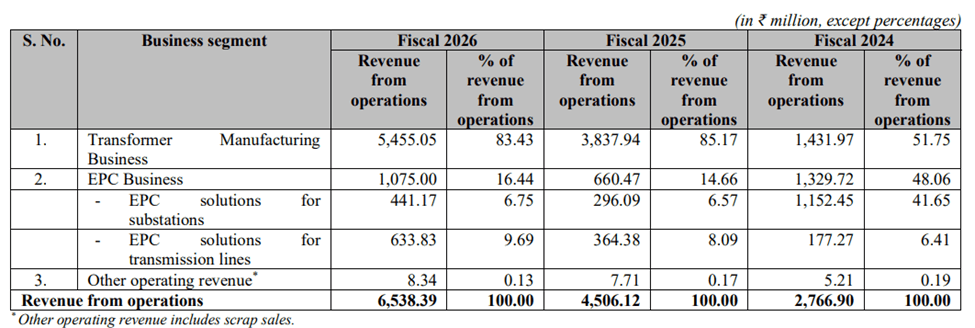
Transformer Manufacturing builds power, traction, Scott, shunt reactor and distribution transformers, and made up 83 percent of FY26 revenue.
- EPC is the smaller segment, undertaking turnkey construction of substations and transmission lines, and made up 16 percent.
As of March 31, 2026, Kanohar is 1 of only 5 Indian companies with short circuit test certification for 500 MVA 400 kV transformers, the class used in high voltage power transmission. It is also one of four manufacturers certified by Research Designs and Standards Organisation, the R&D arm of Indian Railways, to build 100 MVA 132 kV Scott transformers, and one of just two certified for the 220 kV version used in railway electrification. Those certifications are what let it bid for large, high value government tenders that most manufacturers simply cannot qualify for. That is a real moat at the tender stage, but it also ties the business closely to public capex cycles rather than diversified private demand.
As of FY26, 94 percent of the order book by value sits with the government sector, led by large contracts such as a ₹568.7 crore order for 500 MVA 400 kV power transformers from Power Grid Corporation of India in June 2025.
Kanohar Electricals financials
Kanohar's financials tell a fairly clean story: fast revenue growth, margins that have more than doubled in two years, and a balance sheet with low debt, though operating cash flow softened even as profit rose.
- Revenue grew from ₹276.7 crore in FY24 to ₹653.8 crore in FY26, roughly a 54 percent CAGR, driven mainly by a jump in high voltage power transformer orders and a large order book that grew from ₹595.8 crore to ₹1,818.3 crore over the same period.
- EBITDA margin expanded from 11.2 percent to 27.6 percent across the three years, and PAT nearly doubled in FY26 alone, from ₹65.1 crore to ₹129.7 crore.
- Gross debt to equity fell from 0.24 times to 0.10 times, and working capital days tightened from 124 to 107, both genuinely healthy signs for a manufacturing business scaling this fast.
The one thing to watch is cash flow..Operating cash flow actually fell from ₹79.4 crore in FY25 to ₹25.8 crore in FY26, even as profit nearly doubled, because inventories and receivables grew faster than collections.
Cash and equivalents on the books were just ₹0.02 crore at FY26 close, though the company separately holds ₹95.5 crore in other bank balances such as fixed deposits and margin money.
Peer Comparison
Kanohar's RHP lists 6 listed peers, certified as of August 13, 2026 closing prices, though it is worth noting upfront that two of them, Hitachi Energy India and GE Vernova T&D India, are multinational backed giants many times Kanohar's size, and the comparison set as a whole spans companies from roughly four times to over fifty times Kanohar's revenue.
Transformers & Rectifiers is the closest match by business model among the six, and even there Kanohar is roughly four times smaller by revenue. Against that peer, and against the wider peer average of around 107 times earnings, Kanohar's implied price to earnings of roughly 36 to 39 times at the upper band looks reasonably priced, and its return on net worth of 34.8 percent is among the strongest of the entire peer set.
The caveat is that this discount partly reflects Kanohar's smaller scale and lower trading liquidity relative to its peers, not just cheaper valuation.
Kanohar Electricals IPO GMP
Kanohar Electricals IPO was commanding a grey market premium of around ₹200 to ₹215 a piece as of September 7, 2026, according to multiple IPO tracking sites, suggesting an estimated listing price of roughly ₹835 to ₹847, or about a 32 to 34 percent gain over the ₹632 upper band. GMP has ranged from ₹0 to ₹215 over the tracking period, so it has moved around a fair bit rather than sitting still.
Disclaimer: Grey Market Premium is not regulated or recommended by the stock exchanges or SEBI. ArihantPlus does not endorse or facilitate trading in the grey market. Investors are advised to conduct their own research or consult an expert before making any investment decisions.
Risks
A few factors are worth weighing before applying:
Product concentration: Transformers alone are 83 percent of revenue, so any slowdown in transmission or railway capex hits the top line directly.
Customer and tender concentration: Government buyers make up 94 percent of the order book, tying the business to public procurement cycles and payment timelines rather than diversified private demand.
Raw material exposure: Copper and specialised steel are the core inputs, and prices for both are volatile and largely outside the company's control.
Order book is not revenue: A large order book signals demand, but execution delays, penalties or cancellations can mean actual revenue comes in well below that figure.
- Large contingent liabilities: Guarantees and letters of credit stood at ₹324.8 crore as of FY26, roughly half of annual revenue, a real call on the balance sheet if invoked.
Investor Takeaway
Kanohar is positioned to benefit from the structural buildout of India's transmission grid, railway electrification and renewable capacity, supported by a certification based moat that keeps most competitors out of its highest value contracts.
Considering Kanohar's improving margins, low debt and reasonable valuation against listed transformer peers, balanced against its OFS heavy structure, softening operating cash flow and heavy dependence on government tenders, we assign a “SUBSCRIBE” rating for the Kanohar Electricals IPO, best suited to investors comfortable holding through a business tied closely to public infrastructure capex cycles rather than looking for a purely listing day pop.
FAQs
What are the IPO dates for Kanohar Electricals IPO?
The IPO opens on September 8, 2026 and closes on September 10, 2026. Allotment is expected on September 11, with listing tentatively scheduled for September 16 on the BSE and NSE.
What is the Kanohar Electricals IPO price band and lot size?
The price band is ₹601 to ₹632 per share, with a minimum lot of 23 shares. At the upper band, retail investors will need around ₹14,536.
What is Kanohar Electricals IPO GMP?
The latest GMP tracked was around ₹200 to ₹215, implying an estimated listing price of roughly ₹835 to ₹847, or about 32 to 34 percent above the upper price band. GMP is unofficial and can change before listing.
Is Kanohar Electricals IPO a fresh issue or an offer for sale?
Both. The IPO includes a ₹300 crore fresh issue and an offer for sale of ₹755.74 crore. The fresh issue proceeds go to Kanohar, while the offer for sale proceeds go entirely to K Sons Family Trust, the promoter selling shareholder.
What will Kanohar Electricals use the IPO proceeds for?
The company plans to fund capital expenditure at its Gangol manufacturing facility including new machinery and sustainability initiatives, fund incremental working capital, which is the largest identified use, and cover general corporate purposes.
Is Kanohar Electricals profitable?
Kanohar reported a profit of ₹129.7 crore in FY26, up from ₹65.1 crore in FY25 and ₹17.8 crore in FY24, with EBITDA margin expanding from 11.2 percent to 27.6 percent over the same period.

Related Topics

Jio Platforms IPO: 8 Things Every Investor Should Know Before Applying



Jio Platforms IPO Opens 21Oct: Can a Telecom Network Carry Tech Valuation?


Subway Plans ₹600 Crore IPO: What You Need to Know About EverBrands India

Moneyview IPO 2026: From Digital Lending to a ₹1,092 Cr Public Listing




Rentomojo, Karamtara, LCC - 6 IPO Listings Today: Gains, Losses & Key Highlights


NSE IPO 2026: Price Band, GMP, Financials, Risks and Key Highlights



Horizon Industrial Parks IPO: Details, Financials, Strengths and Risks




Dhoot Transmission IPO: A ₹3,067 Crore Bet on India's Electric Future































Important IPO terms all investors should understand before investing


Meesho IPO Opens on 3Dec - Is this ₹5,421 crores IPO worth investing?


10 Things to Know About Sudeep Pharma IPO: Date, Price, GMP & Complete Review








Canara Robeco AMC IPO: Should You Apply for MF Giant’s Public Debut?







Smartworks Coworking Spaces Limited IPO: 10 Key Things to Know Before Investing

Travel Food Services Limited IPO: 10 Key Things to Know Before Investing


Ellenbarrie Industrial Gases Limited IPO: 10 Key Things to Know Before Investing



HDB Financial Services Limited IPO: 10 Key Things to Know Before Investing

Sambhv Steel Tubes Limited IPO: 10 Key Things to Know Before Investing

Indogulf Cropsciences Limited IPO: 10 Key Things to Know Before Investing

Prostarm Info Systems Limited IPO: 10 Key Things to Know Before Investing

Aegis Vopak Terminals Ltd IPO: 10 Key Things to Know Before Investing

Schloss Bangalore Limited IPO: 10 Key Things to Know Before Investing

Belrise Industries Limited IPO: 10 Key Things to Know Before Investing


Hexaware’s Billion Dollar Markets Hits in Bear Market: Should You Invest?