



Jio IPO: Telecom Listing or Digital Infrastructure Bet?

By
Arihant Team
Reliance Jio’s upcoming IPO is one of the most closely watched market events in India right now. The issue is expected to be around $4 billion, and if reports around the size are accurate, it could become India’s biggest IPO.
In This Article
- Introduction
- Inside Jio’s Digital Infrastructure Scale
- Jio’s Operating Lever
- (Understanding) Jio IPO’s ₹14 lakh crore valuation
- Jio’s Dynamic IPO Structure: OFS or Fresh Issue?
- Risks Involved
- Investor Takeaway
Introduction
Markets are excited about the upcoming Relaince Jio IPO. All eyes are on the news about when is the company filing its DRHP, what are teh IPO dates, at what price and valuation is the IPO going to debut?
And, most investors looking at Jio’s IPO will naturally start with Bharti Airtel as the closest comparison. But that may be an incomplete lens. This is because Reliance Jio Infocomm is not just a telecom operating company. It is Jio Platforms, the holding company that sits above it, and the distinction carries enormous valuation consequences.
Jio Platforms houses the telecom network as its base layer, but above that sits
- home broadband (JioFiber),
- cloud infrastructure,
- enterprise services,
- the JioHotstar streaming platform (now the world's second-largest streaming service by users),
- a growing AI data-centre buildout, and
- a digital apps ecosystem that spans payments, health, and education.
Telecom companies globally trade at 5 - 8x EV/EBITDA. Platform and digital infrastructure businesses command 15 - 25x. Jio Platforms is seeking to be valued in the latter category. Whether the market accepts that case is the central investment question of this IPO.
Open a free account today
Invest in tomorrow with just one click
Inside Jio’s Digital Infrastructure Scale
Reliance has announced Reliance Intelligence, a fully owned subsidiary that will build large, AI ready data centres in Jamnagar, powered by green energy. If Jio Platforms becomes the main customer and distribution channel for this infrastructure, the market may start looking at Jio differently.
This does not mean Jio automatically deserves a technology multiple. It means investors now have to evaluate whether telecom, data, cloud, AI, media, and enterprise services can work together as one platform.
Jio’s Operating Lever
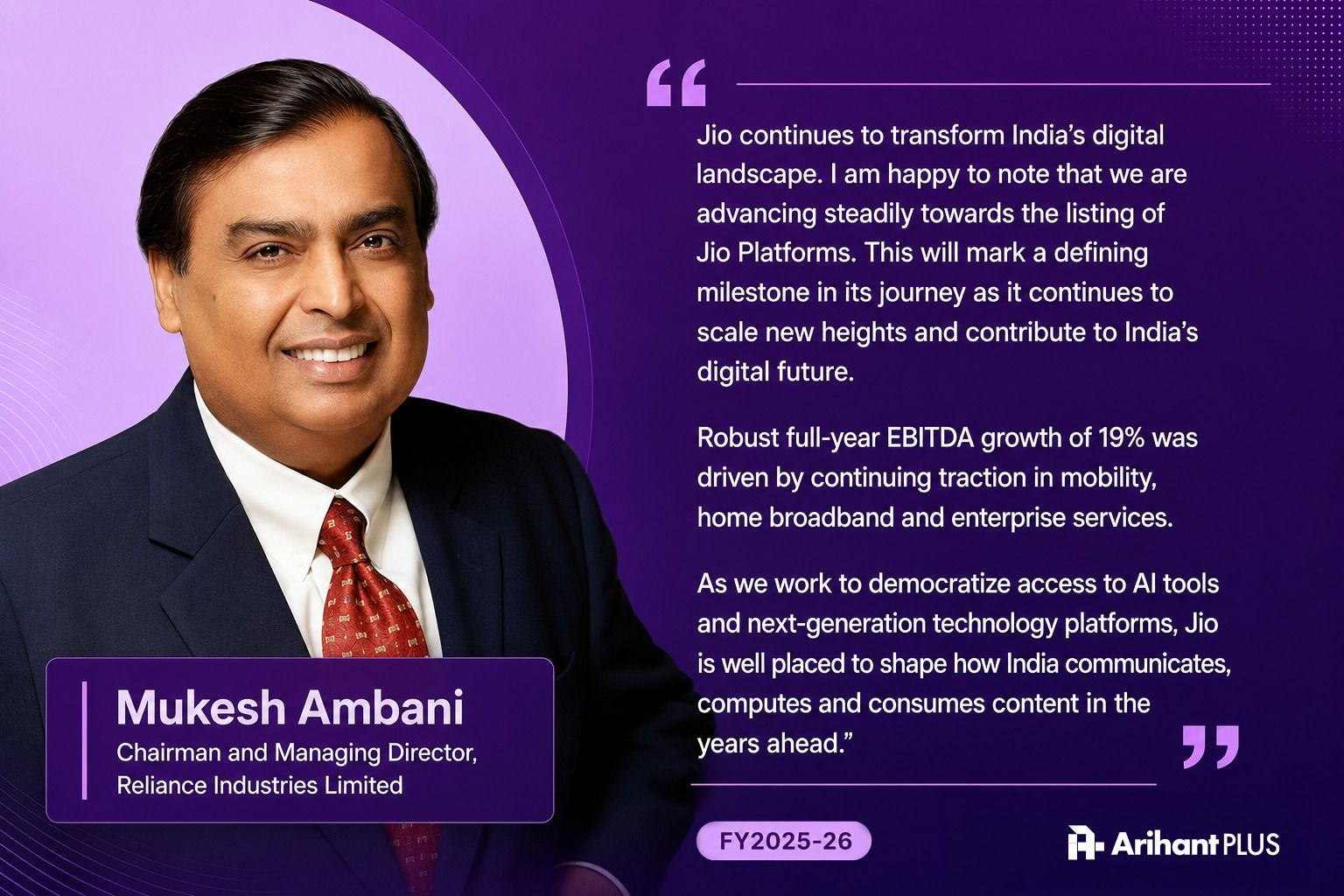
Jio is not a startup entering the public market on hope alone. It is already a mature business with 52.4 crore subscribers, 26.8 crore 5G users, 39.2 percent revenue market share, and improving earnings power.
The most important number to watch is ARPU, or average revenue per user. Jio’s ARPU has moved from around ₹181 two years ago to ₹214 in Q4 FY26. At Jio’s scale, every ₹10 increase in monthly ARPU can add nearly ₹524 crore in revenue every month. That’s a huge number!
Airtel’s ARPU is still higher at ₹257, compared with Jio’s ₹214. This ₹43 gap represents nearly ₹27,000 crore in annualised revenue at Jio’s current subscriber base. Even if Jio closes only part of this gap, the impact on revenue and valuation can be meaningful.
(Understanding) Jio IPO’s ₹14 lakh crore valuation
The valuation debate around Jio Platforms is where the IPO story becomes especially interesting. The market is currently discussing a valuation range of roughly ₹10.8 lakh crore to ₹14.1 lakh crore, which translates to nearly $130 billion to $170 billion. At the lower end, Jio is being valued closer to a telecom company with some additional credit for its digital businesses. At the upper end, investors are beginning to treat it more like a large technology and digital infrastructure platform with similarities to Asian telecom technology giants.
What makes this even more significant is the scale of the business. Investment banks such as Goldman Sachs, Jefferies, and Citi believe Jio could enter the market as one of India’s five largest listed companies by market capitalisation. At the higher valuation band, it could also become one of the world’s largest telecom and digital infrastructure companies.
The valuation largely depends on how investors see Jio’s future. In the bear case, the market treats Jio like a traditional telecom operator, similar to Airtel, where the focus stays on subscriber growth and telecom earnings. In the base case, investors assign value to both telecom and digital platform opportunities, while expecting steady ARPU growth and stronger digital revenues. In the bull case, the market starts pricing Jio as a full scale digital platform driven by AI infrastructure, cloud services, media, and enterprise technology.
Jio’s Dynamic IPO Structure: OFS or Fresh Issue?
Another important detail is the IPO structure itself. Despite the large valuation, the actual issue size is expected to be relatively modest at around ₹33,000 crore to ₹38,000 crore because Reliance is likely to dilute only about 2.5 to 3 percent stake. This became possible after SEBI reduced the minimum public float requirement for mega cap IPOs earlier this year. Without this rule change, Reliance would have needed to bring a much larger issue to the market, making execution more difficult in volatile market conditions.
A significant shift in Jio's IPO strategy has caught the headlines and interest of investors. Reliance Industries is scrapping the earlier plan under which existing investors such as Meta, Google, KKR, Silver Lake and others were to sell a part of their holdings through an Offer for Sale (OFS) route, and is instead moving toward a fully fresh issue.
Under the original OFS structure, these 13 major investors were poised to sell around 8% of their stakes, which would have raised up to $4 billion without Jio Platforms itself raising any new capital, a classic exit strategy for early backers. The biggest trigger for this U-turn appears to be a valuation disagreement. Several early investors wanted a higher IPO valuation to maximise returns on investments made during the 2020 fundraising round, but Reliance has taken a more cautious stance amid volatile market conditions and softer IPO sentiment.
This change is a big positive for retail investors. A fully fresh issue would channel all proceeds directly to the company, with nearly ₹25,000 crore potentially used for debt repayment and the rest allocated for expansion and operational needs. The fresh issue structure also signals that Reliance believes the true value of Jio, particularly its AI ambitions, is not fully reflected in today's pricing, and that allowing the market to determine the price post-listing could unlock more value over time.
For investors, this sends a strong message because early investors are choosing to stay invested rather than exit at the IPO valuation.
Risks Involved
A large part of the valuation depends on the market believing that Jio deserves a digital platform multiple and not just a telecom multiple. ARPU growth remains critical because any slowdown in tariff hikes or pricing power could weaken the growth narrative. Global market conditions, foreign investor flows, regulatory risks, and the possibility of a holding company discount are also important factors to watch closely.
Investor Takeaway
Jio’s IPO valuation will depend on one key question: Will the market value it as a telecom company or as India’s leading digital platform?
Jio already has a massive distribution advantage with over 51.5 crore subscribers, growing 5G adoption, improving pricing power, and expanding digital businesses across media, AI, cloud, and enterprise services. If ARPU continues to move closer to Airtel’s levels and digital revenues scale meaningfully over the next few years, the higher valuation band becomes much easier to justify.

Related Topics

Jio Platforms IPO Review: Can a Telecom Network Carry a Technology Valuation?

Subway Plans ₹600 Crore IPO: What You Need to Know About EverBrands India

Moneyview IPO 2026: From Digital Lending to a ₹1,092 Cr Public Listing




Rentomojo, Karamtara, LCC - 6 IPO Listings Today: Gains, Losses & Key Highlights


NSE IPO 2026: Price Band, GMP, Financials, Risks and Key Highlights


Kanohar Electricals IPO Review 2026: Risks, Strengths and Financials


Horizon Industrial Parks IPO: Details, Financials, Strengths and Risks



Dhoot Transmission IPO: A ₹3,067 Crore Bet on India's Electric Future






























Important IPO terms all investors should understand before investing


Meesho IPO Opens on 3Dec - Is this ₹5,421 crores IPO worth investing?


10 Things to Know About Sudeep Pharma IPO: Date, Price, GMP & Complete Review








Canara Robeco AMC IPO: Should You Apply for MF Giant’s Public Debut?







Smartworks Coworking Spaces Limited IPO: 10 Key Things to Know Before Investing

Travel Food Services Limited IPO: 10 Key Things to Know Before Investing


Ellenbarrie Industrial Gases Limited IPO: 10 Key Things to Know Before Investing



HDB Financial Services Limited IPO: 10 Key Things to Know Before Investing

Sambhv Steel Tubes Limited IPO: 10 Key Things to Know Before Investing

Indogulf Cropsciences Limited IPO: 10 Key Things to Know Before Investing



Prostarm Info Systems Limited IPO: 10 Key Things to Know Before Investing


Aegis Vopak Terminals Ltd IPO: 10 Key Things to Know Before Investing

Schloss Bangalore Limited IPO: 10 Key Things to Know Before Investing


Belrise Industries Limited IPO: 10 Key Things to Know Before Investing


Hexaware’s Billion Dollar Markets Hits in Bear Market: Should You Invest?