

Milky Mist ₹1,553 crore IPO 2026 | Should You Apply?

By
Arihant Team
Milky Mist IPO 2026 brings a ₹1,553 crore issue, offering investors a chance to participate in one of India’s fast-growing value-added dairy brands. Explore its IPO details, financial performance, valuation, key risks and GMP to understand whether Milky Mist IPO is worth applying for.
In This Article
- Introduction
- Key IPO Details: Milky Mist Dairy Food IPO
- Business Overview
- Where will Milky Mist's IPO proceeds go?
- Financial Performance
- Peer Comparison
- Key Risks
- Investor Takeaway
- FAQs
Introduction
When Milky Mist introduced India's first packaged paneer in the late 1990s, taking a loose commodity off neighborhood dairy counters and selling it in a sealed, branded pack seemed counterintuitive.
Nearly three decades later, that single risk remains the company's defining edge: by skipping the thin-margin liquid milk game to build a pure-play, value-added FMCG portfolio across 22 categories and 640 SKUs.
Milky Mist now approaches the market with a ₹1,553 crore IPO valued at ~₹10,778 crore, testing whether investors will pay an FMCG premium for a high-growth dairy brand.
Open a free account today
Invest in tomorrow with just one click
Key IPO Details: Milky Mist Dairy Food IPO
Business Overview
Milky Mist began in 1998 by packaging paneer at a time when most Indian consumers still bought it loose; 28 years later, that single product has expanded into a portfolio of 22 categories and 640 SKUs.
Milky Mist runs the farm to retailer infra chain: it buys milk from 74,654 farmers, processes it at its plant, moves products through refrigerated and ambient trucks, and reaches consumers through distributors and more than 3.75 lakh retail outlets.
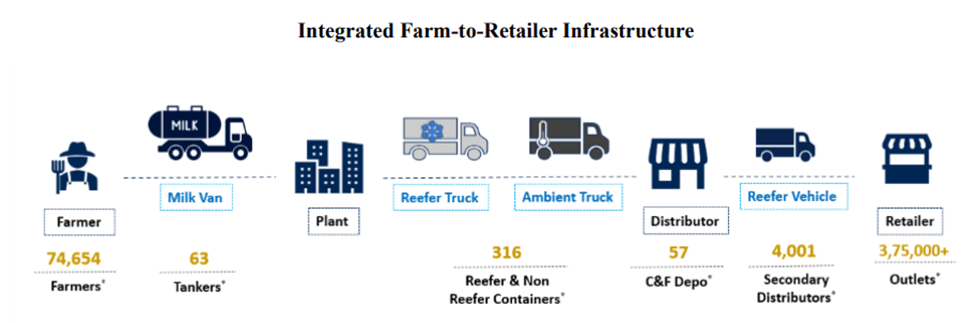
Owning much of this infrastructure helps Milky Mist keep costs tight. Its transportation cost as a share of revenue is among the lowest in its listed peer set, helped by its own fleet, route optimisation and using return trips to carry loads instead of running trucks empty.
Paneer is the anchor, Milky Mist was the largest private packaged paneer brand in India with roughly 19 percent of the organised packaged paneer market by value in FY26. Paneer and curd typically sell at 10 to 30 percent above the average price of Indian brands, , helping it earn better margins and build strong positions across cheese, curd and yogurt as well.
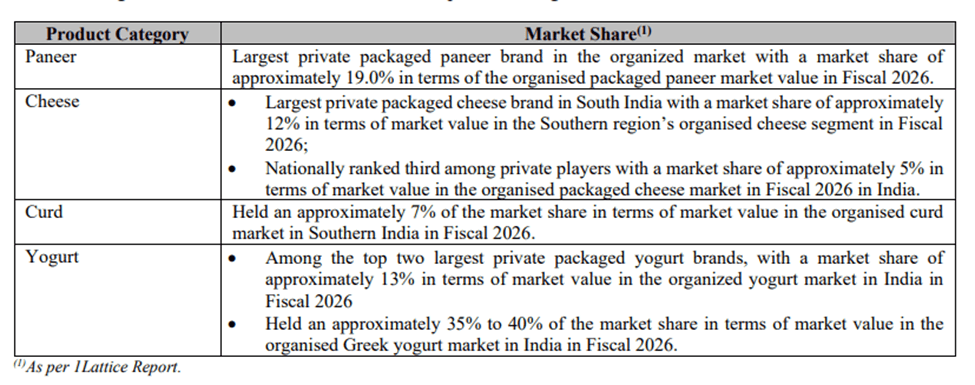
Also, Milky Mist exports to over 15 countries now, but is 3.72% of operational revenue at the moment, leaving a massive, untapped runway for international growth.
Where will Milky Mist's IPO proceeds go?
IPO is largely a fresh proceed. Of the ₹1,553 crore, ₹1,428 crore is fresh capital for the company, amounting roughly 92 percent of the offer. Promoters Sathishkumar T and Anitha S are selling ₹75 crore and ₹50 crore respectively.
Worth noting: Original DRHP filed in July 2025 proposed ₹2,035 crore. The issue was trimmed to ₹1,553 crore after the pre-IPO placement.
Financial Performance
Total income jumped 34% in FY26, compounding at a solid ~31% over two years, while profit after tax surged an impressive 176%.
While a 13.87% EBITDA margin shows the strength of their premium product mix compared to typical single-digit dairy peers, the PAT margin sits at just 4.05% because interest and depreciation eat up most of the operating profit.
- Operating cash flow (₹301.79 crore) wasn't enough to cover heavy capex investments (₹469.69 crore), forcing the company to plug the gap with debt, pushing total borrowings up to ₹1,672 crore with just ₹10.54 crore of cash left on hand.
The IPO solves this cash crunch directly by paying off ~₹497 crore of debt and boosting net worth by ₹1,428 crore, which lifts book value per share from ₹5.87 to ~₹28 and slashes the price-to-book multiple from 24x down to roughly 5x.
Peer Comparison
Milky Mist operationally looks closer to FMCG, with a 13.87 percent EBITDA margin, almost identical to Bikaji’s, despite being a predominantly dairy business.
Real concern comes after EBITDA: ₹1,672 crore of debt drags PAT margin down to 4.05% and makes the stock look especially expensive on P/E. At a proposed market cap of ₹10,778 crore, Milky Mist is being valued at roughly 71x to 85x FY26 earnings, while the average P/E works out to be 52.56.
At 71x to 85x earnings, Milky Mist is priced above Parag and Dodla, above Hatsun’s 58.2x branded dairy precedent, and even above Bikaji’s 62.33x, despite Bikaji being similarly sized, twice as profitable at the PAT level and far less levered.
So the valuation is really a bet on one thing: growth. Milky Mist grew revenue 33.58% in FY26, far ahead of peers. Investors are being asked to pay above both dairy and FMCG benchmarks on the assumption that this growth continues while debt comes down.
Key Risks
Plant concentration: All manufacturing sits at Perundurai. A prolonged shutdown from fire, flood, regulatory action or anything else would stop most production.
Milk supply concentration: 94.51 percent of raw milk came from Tamil Nadu in FY26. Procurement price shifts or state level policy changes hit input costs directly.
Regional revenue skew: South India contributed 69.23 percent of revenue from operations in FY26. The national expansion story is still mostly a plan.
Product concentration: Paneer, cheese and curd together made up 59.05 percent of FY26 revenue. A preference shift or a price war in paneer hits the core.
Leverage: Borrowings stood at ₹1,671.85 crore as of March 2026 and ₹1,390.7 crore as of May 2026. Only about ₹497 crore is being repaid from the issue, so meaningful debt remains and the capex plan continues.
- Input cost: Milk is the single largest cost and it moves with weather, feed prices and procurement competition. Margins in this sector can swing fast on a factor management does not control.

Investor Takeaway
Milky Mist has a strong operating story, with 33.58 percent revenue growth in FY26 and a 13.87 percent EBITDA margin. Its IPO also helps clean up the balance sheet, with ₹497 crore of the fresh proceeds going toward debt repayment.
We think Milky Mist is a legitimately good business wearing a slightly demanding price tag. At ₹140 a share, the company is valued at about ₹10,778 crore, or roughly 71x to 85x earnings, despite FY26 net profit of just ₹127 crore.
Temasek buying in at ₹139.76 just before the IPO tells you serious money looked at the same numbers and was comfortable investing in it. Evaluate Milky Mist IPO as a long term consumer brand position rather than a listing pop trade.
FAQs
What are the IPO dates for Milky Mist IPO?
IPO opens on August 11, 2026 and closes on August 13, 2026. Anchor bidding is on August 10. Allotment is expected on August 14, refunds and share credit on August 17, and listing on August 18 on the BSE and NSE.
What is the Milky Mist IPO price band and lot size?
Price band is ₹133 to ₹140 per share with a minimum lot of 107 shares, requiring ₹14,980 at the upper band.
What is Milky Mist IPO GMP?
Grey market premium, GMP is at 23 right now. GMP is unofficial, and often has little to do with where a stock settles. However if you wish to track it, click here.
Is Milky Mist IPO a fresh issue or an OFS?
Both, the fresh issue component is ₹1,428 crore and the offer for sale is only ₹125 crore, so about 92 percent of proceeds go to the company.
Why was the IPO size reduced?
DRHP filed in July 2025 proposed ₹2,035 crore. The company raised ₹357 crore in an April 2026 pre IPO placement to Jongsong Investments, a Temasek unit, at ₹139.76 per share, and trimmed the public issue accordingly.
How is Milky Mist different from Amul, Hatsun or Dodla?
Amul is a cooperative and is not listed, so there is no investable equity. Hatsun and Dodla derive a meaningful share of revenue from liquid milk. Milky Mist is almost entirely value added, which is why its EBITDA margin is higher and its valuation multiple is being pitched closer to FMCG names than dairy names.
Should you invest in the Milky Mist IPO?
Milky Mist has real brand strength in a fast growing category, an integrated supply chain and an offer structured to strengthen the balance sheet. But a P/E of roughly 71 to 85 times, a 4.05 percent PAT margin, debt to equity of 3.61 and single plant plus single state dependencies make it a demanding ask at ₹140. It suits investors with a multi year horizon and tolerance for input cost volatility rather than those looking for listing gains.
This article is for informational purposes only and is not investment advice. Figures are drawn from the company's RHP and DRHP. Please read the offer documents in full and consult a SEBI registered advisor before investing.
Related Topics


Rentomojo, Karamtara, LCC - 6 IPO Listings Today: Gains, Losses & Key Highlights


NSE IPO 2026: Price Band, GMP, Financials, Risks and Key Highlights


Kanohar Electricals IPO Review 2026: Risks, Strengths and Financials


Horizon Industrial Parks IPO: Details, Financials, Strengths and Risks

Dhoot Transmission IPO: A ₹3,067 Crore Bet on India's Electric Future























Important IPO terms all investors should understand before investing

Meesho IPO Opens on 3Dec - Is this ₹5,421 crores IPO worth investing?


10 Things to Know About Sudeep Pharma IPO: Date, Price, GMP & Complete Review




Canara Robeco AMC IPO: Should You Apply for MF Giant’s Public Debut?




Smartworks Coworking Spaces Limited IPO: 10 Key Things to Know Before Investing

Travel Food Services Limited IPO: 10 Key Things to Know Before Investing


Ellenbarrie Industrial Gases Limited IPO: 10 Key Things to Know Before Investing



HDB Financial Services Limited IPO: 10 Key Things to Know Before Investing

Sambhv Steel Tubes Limited IPO: 10 Key Things to Know Before Investing

Indogulf Cropsciences Limited IPO: 10 Key Things to Know Before Investing

Prostarm Info Systems Limited IPO: 10 Key Things to Know Before Investing


Aegis Vopak Terminals Ltd IPO: 10 Key Things to Know Before Investing

Schloss Bangalore Limited IPO: 10 Key Things to Know Before Investing

Belrise Industries Limited IPO: 10 Key Things to Know Before Investing


Hexaware’s Billion Dollar Markets Hits in Bear Market: Should You Invest?