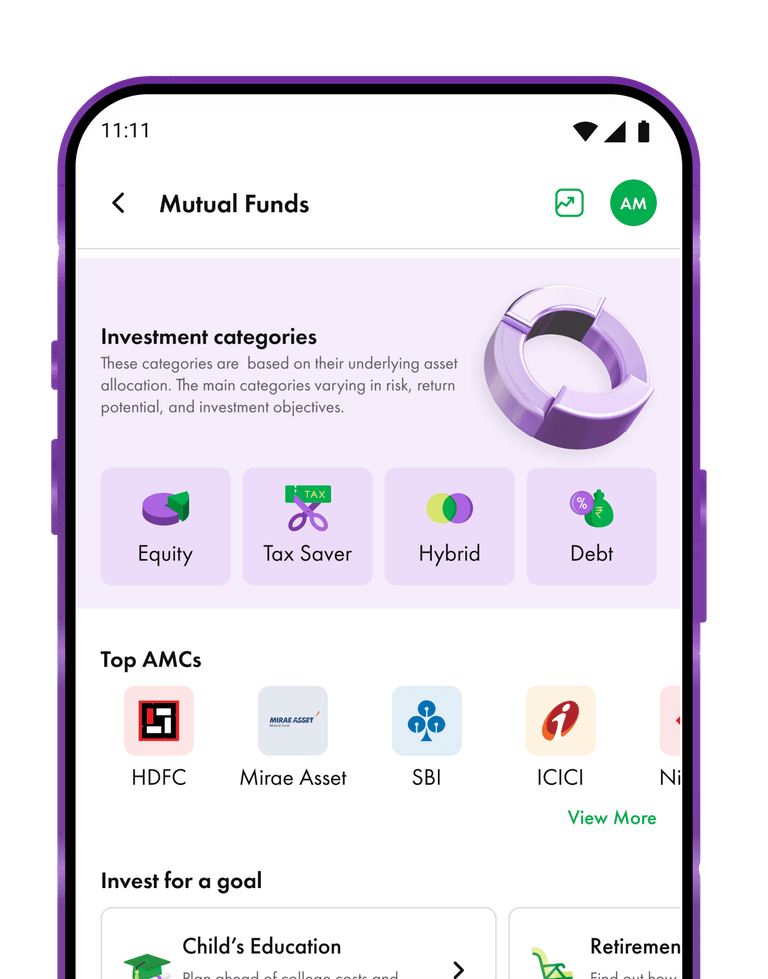




Grow your wealth with Mutual Funds
By signing up, I agree to the T&C, Privacy Policy and Tariff rates and give my consent to open Demat and Trading account in Arihant Capital.

Invest smarter in mutual funds with ArihantPlus

Quick & Paperless KYC
Sign up to invest in mutual funds in just a few steps. Takes 3-minutes & zero hidden charges.

All-in-One Investing
A single app to invest in mutual funds, ETFs, stocks, NCDs and more.

Invest in Best Mutual Funds
Discover mutual funds curated to your needs: top-performing funds, tax-saving & retirement funds, funds with SIP from ₹100 and more.

Insight-Driven Mutual Fund Investing
Detailed info on every fund and in-depth mutual fund portfolio insights to make informed investment decisions.

Instant SIP investment
Build wealth with SIPs starting from ₹100. Set up autopay, manage them all through the ArihantPlus mutual fund app
5000+ Mutual Funds, Find the Right One on ArihantPlus
Explore by Category
01
Better Than Fixed Deposits
02
Index Funds
03
All-Size Companies
04
High-Risk, High-Returns
05
Large-Cap Funds
06
High-Quality Debt Funds
07
Save Tax, Invest Smart
08
Gold Investments
Curated for You
01
High Return
02
My First Crore
03
Long-term Portfolio
04
Best SIP plans with ₹100
05
ESG & Ethical Funds
06
Global Diversification
Download the app and discover more.
Invest in tomorrow with just one click
By signing up, I agree to the T&C , Privacy Policy and Tariff rates and give my consent to open Demat and Trading account in Arihant Capital.





3 Simple Steps
Investing in mutual funds is quick, easy, and hassle-free. Follow these three steps to begin your journey today.
01
Open Your Free Account
Complete your digital KYC in minutes and get started instantly.
02
Choose Your Mutual Fund
Explore top-performing mutual funds and pick the right one for you.
03
Invest Your Way
Start an SIP investment or invest in a lump sum amount as low as ₹100.
Turn Dreams into Reality with Goal-Based Investing
Secure your future with ArihantPlus — link your mutual funds to your life goals, monitor progress, and stay on track with ease.


Two Smart Ways to Invest
Whether you prefer consistency with SIP or a one-time Lumpsum investment, we make it simple and seamless.
Investing in SIP
- Invest small amounts regularly for long-term growth.
- Benefit from rupee cost averaging and market fluctuations.
- Automate investments for hassle-free wealth building.


Investing in Lumpsum
- Invest a large amount in one go
- Ideal for those with surplus funds and long-term vision.
- Take advantage of market opportunities instantly.












Mutual funds investment simplified

Should You Continue SIP in Current Market? Check in this Video!

SIP vs Lumpsum: Which Investment Strategy Gives Higher Returns?

Planning to Stop YOUR SIP? WATCH this NOW

Biggest MUTUAL FUND trends smart investors are watching RIGHT NOW

WE Analysed India’s 5 Biggest FLEXI CAP FUNDS

Multi Cap vs Flexi Cap Funds | Which is better in 2026?
Arihant Digest

Join 2.5+ Lakh Investors Who Trust Us
Frequently Asked Questions
A Systematic Investment Plan, commonly known as the SIP, is a simple way to invest a fixed amount in a mutual fund scheme at regular intervals. It's one of the most popular mutual fund investment plans for beginners because it helps you invest consistently without worrying about market timing.
There are two ways to invest in mutual funds:
- Lump sum investment: Invest a large amount in one go and receive mutual fund units at the current NAV.
SIP investment: Invest a fixed amount weekly or monthly, making it easier to build wealth over time while benefiting from disciplined investing.
One of the biggest advantages of an SIP investment is that you don't need to predict the right time to enter the market. Regular investing helps smooth out market fluctuations and supports your long-term financial goals.
With the ArihantPlus mutual fund investment app, you can start an SIP in both mutual funds and stocks. Before you start investing, you can compare best SIP plans or explore different fund categories to find the best SIP to invest in. ArihantPlus makes it easy to start and manage your investments from one place. To make a SIP investment, download the ArihantPlus app, login, choose the mutual fund scheme you'd like to invest, select SIP investment option, enter the amount you want to invest along with the period of investment (monthly or weekly), set up autopay so the money can directly be debited from your bank account on your chosen day automatically and voila, you're set on the path to your financial freedom!
Mutual funds are one of the best ways to start your investment journey because it allows you to start with as low as ₹500 and your money is managed by the top experts in the investment industry at nominal cost.
To start investing in mutual funds, you simply need to get your KYC done that requires you to fill in the KYC application and upload your pan card, identity proof (like driver’s license or Aadhar card), and address proof (like your passport or driver’s license). Yes its that simple.
If you already have a trading account with Arihant, you don’t need anything. You can buy and sell mutual funds with your same trading account using existing funds in your account.
Yes, mutual funds are regulated by SEBI (Securities and Exchange Board of India) and managed by professional fund managers, making them a reliable investment option. However, like all market-linked investments, their performance and returns can fluctuate depending on market conditions.
The key to investing wisely is choosing a mutual fund that matches your risk appetite, financial goals, and investment horizon. Whether you're considering equity mutual funds, large cap mutual funds, flexi-cap funds, ELSS mutual funds, or long-term mutual funds, understanding the fund's objective and past performance can help you make informed decisions. You can also use MF research to compare different options and identify the best mutual fund to invest based on your needs.
Yes, both NRIs (Non-Resident Indians) and FPIs (Foreign Portfolio Investors) can invest in mutual funds in India, subject to applicable regulations. The eligibility criteria, documentation requirements, and investment process are outlined in the respective scheme's offer document.
An open-ended fund is a type of mutual fund that remains open for investment throughout the year and does not have a fixed maturity date. It allows you to invest in mutual funds or redeem your units whenever you want, offering you the flexibility to enter or exit the fund based on your preference.
Unlike exchange-traded products, the units of open-ended mutual funds are not bought or sold on a stock exchange. Instead, investors purchase or redeem units directly through the fund house at the prevailing Net Asset Value (NAV) on any business day. Since there is no limit on the number of units that can be issued, the fund continuously accepts new investments and processes redemptions.
The NAV of an open-ended fund changes daily based on the performance of its underlying securities. These funds are available across different categories, including equity mutual funds, large cap mutual funds, ELSS mutual funds, and long-term mutual funds, allowing investors to choose a fund that aligns with their investment objectives.