
NSE IPO: 9 Things to Know Before Investing

By
Arihant Team
The NSE IPO is unlike any listing India has seen before, but there’s more to it than just the ₹1,785 price tag. Here are 9 key things to know before you decide whether this IPO belongs on your radar!
In This Article
- Introduction
- 1. NSE IPO Timeline - IPO dates, Allotment & Listing
- 2. NSE IPO Subscription Day 1 Status
- 3. NSE IPO gets interest of Big Investors
- 4. About NSE Limited
- 5. NSE IPO is 100 percent Offer for Sale
- 6. Key Risks
- 7. Peer Comparison Snapshot
- 8. Financials and Valuation Snapshot
- 9. Should You Invest in the NSE IPO?
Introduction
India's capital markets are about to see something that has never happened before, the National Stock Exchange itself going public. For close to three decades, NSE sat on the other side of every listing, deciding who got to raise money on its platform. Now it is asking investors to do the same for its own shares.
If you have been following the NSE IPO, here are 10 things to know about the NSE IPO before you apply. Not just the price band and dates but get the full picture before deciding.
1. NSE IPO Timeline - IPO dates, Allotment & Listing
For the NSE IPO, the bidding window runs from 9 AM to 7 PM, giving investors an unusually long 10-hour window to place their bids.
The IPO timeline is as follows:
Note: Allotment and listing dates are tentative and may be revised.
2. NSE IPO Subscription Day 1 Status
As on 5 PM, September 17, 2026, the issue received bids for 3.64 crore shares against 8.86 crore shares on offer.
Subscription figures tend to move through the day and build further closer to the closing date, so treat this as a live snapshot rather than a final read.
3. NSE IPO gets interest of Big Investors
According to credible sources, commitments came from the Abu Dhabi Investment Authority, Singapore's GIC, Fidelity, Carmignac, Norges Bank Investment Management and LIC, sovereign wealth funds and long only asset managers rather than short term money. That is a meaningful vote of confidence in NSE's market position, even with growth in its biggest revenue segment slowing down.
4. About NSE Limited
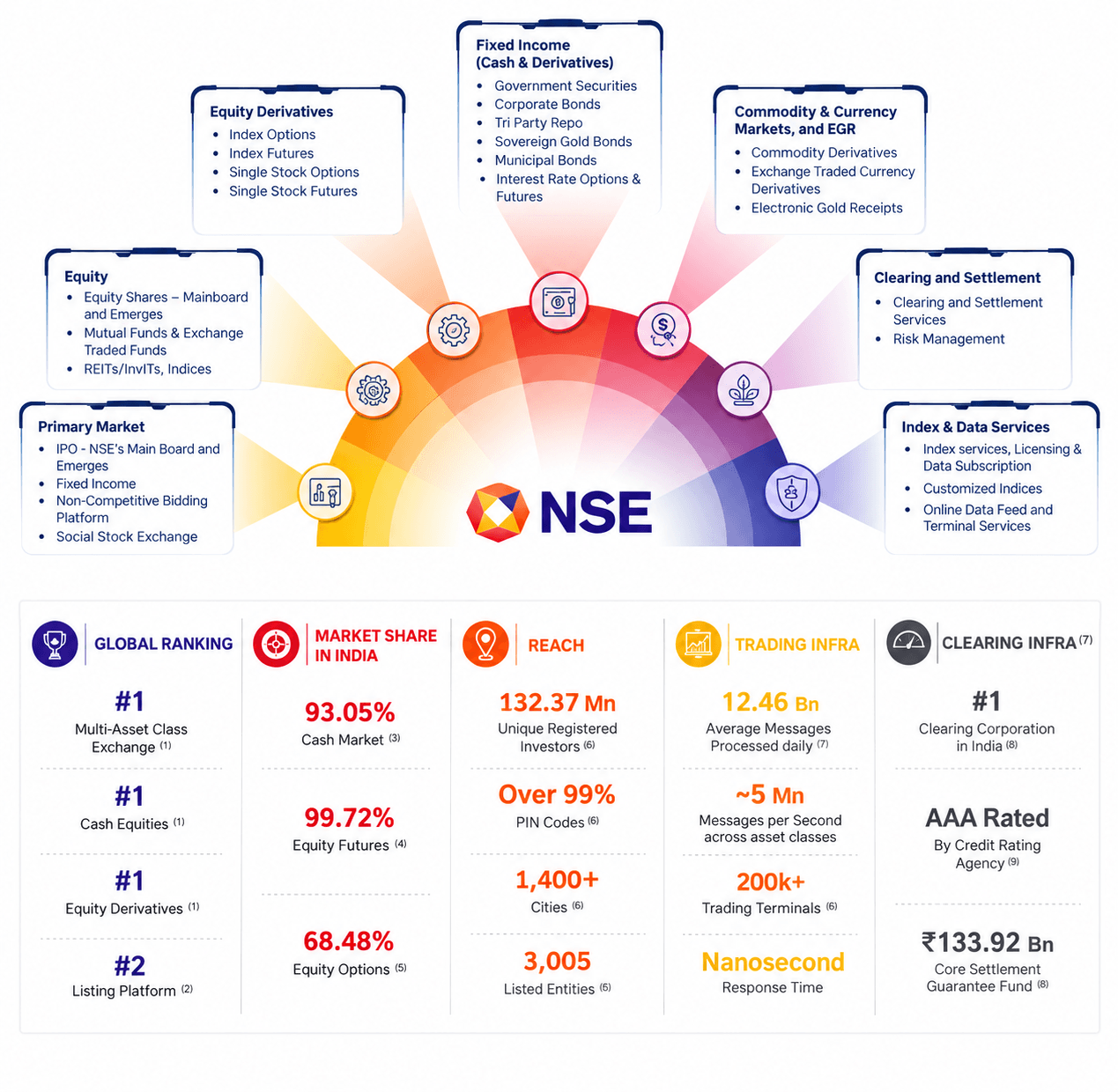
NSE is India's largest stock exchange by market activity and has led the cash market, equity derivatives and exchange traded currency derivatives segments by turnover through FY2026. It also ranked as the world's largest multi asset exchange by number of cash equity and derivatives contracts traded in FY2026.
As of March 2026, the exchange counted over 129 million unique investors, more than 2,900 listed companies and a total listed market capitalization of roughly Rs 411 trillion.
5. NSE IPO is 100 percent Offer for Sale
The entire NSE IPO consists of an Offer for Sale of up to 12.64 crore equity shares held by existing shareholders, with no fresh issue involved. Since there is no fresh issue, NSE itself will not receive any proceeds from the offering, the funds raised go entirely to the shareholders selling their shares.
Key sellers in the OFS include the State Bank of India group, Canada Pension Plan Investment Board, Aranda Investments and MS Strategic, among others. The anchor book also drew commitments from global institutional names including the Abu Dhabi Investment Authority, GIC, Fidelity, Carmignac, Norges Bank Investment Management and LIC.
6. Key Risks
NSE's own volume data since 2020 tells two different versions of the slowdown depending on which measure is used.
Total contracts traded peaked near 12.5 billion around mid 2024 before falling to a much lower band of roughly 1.5 to 3 billion by August 2026, a steeper drop than the 27% decline typically cited for options volumes.
Total derivatives turnover, measured in rupee value rather than contract count, peaked around Rs 65 trillion and settled into a choppier range of roughly Rs 26 to 39 trillion since, a real pullback but less dramatic than the contracts chart suggests.
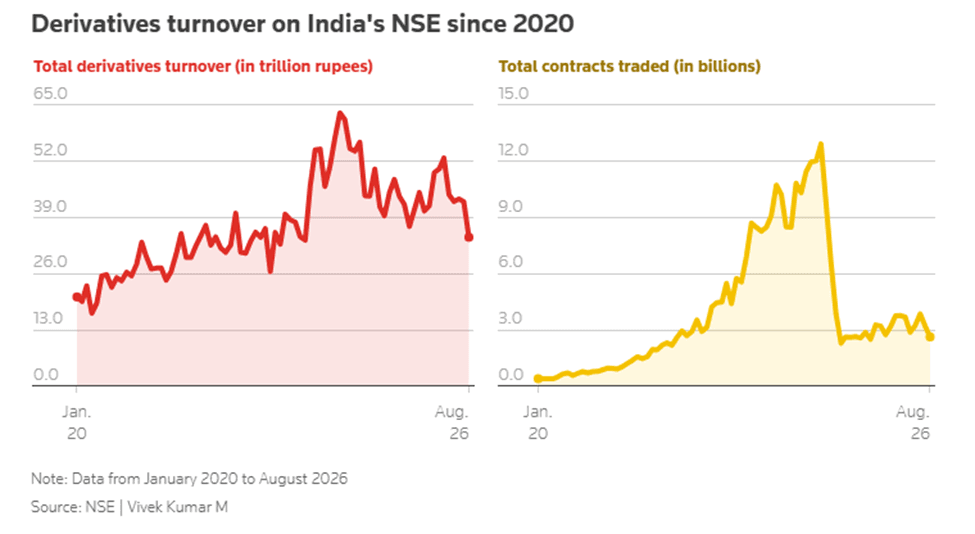
This fall is largely explained by regulation rather than a collapse in trading appetite. SEBI's move to raise minimum contract sizes for index options in 2024 meant fewer, larger contracts changing hands, which mechanically reduces contract counts without reducing notional turnover to the same degree.
However, even with the risk flagged, NSE's dominant position, the scale of its investor base and the strength of institutional demand behind this issue offer real comfort to long term investors.
7. Peer Comparison Snapshot
At the top of its price band, Rs 1,785 a share, NSE is valuing itself at roughly 43 times FY26 earnings, among the richest multiples any exchange operator globally carries.
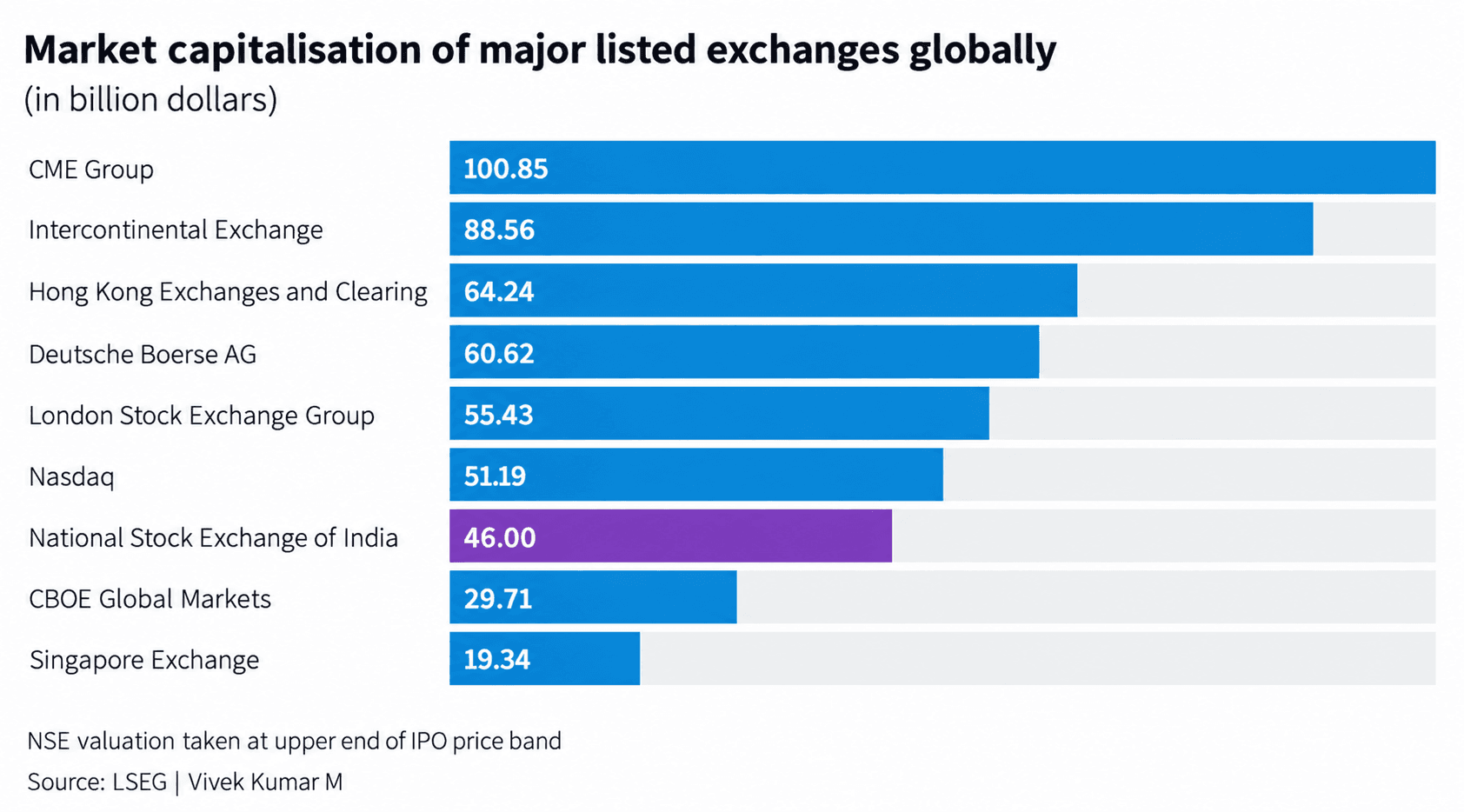
Domestically, BSE, which is NSE’s direct competitor, is currently trading at around 50 P/E. So, you have a larger exchange with stronger profits, but at a lower valuation. That’s definitely a point worth noting.
8. Financials and Valuation Snapshot
FY26 EBITDA margin works out to roughly 67%, and PAT margin to roughly 62%, both exceptionally high even by exchange industry standards, though both metrics dipped from FY25 as revenue and profit fell year on year. At the upper price band, NSE's EPS of Rs 41.62 implies a P/E of close to 43 times, and an implied market capitalisation of roughly Rs 3.9 lakh crore, or around 46 billion dollars.
9. Should You Invest in the NSE IPO?
If you are looking to own a piece of India's core market infrastructure, this IPO is hard to ignore. Here is why it stands out:
Market Dominance: NSE is close to monopoly position across Indian cash equities and derivatives.
High-Profit Business: Exceptionally high margins, with EBITDA margin near 67% in FY26.
Strong Institutional Backing: Serious institutional backing from sovereign wealth funds and long only global investors.
Valuation Reset: A valuation already trimmed 15 to 20% from earlier private market levels.
- India’s Equity Growth Story: Direct exposure to India's structural shift toward equity investing and derivatives participation
That said, near term listing gain seekers should temper expectations, with GMP hovering in the Rs 170 to Rs 210 range, the implied premium is meaningful but not dramatic, and Day 1 subscription numbers have been soft across categories.
For long term investors, this IPO is less about a quick pop and more about owning a piece of market infrastructure that is difficult, arguably impossible, to replicate.
Related Topics

Rentomojo, Karamtara, LCC - 6 IPO Listings Today: Gains, Losses & Key Highlights


NSE IPO 2026: Price Band, GMP, Financials, Risks and Key Highlights


Kanohar Electricals IPO Review 2026: Risks, Strengths and Financials


Horizon Industrial Parks IPO: Details, Financials, Strengths and Risks



Dhoot Transmission IPO: A ₹3,067 Crore Bet on India's Electric Future


























Important IPO terms all investors should understand before investing
Meesho IPO Opens on 3Dec - Is this ₹5,421 crores IPO worth investing?

10 Things to Know About Sudeep Pharma IPO: Date, Price, GMP & Complete Review





Canara Robeco AMC IPO: Should You Apply for MF Giant’s Public Debut?





Smartworks Coworking Spaces Limited IPO: 10 Key Things to Know Before Investing

Travel Food Services Limited IPO: 10 Key Things to Know Before Investing


Ellenbarrie Industrial Gases Limited IPO: 10 Key Things to Know Before Investing



HDB Financial Services Limited IPO: 10 Key Things to Know Before Investing

Sambhv Steel Tubes Limited IPO: 10 Key Things to Know Before Investing

Indogulf Cropsciences Limited IPO: 10 Key Things to Know Before Investing

Prostarm Info Systems Limited IPO: 10 Key Things to Know Before Investing

Aegis Vopak Terminals Ltd IPO: 10 Key Things to Know Before Investing

Schloss Bangalore Limited IPO: 10 Key Things to Know Before Investing

Belrise Industries Limited IPO: 10 Key Things to Know Before Investing


Hexaware’s Billion Dollar Markets Hits in Bear Market: Should You Invest?