What Jio and NSE Reveal About India's Digital Economy

By
Arihant Team
Jio and NSE's upcoming IPOs are more than record-breaking listing, they reflect India's digital transformation. As affordable internet brought millions online, retail investing surged alongside it, showing how digital infrastructure and capital markets have evolved hand in hand.
In This Article
- Introduction
- The company that made data (almost) free: Jio IPO
- India’s most anticipated IPO: NSE
- Why the timing is strategic, not coincidental
- What should you do? Investor takeaway
Introduction
India's IPO market is about to receive its largest dual-listing event in over a decade. Jio Platforms, the digital arm of Reliance Industries, and the National Stock Exchange (NSE), the country's dominant bourse, filed draft IPO papers with SEBI within 48 hours of each other in June 2026, planning to raise over ₹65,000 crore (roughly $7.5 billion) through fresh issue and secondary capital.
On the surface, these are two large but unrelated fundraises. Examined together, however, they form a single coherent narrative:
- one company built the infrastructure that brought hundreds of millions of Indians online, and
- the other built the marketplace that now channels their savings into equities.
Their near-simultaneous listings offer a rare, quantifiable snapshot of how thoroughly India's consumer and financial behaviour has digitised over the past decade.
Open a free account today
Invest in tomorrow with just one click
The company that made data (almost) free: Jio IPO
When Jio launched in 2016, it disrupted the telecom market by offering free data and voice calls. It sparked a brutal price war, and shrank a 17-operator market down to basically three. Data prices crashed from ₹225/GB to about ₹10, putting the internet in the hands of hundreds of millions of Indians who couldn't afford it before.
Today, it's gone even further: calls cost as little as 3 paisa a minute, and data is around ₹9/GB, among the lowest prices anywhere on earth.
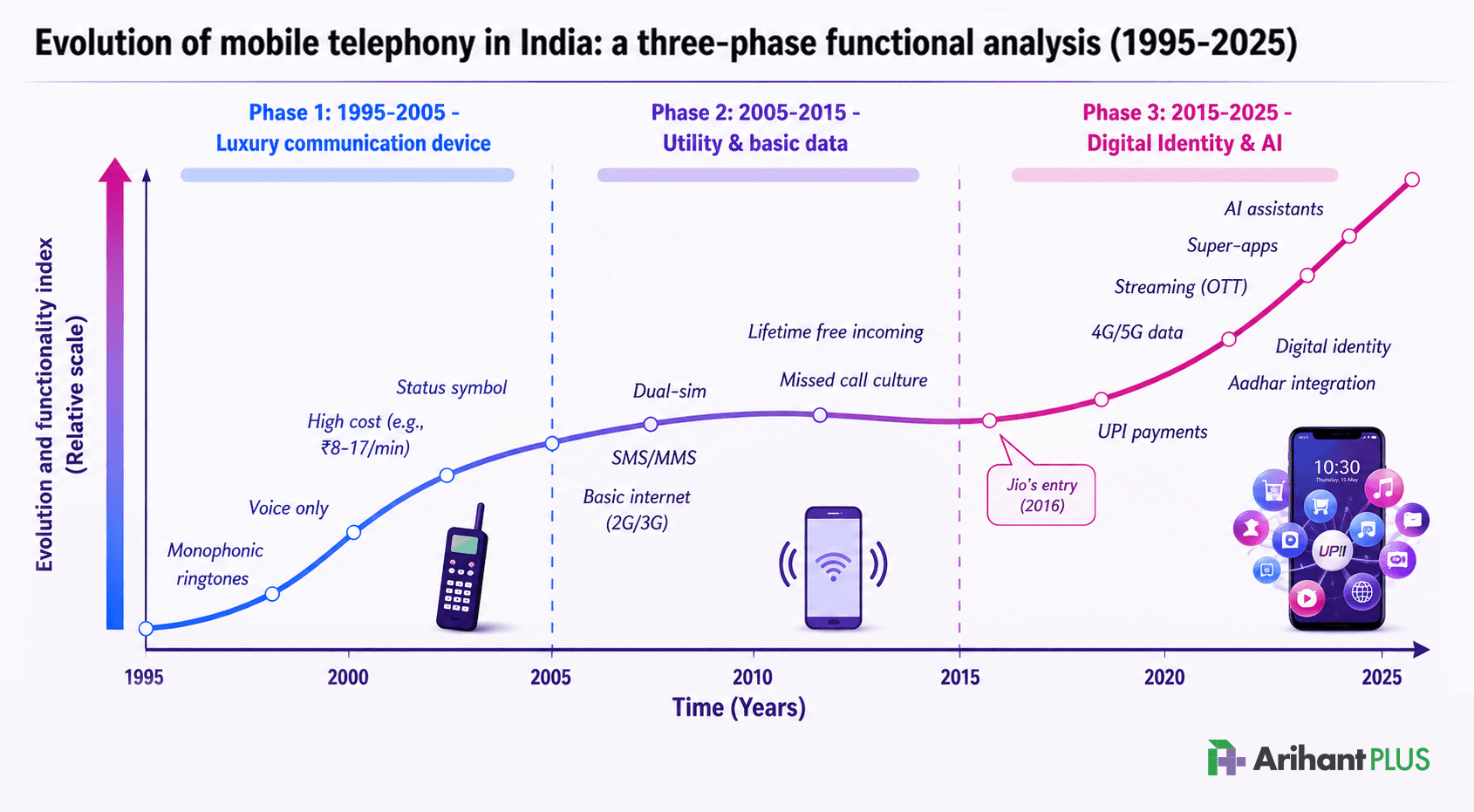
Indians now consume more mobile data than anyone else on earth, including the US and China. Jio alone serves 524 million subscribers, with 268 million already on 5G; the largest 5G subscriber base outside China. MyJio app pulls in over 215 million monthly active users. TJio's gone from telecom disruptor to literal digital infrastructure for the world's most populous country.
The Jio IPO narrative tells the same story. Jio's prospectus emphasises AI and infrastructure ambitions, data centre partnerships with Nvidia and Meta, large language models trained on Indian languages alongside a stated shift from customer acquisition to monetisation, via tariff increases and broadband upsells. Structurally, the offering is a 100% fresh issue of up to 27 crore shares: no existing investor is selling down. Proceeds, estimated at ₹37,700 crore, are earmarked primarily for debt reduction and AI infrastructure spend.
India’s most anticipated IPO: NSE
If Jio represents the supply side of India's digital story, NSE represents the demand side made measurable. As data got cheaper and smartphones usage multiplied, retail investing exploded right along with it. Online trading accounts jumped from roughly 3 crore to over 20 crore in just a few years. The pandemic didn't start this shift, it just poured fuel on it: low interest rates, easy to use trading platforms, and way more screen time pulled a wave of new investors in.
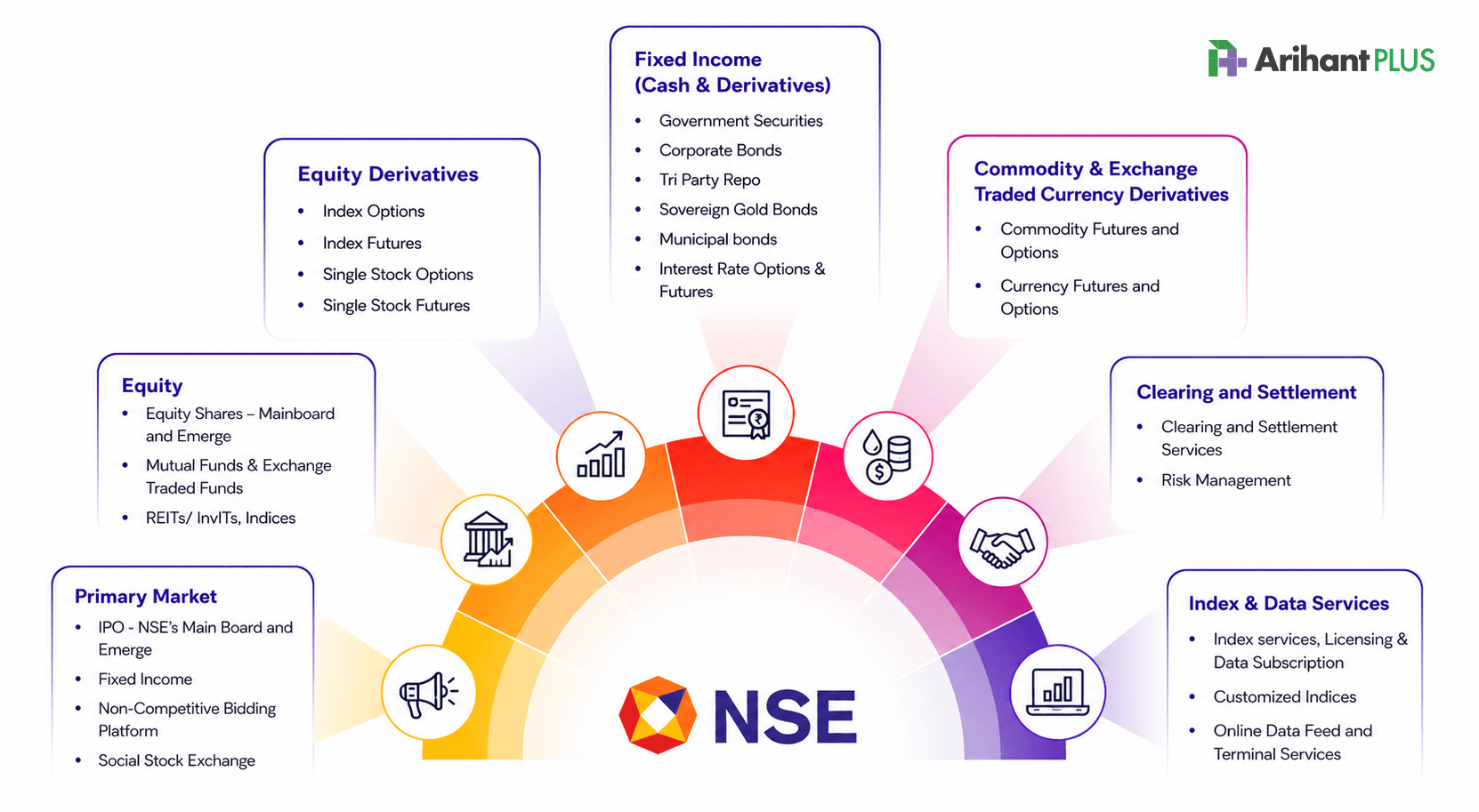
NSE sits right at the center of all this. It's the exchange where almost all of that retail trading actually happens. So every new trader who signs up, and every single trade they place, puts money straight into NSE's pocket. More retail activity simply means more revenue for the exchange.
This listing has been almost ten years in the making, held up again and again by governance troubles - most notably the co-location scandal, only put to rest in January 2026 with a ₹1,300 crore settlement with SEBI. With that mess finally behind it, NSE filed for a ₹30,000 crore offer-for-sale (OFS), valuing the exchange at around ₹5 lakh crore (about $57 billion) - briefly making it the biggest IPO in Indian history, a title Jio's filing snatched right back two days later.
And unlike Jio, NSE isn't raising any fresh money here. This IPO is purely existing shareholders selling their stakes. So this isn't really a growth story. It's more of a coming-of-age moment: a marketplace that tens of millions of Indians already use every day is simply putting an official price tag on itself. Its selling its stake to the public, so existing investors can pocket some cash.
Why the timing is strategic, not coincidental
Interestingly, both these companies are planning to go public at a genuinely rough time for Indian equity markets. The Nifty just had its worst first half since 2020, down 8.7% between January and June 2026. Its quite known this sharp downside was triggered by the US-Iran conflict, which sent crude oil prices spiking and disrupted global shipping, and that kind of geopolitical shock rattled not just the Indian markets but global markets for months.
On top of that, several recent IPOs have flopped after listing, which has made investors wary of IPOs altogether. That's exactly why bankers are treating Jio and NSE, alongside SBI Mutual Fund and Zepto, as "anchor" listings. These big, credible names entering the IPO market would restore confidence and get the IPO pipeline moving again, with over 200 companies reportedly waiting in the wings for the second half of 2026.
However, there is real risk in launching two giants so close together. If SEBI clears both the DRHPs on around the same time (normally a review takes 30 to 75 days), two issues raising upwards of ₹30,000 crore each could end up competing for the same pool of institutional capital within the same two-to-three-week window in August or September. That's a scale of concurrent demand Indian primary markets have never handled before.
The saving grace is that analysts expect fund managers will likely fund these investments by selling out expensive large-cap holdings rather than pulling money from mid- and small-cap stocks, which should limit broader market disruption. Still, that's a working assumption, not a guarantee, since nothing this size has happened before.
What should you do? Investor takeaway
Set aside ticker symbols and prospectus terminology, and the story here is simple. Ten years ago, internet access in India was costly and owning stocks was mostly a big-city thing. You needed a broker relationship, lengthy forms and paperwork and, often, a landline. Today, cheap data and mobile-first investing apps have thrown both doors wide open, often on the very same phone, in the same few minutes.
Jio built the access layer; and NSE built the marketplace that let newly-online Indians start investing. Their near-simultaneous listings now offer investors a direct route to own a stake in that underlying infrastructure themselves. Several analysts are calling it a landmark event for India's capital markets, comparable to the IPOs of the country's earliest software giants decades ago.
This article is for informational purposes only and does not constitute investment advice.

Related Topics
Subway Plans ₹600 Crore IPO: What You Need to Know About EverBrands India
Moneyview IPO 2026: From Digital Lending to a ₹1,092 Cr Public Listing


Rentomojo, Karamtara, LCC - 6 IPO Listings Today: Gains, Losses & Key Highlights


NSE IPO 2026: Price Band, GMP, Financials, Risks and Key Highlights


Kanohar Electricals IPO Review 2026: Risks, Strengths and Financials

Horizon Industrial Parks IPO: Details, Financials, Strengths and Risks


Dhoot Transmission IPO: A ₹3,067 Crore Bet on India's Electric Future



















Important IPO terms all investors should understand before investing
Meesho IPO Opens on 3Dec - Is this ₹5,421 crores IPO worth investing?

10 Things to Know About Sudeep Pharma IPO: Date, Price, GMP & Complete Review




Canara Robeco AMC IPO: Should You Apply for MF Giant’s Public Debut?





Smartworks Coworking Spaces Limited IPO: 10 Key Things to Know Before Investing

Travel Food Services Limited IPO: 10 Key Things to Know Before Investing


Ellenbarrie Industrial Gases Limited IPO: 10 Key Things to Know Before Investing



HDB Financial Services Limited IPO: 10 Key Things to Know Before Investing

Sambhv Steel Tubes Limited IPO: 10 Key Things to Know Before Investing

Indogulf Cropsciences Limited IPO: 10 Key Things to Know Before Investing


Prostarm Info Systems Limited IPO: 10 Key Things to Know Before Investing


Aegis Vopak Terminals Ltd IPO: 10 Key Things to Know Before Investing

Schloss Bangalore Limited IPO: 10 Key Things to Know Before Investing

Belrise Industries Limited IPO: 10 Key Things to Know Before Investing


Hexaware’s Billion Dollar Markets Hits in Bear Market: Should You Invest?