

Orient Electric Q2FY27 Results: Is the Stock Undervalued?

By
Arihant Team
Ceiling fans have been the same product for decades, a commodity in every sense, bought on price and forgotten on the ceiling. But a quiet regulatory shift has turned this humble appliance into one of the most interesting investment stories in Indian consumer durables right now.
In This Article
- Introduction
- Business Overview
- Orient Electric Q2FY27 Result Highlights
- Orient Electric Growth Drivers
- Financial Performance
- Key Strengths
- Key Risks
- Investor Takeaway
Introduction
In January 2026, the Bureau of Energy Efficiency revised its star rating criteria for ceiling fans, raising the minimum efficiency bar and effectively making older induction motor fans obsolete by reclassification.
This shift favours BLDC fans, which consume less electricity than conventional fans but cost more upfront (~50% premium).
But Orient Electric is not the largest player in this market; Crompton and Havells both are. Yet Orient may be the one best positioned to benefit from this transition, and its Q2FY27 numbers suggest the thesis is starting to show up in the financials.
Revenue grew 25.2% year on year to ₹879 crore, comfortably above street estimates of ₹752 crore. Profit after tax more than doubled to ₹27 crore. And the company outpaced the broader industry in fans for the eighth consecutive quarter.
For a stock trading at ₹197 with a market cap of just ₹4,204 crore, that kind of momentum raises an obvious question: is the market underpricing a structural transition story?
Business Overview
Orient Electric is a CK Birla Group company that operates across fans, lighting, appliances, and switchgear including wires. It has historically been defined by its ceiling fan business, but over the past two years has been deliberately expanding into adjacent electrical categories under a strategy it calls "One Orient and Threeford."
Promoters hold 38.3% of the company, domestic institutional investors hold 32.49%, and foreign institutional ownership remains low at 3.28%. Now, focus on the last number, FII under ownership in a mid cap with improving return ratios often means there is room for re-rating if the execution story holds.
Open a free account today
Invest in tomorrow with just one click
Orient Electric Q2FY27 Result Highlights
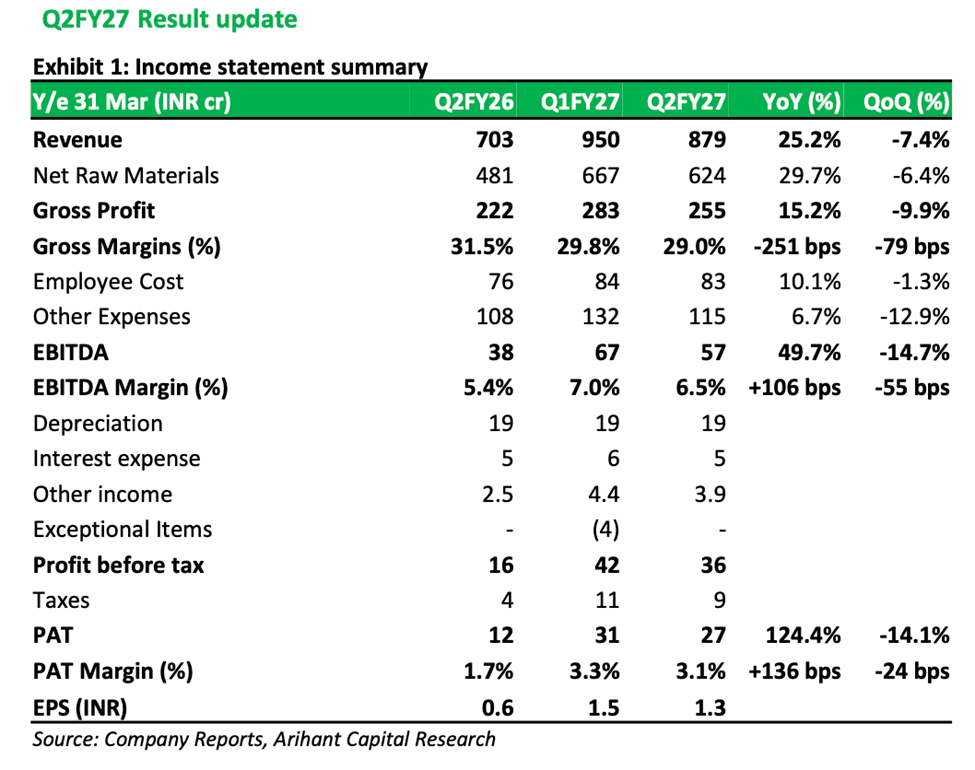
Orient Electric reported revenue of ₹879 crore in Q2FY27, up 25.2% year on year, driven by volume led growth across every major category.
- EBITDA rose 49.7% to ₹57 crore, with margins improving 106 basis points year on year to 6.5%, supported by operating leverage and ₹13 crore in cost savings from Project Sanchay, the company's internal efficiency programme.
- PAT came in at ₹27 crore, more than doubling from INR 12 crore in Q2FY26, with PAT margin expanding 136 basis points to 3.1%.
All three Q2 numbers beat street estimates, and what makes this quarter particularly worth paying attention to is that Q2 is seasonally the weakest period for consumer durables, which means the underlying demand signal is stronger than the absolute numbers suggest.
Orient Electric Growth Drivers
Orient Electric is looking beyond fans to power its next phase of growth. Three things are driving this shift: premium fans, a wider product portfolio, and better distribution.
Fans and the BLDC Advantage: India’s ceiling fan market is projected to grow from USD 1.52 billion in 2026 to USD 2.58 billion by 2032. Orient is gaining ground in premium fans, with BLDC products accounting for 30% of its fan portfolio versus the industry average of 17-18%. The segment has grown 26% year on year for eight consecutive quarters. New products also contribute over 30% of fan revenue, with a commercialisation success rate above 90%, suggesting that innovation is translating into sales.
Wires, Switches and Lighting: Orient is expanding into wires, switches and lighting. Wires revenue more than doubled year on year, while switches and switchgear and consumer lighting recorded double-digit growth. Premium products now account for 66% of its room lighting mix, helping the company move towards higher-value products. The company is focusing its wire business expansion in North and East India, where it can leverage its existing distribution network.
- Distribution & Quick Commerce: Orient expanded its reach in its direct-to-market across newer markets, including Madhya Pradesh, Chhattisgarh and Jharkhand. These markets are growing 5 - 6 percentage points faster than the company average. Meanwhile, quick commerce contributes around 15% of digital revenue and is growing nearly 100% year on year, giving Orient another route to reach customers.
Financial Performance
Orient Electric’s Q2 FY27 performance reflects a key trade-off: rising raw material costs are squeezing gross margins, but cost savings are helping protect operating profitability.
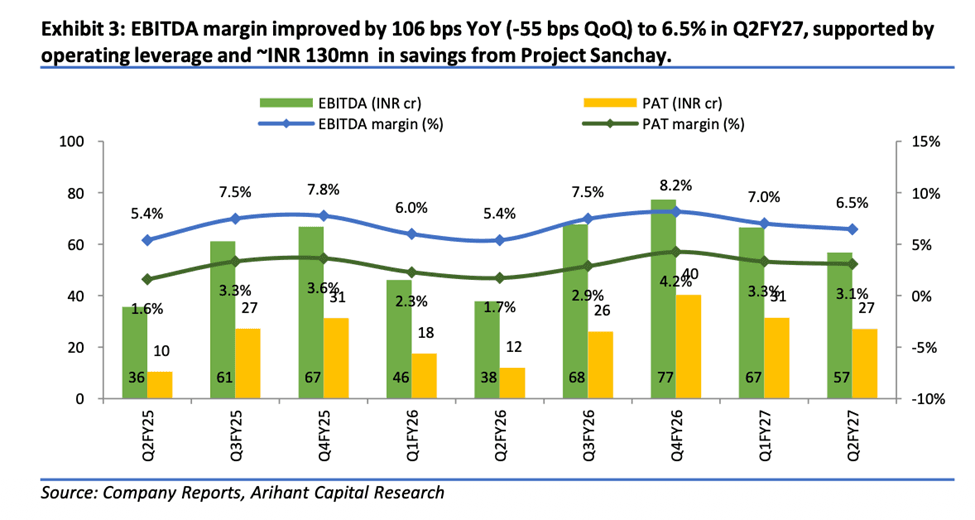
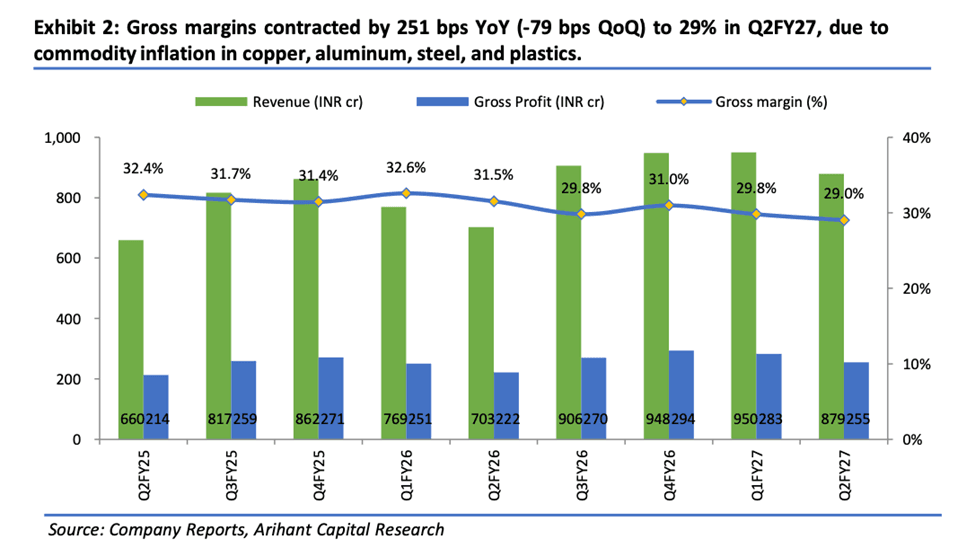
Gross Margin Pressure: Gross margin fell 2.51 percentage points year on year (yoy) to 29%, as copper, aluminium and steel prices rose sharply. Price hikes have offset only 80–100% of the cost increase, depending on the product.
Cost Control: Despite lower gross margins, EBITDA margin improved yoy. Project Sanchay generated ₹13 crore in savings during the quarter, with a target of over ₹70 crore for FY27.
- Margin Improvement: Orient aims to raise gross margins to 32% and achieve double-digit EBITDA margins over the medium term. Better factory utilisation, cost savings and premium products are expected to support this improvement.
- Strong Growth Outlook: Arihant Capital’s research team expects revenue to grow 18.6% annually between FY26 and FY29, with EBITDA growing at 24.7% and profit after tax at 36.4%. This means its profits could grow even faster. This suggests Orient may become more profitable as its business expands.
- Improving Returns: Return on equity is projected to rise from 13.2% in FY26 to 22.8% by FY29, while return on capital employed could increase from 13.1% to 20.9%, indicating more efficient use of capital. These are analyst projections, not guaranteed outcomes.
Key Strengths
Orient Electric’s Q2FY27 performance stands out for key growth drivers that could strengthen its revenue mix, competitive position and margins:
BLDC Leadership: Orient's BLDC fans make up 30% of its portfolio, versus 17–18% for the industry. With energy-efficiency norms becoming stricter, this could give Orient an edge. It also makes 80% of its BLDC circuit boards in-house, helping control costs and quality.
Product Innovation: Over 90% of Orient's new products make it to market, contributing over 30% of fan revenue. Its Project Samvad consumer research helps guide product development.
New Growth Drivers: Wires revenue doubled year-on-year, while switchgear grew at a high double-digit rate, showing early traction beyond fans.
- Cost Efficiencies: Project Sanchay aims to save over ₹70 crore in FY27. Better use of its Hyderabad factory could further improve profitability.
Key Risks
However, Orient’s growth story also faces a few challenges.
- Rising raw materials cost: Copper prices have nearly doubled since early 2024, reaching around $14,500 per tonne. Sustained high prices could delay the path to 32% gross margins. Further price hikes may also hurt volumes, especially in mass-market segments.
Working Capital Pressure: Working capital days have risen to 34 from a normalised level of around 20, driven by the direct-to-market transition and channel financing. Management expects normalisation over four to six quarters, leaving capital tied up through FY28.
- Wires Competition: Despite strong growth, the wires business faces established players such as Polycab, Havells and KEI, which have deep distribution networks and pricing advantages. Sustaining 100%+ growth as the business scales will be challenging.
- Revenue Concentration: Fans continue to dominate Orient’s revenue and profit mix. Slower BLDC adoption or a plateau in premiumisation could weaken growth, despite the company’s diversification efforts.

Investor Takeaway
At ₹197, Orient Electric trades at around 27.9 times its estimated FY27 earnings. Arihant Capital’s research team has a Buy rating and a target price of ₹342, based on 30 times estimated FY29 earnings per share of ₹11.4. That implies a potential upside of about 73.5% from the stated market price.
The larger story is about whether Orient can turn its strengths into sustained profits. Its position in BLDC fans, successful product launches and expansion into wires and switchgear offer opportunities for growth. Cost savings could also help margins recover as raw material pressures ease.
But there are hurdles. Commodity inflation could continue to squeeze margins, working capital may remain elevated, and newer businesses must prove they can grow profitably.
The key question for investors is: whether Orient can execute its growth plans while improving profitability. If it does, the business could become more valuable over time. If costs remain high or diversification disappoints, the recovery could take longer than expected. The investment case ultimately depends on execution, valuation and an investor’s risk appetite.
Related Topics


LIC Gets RBI Nod for 9.99% HDFC Bank Stake: Buy Signal or Market Noise?

Has Bandhan finally become a real bank? l Q1FY2027 Results Analysis
Bajaj Auto vs TVS Motor Q1FY27 | Beyond profits, whose quarter was stronger?


Wipro Q1 FY27 Results | 7 Key Takeaways Every Investor Should Know





Tata Motors Demerger Gets NCLT Nod: What Shareholders Must Know
ICICI Lombard Q1FY26 Result: Profit jump 28.7%, Strong Margin & Digital Momentum