



Jio Platforms IPO Review: Can a Telecom Network Carry a Technology Valuation?

By
Arihant Team
Jio wants to be valued as a technology platform, yet its financials still look like those of an exceptional telecom operator. Does the infrastructure behind that ambition really exist today, or are IPO investors being asked to pay for it in advance?
In This Article
- Introduction
- What are the key details of the Jio Platforms IPO?
- What does Jio Platforms actually do?
- What is JioBrain and why does it matter for the valuation?
- How will the IPO money be used?
- Why does Indian telecom reward the lowest cost operator?
- What do Jio's financials really say?
- What are the main risks of the Jio IPO?
- Jio IPO GMP
- Jio Peer Comparison
- Does Jio have the infrastructure to back a technology listing?
- FAQs
Introduction
Jio Platforms wants investors to value it as a technology platform, while its numbers still read like those of an exceptional telecom operator, and this review uses the DRHP to test whether the infrastructure behind that ambition already exists.
Open a free account today
Invest in tomorrow with just one click
What are the key details of the Jio Platforms IPO?
Jio Platforms has filed to raise fresh capital only, with no offer for sale, and the price band, lot size and final dates will arrive with the Red Herring Prospectus (RHP).
The issue size and dates come from media reports and are not confirmed by the company, so please verify them against the RHP.
What does Jio Platforms actually do?
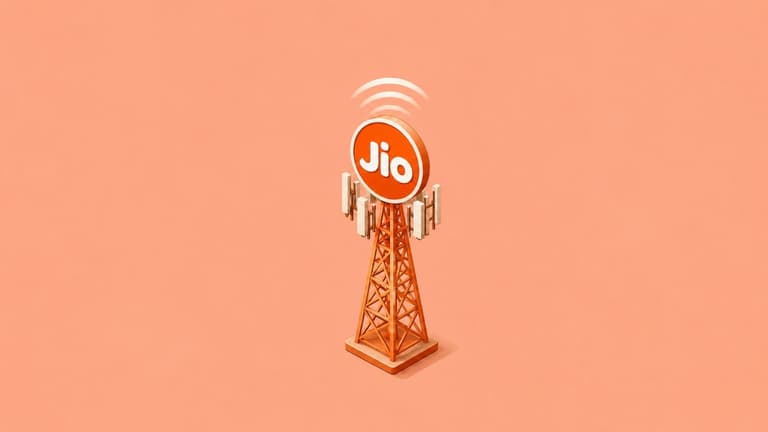
Jio runs India's largest digital connectivity network and sells digital services on top of it, using technology it has designed and built itself.
By March 2026 the network had 268.5 million 5G subscribers and 12.9 million JioAirFiber home broadband subscribers, and in FY26 roughly 60 per cent of India's wireless data traffic ran on it, which the DRHP puts at about 1.4 times the combined 4G and 5G subscriber base of the second largest player. The company draws its business as a single stack that starts with proprietary technology at the bottom and rises through customer insight, physical reach and connectivity to products such as cloud, enterprise AI and cyber security.
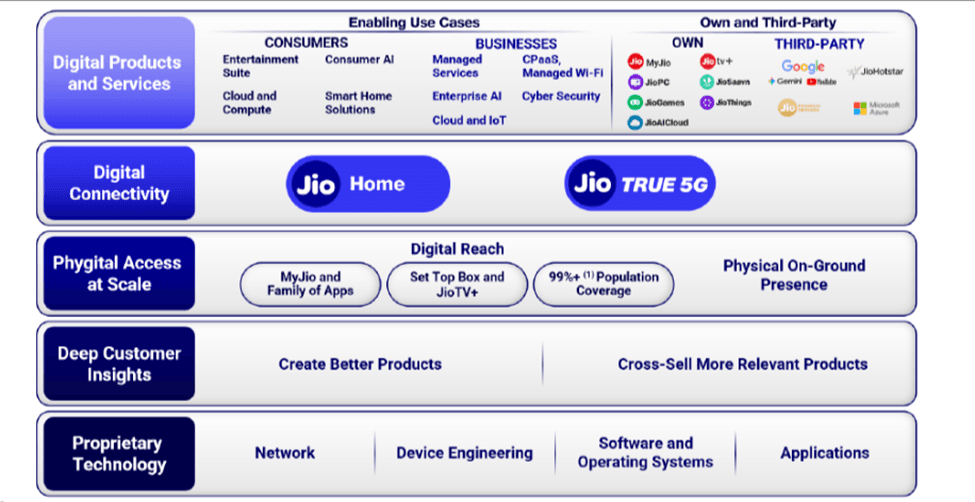
Source: Jio Platforms DRHP, page 179.
The technology claim has real evidence behind it, because the DRHP reports 11,303 people in its digital and technology teams (about 40 per cent of full time employees), 6,817 patent applications and a place among the top 20 companies in the Patent Cooperation Treaty rankings for 2025.
What is JioBrain and why does it matter for the valuation?
JioBrain is Jio's own AI platform for running its network, and it is the main reason the company believes it deserves a technology multiple instead of a telecom one.
Jio’s DRHP describes it as the system that handles capacity allocation, fault prediction, anomaly detection, churn and spam detection, antenna tilt and energy management, and says Jio is working towards Level 4 on the TM Forum's Autonomous Networks scale, where the network can predict, decide and act with minimal human intervention.
The commercial idea is that an operator which has already built and run a network for hundreds of millions of people can sell that know how to operators that have not, and the DRHP says Jio intends to offer JioBrain, its cloud native RAN, 5G core, OSS and BSS platforms and its AI driven network automation to other global telecom companies as managed services.
The filing is just as clear about timing, since it states that Jio has "not yet commenced monetisation of our technology stack in international markets". The technology valuation therefore rests on a capability proven inside India that has not yet earned revenue outside it, which makes it a forecast that investors should price with that in mind.
How will the IPO money be used?
The lead use being debt reduction, rather than technology or compute expansion, sits a little awkwardly beside the growth story, so the RHP's final allocation is worth reading closely.
Why does Indian telecom reward the lowest cost operator?
Indian telecom is a volume business in which the winner is whoever carries the most traffic at the lowest cost, and Jio's cost line shows it has been winning that race.
Network operating expenses fell from 27.69 per cent of revenue in FY24 to 23.48 per cent in FY26, a drop of 4.21 percentage points while traffic kept growing, and this is exactly what an automated, software driven network is supposed to deliver.
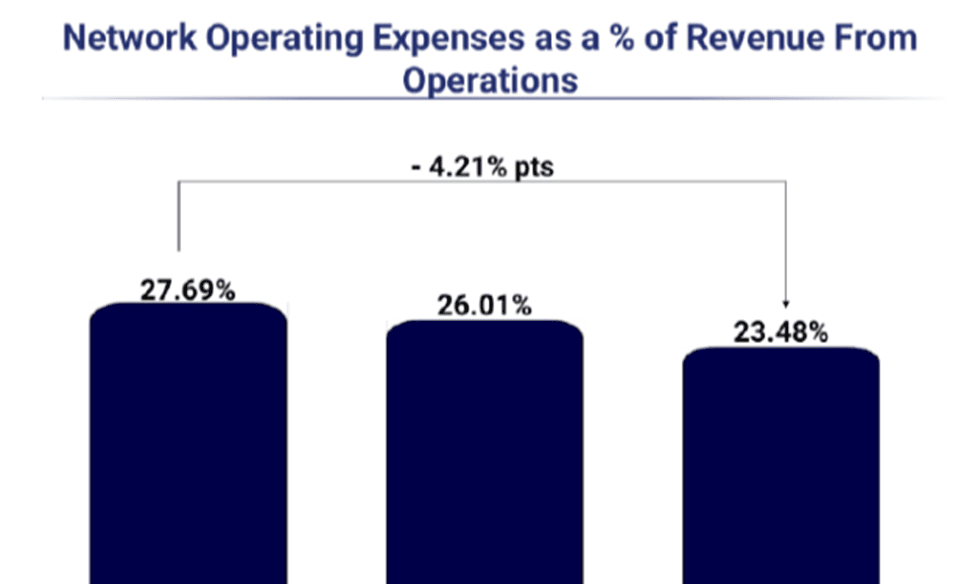
Source: Jio Platforms DRHP, page 386.
That cost advantage is also what Jio hopes to export, since any operator anywhere that must roll out 5G and fixed wireless broadband affordably is a potential customer. At home, however, growth is slowing, with revenue growth easing from 17.0 per cent in FY25 to 14.6 per cent in FY26 and ARPU rising a modest 3.78 per cent, so a new source of growth is what a premium valuation ultimately depends on.
What do Jio's financials really say?
The headline numbers are strong, and four readings underneath them explain why the story is more interesting than the totals.
Source: Jio Platforms DRHP
- EBITDA growth sped up to 18.8 per cent in FY26 while profit after tax growth slowed from 21.9 per cent to 15.1 per cent, largely because finance costs rose 76.42 per cent to ₹8,653 crore as interest on deferred spectrum payments and 5G borrowings, part of which had earlier been capitalised, began to flow through the income statement.
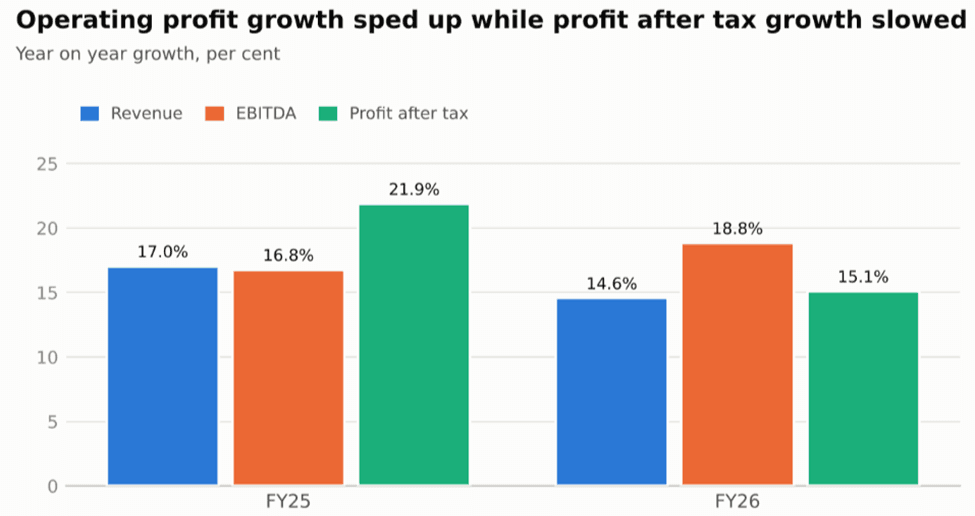
Reported EBITDA margin of 51.9 per cent counts other income, which grew 157.83 per cent to ₹2,874 crore on interest from investments and deposits, so the margin on core operations is closer to 50.0 per cent and about 14.6 per cent of the rise in EBITDA came from that line.
Cash capex fell from ₹53,510 crore in FY24 to ₹34,184 crore in FY26, or from 48.84 per cent of revenue to 23.27 per cent, which lifted the share of EBITDA left after capex from 2.64 per cent to 55.17 per cent and means Jio is now harvesting a network that took two heavy years to build.
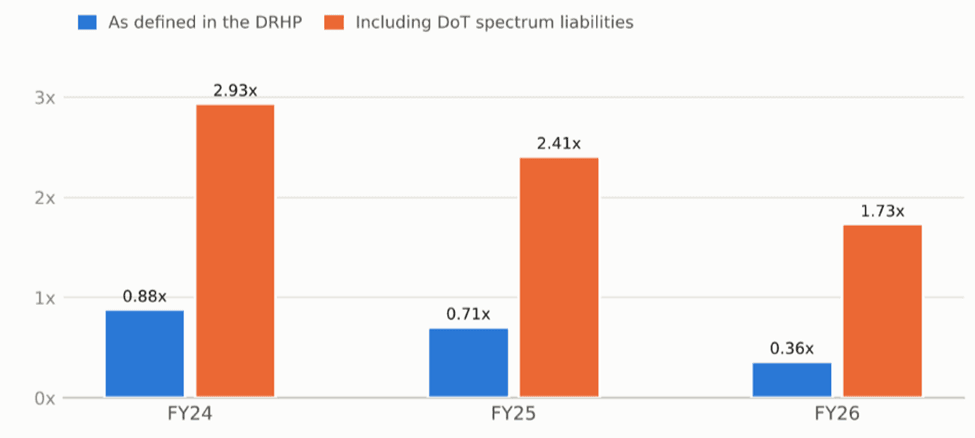
- On the DRHP's definition net debt is ₹27,579 crore, or 0.36 times EBITDA, with ₹43,202 crore of cash and marketable securities, but that definition leaves out ₹1,04,514 crore of deferred spectrum payments owed to the Department of Telecommunications, and including them the figure is about 1.73 times, still comfortable and clearly improving from 2.93 times in FY24.
What are the main risks of the Jio IPO?
The biggest risk is paying today for technology revenue that has not yet started, and the DRHP points to several others.
Unproven monetisation: Jio has not begun earning from its technology stack in international markets.
Promoter dependence: Reliance Retail is the sole distributor of prepaid connectivity, which made up 77.08 per cent of FY26 revenue, and Jio relies on the Promoter for data centre access.
Valuation gap: A technology multiple on a business earning a 9.42 per cent return on net worth could compress if growth slows further.
Regulatory exposure: Spectrum, licence fees and tariffs sit outside the company's control, and over ₹1 lakh crore of deferred spectrum dues remain.
Slowing growth: Revenue growth eased to 14.6 per cent in FY26 from 17.0 per cent a year earlier.
- AI execution: DRHP carries its own risk factor on AI, and selling managed services to foreign operators is a different task from running a domestic network.
Jio IPO GMP
There is no reliable GMP yet because the price band has not been announced, and Jio's return on net worth is less than half of Bharti Airtel's.
Grey Market Premium is an unofficial indicator of demand and expected listing gains, it is not regulated by SEBI or any exchange, it can change quickly, and it should never be the sole basis for an investment decision.
Jio Peer Comparison
Jio's basic EPS in the DRHP is ₹33.63 and its net asset value per share is ₹373.66, so as an illustration only, Airtel's 42.27 times applied to that EPS would give roughly ₹1,420 a share, although the final multiple depends on the price band and on the share count after the issue.
The DRHP benchmarks Jio against Airtel and Vodafone Idea, both telecom operators, even though it describes Jio as a technology platform company.

Does Jio have the infrastructure to back a technology listing?
Jio has the network and the engineering depth, but the compute, the outside customers and the independent revenue that a technology valuation usually rests on are still missing or borrowed.
The physical side is genuinely strong, with a network carrying around 60 per cent of India's wireless traffic, a falling cost curve, falling capex and a balance sheet that has improved sharply. The technology side is earlier in its journey, because the data centres come partly from the Promoter, three quarters of revenue passes through one related distributor, no external technology revenue exists yet, and the peer set used for valuation is telecom only.
An investor who sees Jio as a premier telecom with a credible technology option can judge the price against cash flow and returns. An investor paying for the full technology story is paying in advance for contracts that have not been signed.
The signals worth watching after listing are the first overseas managed services contract, any fall in the share of revenue routed through Reliance Retail, return on net worth as post capex cash builds up, and any announced investment in owned data centre capacity. This is analysis for education and not investment advice, so please read the final RHP and price band before deciding.
FAQs
What is the Jio Platforms IPO size?
Media reports put the fresh issue at up to 27 crore shares, or about ₹37,700 crore, with no offer for sale, and the RHP will confirm the details.
What is JioBrain?
JioBrain is Jio's proprietary AI platform for running its network, and the DRHP says Jio intends to offer it and its wider technology stack to other telecom operators.
Is Jio a telecom company or a technology company?
Financially it is a telecom operator today, while the technology case rests on its platform, patents and plans to sell its stack overseas, which the DRHP says has not started.
Is Jio debt free?
No, net debt was ₹27,579 crore at March 2026 on the DRHP's definition, and a further ₹1,04,514 crore of deferred spectrum payments to the Department of Telecommunications sits outside that definition.
Who distributes Jio's prepaid plans?
Reliance Retail is the sole distributor of Jio's prepaid connectivity, which made up 77.08 per cent of consolidated revenue from operations in FY26.
Related Topics

Subway Plans ₹600 Crore IPO: What You Need to Know About EverBrands India

Moneyview IPO 2026: From Digital Lending to a ₹1,092 Cr Public Listing



Rentomojo, Karamtara, LCC - 6 IPO Listings Today: Gains, Losses & Key Highlights


NSE IPO 2026: Price Band, GMP, Financials, Risks and Key Highlights


Kanohar Electricals IPO Review 2026: Risks, Strengths and Financials


Horizon Industrial Parks IPO: Details, Financials, Strengths and Risks



Dhoot Transmission IPO: A ₹3,067 Crore Bet on India's Electric Future





























Important IPO terms all investors should understand before investing

Meesho IPO Opens on 3Dec - Is this ₹5,421 crores IPO worth investing?


10 Things to Know About Sudeep Pharma IPO: Date, Price, GMP & Complete Review







Canara Robeco AMC IPO: Should You Apply for MF Giant’s Public Debut?







Smartworks Coworking Spaces Limited IPO: 10 Key Things to Know Before Investing

Travel Food Services Limited IPO: 10 Key Things to Know Before Investing


Ellenbarrie Industrial Gases Limited IPO: 10 Key Things to Know Before Investing



HDB Financial Services Limited IPO: 10 Key Things to Know Before Investing

Sambhv Steel Tubes Limited IPO: 10 Key Things to Know Before Investing

Indogulf Cropsciences Limited IPO: 10 Key Things to Know Before Investing



Prostarm Info Systems Limited IPO: 10 Key Things to Know Before Investing


Aegis Vopak Terminals Ltd IPO: 10 Key Things to Know Before Investing

Schloss Bangalore Limited IPO: 10 Key Things to Know Before Investing


Belrise Industries Limited IPO: 10 Key Things to Know Before Investing


Hexaware’s Billion Dollar Markets Hits in Bear Market: Should You Invest?