

Manipal Health ₹9000 crore IPO 2026 | Should You Apply?

By
Arihant Team
India's largest healthcare IPO is here. Explore Manipal Health's business, financials, valuation, risks, GMP, and whether the ₹9,275 crore IPO is worth applying for.
In This Article
- Introduction
- Key IPO Details: Manipal Health IPO
- Business Overview
- Where will Manipal Health's IPO proceeds go?
- Financial Performance
- Peer Comparison
- Key Risks
- Investor Takeaway
- FAQs
Introduction
Rising insurance penetration, an ageing population and growing demand for complex treatment are steadily moving patients toward organised hospital chains.
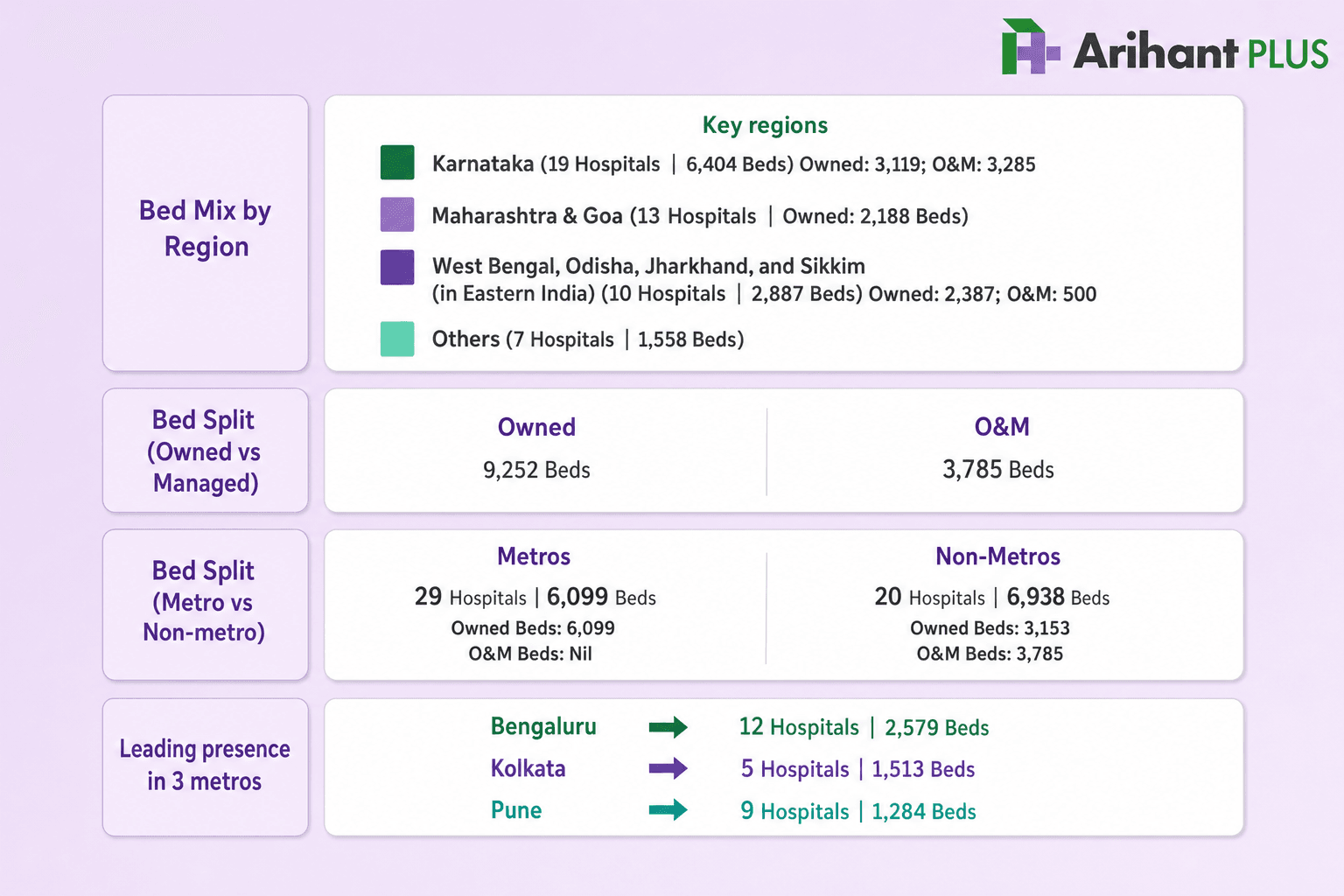
Manipal Health Enterprises sits comfortably at the centre of that shift, running 49 hospitals with 13,037 licensed beds across 14 states and union territories, the largest private hospital network in India by bed capacity.
It is now coming to market with a ₹9,275.22 crore IPO at ₹560 to ₹590 per share, valuing the company at about ₹77,606 crore.
At roughly 85 times FY26 earnings, what does the business need to deliver for that price to make sense?
Key IPO Details: Manipal Health IPO
Business Overview
Manipal Health Enterprises runs multispecialty hospitals that cover everything from outpatient consultations to advanced care such as organ transplants, cardiac surgery, oncology and neurosurgery.
These treatments generate higher revenue per patient, but they also require specialised equipment and experienced doctors. That is where the group has focused much of its investment.
In FY26, the network treated 7.63 million patients and had 11,064 doctors across its hospitals.
It is also the only private hospital chain in India that leads three major metro markets by bed capacity: Bengaluru, Kolkata and Pune. It also holds leading positions in Karnataka, the Maharashtra and Goa region, and eastern India.
The business earns revenue from three main payor groups.
Cash-paying and privately insured patients generate the highest realisation and stand to benefit as insurance coverage expands.
Corporate tie-ups bring steady patient volumes, although rates are usually negotiated in advance.
Government schemes contributed 13.80 percent of revenue in FY26, up from 11.04 percent in FY24.
These schemes support volumes, but the tariffs are lower than commercial rates.
By specialty, a large share of revenue comes from what the company calls CONGO R. This includes cardiac sciences, oncology, neurosciences, gastro sciences, orthopaedics and renal sciences.
Together, these specialties contributed 64.30 percent of gross inpatient revenue.
Karnataka remained the largest market, contributing 46.40 percent of revenue. However, this was down from 59.98 percent two years earlier as the network expanded into other regions.
Where will Manipal Health's IPO proceeds go?
This is largely a fresh issue rather than a promoter exit.
Of the ₹9,275.22 crore raised, ₹8,000 crore is new capital for the company and ₹1,275.22 crore goes to selling shareholders including Temasek and TPG entities, so roughly 86 percent of the money stays with the business.
Interestingly, 2 details changed between the draft prospectus in March and the final offer.
The offer for sale was reduced from 4.32 crore shares to 2.16 crore, so existing holders are selling less than first proposed, and the retail allocation moved from 35 percent to 10 percent with institutions taking 75 percent.
Financial Performance
Revenue compounded at 29.41 percent over two years.
Profit moderated in FY26 and earnings per share moved from ₹9.25 to ₹7.71, which the prospectus links to higher employee costs, finance costs, depreciation and exceptional items.
For a hospital chain, occupancy connects growth to profitability, because costs are largely fixed.
Occupancy eased from 67.09 percent to 64.47 percent while inpatient volumes rose from 439,724 to 527,227, so capacity was added ahead of patient flow.
Return on capital employed moved from 27.74 percent to 21.88 percent, a usual pattern in an expansion phase and the number to watch as beds fill.
Borrowings rose in FY26 alongside the Sahyadri acquisition, and ₹5,552.76 crore is now being retired, after which management expects the company to be net debt free.
Peer Comparison
Manipal carries the highest multiple of the four, largely because it is the biggest by beds and the smallest by current earnings. Narrowing that gap is what the debt repayment and rising occupancy are meant to do.
Key Risks
Valuation: The price builds in the debt repayment, improving occupancy and a margin recovery, so there is limited cushion if these take longer.
Occupancy and utilisation: Manipal has 13,037 licensed beds and 6,227 operational, so filling that capacity is central to the near term earnings path.
Integration: The Sahyadri acquisition closed in late 2025 and integration is still in progress. Doctor retention is usually the first indicator here.
Geographic concentration: Karnataka still contributes 46.40 percent of revenue, although this has come down meaningfully.
Regulatory pricing: Caps on stents, implants and devices have been introduced before and could return, with hospitals typically absorbing them.
- Payor mix: Government share at 13.80 percent has been rising, so part of the volume growth comes at lower realisation.

Investor Takeaway
Manipal Health offers exposure to India's largest hospital network at a point where reported earnings still carry acquisition related interest, depreciation and integration costs. The offer is structured so most of the money strengthens the business, and the debt repayment alone should support earnings even before operations improve.
The balancing point is that much of the value here is ahead rather than behind. The repayment, the occupancy recovery and the Sahyadri integration are all in progress, so FY26 reflects the investment phase rather than the payoff.
Investors comfortable holding through a few years of execution get a market position that is hard to find elsewhere in listed Indian healthcare. Those who prefer more evidence can watch one finance cost print and one occupancy print after listing.
FAQs
What are the IPO dates for Manipal Health IPO?
IPO opens on July 29, 2026 and closes on July 31, 2026. Allotment is expected on August 3 and listing on August 5 on the BSE and NSE.
What is Manipal Health IPO GMP?
Grey market premium peaked near ₹50 on July 20 and was around ₹10 by July 28, implying a listing premium of roughly 1 to 2 percent. GMP is unofficial and moves quickly, so it is best treated as a mood check.
What is the lot size for retail investors?
The minimum lot is 25 shares, requiring ₹14,750 at the upper price band of ₹590.
Is Manipal Health IPO a fresh issue or an OFS?
Both. The fresh issue is ₹8,000 crore and the offer for sale ₹1,275.22 crore, so about 86 percent of proceeds go to the company.
Should I invest in the Manipal Health IPO?
Scale, brand strength and a much stronger post issue balance sheet sit alongside a premium valuation and an occupancy recovery still underway. Reading the prospectus risk factors and matching the holding period to your own plan is a sensible next step.

Related Topics

EAAA India Alternatives IPO 2026: Price, Financials, Valuation & Review
Jio Platforms IPO: 8 Things Every Investor Should Know Before Applying

Jio Platforms IPO Opens 21Oct: Can a Telecom Network Carry Tech Valuation?


Subway Plans ₹600 Crore IPO: What You Need to Know About EverBrands India

Moneyview IPO 2026: From Digital Lending to a ₹1,092 Cr Public Listing

Rentomojo, Karamtara, LCC - 6 IPO Listings Today: Gains, Losses & Key Highlights


NSE IPO 2026: Price Band, GMP, Financials, Risks and Key Highlights


Kanohar Electricals IPO Review 2026: Risks, Strengths and Financials


Horizon Industrial Parks IPO: Details, Financials, Strengths and Risks


Dhoot Transmission IPO: A ₹3,067 Crore Bet on India's Electric Future





















Important IPO terms all investors should understand before investing
Meesho IPO Opens on 3Dec - Is this ₹5,421 crores IPO worth investing?

10 Things to Know About Sudeep Pharma IPO: Date, Price, GMP & Complete Review





Canara Robeco AMC IPO: Should You Apply for MF Giant’s Public Debut?



Smartworks Coworking Spaces Limited IPO: 10 Key Things to Know Before Investing

Travel Food Services Limited IPO: 10 Key Things to Know Before Investing


Ellenbarrie Industrial Gases Limited IPO: 10 Key Things to Know Before Investing



HDB Financial Services Limited IPO: 10 Key Things to Know Before Investing
Sambhv Steel Tubes Limited IPO: 10 Key Things to Know Before Investing

Indogulf Cropsciences Limited IPO: 10 Key Things to Know Before Investing

Prostarm Info Systems Limited IPO: 10 Key Things to Know Before Investing

Aegis Vopak Terminals Ltd IPO: 10 Key Things to Know Before Investing

Schloss Bangalore Limited IPO: 10 Key Things to Know Before Investing

Belrise Industries Limited IPO: 10 Key Things to Know Before Investing


Hexaware’s Billion Dollar Markets Hits in Bear Market: Should You Invest?