
NSE Lists at 0.84% Gain: Why Is BSE Falling?

By
Arihant Team
NSE’s muted 0.8% debut triggers a sharp valuation reset across exchange stocks. After NSE listed at ₹1,800, BSE’s shares tumbled. What was the reason for this fall and does NSE remain a solid long-term buy?
In This Article
- Introduction
- About NSE
- Why is BSE falling?
- BSE Faces a Valuation Rethink After NSE Listing
- NSE's Muted Debut, Explained
- Should you hold NSE for the long term?
Introduction
India’s most anticipated listing in years just landed, and Dalal Street’s first reaction was to sell off its closest rival, the Bombay Stock Exchange (BSE).
After a decade of hype, the National Stock Exchange (NSE) finally made its long-awaited debut. The ₹22,569 crore IPO, India’s second-largest after Hyundai Motor India’s 2024 offering, was subscribed nearly 6 times.
However, the debut was relatively lackluster. NSE listed today at ₹1,800, a modest premium of 0.84% over its issue price of ₹1,785. While it climbed 5.2% intraday on the BSE to hit ₹1,878, it ultimately closed up 1.85%. At that price, NSE is valued at roughly ₹4.49 lakh crore, instantly becoming India's largest listed exchange, nearly double the combined market cap of BSE, MCX and IEX together.
Meanwhile, the shares of BSE are falling.
Open a free account today
Invest in tomorrow with just one click
About NSE
If you have ever executed a trade, it almost certainly passed through NSE. Handling approximately 93% of India's cash market and virtually all equity futures volume, NSE spent three decades operating as the central nervous system of Indian capital markets. Yet the ordinary investors never got to own a piece of.
Which of course, changed today with its debut listing on BSE.
And because NSE and BSE are the two listed proxies for "how well is Indian trading activity doing," the market immediately started comparing them against each other, which is exactly what triggered the selloff in BSE shares.
Why is BSE falling?
BSE shares fell as much as 1.52% on NSE's listing day alone, hitting an intraday low of ₹3,221, amidst a broader selloff that also dragged the Sensex down 1.17% and the Nifty down 1.19%.
But the real story started well before the listing day.
On September 4, the day SEBI cleared NSE's IPO, BSE closed at ₹3,409.80. It briefly rose to ₹3,452.70 by September 15, then reversed and fell to ₹3,161 by September 21. Thursday's low left BSE down more than 5% from its pre clearance level.
Once NSE's listing became certain, the market finally had a direct comparison for BSE, and that comparison was not entirely flattering.
BSE Faces a Valuation Rethink After NSE Listing
Valuation disconnect: NSE listed at 40.9 to 42.9 times its FY26 earnings while BSE trades at roughly 54.3 times earnings.
Market dominance yet cheaper: NSE runs about 93% of India's cash market and 99.8% of equity futures, making it the dominant exchange by a wide margin, and yet it came at a cheaper valuation than BSE on a pure earnings multiple basis.
- Capital realignment: When the bigger, more dominant business trades at a discount to the smaller one, capital tends to move naturally towards the discounted leader placing immediate pressure on the premium-priced player.
NSE's Muted Debut, Explained
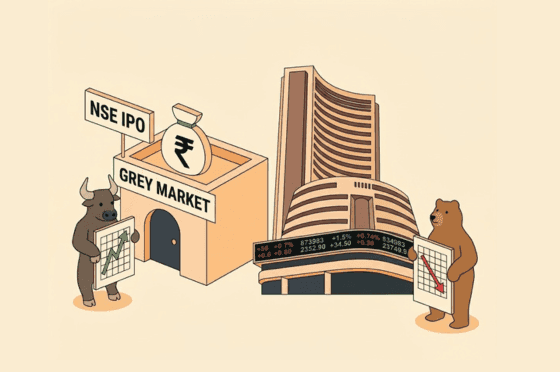
Ahead of listing, NSE's grey market premium sat around ₹40, pointing to a listing near ₹1,825, about a 2.24% premium. However, its listing at ₹1,800, just 0.84% above issue price, caught many investors by surprise.
This is a classic reminder that GMP reflects short-term listing-day sentiment, not fundamental quality. The two often diverge on debut day.

Should you hold NSE for the long term?
If you are thinking about this as a long term holding rather than a listing day trade, consider two distinct perspectives.
The Bull Case
- Unmatched Moat: Dominant market share across cash and futures segments.
- Cash Generation: Strong balance sheet with industry-leading profit margins.
- Macro Tailwind: A direct proxy on the structural "financialization of Indian savings" in the next decades.
The Bear Case:
- Volume Sensitivity: ~79% of NSE's revenue depends on transaction fees, tying its top-line performance directly to market activity, not just with the company's own execution.
- Regulatory Headwinds: Its share of index options has already slipped from 97% to around 65% as SEBI tightened rules on weekly expiries. Regulation, more than competition, is the pain point here, and it is worth watching every time SEBI makes a policy move.
NSE's listing officially reset how the market prices financial exchange businesses in India, and BSE is the one absorbing that reset first.
Related Topics

Moneyview IPO 2026: From Digital Lending to a ₹1,092 Cr Public Listing


Rentomojo, Karamtara, LCC - 6 IPO Listings Today: Gains, Losses & Key Highlights


NSE IPO 2026: Price Band, GMP, Financials, Risks and Key Highlights


Kanohar Electricals IPO Review 2026: Risks, Strengths and Financials


Horizon Industrial Parks IPO: Details, Financials, Strengths and Risks


Dhoot Transmission IPO: A ₹3,067 Crore Bet on India's Electric Future



























Important IPO terms all investors should understand before investing

Meesho IPO Opens on 3Dec - Is this ₹5,421 crores IPO worth investing?

10 Things to Know About Sudeep Pharma IPO: Date, Price, GMP & Complete Review





Canara Robeco AMC IPO: Should You Apply for MF Giant’s Public Debut?






Smartworks Coworking Spaces Limited IPO: 10 Key Things to Know Before Investing

Travel Food Services Limited IPO: 10 Key Things to Know Before Investing


Ellenbarrie Industrial Gases Limited IPO: 10 Key Things to Know Before Investing



HDB Financial Services Limited IPO: 10 Key Things to Know Before Investing

Sambhv Steel Tubes Limited IPO: 10 Key Things to Know Before Investing

Indogulf Cropsciences Limited IPO: 10 Key Things to Know Before Investing


Prostarm Info Systems Limited IPO: 10 Key Things to Know Before Investing


Aegis Vopak Terminals Ltd IPO: 10 Key Things to Know Before Investing

Schloss Bangalore Limited IPO: 10 Key Things to Know Before Investing

Belrise Industries Limited IPO: 10 Key Things to Know Before Investing


Hexaware’s Billion Dollar Markets Hits in Bear Market: Should You Invest?