

Clean Max Enviro IPO Review: Price Band, Analysis & Risks

By
Arihant Team
The Clean Max Enviro Energy Solutions IPO offers investors exposure to India’s fast-growing corporate renewable energy market. With strong EBITDA growth and long-term contracts, the company shows potential, but high debt, modest profitability, and premium valuation make it a growth-focused, higher-risk IPO.
In This Article
- Introduction
- Clean Max Business Model & Structure
- IPO Structure & Issue Details
- IPO Objectives: How will Clean Max use IPO funds?
- Client Profile | Clean Max Enviro Energy Solutions IPO
- Financial Snapshot of Clean Max Enviro Energy Solutions IPO
- Clean Max Enviro Energy Solutions IPO GMP
- Peer Comparison | Clean Max IPO
- Key IPO Risks | Clean Max Enviro Energy Solutions IPO
- Investor Takeaway | Clean Max Enviro Energy Solutions IPO
- FAQs | Clean Max IPO
Introduction
Countries worldwide are seeking ways to replace fossil fuels with renewable sources, thanks to the impact of climate change. With this backdrop, India’s clean energy transition is no longer just an ambition.
With the government committing to 500 GW of non-fossil fuel capacity by 2030, state-level open access reforms, and increasing pressure on corporates to meet ESG and carbon disclosure norms, the move toward renewable power is accelerating.
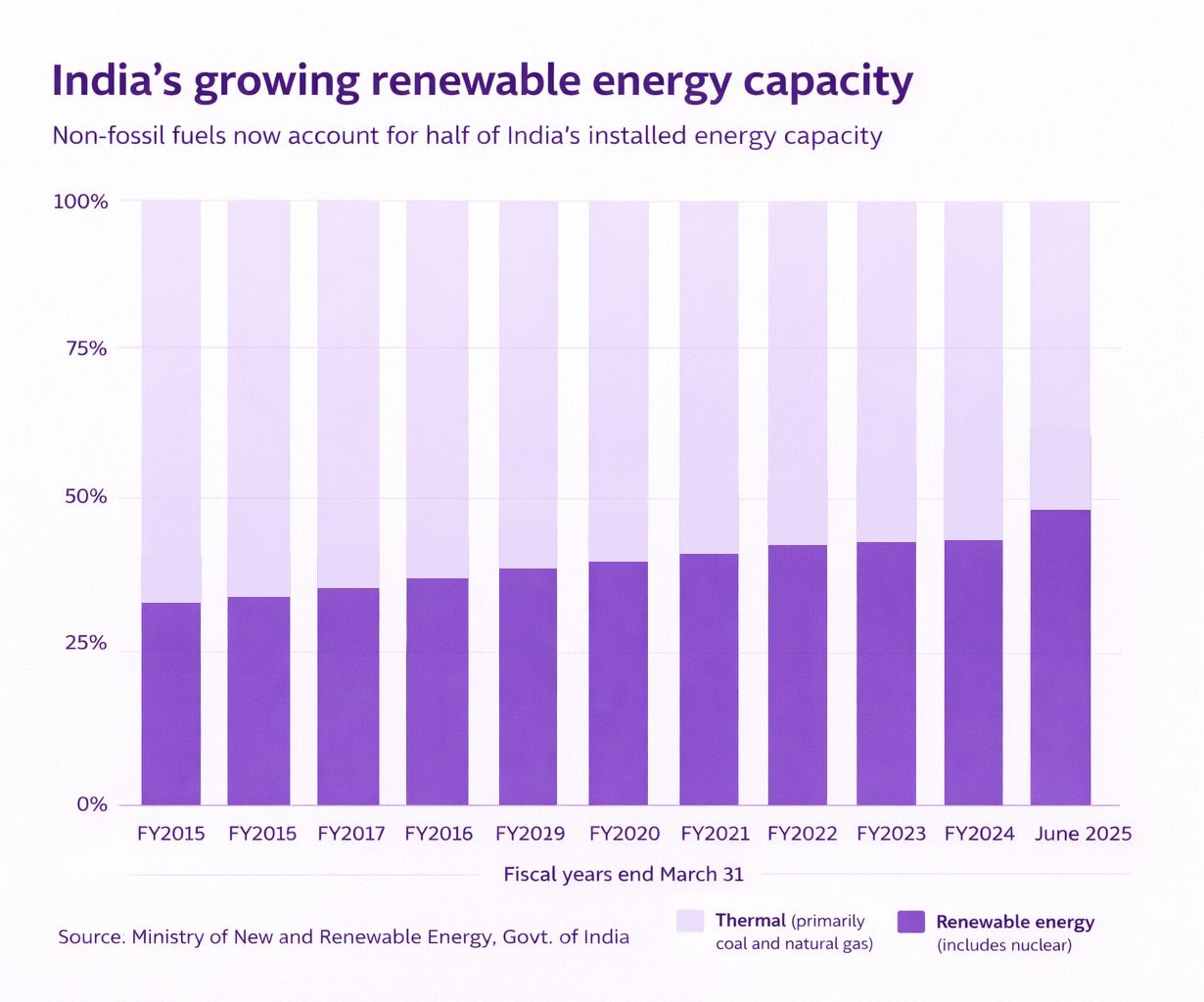
Falling solar and wind tariffs have further strengthened the case, making green power not just environmentally necessary but economically viable.
It is against this backdrop that the Clean Max Enviro Energy Solutions IPO comes in.
The company is offering investors a chance to participate in India’s growing corporate renewable energy story with its ₹3,100 crore IPO at a price band of ₹1,000-₹1,053 per share.
Originally targeting to raise a massive ₹5,200 crore ($630 million) in its preliminary August 2025 filings, the company has slashed the issue size by 40% to ₹3,100 crore (approx. $375 million). This downsizing highlights significant cooling in India's renewable sector. Many energy-related companies that listed last year are currently trading well below their offer prices, hurt by squeezed earnings and a global oversupply of solar equipment that has complicated project margins. By reducing the offer, CleanMax aims to ensure better subscription levels and more realistic valuation in a market that has recently penalized aggressive pricing.
As the world transitions away from fossil fuels, there is still a huge opportunity for companies investing in clean or renewable energy sources. This makes Clean Max IPO an interesting play - the question is, should you invest?
Let’s explore.
Clean Max Business Model & Structure
Clean Max Enviro Energy Solutions is a leader in B2B renewable energy space, powering large businesses with clean solar and wind energy under long-term agreements. According to a CRISIL report, Clean Max Enviro is the largest provider of renewable energy solutions for commercial and industrial consumers in India as of March 31, 2025. The company develops, owns and operates:
- Rooftop solar projects
- Ground-mounted solar farms
- Wind projects
- Wind-solar hybrid projects
Unlike its listed peers who sell electricity to state-run utility companies (DISCOMs) via government contracts, Clean Max’s unique "energy sale" (OPEX) model involves supplying clean power directly to corporates like Google and Amazon via long-term supply agreements, cutting out the middleman. This bypasses state distribution bottlenecks, offering higher margins and superior counterparty credit quality.
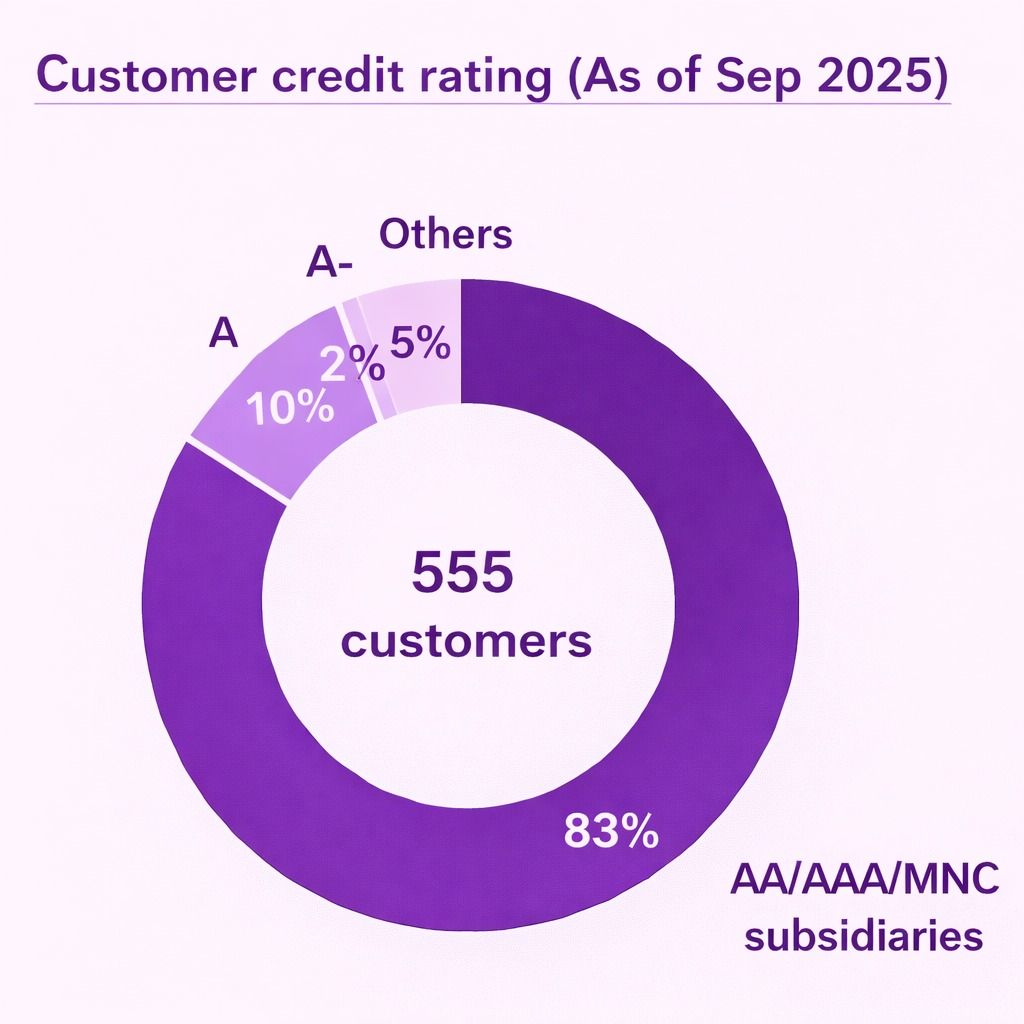
As per its RHP, it currently serves over 550 corporate customers, of which ~85% are AAA-rated or subsidiaries of multinational companies.
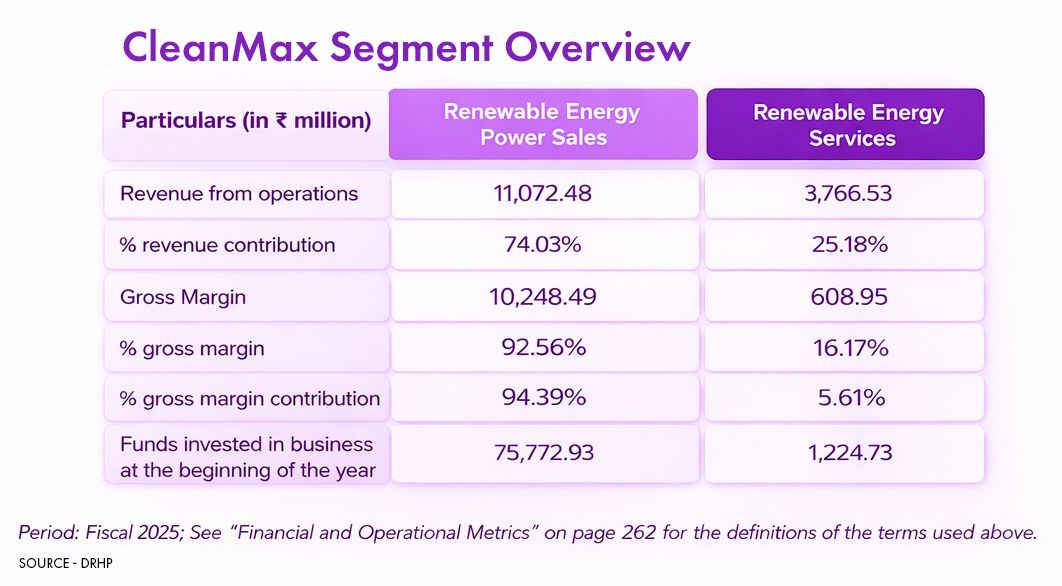
Clean Max Enviro Energy Solutions operates through two distinct segments and understanding the difference is critical to evaluating the IPO.
i) Renewable Energy Power Sales
This is the core business.
CleanMax builds and owns solar and wind plants and signs long-term (~25-year) PPAs directly with corporates. Many projects follow a group captive model, where the client owns at least 26%, which keeps both sides aligned and helps the client save ~30% on power costs.
The plant doesn’t have to be at the client’s site. Power is generated at CleanMax’s location, injected into the grid, and adjusted against the client’s electricity bill.
This segment contributes ~74% of revenue and ~94% of gross margin. EBITDA margins are high because tariffs are contracted and operating costs are relatively stable.
ii) Renewable Energy Services
This includes EPC, advisory, carbon services and structured renewable solutions. It contributes ~25% of revenue but only ~6% of gross margin. Capital requirement is low and leverage impact is minimal. In many cases, the client owns the asset and CleanMax provides development or execution support.
While this segment adds revenue diversification, the core investment thesis remains the power sales business.
IPO Structure & Issue Details
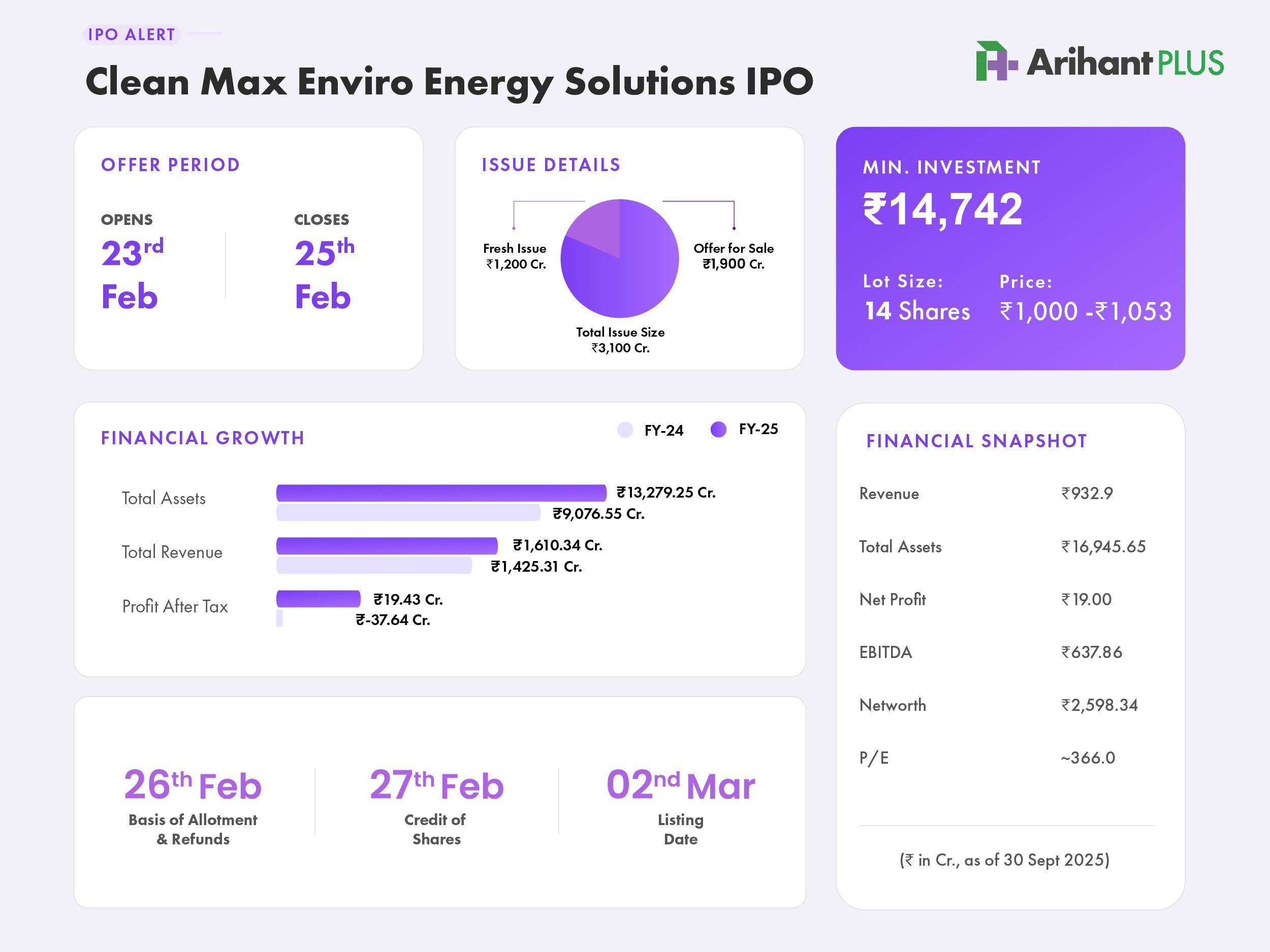
- IPO Size: ₹3,100 crores
- IPO Opens: February 23, 2026
- IPO Closes: February 25, 2026
- Price Band: ₹1,000 - ₹1,053 per share
- Face Value: ₹1 per share
- Lot Size: 14 shares
- Minimum Investment: ₹14,742 (at upper price band)
- Expected Allotment: February 26, 2026
- Credit of Shares: February 27, 2026
- Proposed Listing: March 2, 2026 on BSE and NSE
- Lead Managers: Axis Capital, J.P. Morgan India, BNP Paribas + 5 others
CleanMax’s IPO is a book-built issue comprising a total of 2,94,39,695 equity shares, (₹3100 crore) consisting of a mix of fresh issue and offer for sale. At the upper price band of ₹1,053, the IPO implies a market capitalisation of approximately ₹12,400 crore.
The OFS will see stake sales by promoters Kuldeep Jain, Brookfield’s BGTF One Holdings (DIFC) and KEMPINC, along with existing investors Augment India I Holdings and DSDG Holding APS.
IPO Objectives: How will Clean Max use IPO funds?
Clean Max’s ₹3,100 crore IPO includes a fresh issue of ₹1,200 crore (around 39% of the total issue size), while 61% of the issue is an offer for sale, which means ₹1,900 crore raised through the IPO will go into existing shareholders pocket, and only ₹1,200 crore will be infused in the company.
Moreover, the proceeds from fresh issue is heavily skewed toward balance sheet repair rather than expansion. Out of the ₹1,200 crore fresh issue, approximately ₹1,122 crore (nearly 93.5%) will be used for repayment or prepayment of borrowings of the company and its subsidiaries. The remaining amount will be allocated toward general corporate purposes.
This is a critical detail.
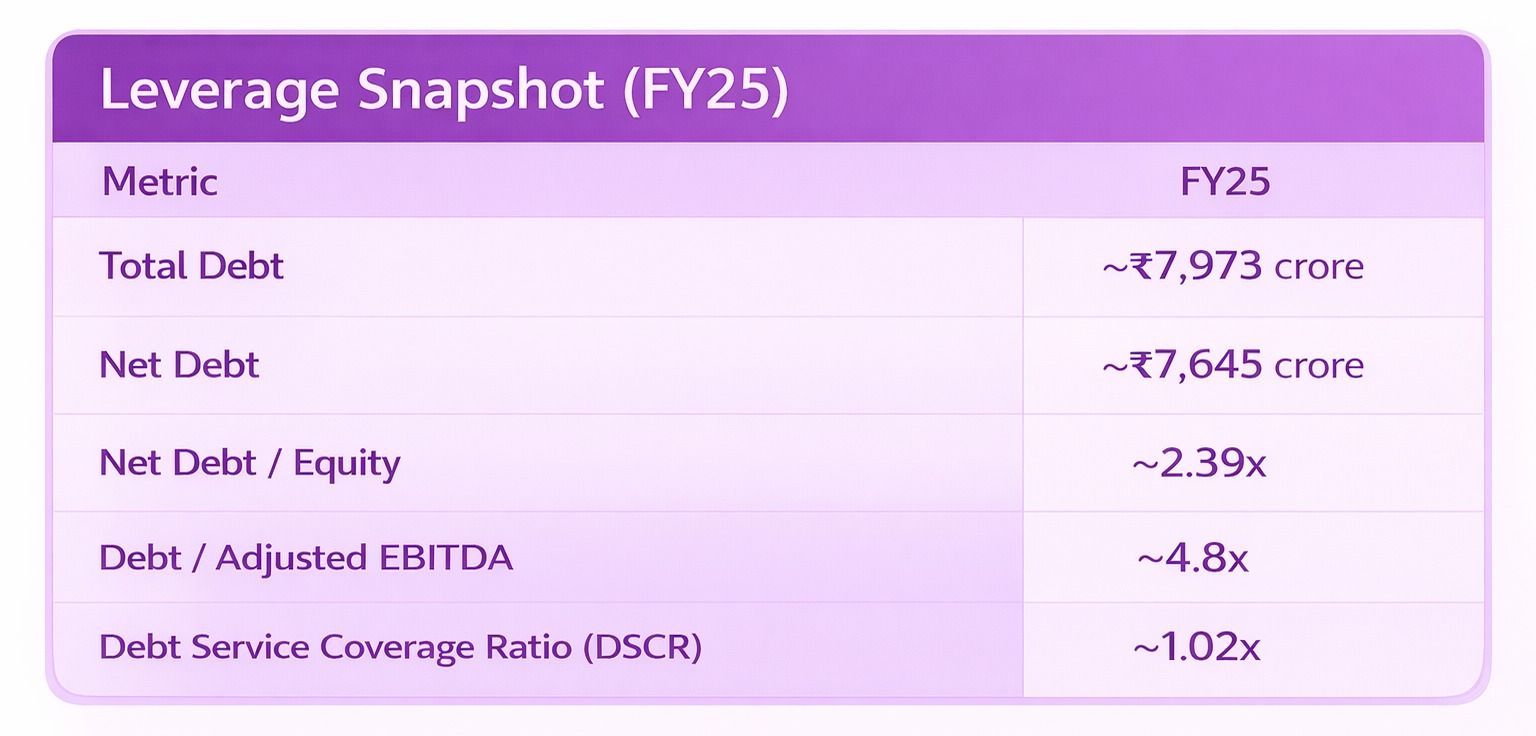
Renewable energy development is capital-intensive and largely debt-funded. As of FY25, the company’s net debt stood at ~₹7,645 crore, with a Net Debt/Equity ratio of ~2.39x.
The IPO, therefore, is primarily a deleveraging exercise rather than a capex-driven expansion raise. While reducing leverage can lower interest costs and improve financial stability over time, it also indicates that the bulk of fresh capital is not being deployed directly into new capacity addition. Future expansion would continue to depend on internal accruals and additional project-level financing.
Client Profile | Clean Max Enviro Energy Solutions IPO
Now that we’ve discussed what CleanMax does and how its business model works, the next critical question is, who does it do it for? In a long term renewable power platform, customers are central to the IPO story because revenue visibility depends entirely on the strength and stickiness of counterparties.
It has more than 550 corporate clients. The company primarily partners with investment-grade (‘A’ rated and above) customers, and mitigates counterparty risk through parent guarantees, bank guarantees, and strict financial diligence before signing long-term PPAs.
A key strength of their business is also its high repeat customer rate. In FY25, ~77% of newly contracted capacity came from existing customers, indicating strong execution credibility and revenue visibility in a long-gestation sector.
Data & AI Infrastructure
Data centers and AI-driven infrastructure account for ~43% of contracted capacity (as of October 2025).
In March 2024, contracted capacity from this segment was ~250 MW. By October 2025, it crossed ~2,200 MW (nearly 10x growth in 18 months).
Customers include global big tech companies like Amazon, Google and others, who are contracting renewable capacity to offset both India and global emissions.
Manufacturing & Industrial Corporates
The remaining ~57% comes from manufacturing and infrastructure businesses using green power to reduce both energy costs and carbon footprint.
India’s corporate power market is ~₹3 lakh crore in size, but only ~7% currently buys bilateral green power indicating a long runway.
Financial Snapshot of Clean Max Enviro Energy Solutions IPO
Operationally, momentum is strong.
Revenue increased from ₹960.98 crore in FY23 to ₹1,610.34 crore in FY25.
EBITDA rose from ₹405.92 crore in FY23 to ₹1,015.07 crore in FY25, reflecting operating leverage as more projects became operational.
Importantly, profitability has also turned around. The company reported a PAT attributable to owners of ₹₹19.43 crore in FY25, compared to a loss of (₹59.47) crore in FY23 (and a loss of (₹37.64 crore in FY24).
That said, equity returns remain modest. Net profit margin in FY25 was ~1.7%, and RoNW stood at ~1.09%. The gap between strong EBITDA growth and low return ratios is largely due to high finance costs and depreciation, typical of capital-intensive renewable platforms.
For renewable energy platforms, the key risk is not demand, it is leverage and debt servicing capacity. In that context, debt metrics become central to evaluating this IPO.
As of FY25, total debt stood at ~₹7,973 crore, with net debt at ~₹7,645 crore. Net debt to equity was ~2.39x, while Debt to Adjusted EBITDA was ~4.8x. The Debt Service Coverage Ratio (DSCR) was ~1.02x, indicating that operating cash flows are just about sufficient to service debt obligations.
Clean Max Enviro Energy Solutions IPO GMP
Clean Max Enviro Energy Solutions IPO’s latest Grey Market Premium (GMP) stands at ₹2 as per the data from investorgain.com and media reports.
Over the last 13 sessions, GMP has ranged between ₹0 and ₹14, with the current trend indicating softer grey market sentiment.
Disclaimer: Grey Market Premium (GMP) is not regulated or recommended by the stock exchanges or SEBI. ArihantPlus does not endorse or facilitate trading in the grey market. Investors are advised to conduct their own research or consult an expert before making any investment decisions.
Peer Comparison | Clean Max IPO
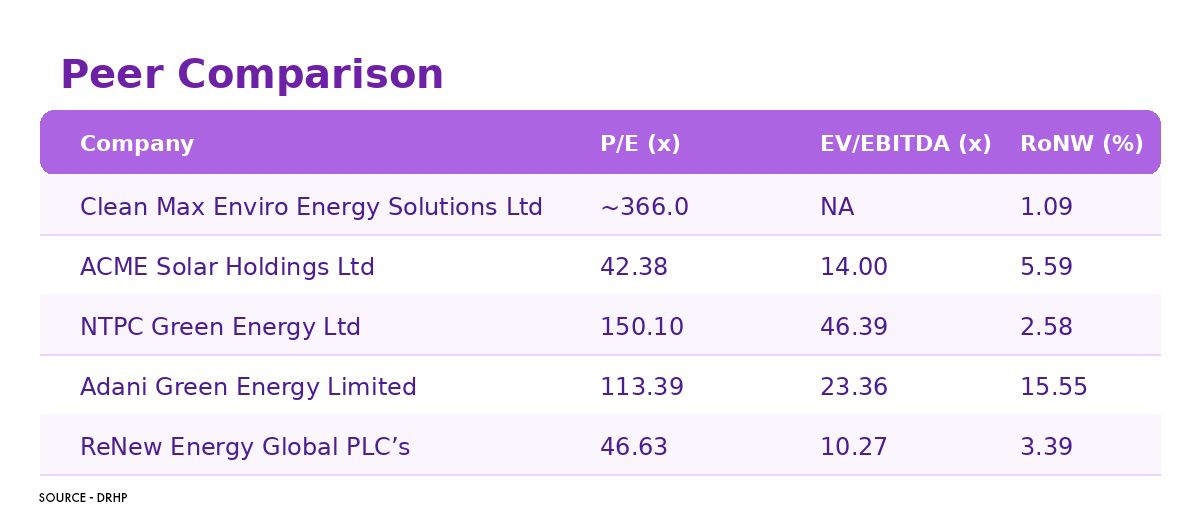
Clean Max Enviro Energy Solutions is comparable in scale to ACME Solar Holdings but significantly smaller than larger players like Adani Green and ReNew. Its return on net worth (RoNW) of ~1.09% is the lowest in the peer set, indicating weaker returns on shareholder capital at present.
At the upper price band of ₹1,053 and FY25 diluted EPS of ₹2.79, the IPO is priced at ~366x P/E, a steep premium to listed renewable peers.
While operating performance has improved, larger players are able to translate scale into materially stronger profitability and returns.
Key IPO Risks | Clean Max Enviro Energy Solutions IPO
- High Debt & NCD Obligations: Borrowings exceed ₹10,000 crore. Listed NCDs require strict compliance and regular disclosures. Any covenant breach or refinancing stress could impact cash flows.
- Customer Concentration Risk: ~45% of revenue comes from the top 10 customers; loss or non-renewal of key clients can materially impact cash flows.
- Execution Risk: Despite ~23-year PPAs with long lock-ins, delays in commissioning, supply shortfalls or regulatory issues can trigger penalties or termination.
- Construction & Cost Overrun Risk: Land acquisition, approvals and grid connectivity delays or rising capex/financing costs can weaken project economics.
- Power Exchange Price Risk: A portion of upcoming CTU-connected capacity will sell electricity on power exchanges instead of fixed-tariff PPAs. Exchange prices fluctuate daily based on demand-supply dynamics, seasonality, fuel costs and policy changes. Although ~83% of this exposure is contractually protected through customer compensation clauses, prolonged price weakness or counterparty issues could still impact realised revenues and cash flow predictability.
- Carbon Business Uncertainty: The carbon segment contributes less than 1% of revenue and is still at an early stage. Growth depends on the development and stability of global voluntary carbon markets, where pricing, demand and credit quality standards remain uncertain. Any delay in market maturity, regulatory clarity or monetisation of credits could limit scale-up and expected returns from this business.
- Corporate Guarantee Exposure: The company has guaranteed some subsidiary loans. If subsidiaries default, the parent may need to repay, increasing financial risk.
- Revenue Dependence on Power Sales: Over 75% of revenue comes from power sales. Any issue in generation, grid connectivity or customer payments directly affects earnings.
- Capital-Intensive Model: The business needs large upfront investment. Growth depends on continuous access to funding.
- Technology Risk: New wind turbines (5 MW) are being used for the first time. Performance issues or tech changes could affect output and returns.
- Regulatory & Geographic Risk: Operating across multiple states and countries exposes the company to policy, tax and currency risks.
Investor Takeaway | Clean Max Enviro Energy Solutions IPO
India’s clean energy push is clearly accelerating, backed by lower technology costs, policy support and growing corporate demand for green power. Clean Max operates within this expanding space, focusing on renewable supply to businesses.
However, the company is still in a growth phase. Its size is closer to ACME Solar and far smaller than players like Adani Green and ReNew.
So this IPO is more about future growth than current profitability. If the company manages debt well and improves returns over time, the story can strengthen. You should view it as a gradual growth story rather than an immediate high return play.
FAQs | Clean Max IPO
1. What are the IPO dates for the Clean Max IPO?
Clean Max Enviro Energy Solutions IPO opens on February 23, 2026 and closes on February 25, 2026. The shares are proposed to be listed on March 2, 2026.
2. What is the Clean Max IPO price band?
The price band is ₹1000 to ₹1053 per share.
3. What is the lot size of the Clean Max IPO?
Minimum lot size is 14 shares for retail investors.
4. Who should consider applying for the Clean Max IPO?
Investors looking for exposure to India’s renewable energy and corporate decarbonisation theme may find this IPO interesting. However, they should be comfortable with risks related to leverage, project execution and refinancing.
5. Is Clean Max IPO a fresh issue or OFS?
The IPO includes a fresh issue of ₹1,200 crore and an offer for sale of ₹1,900 crore. The fresh issue will support growth and balance sheet strengthening, while the OFS allows existing shareholders to partially exit.

Related Topics

Subway Plans ₹600 Crore IPO: What You Need to Know About EverBrands India

Moneyview IPO 2026: From Digital Lending to a ₹1,092 Cr Public Listing



Rentomojo, Karamtara, LCC - 6 IPO Listings Today: Gains, Losses & Key Highlights


NSE IPO 2026: Price Band, GMP, Financials, Risks and Key Highlights


Kanohar Electricals IPO Review 2026: Risks, Strengths and Financials


Horizon Industrial Parks IPO: Details, Financials, Strengths and Risks



Dhoot Transmission IPO: A ₹3,067 Crore Bet on India's Electric Future

























Important IPO terms all investors should understand before investing


Meesho IPO Opens on 3Dec - Is this ₹5,421 crores IPO worth investing?


10 Things to Know About Sudeep Pharma IPO: Date, Price, GMP & Complete Review







Canara Robeco AMC IPO: Should You Apply for MF Giant’s Public Debut?







Smartworks Coworking Spaces Limited IPO: 10 Key Things to Know Before Investing

Travel Food Services Limited IPO: 10 Key Things to Know Before Investing


Ellenbarrie Industrial Gases Limited IPO: 10 Key Things to Know Before Investing



HDB Financial Services Limited IPO: 10 Key Things to Know Before Investing

Sambhv Steel Tubes Limited IPO: 10 Key Things to Know Before Investing

Indogulf Cropsciences Limited IPO: 10 Key Things to Know Before Investing

Prostarm Info Systems Limited IPO: 10 Key Things to Know Before Investing

Aegis Vopak Terminals Ltd IPO: 10 Key Things to Know Before Investing

Schloss Bangalore Limited IPO: 10 Key Things to Know Before Investing

Belrise Industries Limited IPO: 10 Key Things to Know Before Investing


Hexaware’s Billion Dollar Markets Hits in Bear Market: Should You Invest?