
Elevate Campuses IPO Review 2026: Risks, Strengths and Financials

By
Arihant Team
Elevate Campuses IPO 2026 is raising ₹2,100 crore to bet on India’s growing student housing and K-12 education markets. But with over half the IPO money going to promoter-linked entities and FY26 profits boosted by a one-off gain, is the growth story as strong as it looks?
In This Article
- Introduction
- IPO Snapshot
- What does the company actually do?
- Elevate Campus IPO Proceed Utilisation
- Elevate Campuses Industry Opportunity
- Elevate Campuses financials
- Risks
- GMP
- Peer Comparison
- Investor takeaway
- FAQs
Introduction
Elevate Campuses Limited opens its ₹2,100 crore IPO on September 23, and it is one of the more interesting listings this year. It owns and manages student housing across India and the UAE, and it is about to become a K-12 school landlord too, buying those schools from companies controlled by its own promoter group.
Open a free account today
Invest in tomorrow with just one click
IPO Snapshot
What does the company actually do?
Elevate Campuses runs two key businesses under one roof:
- Owned student housing (7 campuses, 20,368 beds),
- Managed student housing for HEIs (14 campuses, 55,487 beds, an asset light fee model),
And once this IPO closes, the company plans to acquire 16 K-12 assets (a mix of operating schools, schools still under construction, and two hostel facilities run by HEIs).
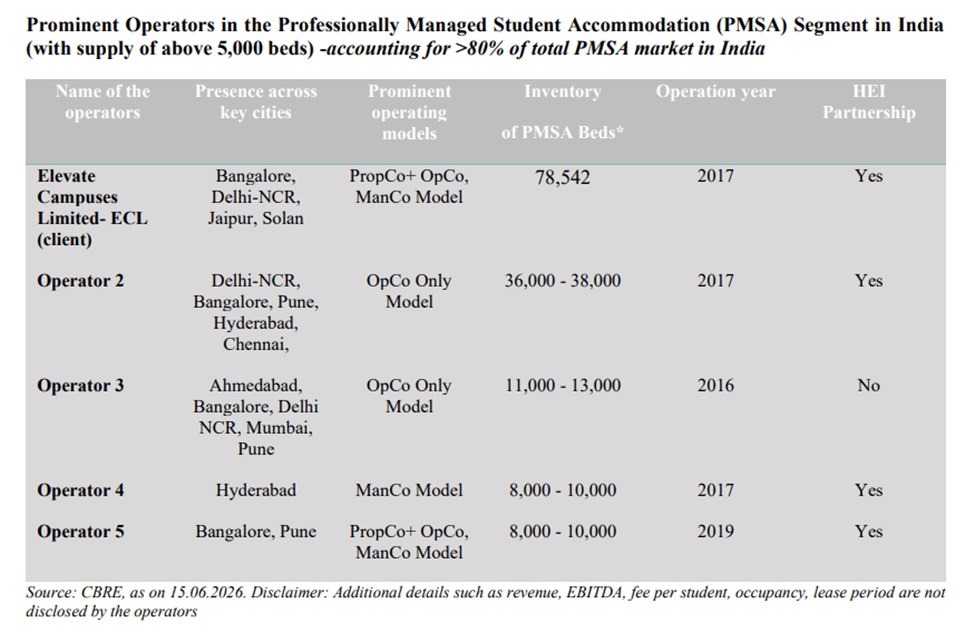
Combined, the platformtouches 80,255 students across 15 Indian cities plus Dubai. By CBRE's count, its 78,542 beds already make it the largest PMSA operator in the country, roughly twice the size of the next largest and six times the third largest.
Elevate Campus IPO Proceed Utilisation
More than half the fresh issue funds a related party transaction, so read that IPO fund utilisation table closely:
A quick look at the objectives of the IPO flags an interesting point. 54% of the money raised through the IPO will be used to fund into acquisition of promoter’s owned entity. And about ₹750 crores will be used to repay company’s debts.
Elevate Campuses Industry Opportunity
India's organised student housing sector serves under 0.5% of enrolled students, against 13 to 15% in the US and 24 to 26% in the UK. That gap is why monthly rents per bed in India average just $140 to $150, versus $800 to $1,000 in the US. (Chart 1 - penetration comparison, sent separately.)
The K-12 side is arguably the bigger number. CBRE projects the addressable market of private, board affiliated K-12 schools in India growing from 8,027 schools generating $17.0 billion in tuition fees today, to 12,918 schools and $28.4 billion by academic year 2029, a CAGR of roughly 17 to 19%. (Chart 2 - K-12 market growth, sent separately.) Whether Elevate can actually capture a meaningful share of either market is a separate question from whether the markets themselves are real, and the RHP data suggests they are.
Elevate Campuses financials
A few things worth pulling out of that table:
- Revenue growth genuinely accelerated, but FY26 also happens to be the year investment properties on the balance sheet nearly quadrupled, so a chunk of that jump is new assets coming online, not the existing portfolio suddenly performing better.
- PAT increased more than three times and RoNW nearly tripled, but a large part of that is a one time exceptional gain of roughly ₹105 crore, mostly from selling a hostel undertaking. RoACE, which strips out exceptional items, actually fell to 6.4% from 9.9%, which is the more honest read of underlying returns.
- Leverage grew in step with the balance sheet: total borrowings roughly quadrupled to ₹4,121 crore, and the company's own disclosure notes that net debt to EBITDA would be 6.23 times, not 4.98 times, if that one off gain were excluded.
Risks
Related party deal: Roughly 52% of the fresh issue pays Elevate's own promoter group entities for the K-12 schools it is acquiring. Some of those very schools already have unresolved disputes with their operators over rent adjustments, building defects and, in one case, an allegation about statutory approvals.
Lean revenue: Owned Portfolio occupancy alone drove about 66% of FY26 revenue, and 70% of revenue comes from just north and south India. A regional disruption or an occupancy dip would show up directly in the topline.
- Rising Debt: Total borrowings nearly quadrupled in a single year, and loan covenants require lender consent for changes in ownership, mergers or early repayment, constraints that can limit flexibility exactly when it might be needed.
GMP
Grey market premium (GMP) for Elevate Campuses stood at roughly ₹3 as of September 23, about 0.83% over the upper price band, implying a listing price near ₹365. That is a fairly muted premium for a mainboard IPO, and it moves daily on thin, unofficial trading, so it says more about short term sentiment than about what the business is worth.
Disclaimer: Grey Market Premium (GMP) is not regulated or recommended by the stock exchanges or SEBI. ArihantPlus does not endorse or facilitate trading in the grey market. Investors are advised to conduct their own research or consult an expert before making any investment decisions.
Peer Comparison
Elevate Campuses has no listed peer to check the price against. The RHP itself says no comparable listed company exists in India, so the roughly 35 times P/E has no direct market benchmark, only the company's own trajectory to lean on.

Investor takeaway
Elevate is a genuine bet on two under-built Indian markets, student housing and private K-12 education, backed by scale that is hard to dispute.
While the student accommodation story is interesting, the bigger question is: what are investors actually funding? Over ₹1,100 crore of the ₹2,100 crore IPO proceeds will go towards buying K-12 assets from promoter-group entities, with another ₹750 crore going towards debt repayment. So despite being a fresh issue, this IPO looks less like a fundraise for organic growth and more like a way to monetise assets sitting within the promoter group.
Additionally, the FY26 profit shows a sharp jump but its due to a one off gain and the company’s leverage has risen faster than operating cash flow.
None of that makes the story false, it just means the growth deserves a second look before the price band does the convincing for you.
FAQs
When does the Elevate Campuses IPO open?
Bidding runs from September 23 to September 25, 2026.
What is the price band and lot size?
₹343 to ₹362 per share, in lots of 41 shares, so the minimum investment is ₹14,842 at the upper band.
Is this a fresh issue or does it include an offer for sale?
It is entirely a fresh issue of ₹2,100 crore. No promoter or existing investor is selling shares through this IPO.
When will shares be allotted and listed?
Allotment is expected on September 28, with listing on BSE and NSE on September 30, 2026.
Where is the IPO money actually going?
About 52% buys K-12 schools from promoter linked entities, 36% repays existing debt, and the remainder funds general corporate purposes and future acquisitions.
Is Elevate Campuses profitable?
Yes, but treat the FY26 profit jump with caution. A meaningful part of the reported profit and margin improvement comes from a one time exceptional gain rather than the ongoing business.
Related Topics


Rentomojo, Karamtara, LCC - 6 IPO Listings Today: Gains, Losses & Key Highlights


NSE IPO 2026: Price Band, GMP, Financials, Risks and Key Highlights


Kanohar Electricals IPO Review 2026: Risks, Strengths and Financials


Horizon Industrial Parks IPO: Details, Financials, Strengths and Risks



Dhoot Transmission IPO: A ₹3,067 Crore Bet on India's Electric Future






























Important IPO terms all investors should understand before investing

Meesho IPO Opens on 3Dec - Is this ₹5,421 crores IPO worth investing?


10 Things to Know About Sudeep Pharma IPO: Date, Price, GMP & Complete Review






Canara Robeco AMC IPO: Should You Apply for MF Giant’s Public Debut?







Smartworks Coworking Spaces Limited IPO: 10 Key Things to Know Before Investing

Travel Food Services Limited IPO: 10 Key Things to Know Before Investing


Ellenbarrie Industrial Gases Limited IPO: 10 Key Things to Know Before Investing



HDB Financial Services Limited IPO: 10 Key Things to Know Before Investing

Sambhv Steel Tubes Limited IPO: 10 Key Things to Know Before Investing

Indogulf Cropsciences Limited IPO: 10 Key Things to Know Before Investing

Prostarm Info Systems Limited IPO: 10 Key Things to Know Before Investing


Aegis Vopak Terminals Ltd IPO: 10 Key Things to Know Before Investing

Schloss Bangalore Limited IPO: 10 Key Things to Know Before Investing

Belrise Industries Limited IPO: 10 Key Things to Know Before Investing


Hexaware’s Billion Dollar Markets Hits in Bear Market: Should You Invest?