

Meesho IPO Opens on 3Dec - Is this ₹5,421 crores IPO worth investing?

By
Arihant Team
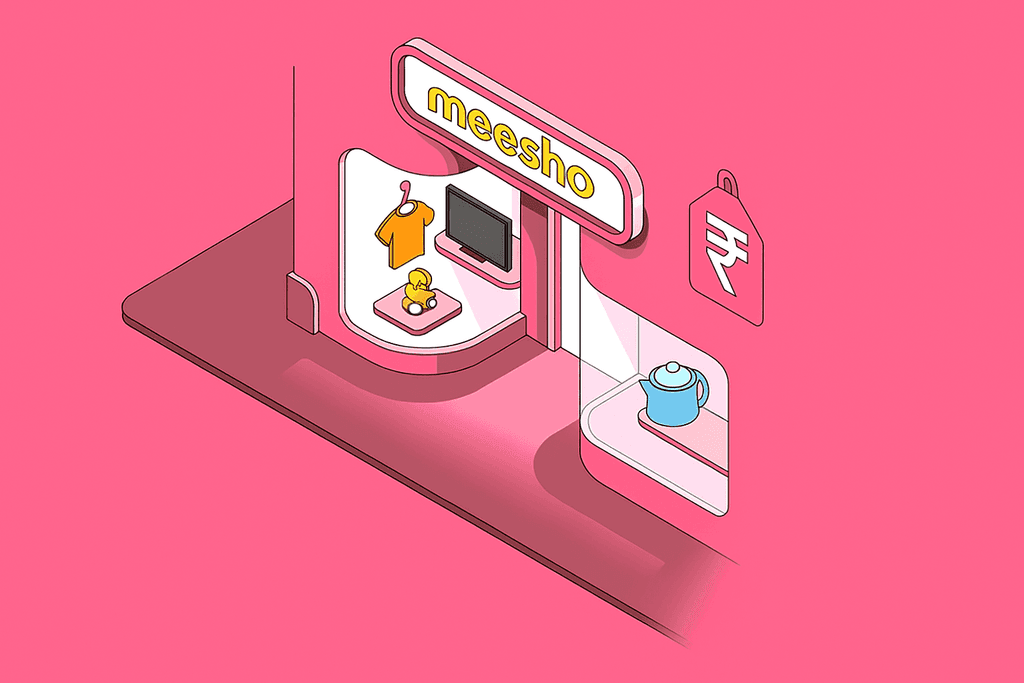
Meesho ₹5,421.20 crores IPO is set to open on 3rd Dec 2025 until 5 Dec 2025 with a price band of ₹105 to ₹111 per share, valuing the company at ₹50,096 crore. Is this big bang e-commerce IPO worth investing in?
In This Article
- Meesho’s $1 Trillion Market Opportunity
- Meesho’s Financial Health
- Meesho’s Revenue Breakdown
- Meesho’s IPO Strategy
- IPO Reality Check
- IPO Verdict: Should you invest in Meesho?
- Meesho IPO Details
Meesho’s $1 Trillion Market Opportunity
Forget the metros for a second. India’s real growth is in its Tier 2 and Tier 3 towns where nearly 86% of the population drives over $1.4 trillion in spending power. Urban India, by comparison, accounts for less than half that (source).
No, we’re not kidding!
Small towns now outspend the top 60 cities combined by almost three times, and this massive shift has created an opening that one company has learned to dominate: Meesho.
While most of India’s e-commerce players (like Flipkart & Amazon) built for convenience and prime memberships, Meesho went for the opposite in 2015. It’s built for value.
Zero commissions for sellers, low-price products for buyers, and a lean supply chain built to handle ₹200 kurtis and ₹150 kitchen sets profitably. The model sounds impossible on paper, yet today Meesho serves over 21 crore buyers and powers close to 30% of India’s total e-commerce shipments. It’s the app of the small-town shopkeeper, the homemaker, and the reseller; all rolled into one ecosystem that Amazon and Flipkart have struggled to reach this deeply. Even the average order size of these guys on the platform is just ₹274. Still it’s winning because it cracked the holy grail of Indian retail: trust in low-cost, everyday products.
But capturing the market is one thing; making money from it is a completely different beast. Does selling cheap kurtis and kitchen sets actually add up on the balance sheet, or is this just another cash burning startup story? Let’s look at the books.
Meesho’s Financial Health
The financial turnaround has been just as interesting.
- The headline number: a ₹3,915 crore loss, seems alarming at first glance. But peel back the layers and 98% of that loss is purely accounting: employee stock option expenses and restructuring costs. The actual operational loss is just ₹108 crore, effectively breakeven for a company handling billions of orders a year.
- Adjusted EBITDA has improved from -29.5% to -2.3% in just two years, a swing that few startups have pulled off.
- Operating cash flow turned positive at ₹539 crore, and free cash flow stood at ₹591 crore. In other words, Meesho no longer burns cash to stay alive; a rarity among Indian unicorns.
- Marketing spends dropped from over ₹900 crore to a fraction of that, yet user growth has stayed steady at more than 20 percent annually. That means new users are coming through organic discovery, not paid ads. For a consumer app, that’s the clearest sign of strong product-market fit.
So, they aren't burning cash on marketing, and they aren't charging sellers a commission. Which begs the question: If sellers aren't paying a cut, where on earth is the revenue coming from?

Meesho’s Revenue Breakdown
Now, the real question…how does a “zero commission” marketplace make money?
- At first glance, Meesho looks free for sellers. But behind that free listing lies an intricate web of revenue streams. The biggest piece is logistics. Meesho acts as the gatekeeper of deliveries. Sellers pay Meesho a shipping fee, and Meesho fulfills the delivery through its in-house logistics arm, Valmo, or third party partners. Valmo was launched by Meesho to build its own cost-effective logistics infrastructure and reduce dependence on external partners, a strategy similar to Amazon's ATS and Flipkart's Ekart. Valmo now manages over 60% of shipments, cutting delivery costs by nearly 12%. Meesho pockets the spread between what it charges sellers and what it actually pays to move the parcel. It’s essentially earning a logistics margin on every sale.
- Then there’s advertising. When everyone can list for free, visibility becomes the new currency. Sellers pay to promote their products so they appear higher on search results and recommendations.
- Next comes the RTO Assurance product. RTO meaning Return to Origin, or failed deliveries. Sellers pay a small fee to insure themselves against these returns. Meesho collects the premiums but only pays out when returns actually happen. Since the total collected is usually higher than the payouts, this works almost like a profitable insurance float.
- And finally, there’s Meesho Mall; the company’s curated section for branded goods where it moves away from its 0 commission model and charges traditional commissions.
Add on smaller revenue lines like Seller Insights (paid analytics tools), creator collaborations, and early stage fintech services like working capital loans for sellers, and you get a diversified business model.
All of this brought in ₹9,390 crore in revenue for FY25, with a contribution margin of nearly 5%. For context, both Amazon India and Flipkart are still losing money despite far higher average order values.
With the unit economics finally working and the competition still struggling to find profitability, Meesho has decided it's time to cash in on this momentum. It’s time to go public.
Open a free account today
Invest in tomorrow with just one click
Meesho’s IPO Strategy
And now, the company is taking the next step: going public. The planned ₹5,600 crore IPO, including a ₹4,250 crore fresh issue, isn’t just about cashing out early investors. It’s a play for structural dominance. The allocation of funds tells that story clearly.
The company plans to use the proceeds from the IPO, according to his RHP:
- Roughly a third of the proceeds (₹1,390 crore) will go into building in-house cloud infrastructure between FY27 and FY29.Most tech startups stay on AWS or GCP forever. Meesho choosing to spend ₹1,390 crore on in-house infra means: they want to control long term margins and reduce variable cloud cost exposure.
- The second big slice (₹1,020 crore) will reignite marketing after two years of restraint. Expect sharper digital campaigns, vernacular influencer partnerships, and regional storytelling designed to deepen the brand’s hold over Bharat’s fast-growing internet users.
- About ₹480 crore is earmarked for technology and talent. That means hiring more engineers, data scientists, and AI specialists to strengthen its personalization algorithms and seller tools; the backbone of its discovery led shopping model. The rest of the IPO funds will sit as flexible capital for acquisitions or expansion into adjacent categories like home goods or regional fashion.
However, throwing money at cloud servers and marketing campaigns doesn't fix the fundamental cracks in the foundation.
Of the total ₹5,421.20 crores company is raising through the IPO, ₹1,171.20 crores is offer-for-sale (OFS). This means this money will directly go into the existing shareholders’ pockets who are offloading their stakes with this IPO.
IPO Reality Check
There’s a breakdown of some of the challenges Messho faces.
- Serving small town India comes with friction. Zero-commission onboarding brings scale, but it also opens the door to fake listings and counterfeit products. The Central Consumer Protection Authority has already issued notices on that front. In an ecosystem built on affordability, even a few bad experiences can erode trust quickly.
- Then there’s the COD problem. Around 3/4th of all Meesho orders are paid for in cash, and one in four of those fails. Every failed COD order means double shipping costs with no revenue; a direct dent in profitability.
- Meesho is tackling this through Valmo’s tighter control of logistics and by pushing digital payment options like Buy Now, Pay Later, but the behavioural shift will take time. Until then, Meesho is effectively subsidizing trust with capital.
- Meesho customers care more about low prices than what brand they’re buying from. So if another app like Shopsy or Snapdeal is to revive, and offers the same product cheaper or gives cashback, they can easily switch. There’s no user stickiness like Amazon Prime or Flipkart Plus folks.
IPO Verdict: Should you invest in Meesho?
Despite the challenges, it’s hard to overlook the scale of what Meesho has built. In just a few years, it has brought millions of first-time buyers online, expanded the reach of small merchants, and created an entirely new middle layer of digital commerce that didn’t exist before. It’s become the shopping gateway for India’s next billion users, a position that’s both powerful and precarious.
At a proposed valuation of ₹50,096 crore, Meesho is commanding roughly 5x its FY25 revenue. This seems like a decent play, especially when weighed against the Total Addressable Market (TAM). The Indian e-commerce market, valued at over $136 billion (2025 estimate), is projected to expand to roughly $327 billion by 2030. This anticipated ~19% CAGR offers significant headroom for an aggressive growth platform like Meesho (Source).
The grey market premium (GMP) of Meesho's IPO has gone up from ₹35-37 earlier (as of 28 November) to ₹42 as on 30th November 2025, which indicates the IPO may list at a premium of ~38%, as per investorgain.com website. Having said that, the company is still in losses and at the upper end of the price band, the price-to-book (PB) is 30.16, which seems rather expensive. Investors should tread with caution.
So if you decide to invest based on the above outlook, below are the key IPO details required to help your investment.
Meesho IPO Details
- IPO Dates: 3 Dec - 5 Dec 2025
- Issue size: ₹5,421.20 Cr
- Price band: ₹105 to ₹111 per share
- Lot size: 135 Shares
- Minimum investment: ₹14,985
- IPO Type: Fresh Capital (₹4,250 crore) + OFS (₹1,171.20 crores)
Related Topics

Jio Platforms IPO Review: Can a Telecom Network Carry a Technology Valuation?
Subway Plans ₹600 Crore IPO: What You Need to Know About EverBrands India

Moneyview IPO 2026: From Digital Lending to a ₹1,092 Cr Public Listing


Rentomojo, Karamtara, LCC - 6 IPO Listings Today: Gains, Losses & Key Highlights


NSE IPO 2026: Price Band, GMP, Financials, Risks and Key Highlights


Kanohar Electricals IPO Review 2026: Risks, Strengths and Financials

Horizon Industrial Parks IPO: Details, Financials, Strengths and Risks


Dhoot Transmission IPO: A ₹3,067 Crore Bet on India's Electric Future





















Important IPO terms all investors should understand before investing

10 Things to Know About Sudeep Pharma IPO: Date, Price, GMP & Complete Review




Canara Robeco AMC IPO: Should You Apply for MF Giant’s Public Debut?





Smartworks Coworking Spaces Limited IPO: 10 Key Things to Know Before Investing

Travel Food Services Limited IPO: 10 Key Things to Know Before Investing


Ellenbarrie Industrial Gases Limited IPO: 10 Key Things to Know Before Investing


HDB Financial Services Limited IPO: 10 Key Things to Know Before Investing

Sambhv Steel Tubes Limited IPO: 10 Key Things to Know Before Investing

Indogulf Cropsciences Limited IPO: 10 Key Things to Know Before Investing

Prostarm Info Systems Limited IPO: 10 Key Things to Know Before Investing


Aegis Vopak Terminals Ltd IPO: 10 Key Things to Know Before Investing

Schloss Bangalore Limited IPO: 10 Key Things to Know Before Investing

Belrise Industries Limited IPO: 10 Key Things to Know Before Investing


Hexaware’s Billion Dollar Markets Hits in Bear Market: Should You Invest?