



Omnitech Engineering IPO 2026 | Should You Invest?

By
Arihant Team
Omnitech Engineering IPO opens Feb 25–27, 2026, aiming to raise ₹583 crore. The company manufactures safety-critical precision components with ~79% export revenue and strong FY25 growth. This review covers business model, financials, valuation, risks, and whether the IPO offers long-term investment potential.
In This Article
- Omnitech Engineering Business Overview
- Key IPO Details: Omnitech Engineering IPO
- IPO Objectives: How Will Omnitech Engineering Use IPO Funds?
- Financial Snapshot of Omnitech Engineering
- Peer Comparison
- Key Risks of Omnitech Engineering IPO
- Investor Takeaway: Should You Invest in Omnitech Engineering IPO?
- FAQs
We rarely think about the parts inside machines.
We notice the power plant. The turbine. The automation system.
But never the precision components that quietly make them work.
Until they fail.
That’s the layer Omnitech Engineering operates in.
For nearly two decades, Omnitech Engineering has been manufacturing safety critical machined components used across energy, motion control and heavy industrial systems. It’s not a consumer facing brand. It’s a backend industrial supplier and a largely global one at that, with ~79% of revenue coming from exports.
Omnitech Engineering is launching a ₹583 crore IPO at a price band of ₹216-₹227 per share. The IPO consists of a fresh issue of ₹418 crore and an offer for sale (OFS) of ₹165 crore, which is entirely from the promoter, Mr. Udaykumar Arunkumar Parekh.
The real question for investors is: can a company that powers industries behind the scenes create visible value for shareholders? Let’s break down its business model, financial strength, and IPO details to help you decide.
Open a free account today
Invest in tomorrow with just one click
Omnitech Engineering Business Overview
India’s precision engineering industry is closely linked to global industrial growth across energy, automation, heavy machinery and capital goods.
With 19 years of operating experience, Omnitech manufactures customised, safety critical machined components across a wide size range from very small parts (0.003 kg) to large assemblies exceeding 500 kg.
Its products are used across 4 key end user segments:
- Energy (oil & gas, wind, power)
- Motion control & automation (motors, hydraulics, drives, sensors)
- Industrial equipment systems (construction and aerospace ground equipment),
- Other industrial applications such as metal forming
The energy segment contributes a relatively high share of revenue (~50% in recent periods), making sectoral cycles relevant to performance.
The company has supplied to 256+ customers across 24 countries, including the US, Germany, UK, UAE, France and Australia. Exports account for roughly ~79% of revenue in recent periods, making it a globally integrated manufacturing player.
Let’s talk about the company’s clients. Omnitech serves a diversified global customer base across energy (oil & gas, wind, power), motion control & automation, industrial equipment systems and other industrial applications. A significant majority of revenue is export-driven (~79%), reflecting strong integration into global industrial supply chains.
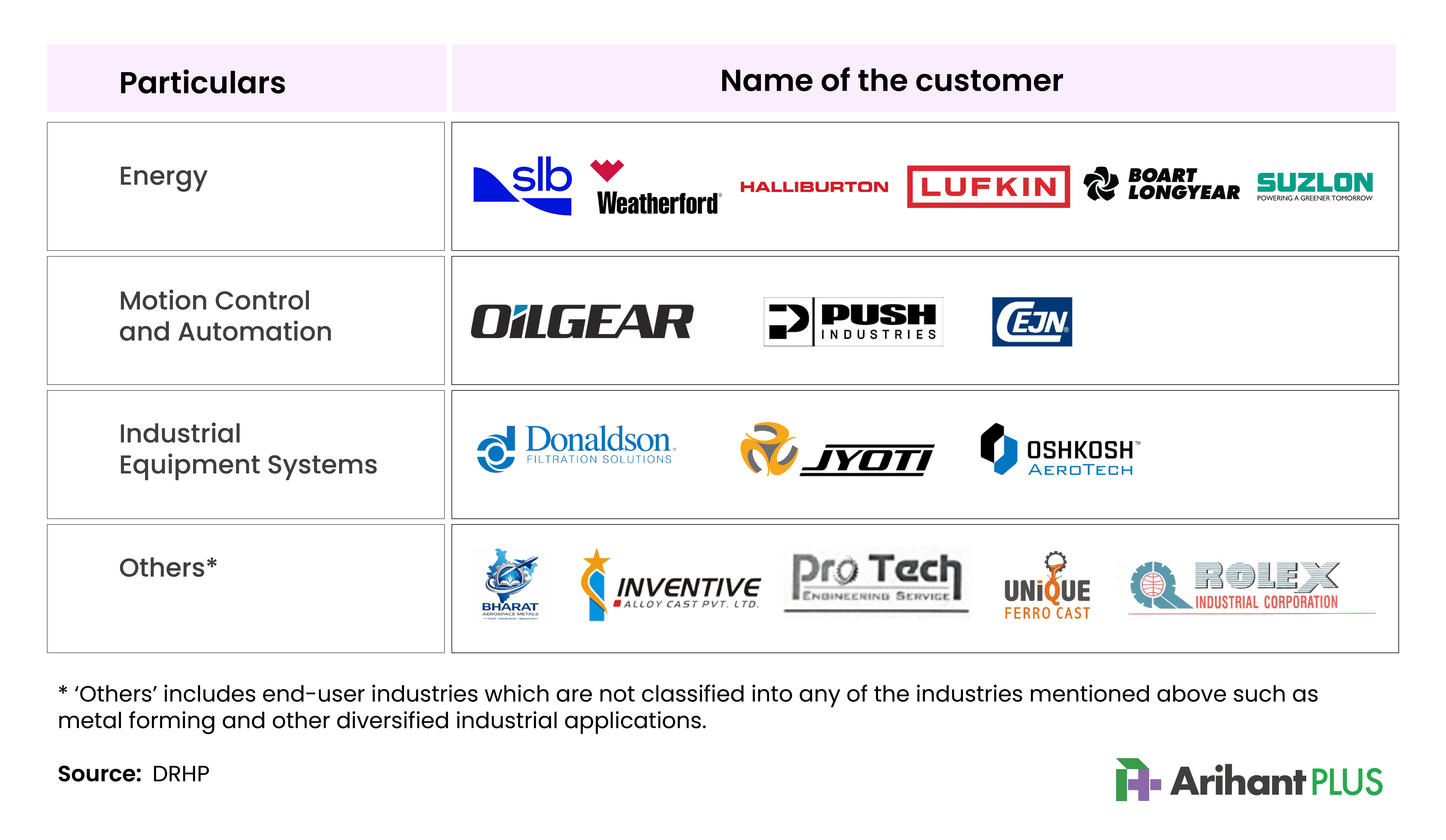
A key strength is its high repeat revenue profile. Revenue from repeat customers stood at 96.87% in 6M FY26. This indicates strong relationship stickiness and consistent execution capability.
However, revenue concentration remains meaningful. The top 10 customers contributed ~69% of revenue across recent years. While customer quality and repeat business are structural strengths, retention of key accounts remains critical to sustaining revenue stability and growth.
Key IPO Details: Omnitech Engineering IPO
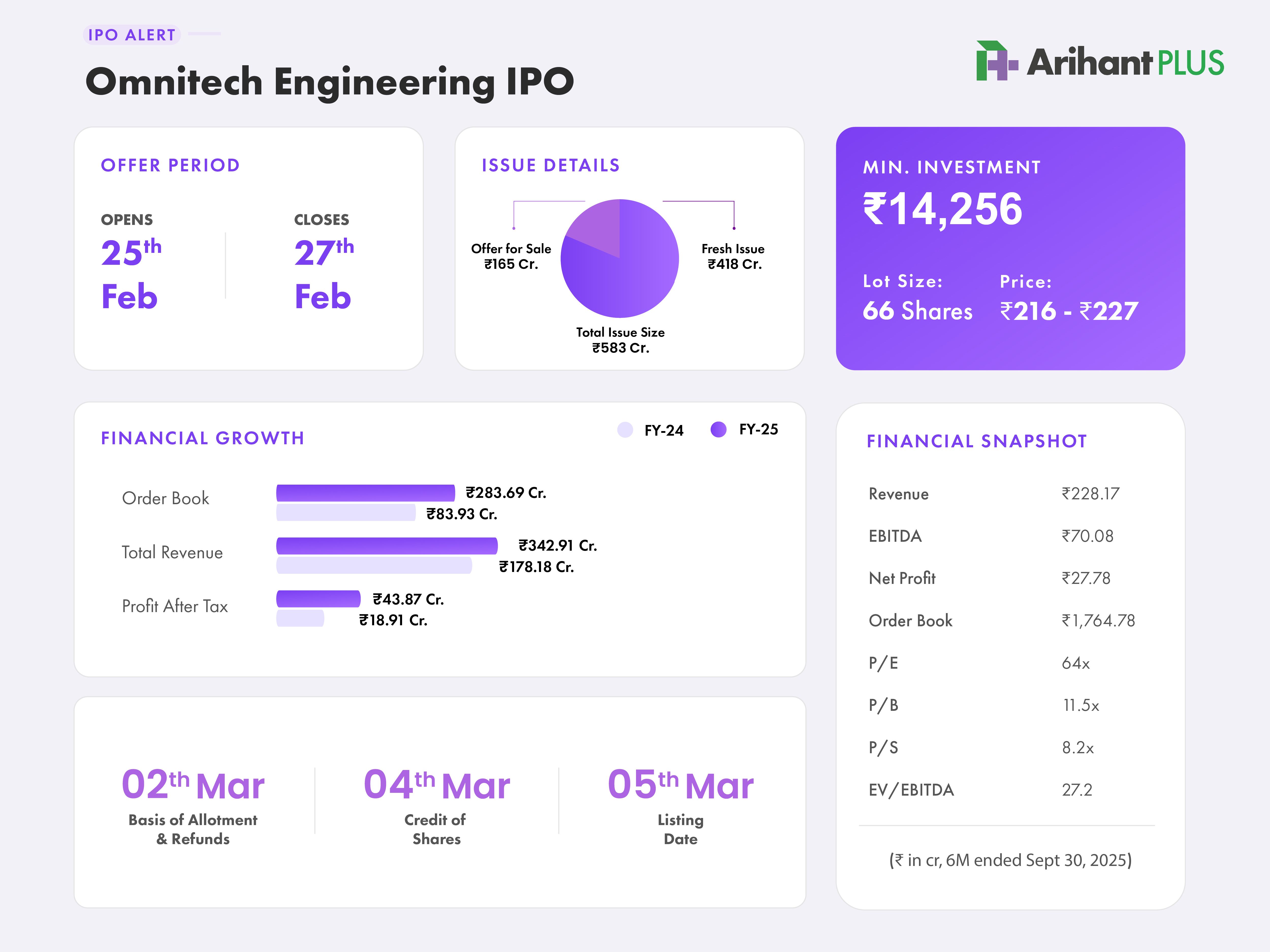
Here are the key details investors should know:
- IPO Size: ₹583 crore
- Price Band: ₹216 - ₹227 per share
- IPO Dates: 25 - 27 February 2026
- IPO Type: Fresh Issue + OFS
- Minimum investment: ₹14,256 (or 66 shares - lot size)
- Listing Date: March 5, 2026
- Proposed Listing: BSE & NSE
- Lead Managers: Equirus Capital Pvt. Ltd.
IPO Objectives: How Will Omnitech Engineering Use IPO Funds?
Omnitech Engineering’s ₹583 crore IPO is a book-built issue comprising ₹418 crore (72%) fresh issue and ₹165 crore (28%) Offer for Sale. Thus, a majority of the proceeds will go to the company, while 28% will go entirely to the promoter, Udaykumar Arunkumar Parekh.
As per the company’s Red Herring Prospectus (RHP), the fresh issue proceeds from the IPO will be used for:
- Repayment / prepayment of borrowings: ₹50 crore
- Funding new projects:
- Proposed Facility 1 - ₹132.84 crore
- Proposed Facility 2 - ₹100.71 crore
- Capital expenditure: ₹18.70 crore towards installation of rooftop solar panels and purchase of new equipment/machinery for an existing facility
- General corporate purposes
Financial Snapshot of Omnitech Engineering
Omnitech Engineering reported a sharp jump in revenue from ₹178.18 crore in FY24 to ₹342.91 crore in FY25 (92% YoY growth), while profit after tax (PAT) more than doubled from ₹18.91 crore to ₹43.87 crore. Earnings before interest tax, depreciation and amortisation (EBITDA) rose to ₹117.65 crore in FY25, translating into a healthy 34.31% EBITDA margin.
The order book improved significantly to ₹283.69 crore in FY25, compared to ₹83.93 crore in FY24, supporting near-term revenue visibility.
However, the business remains working-capital intensive, with net working capital days at 282.69 days in FY25. This ties up substantial capital and partly explains the company’s leverage levels, with net debt-to-equity at 1.60x in FY25 (improved from 2.87x in FY24).
Return ratios have moderated compared to FY23 highs, with RoE at 21.55% in FY24 and trending lower in FY25, indicating that sustaining profitability alongside expansion will be key.
Peer Comparison
Omnitech operates alongside Azad Engineering, Unimech Aerospace, MTAR Technologies, PTC Industries and Dynamatic Technologies in the precision engineering space.
At ₹227 and FY25 EPS of ₹3.55, the IPO is priced at 64x P/E, similar to Unimech (56.7x) and lower than Azad Engineering (103.3x), MTAR Technologies (196.8x), Dynamatic (139.3x) and PTC Industries (428.5x). The industry average stands at 184.9.
It trades at 11.5x P/B, 8.2x P/S and 27.2x EV/EBITDA. While EV/EBITDA is relatively lower than most peers, Omnitech carries higher leverage (1.60x net debt/equity).
Overall, valuation appears reasonable versus high-growth peers, but sustaining margins and managing debt will be key to justifying these multiples.
Key Risks of Omnitech Engineering IPO
- Global Trade & Tariff Risk: Given its exposure to global customers, demand and margins may be impacted by tariffs, trade restrictions, geopolitical tensions and cross-border regulatory changes.
- Customer Concentration Risk: A significant portion of revenue is derived from the top 10 customers (up to ~69% historically); loss of key clients, reduced orders, or inability to maintain relationships and quality standards could materially impact revenues and profitability.
- Sector Dependence Risk: A large share of revenue and order book is concentrated in the energy (especially oil & gas) segment; any sectoral slowdown could materially impact performance.
- High Working Capital Requirement Risk: The business is working capital intensive (net working capital up to ~256 days), requiring significant funding for inventory and receivables; any strain on collections or financing availability could impact liquidity and operations.
- Geographic Concentration Risk: All existing and proposed manufacturing facilities are concentrated in Rajkot, Gujarat; any regional disruptions, policy changes, power outages or natural calamities could materially affect operations and production continuity.
- Export & Forex Risk: With a majority of revenue (~79%) derived from exports and significant import dependence, the company is exposed to foreign exchange volatility, trade restrictions and global supply chain disruptions, which may impact margins and cash flows.
Investor Takeaway: Should You Invest in Omnitech Engineering IPO?
Omnitech operates in the precision engineering components space, where the global market is projected to expand from ~USD 269 bn in 2024 to ~USD 395 bn by 2028, driven by automation, energy transition and rising quality standards across industries. The company has already delivered sharp growth, with FY25 revenue up 92% and EBITDA margins of ~34%, supported by strong repeat business.
At the upper band of ₹227, the issue is valued at a P/E of 64x (FY25 EPS of ₹3.55) and ~27x EV/EBITDA. While it trades at a discount to listed precision engineering peers, the multiple reflects export concentration, energy exposure and elevated leverage. Overall, the valuation appears fair, with re-rating contingent on sustained growth delivery and balance sheet improvement. We recommend a Neutral rating on the issue.
FAQs
1. What are the IPO dates for the Omnitech Engineering IPO?
Omnitech Engineering IPO opens on February 25, 2026 and closes on February 27, 2026. The shares are proposed to be listed on March 5, 2026 on BSE and NSE.
2. What is Omnitech Engineering IPO GMP?
The grey market is showing tepid interest in Omnitech Engineering IPO GMP (grey market premium). The current GMP is ₹7, indicating that the stock could be listed at a modest premium of about 3.08%, according to data from investorgain.com.
3. What is the lot size for retail investors?
The minimum lot size is 66 shares, which translates to minimum investment of ₹14,256-₹14,982 at the price band.
4. Is the Omnitech IPO a fresh issue or an OFS?
The ₹583 crore IPO comprises ₹418 crore (72%) fresh issue and ₹165 crore (28%) Offer for Sale. The fresh issue will be used for debt repayment, funding new manufacturing facilities, capital expenditure and general corporate purposes.
5. Should I invest in Omnitech IPO?
If you are seeking exposure to the precision engineering and global industrial manufacturing theme may find this IPO relevant. However, they should be comfortable with risks related to export dependence (~79% revenue), energy sector exposure, working capital intensity and leverage.
6. What drives growth for Omnitech?
Growth is linked to global industrial capex, energy investments and automation demand. The company reported 92% revenue growth in FY25, supported by a sharp increase in order book and strong repeat customer contribution.

Related Topics

Jio Platforms IPO Review: Can a Telecom Network Carry a Technology Valuation?

Subway Plans ₹600 Crore IPO: What You Need to Know About EverBrands India

Moneyview IPO 2026: From Digital Lending to a ₹1,092 Cr Public Listing




Rentomojo, Karamtara, LCC - 6 IPO Listings Today: Gains, Losses & Key Highlights


NSE IPO 2026: Price Band, GMP, Financials, Risks and Key Highlights


Kanohar Electricals IPO Review 2026: Risks, Strengths and Financials


Horizon Industrial Parks IPO: Details, Financials, Strengths and Risks



Dhoot Transmission IPO: A ₹3,067 Crore Bet on India's Electric Future






























Important IPO terms all investors should understand before investing

Meesho IPO Opens on 3Dec - Is this ₹5,421 crores IPO worth investing?


10 Things to Know About Sudeep Pharma IPO: Date, Price, GMP & Complete Review







Canara Robeco AMC IPO: Should You Apply for MF Giant’s Public Debut?







Smartworks Coworking Spaces Limited IPO: 10 Key Things to Know Before Investing

Travel Food Services Limited IPO: 10 Key Things to Know Before Investing


Ellenbarrie Industrial Gases Limited IPO: 10 Key Things to Know Before Investing



HDB Financial Services Limited IPO: 10 Key Things to Know Before Investing

Sambhv Steel Tubes Limited IPO: 10 Key Things to Know Before Investing

Indogulf Cropsciences Limited IPO: 10 Key Things to Know Before Investing

Prostarm Info Systems Limited IPO: 10 Key Things to Know Before Investing


Aegis Vopak Terminals Ltd IPO: 10 Key Things to Know Before Investing

Schloss Bangalore Limited IPO: 10 Key Things to Know Before Investing

Belrise Industries Limited IPO: 10 Key Things to Know Before Investing


Hexaware’s Billion Dollar Markets Hits in Bear Market: Should You Invest?