



SBI Funds Management IPO: Price Band, GMP, Risks and Key Highlights
India's largest asset manager is finally heading to the stock market with an ₹11,693 crore IPO. The buzz isn't just about the GMP, there's one detail in the issue structure that could change how investors view the offering.
In This Article
- Introduction
- Key IPO Details
- SBI Fund Management IPO Structure
- About SBI Fund Management
- SBI Fund Management Financial Numbers
- IPO’s Institutional Signal
- About SBI Funds Management GMP
- Risks
- Investor Takeaway
Introduction
For over four decades, SBI Mutual Fund has quietly built itself into India's largest asset manager. Now, its parent, SBI Funds Management Ltd, is finally going public. The SBI Mutual Fund is set to launch a ₹11,693 crore IPO - the biggest of 2026 so far.
The issue opens on July 14, closes on July 16, with allotment expected July 17 and listing on NSE and BSE tentatively on July 21, 2026.
Anchor investor bidding happens a day before the issue opens, on July 13.
But before looking at the valuation or the grey market premium, there's one important detail investors should understand.
Key IPO Details
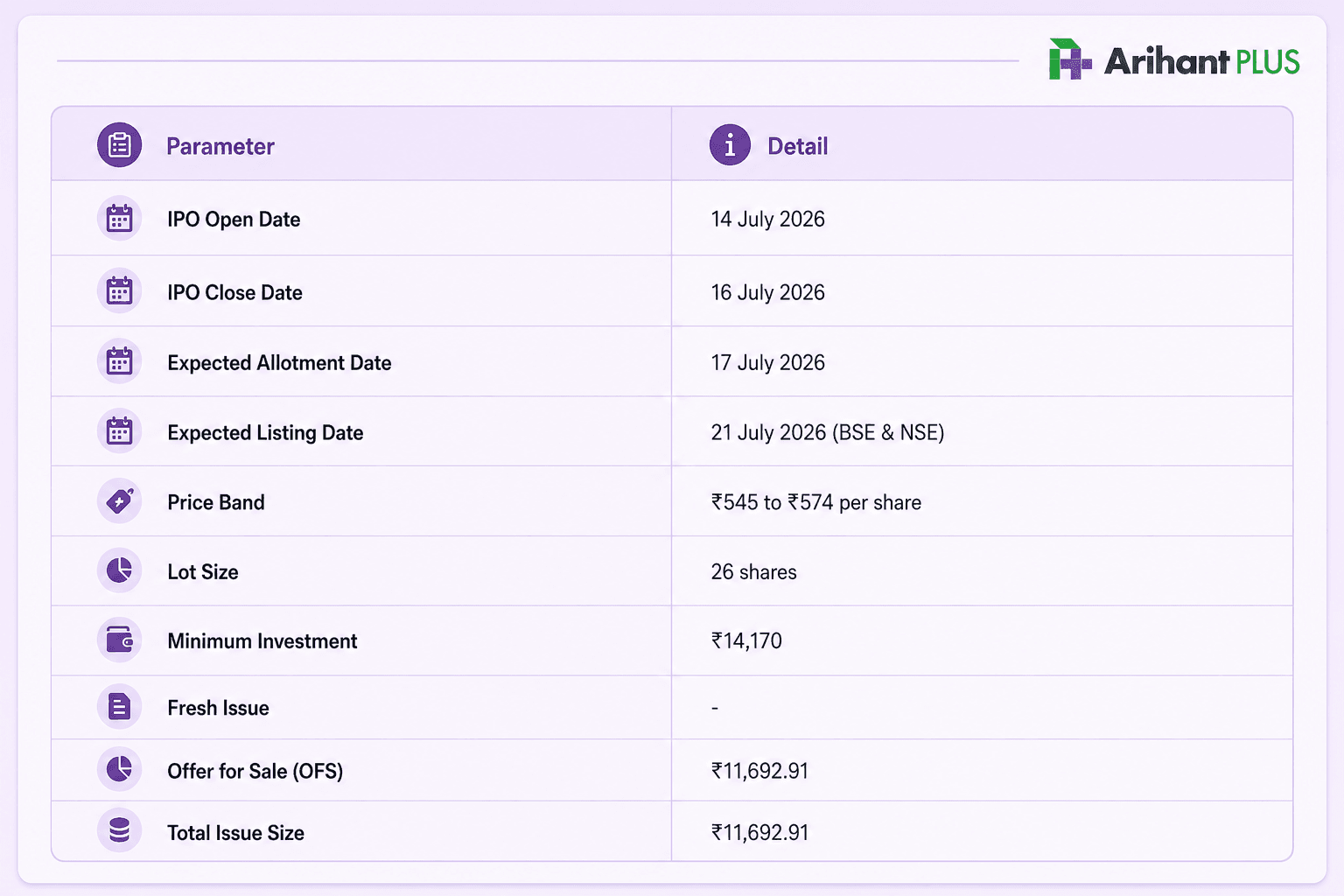
SBI Fund Management IPO Structure
SBI Fund Management’s IPO is a 100% Offer for Sale (OFS), which means the AMC is not raising any fresh capital. The entire ₹11,693 crore will go to existing shareholders, State Bank of India and Amundi, who are selling around 10% of their stake.
The company itself won't receive any proceeds and the primary objective is to list the business and provide public market price discovery. After the IPO, SBI will continue to remain the controlling shareholder with an 88% stake.
About SBI Fund Management
Founded in 1987, SBI Funds Management is the investment manager for SBI Mutual Fund and the largest asset management company in India by quarterly average assets under management (QAAUM). As of December 31, 2025, it managed a QAAUM of ₹12.5 lakh crore and held a 15.4% share of the country's mutual fund industry AUM.
The company is a joint venture between State Bank of India and Amundi Asset Management. Its product portfolio spans across mutual funds, PMS, AIFs, SIFs and advisory mandates. Its extensive distribution network, backed by SBI, along with digital platforms such as InvesTap and YONO, provides strong reach and supports steady long term growth.
SBI Fund Management Financial Numbers
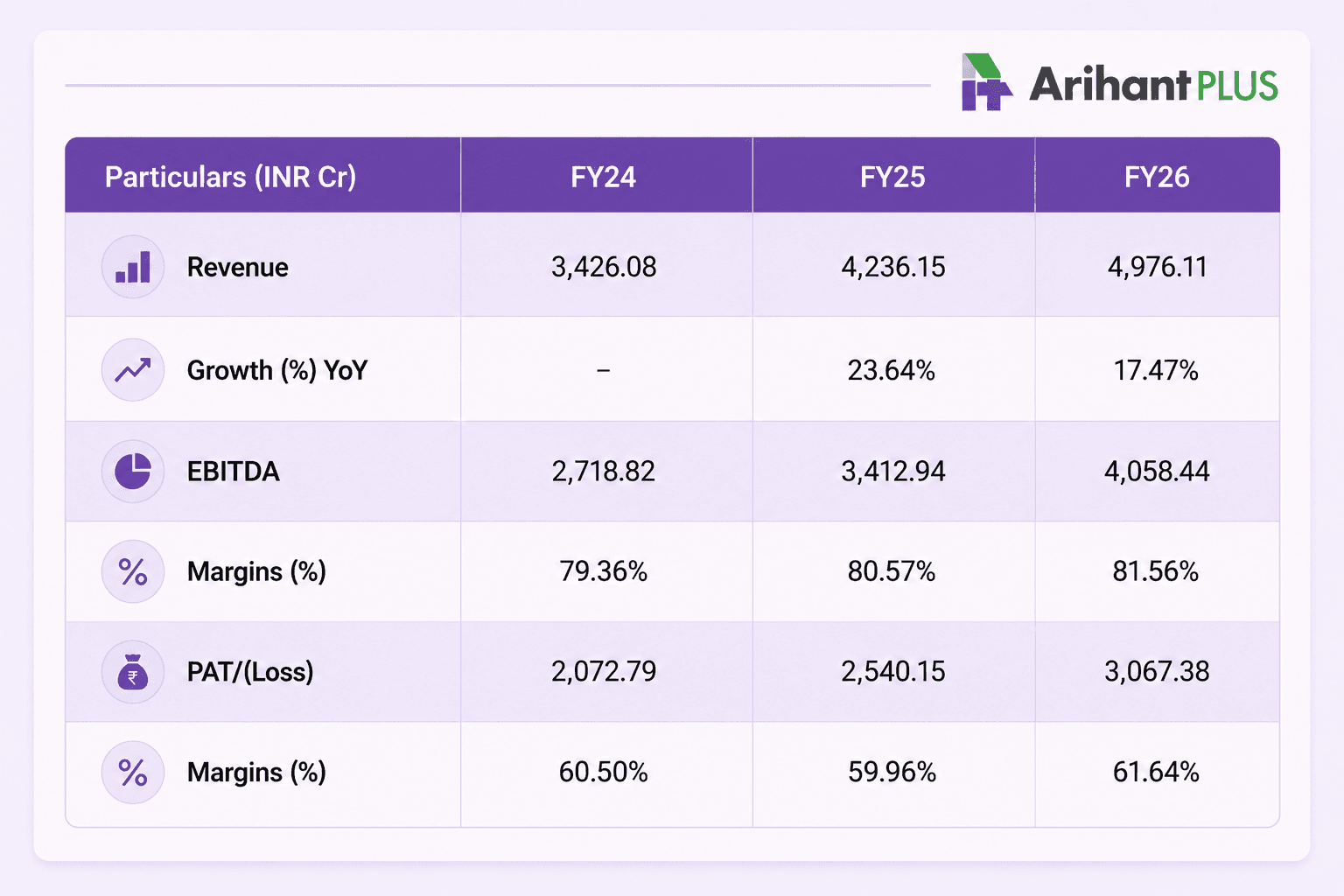
- Total income increased from INR 34,260.8 Mn in FY24 to INR 49,761.1 Mn in FY26, reflecting healthy business growth.
- PAT rose from INR 20,727.9 Mn to INR 30,673.8 Mn over the same period, with ~21% YoY growth in FY26.
- EBITDA stood at INR 40,584.4 Mn in FY26, translating into an EBITDA margin of ~82%.
The company operates an asset light, cash generative model with consistently strong return ratios, positioning it well to benefit from the long term growth of India's mutual fund industry.
IPO’s Institutional Signal
There are two separate things to pay attention to:
First, SBI raised ₹1,655 crore through a pre IPO placement at the upper price band of ₹574, with 30 institutional investors including Malabar India Fund, Tata AIG, 360 ONE, Dymon Asia, and others.
Second, multiple sources reported that ADIA and GIC have come in as anchor investors, with institutional demand running at around five times the QIB allocation. Since anchor bidding happens on July 13, these are expectations, not confirmed allotments.
Strong institutional interest is a positive signal, but it is not a guarantee of listing gains or long term returns. Institutions invest with different objectives and time horizons than retail investors.
About SBI Funds Management GMP
The grey market premium has ranged from ₹70 to ₹143 over the past week, suggesting potential listing gains of about 12% to 25% over the ₹574 issue price. On July 10, most trackers placed it in the ₹86 to ₹96 range.
That said, GMP is an unofficial sentiment indicator. It can change quickly so it should be treated as a mood check rather than a prediction.
Risks
Every investment comes with a risk. Here are key things to consider before you invest in SBI MF IPO:
Distributor dependence: While 57.7% of assets come through the direct channel, the top five distributors still account for 25.3% of mutual fund AUM. Any disruption in these relationships could affect the company's ability to attract and retain investors.
Third party dependence: The company relies on external partners for key operations. Any disruption or service failure could impact operations and investor experience.
Performance: As of FY26, 11 of its 128 schemes, managing ₹94,109 crore, were in the bottom quartile over the past three years. Continued underperformance could lead to investor redemptions, lower AUM, and reputational damage.
International operations: The company's overseas subsidiaries in Mauritius and GIFT City face regulatory, tax, and geopolitical risks that could affect growth and profitability.
Margin pressure: Nearly a third of SBI Funds' AUM is in passive products, which typically earn much lower fees than active funds and can weigh on profitability.
- Lower yield mix: Active equity accounts for just 46% of QAAUM, well below peers like ICICI AMC and HDFC AMC, limiting the company's blended fee yield.
Investor Takeaway
SBI Funds Management is India's largest asset manager with AUM of INR 12.51 trillion and a 15.3% market share. The business continues to benefit from rising financialisation, growing SIP inflows and SBI's strong distribution network, supporting steady long term growth.
At the upper price band of INR 574, the IPO is valued at 38.1x FY26 EPS, broadly in line with listed peers. Given its market leadership, strong profitability and scalable business model, we recommend Subscribe for Long Term.
Disclaimer: Grey Market Premium (GMP) is not regulated or recommended by the stock exchanges or SEBI. ArihantPlus does not endorse or facilitate trading in the grey market. Investors are advised to conduct their own research or consult an expert before making any investment decisions.

Related Topics

Jio Platforms IPO Review: Can a Telecom Network Carry a Technology Valuation?

Subway Plans ₹600 Crore IPO: What You Need to Know About EverBrands India

Moneyview IPO 2026: From Digital Lending to a ₹1,092 Cr Public Listing



Rentomojo, Karamtara, LCC - 6 IPO Listings Today: Gains, Losses & Key Highlights


NSE IPO 2026: Price Band, GMP, Financials, Risks and Key Highlights


Kanohar Electricals IPO Review 2026: Risks, Strengths and Financials


Horizon Industrial Parks IPO: Details, Financials, Strengths and Risks




Dhoot Transmission IPO: A ₹3,067 Crore Bet on India's Electric Future




























Important IPO terms all investors should understand before investing


Meesho IPO Opens on 3Dec - Is this ₹5,421 crores IPO worth investing?


10 Things to Know About Sudeep Pharma IPO: Date, Price, GMP & Complete Review







Canara Robeco AMC IPO: Should You Apply for MF Giant’s Public Debut?






Smartworks Coworking Spaces Limited IPO: 10 Key Things to Know Before Investing

Travel Food Services Limited IPO: 10 Key Things to Know Before Investing


Ellenbarrie Industrial Gases Limited IPO: 10 Key Things to Know Before Investing



HDB Financial Services Limited IPO: 10 Key Things to Know Before Investing

Sambhv Steel Tubes Limited IPO: 10 Key Things to Know Before Investing

Indogulf Cropsciences Limited IPO: 10 Key Things to Know Before Investing


Prostarm Info Systems Limited IPO: 10 Key Things to Know Before Investing


Aegis Vopak Terminals Ltd IPO: 10 Key Things to Know Before Investing

Schloss Bangalore Limited IPO: 10 Key Things to Know Before Investing

Belrise Industries Limited IPO: 10 Key Things to Know Before Investing


Hexaware’s Billion Dollar Markets Hits in Bear Market: Should You Invest?