Stock Split vs Bonus Shares: What’s the Difference & What It Means For You?

By
Mohini Jain
Both stock splits and bonus shares are ways a company uses to reward shareholders with extra shares without added cost. While both lower the share price to boost accessibility, they differ in face value and accounting treatment. Ultimately, neither corporate action creates immediate wealth. Your total investment value remains the same, leaving long-term growth dependent on the company's underlying fundamentals.
In This Article
- Introduction
- What is a stock split and why do companies do it?
- What are bonus shares?
- Stock Split vs Bonus Shares: The Key Differences
- So, does a bonus or split make you wealthier?
- Is a bonus or split a buy signal?
- The bottom line
- Frequently Asked Questions
Introduction
You may have seen a stock announce a 1:1 bonus issue or a 1:5 stock split and wondered: “I’m getting more shares, so am I making more money?”
Well, not exactly.
Both a stock split and a bonus issue put more shares in your demat account, and both usually bring the share price down after adjustment. But how they work and why companies choose one over the other is quite different.
Let’s break it down simply.
Open a free account today
Invest in tomorrow with just one click
What is a stock split and why do companies do it?
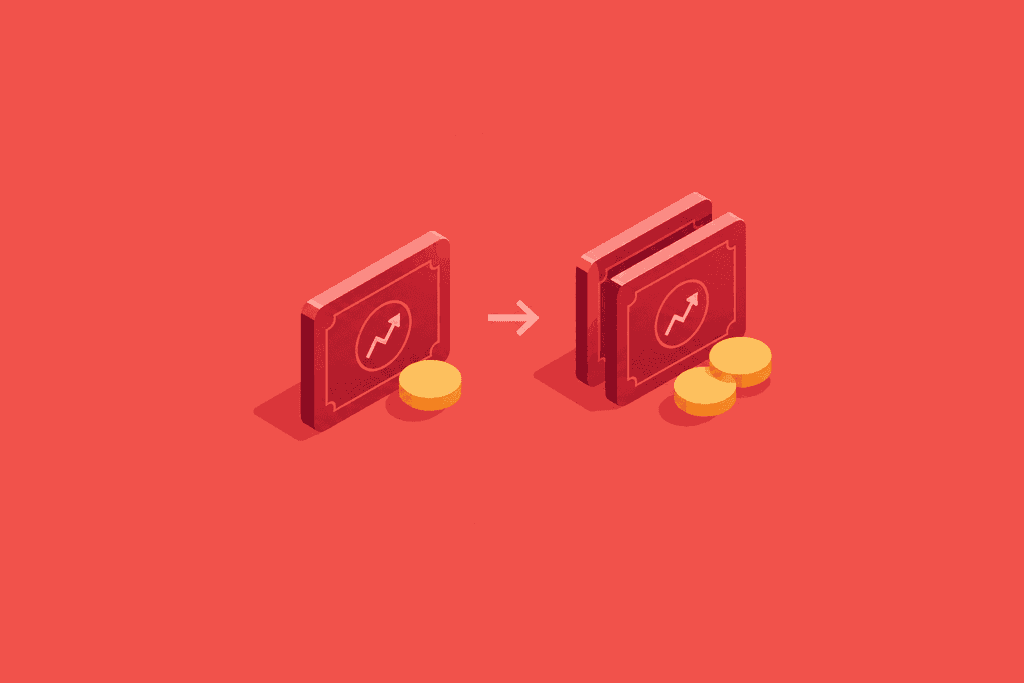
A stock split happens when a company divides its existing shares into smaller units by reducing the face value. Say a company's share has a face value of ₹10, and it announces a 1:2 split. Your single ₹10 share now becomes two shares of ₹5 face value each. So, if the stock was trading at ₹1,000 before the split, the adjusted price would settle somewhere around ₹500.
Here's what that looks like if you held 100 shares:
- Before the split: 100 shares × ₹1,000 = ₹1,00,000
- After the split: 200 shares × ₹500 = ₹1,00,000
Your share count doubled. Your investment value? Pretty much where it was. Where the price goes from there depends on demand, sentiment, and how the business actually performs.
Naturally, you would be wondering - why do companies go for a stock split?
The most common reason is accessibility. A stock trading at ₹1,000 can feel out of reach for smaller investors. After a 1:5 split, the same stock trades around ₹200 - easier to buy, and often with better liquidity. But don't be fooled by the number. ₹200 instead of ₹1,000 doesn't make the business any cheaper. Nothing about the company's fundamentals has changed, only the packaging
What are bonus shares?
A bonus issue is when a company hands out additional fully paid-up shares to existing shareholders, free of cost, in a fixed ratio. These shares are created by capitalising the company's eligible reserves.
In a 1:1 bonus, you get one extra share for every share you own. Hold 100 shares? You now hold 200.
And just like a split, the price adjusts. A stock trading at ₹1,000 before the bonus would theoretically trade around ₹500 after it. So while you will have more shares in hand, the value of your holding will stay the same.
- Before the bonus: 100 × ₹1,000 = ₹1,00,000
- After the bonus: 200 × ₹500 = ₹1,00,000
So, why do companies issue bonus shares? Companies that have built up healthy reserves over the years sometimes choose to capitalise a portion of them through a bonus issue. Doing so can:
- Increase the company's paid-up share capital
- Reward long-standing shareholders with additional shares
- Bring the per-share price to a more accessible level
- Restructure the company's capital base
One thing to note, a bonus issue doesn't bring a single rupee of fresh cash into the company. That's an important distinction many investors miss.
Stock Split vs Bonus Shares: The Key Differences
Metrics | Stock Split | Bonus Shares |
What happens? | Existing shares are divided | Additional shares are issued |
Face value | Reduces | Remains unchanged |
Number of shares | Increases | Increases |
Share capital | Generally unchanged by the split itself | Increases |
Reserves | Not capitalised | Eligible reserves are capitalised |
Cash received by company | No | No |
Immediate value for shareholder | Unchanged by the corporate action itself | Unchanged by the corporate action itself |
The easiest way to remember it:
- Stock split - your existing shares are cut into smaller pieces.
- Bonus issue - the company gifts you extra shares by converting its reserves into share capital.
What happens to the share price?
After either corporate action, the share price adjusts to reflect the higher number of shares in the market.
- A ₹800 stock after a 1:1 bonus? Adjusted price around ₹400.
- A ₹900 stock with a ₹10 face value split into ₹5 shares? Adjusted price around ₹450.
The stock looks cheaper. But here's the catch - a lower price per share doesn't mean the company has become cheaper in valuation terms. The market capitalisation stays where it was and so does the value of your holdings.
So, does a bonus or split make you wealthier?
Not automatically.
If you own 100 shares at ₹1,000 each, your holding is worth ₹1 lakh. After a 1:1 bonus, you own 200 shares at roughly ₹500 each. Your holding is still worth about ₹1 lakh.
What builds wealth over the years isn't the number of shares sitting in your demat account - it's the company's ability to grow its earnings, cash flows, and business value. The split or bonus simply rearranges the math.
What happens to EPS?
Since the share count goes up while earnings stay the same, earnings per share (EPS) adjusts downward.
Before: ₹1,000 crore earnings ÷ 10 crore shares = ₹100 EPS
After a 1:1 bonus: ₹1,000 crore earnings ÷ 20 crore shares = ₹50 EPS
Has the company become less profitable? Not at all. The same profit is now spread across more shares. That's why, when comparing historical EPS, always look at adjusted figures.
Is a bonus or split a buy signal?
On its own NO.
These announcements do grab attention, and stocks often see increased activity around them. But neither guarantees the price will move up. Before acting on any such news, ask the questions that actually matter:
- Is the company's revenue growing?
- Are earnings consistent?
- Are cash flows healthy?
- How much debt is on the books?
- Does the valuation make sense against the fundamentals?
- What do the future growth prospects look like?
A corporate action is one piece of the puzzle, never the whole picture.

The bottom line
A stock split cuts the face value and divides your shares into smaller units. A bonus issue gives you extra shares by capitalising reserves, with the face value staying put.
For you as an investor, the takeaway is simple: while the announcement of bonus and split and the action itself may lead to some action in share price, in reality more shares don't mean more wealth. What matters over the long run is the strength of the business behind those shares.
So the next time a 1:1 bonus or a 1:5 split flashes on your screen, look past the share count. Look at the company.
Frequently Asked Questions
Is a stock split better than a bonus issue?
Neither is inherently better. They are different corporate actions with different purposes and accounting treatments.
Does a stock split increase the value of my investment?
No. The price adjusts in proportion to the new share count, so the split itself doesn't create wealth.
Do bonus shares increase my wealth?
Not right away. You receive extra shares, but the market price adjusts accordingly.
What is the impact of a split or a bonus on EPS?
The EPS is adjusted downwards because the same amount of earnings is now spread out over more shares .
Why do companies announce stock splits?
Primarily to bring the price per share down to a more affordable level, and to make it easier to trade.
Why do companies issue bonus shares?
To capitalize eligible reserves and to increase the paid-up share capital and reward the existing shareholders.
Should I buy a stock just because it announced a bonus or split?
No. But don’t buy on the back of the announcement – look at the fundamentals, the valuation and the long-term prospects first.
Related Topics


Stock SIP Explained: A Smarter Way to Build Long-Term Wealth

Mutual Funds vs PMS: What’s the difference and which one is right for you?

Inside REITs: India’s Growing Real Estate Income Opportunity

Small Caps Lead Q1 Growth: Truth Behind India Inc’s Q1FY27 Earnings

Understanding Margin Trading Facility (MTF): A Detailed Guide


What is an Offer for Sale (OFS)? A Complete Guide for Investors

Good-Till-Date Orders: A Smarter Way to Invest Without Constant Monitoring

Ethical Investing Gets Real: NSE and BSE Launch Saatvik and Ahimsa Indices

CM Vijay's ₹213 Crore Bank Balance Teaches India's Biggest Investing Mistake

Understanding Bonus Shares and Their Impact on Your Portfolio

Understanding Stock Splits and Their Impact on Your Portfolio




How to Analyse a Stock in 2026: Fundamental + Technical Checklist




Silver vs gold 2025: Why smart investors are choosing silver now