
HDFC Bank Stock at 5-year Low: Is it Time to Buy?

By
Arihant Team
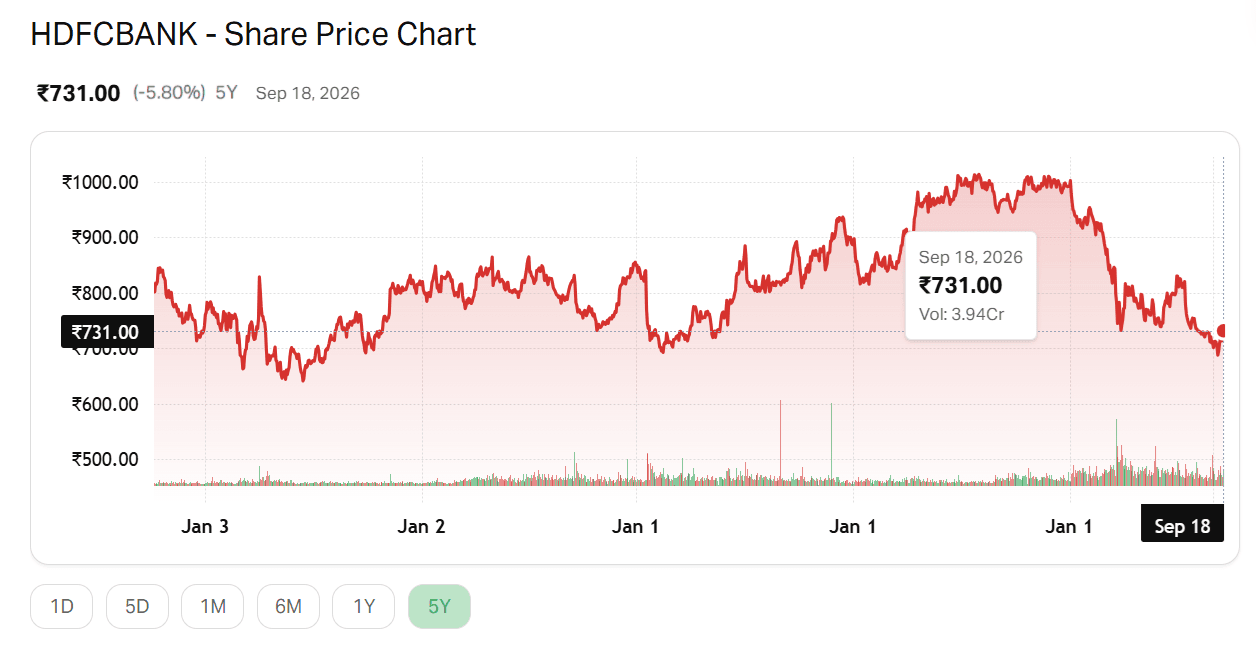
HDFC Bank stock is at 5-year low/ The stock is down 28% this year, on track for the worst annual decline since 2008. Why is the stock underperforming? Should you buy HDFC Bank now?
In This Article
- Introduction
- HDFC’s merger's real bill
- Leadership Crises and Sudden Exits Shake Investor Trust at HDFC Bank
- What HDFC’s financial numbers actually say
- Deep Valuation Discount: Value Opportunity or Trap?
- Leadership Succession: Who Will Lead the Bank Next?
- Investor Takeaway
Introduction
For years, most Indian investors owned HDFC Bank in their portfolios, just the way they owned gold, or a fixed deposit. The stock was considered a safe haven, one that will grow over time without market drama. Safe and stable!
What built that trust was two decades of being boring, in a very profitable way. HDFC Bank grew loans steadily, kept a large base of cheap current and savings account depositors, and reported some of the highest returns on equity in Indian banking.
Then came the massive HDFC Bank’s merger with HDFC in 2023 and it changed the math. Ever since then the stock has been underperforming. In fact, this year its shares kept making fresh 52-week lows, eventually touching around ₹682, more than 33 per cent below the bonus adjusted high of ₹1,020.50 the stock had set barely a year before.
There’s a lot to the HDFC Bank story, which we will decode today.
Open a free account today
Invest in tomorrow with just one click
HDFC’s merger's real bill
HDFC Bank’s trouble started on July 1, 2023, when it merged with its parent, Housing Development Finance Corporation, the country's largest mortgage lender, creating a combined entity worth close to $180 billion.
The logic held up on paper: HDFC Ltd had a huge home loan book but no deposit franchise, HDFC Bank had the deposits but a smaller mortgage business.
While the merger added a massive loan book to the merged entity's balance sheet overnight; it couldn't add cheap depositors overnight, those relationships take years. Before the merger, HDFC Ltd relied heavily on market borrowings, which cost roughly 2.5% more than ordinary bank deposits. Bringing those expensive liabilities onto HDFC Bank’s balance sheet drastically altered its financials.
Its loan-to-deposit ratio surged from 85% to nearly 110% overnight, meaning the bank was lending out significantly more money than it held in deposits. At the same time, its share of low-cost current and savings deposits (CASA) fell from 44% to under 38%. With funding costs climbing, net interest margin (NIM), the core profit margin on lending, dropped from its historic average of over 4% down to record lows near 3.26%.
Though total loans and deposits continued to grow at a healthy pace of 15%, core interest income grew at less than half that rate, a clear signal that sheer size was eroding overall profitability.
This isn't the first time the market has punished the stock for it. In January 2024, post merger margin pressure first became visible in results, and the stock fell more than 8 per cent in a day before sliding to a fresh low. It recovered fully and set a new record high by June 2025. That history doesn't predict this one, though: the 2024 scare was purely a numbers problem. What's different now is that a numbers problem has been joined by a trust problem, and trust doesn't run on the same clock as a margin does.
Leadership Crises and Sudden Exits Shake Investor Trust at HDFC Bank
For years, HDFC Bank's massive size offered safety - the bank was too large, too regulated, too central to cut corners and run into governance issues. That confidence was shaken in 2026.
In March 2026, bank’s non-executive chairman Atanu Chakraborty resigned abruptly, saying certain practices at the bank weren't in line with his personal ethics. Imagine the ethics of a bank like HDFC Bank being questioned!
The issue traced back to government deposits the bank had taken from the Maharashtra State Road Development Corporation (MSRDC) in 2017 and 2021, at an inflated rate, with the extra allegedly routed through third party vendors, an episode that triggered US securities lawsuits.
Though external legal reviews cleared executives of personal wrongdoing, the reputational damage remained. Adding to the instability, in August 2026, CEO Sashidhar Jagdishan announced he would step down at the end of his term and not seek reappointment. Losing both its Chairman and CEO within six months broke the bank's long-standing promise of stability, reigniting serious concerns about its corporate governance.
What HDFC’s financial numbers actually say
Look past the headlines, and the business is in better shape than the stock price suggests.
Replacing High-Cost Debt: Expensive borrowings inherited from HDFC Ltd have fallen from 21% of liabilities in September 2023 to roughly 11% by June 2026. Only ₹40,000–₹50,000 crore of this expensive debt remains to be paid off over the next two years.
Healthier Deposit Growth: The loan-to-deposit ratio has eased to about 96% by March 2025, and deposits, at ₹31.71 lakh crore, are still growing faster than loans.
- Passive Fund Pressure: HDFC Bank's weight in the Nifty 50 index fell from nearly 14% in mid 2025 to close to 10% in August 2026. Actively managed mutual funds have trimmed their average exposure from 9% to 7.2% over the past year. Many funds continue holding it simply to match index benchmarks, rather than out of strong conviction.
Deep Valuation Discount: Value Opportunity or Trap?
At around 14 times trailing earnings and under 2x book value, HDFC Bank now trades cheaper than ICICI Bank and Kotak Mahindra Bank, both well into the high teens, and well below its own historical average of 20-26x.
The Optimists' View: Value investors see this low price as a temporary discount that compensates for short-term post-merger integration problems, and the problems are already being fixed.
- The Skeptics' View: Skeptics believe the market will refuse to pay a premium again until predictable profit growth is fully proven, not just promised.
Leadership Succession: Who Will Lead the Bank Next?
The board has sent two shortlisted names for the MD and CEO role to the RBI without disclosing them, though deputy managing director Kaizad Bharucha is widely reported as the strong internal contender. Keki Mistry, who ran HDFC Ltd when that mortgage book was built, is now interim chairman, a small irony worth sitting with.

Investor Takeaway
What this year really shows is less a story about a complex bank merger - it’s a lesson how investor trust works. For years, investors mistook familiarity for true safety. They trusted HDFC Bank simply because it had been reliable for so long, right up until the moment it was forced to prove itself all over again.
While HDFC Bank's balance sheet metrics are repairing quarter by quarter, regaining market trust is a much slower process. HDFC Bank's numbers suggest that the bank's business will likely recover before its valuation multiple does, and regaining that trust will depend on consistent execution and transparent governance. And also, will the investors be willing to trust the bank again?
Related Topics
LIC Gets RBI Nod for 9.99% HDFC Bank Stake: Buy Signal or Market Noise?

Has Bandhan finally become a real bank? l Q1FY2027 Results Analysis
Bajaj Auto vs TVS Motor Q1FY27 | Beyond profits, whose quarter was stronger?
Wipro Q1 FY27 Results | 7 Key Takeaways Every Investor Should Know



Tata Motors Demerger Gets NCLT Nod: What Shareholders Must Know
ICICI Lombard Q1FY26 Result: Profit jump 28.7%, Strong Margin & Digital Momentum