


Closing Auction Session (CAS) kicks in from 3rd August: Market timing changes

By
Arihant Team
From August 3, 2026, NSE and BSE will adopt a Closing Auction Session for Futures and Options stocks, replacing the VWAP method to enhance price discovery. Stocks with F&O contracts will stop continuous trading at 3:15 PM and move into CAS while all other stocks will continue to trade until 3:30 PM.
In This Article
- Key Takeaways
- What is Closing Auction Session (CAS)?
- What is really changing from 3 August?
- How does this affect me?
- What happens during the closing auction?
- Why did SEBI introduce a new closing?
- Which stocks are eligible under CAS?
- Why was this change needed?
- 5 mistakes to avoid
- FAQS
Key Takeaways
- Trading Timings: Stocks with F&O contracts will stop trading at 3:15 PM, and move into CAS that ends at 3:35 PM. Other stocks will continue trading until 3:30 PM.
- Derivative Timings: Stock and index derivatives will trade until 3:40 PM. This gives F&O participants additional time to respond after the cash market closing price is discovered.
- Closing Method: Closing price will be discovered through an auction instead of being calculated as an average. It will be the price at which the maximum number of shares can be matched.
- Order Cancellation: Pending stop loss orders will be cancelled at 3:15 PM. Any position relying on these orders will need to be managed before regular trading ends.
- Price Range: Orders must remain within 3 percent above or below the reference price. This reference price will generally be based on the average traded price between 3:00 PM and 3:15 PM.
Random Closing: Order entry window will close at a randomly selected time between 3:28 PM and 3:30 PM. There will therefore be no fixed final second for placing an order.
Post Session: Post close session will move to 3:50 PM to 4:00 PM.
Delivery Impact: For participants who primarily buy and hold stocks, very little changes in practice. The main difference is the method used to determine the official closing price.
- Intraday Trades: Auto square-off timings will change now - all cash stocks (CAS and non-CAS) will square-off at 3:07 PM, while intraday F&O positions will square-off at 3:25 PM on ArihantPlus trading platforms.
What is Closing Auction Session (CAS)?
A stock’s closing price is a number you probably see every day without giving it much thought.
It appears on your portfolio screen, is used to calculate mutual fund NAVs, forms the basis of indices such as the Nifty and Sensex, and is also used to settle F&O contracts on expiry.
From Monday, August 3, 2026, the way this price is calculated will change for a significant part of the market.
Many people assume that a stock’s closing price is simply the last price at which it traded before the market closed. But that is not how it is calculated.
Under the current system, the exchange considers all trades executed between 3:00 PM and 3:30 PM. It then calculates the average price, giving more weight to prices at which a higher number of shares were traded. This volume weighted average becomes the official closing price.
The method was designed to reflect trading activity during the final thirty minutes rather than one isolated transaction. However, a large order placed during this period can still influence the average, particularly in a stock with relatively low trading volumes.
From August 3, 2026, this process will change. Instead of trading continuously until 3:30 PM, eligible stocks will stop regular trading at 3:15 PM. Buy and sell orders will then be collected in a common order book. This new process is called the Closing Auction Session, or CAS.
Under CAS, the exchange will identify the price at which the maximum number of shares can be matched. That price will become the official closing price. So, instead of averaging, all orders are pooled and matched at a single equilibrium price, the one price at which the maximum number of shares can actually be traded.
This will create deeper liquidity at the close, making it easier for large investors, such as mutual funds, insurance companies and FIIs, to execute sizeable trades without breaking them into multiple smaller orders or causing unnecessary price swings. The result will be more efficient execution, lower market impact and a closing price that better reflects true market demand and supply.
In fact, this is not a new concpet and major exchanges like New York Stock Exchange (NYSE) already follow CAS to determine closing prices.
Open a free account today
Invest in tomorrow with just one click
What is really changing from 3 August?
Here are some things every trader and investor needs to know before 3rd August so you can plan your trades better.
How does this affect me?
That depends on how you participate in the market.
- Delivery investor: Very little changes in practice. Holdings and settlement remain unaffected, though closing price calculation shifts. The primary change is the post-close session moving to 3:50 PM - 4:00 PM (previously 3:40 PM - 4:00 PM).
- Intraday trader: Your trading window for CAS-eligible stocks ends earlier at 3:15 PM. The automatic square-off timing for intraday trades on ArihantPlus trading platforms will change for cash stocks and equity derivatives, as follows:
- Equity (stocks under CAS): 3:07 pm
- Equity (stocks not under CAS): 3:07 pm
- Index and stock F&O contracts: 3:25 pm
- F&O trader: Derivatives trade for an extra 10 minutes, closing at 3:40 PM. Daily settlement VWAP calculation window shifts to 3:10 PM - 3:40 PM (from 3:00 PM - 3:30 PM). Expiry settlement rules will also update accordingly.
- Index fund / ETF investor: No visible changes on the surface. Behind the scenes, fund managers can execute orders closer to the official closing price, helping reduce tracking error against benchmarks.
- Running algos or APIs: Stop-loss orders will not stay active after 3:15 PM for eligible stocks. However, algos can now place market orders during CAS without incurring the penalty that applied under the older framework.
What happens during the closing auction?
Once continuous trading ends at 3:15 PM, the closing auction takes place in four stages.
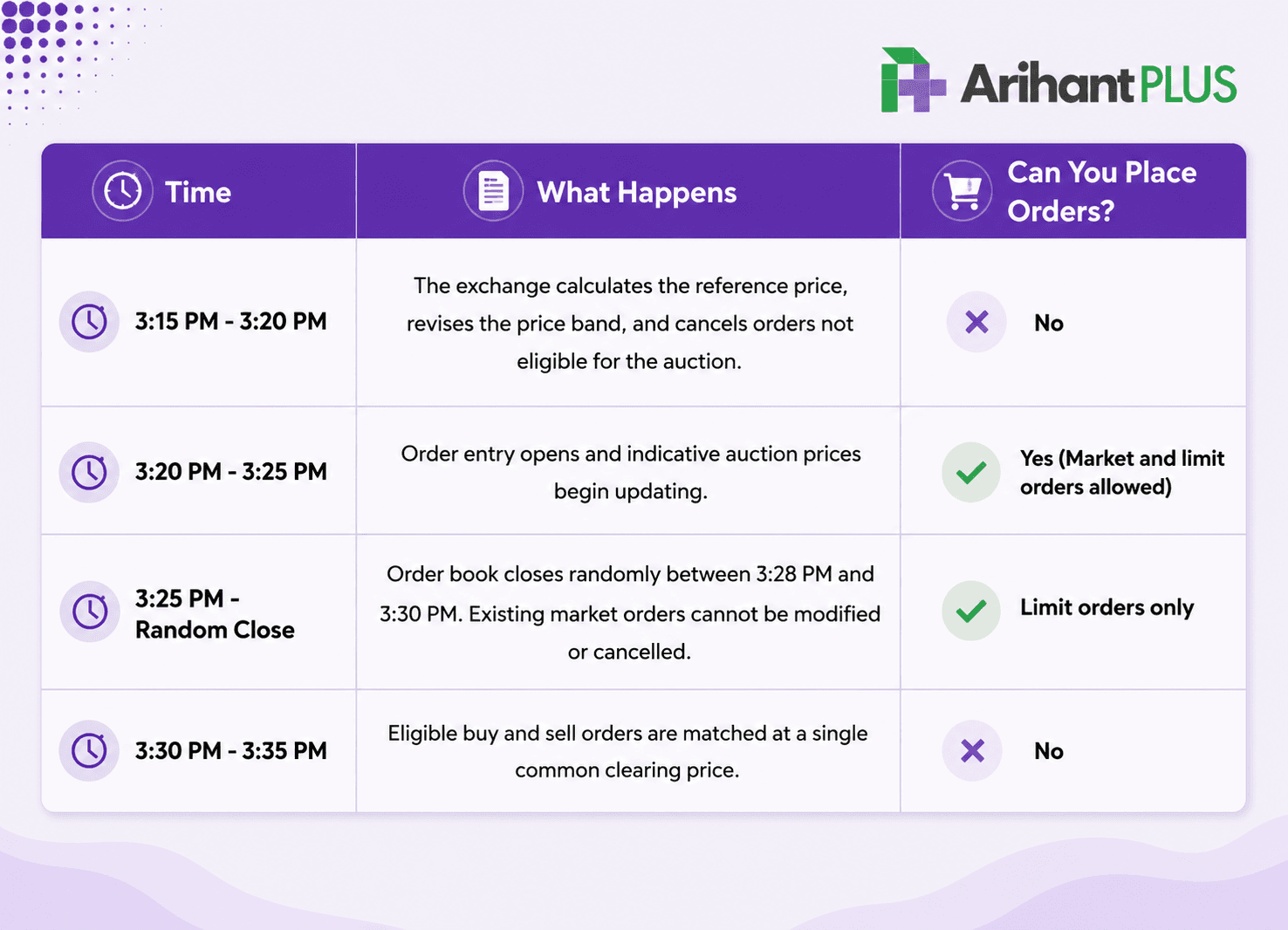
A few details are worth understanding about how orders are handled during the auction.
Live Indicators: From 3:20 PM, the exchange will publish the indicative equilibrium price, cumulative buy and sell quantities, and the difference between the two sides. This allows participants to see how the auction is developing before placing an order.
Matching Priority: Market orders receive priority during matching. Market orders are first matched with other market orders, followed by limit orders. Limit orders are matched with one another after that.
Existing Orders: Unexecuted limit orders from the regular session will carry forward into the auction and receive priority over new orders placed during CAS. However, an order will be removed if it falls outside the permitted 3 percent price band. If an existing order is modified during the auction, it will lose its earlier priority and move behind other eligible orders.
Excluded Orders: Pending stop loss orders will be cancelled at 3:15 PM. These orders will not enter the closing auction.
- Fallback Price: In some cases, there may not be sufficient overlap between buy and sell orders to discover an equilibrium price. If this happens, the reference price will become the official closing price.
Why did SEBI introduce a new closing?
The random closing window is designed to prevent orders from being concentrated in the final few seconds. Under the existing system, participants know exactly when trading will end and can place large orders just before 3:30 PM, potentially influencing the closing price.
Under CAS, the order book can close at any time between 3:28 PM and 3:30 PM. Since the exact time is not known in advance, participants cannot reliably wait until the final second to place an order. This will support a more orderly and representative closing price.
From August 3, the timings will be:
For derivatives traders, the additional ten minutes are important. It allows them to see the final cash market closing price before the derivatives session ends.
This should support closer alignment between the closing price of a stock and its corresponding futures contract.
Which stocks are eligible under CAS?
CAS will initially apply to stocks included in the F&O segment on the relevant exchange.
This distinction is important because the eligible list may not be identical on NSE and BSE. Each exchange will include only those F&O stocks that meet its own eligibility conditions. For example, BSE has excluded CDSL and BSE Limited from its CAS list.
Participants should therefore check the eligible list published by the exchange on which they are placing the order.
The rollout will take place in phases, with more stocks expected to be included over time. F&O stocks first (Aug 3), pre-open auction changes later (Sept 7), and non-F&O stocks continue to follow the existing VWAP closing process.
Why was this change needed?
There are two main reasons for introducing the closing auction.
- GLOBAL PRACTICE: Several major exchanges, including the New York Stock Exchange, the London Stock Exchange and Euronext, already use closing auctions. India was one of the larger markets that continued to determine closing prices using an average of trades during the final thirty minutes.
- CLOSING ALIGNMENT: Trading activity often rises on index rebalancing and expiry days, when large funds need to transact close to the official closing price. Under the existing system, that price is known only after trading ends, so the execution price may differ slightly from the price used to value the fund. This creates tracking error. A closing auction brings all eligible orders into one book and discovers a single price at which the maximum quantity can be matched. Participants can therefore transact at the official closing price itself.
The trade off is that while price certainty improves, orders may remain unmatched if the book is heavily one sided.

5 mistakes to avoid
- Old Timings: Do not assume that your existing MIS square off timings will remain unchanged. Brokers may revise the cutoffs for CAS stocks and equity derivatives, so confirm the latest timings with your broker.
- Final Second: Do not wait until the last second to place an order. The auction order book will close at a random time between 3:28 PM and 3:30 PM.
- Stop Protection: Pending stop loss orders in eligible stocks will be cancelled at 3:15 PM. Any position relying on them should be managed before regular trading ends.
- Price Limits: Orders placed beyond 3 percent above or below the reference price will be rejected. Existing limit orders carried into the auction will also be removed if they fall outside this range.
- Expiry Settlement: Daily settlement will continue to use the same method, although the calculation window will change. On expiry, stock derivatives will settle using a volume weighted average of the stock’s closing prices across recognised exchanges.
FAQS
What time will the stock market close from August 3, 2026?
The closing time will depend on the segment.
- Continuous trading in CAS eligible F&O stocks will end at 3:15 PM, followed by the auction until 3:35 PM.
- Other cash market stocks will close at 3:30 PM.
- Equity derivatives will close at 3:40 PM.
- The post close session will run from 3:50 PM to 4:00 PM.
Which stocks are eligible for Closing Auction Session (CAS) in the equity segment?
CAS shall be applicable to those stocks in the equity cash segment on which derivative contracts are available. Accordingly, the closing price of such securities shall be determined through the CAS mechanism.
What about non-F&O stocks?
Nothing will change for stocks that don't trade in F&O segment. They will continue to trade as usual until 3:30 PM under the existing market timings. For example, a stock that isn't part of the F&O segment, such as many mid and small-cap stocks, will continue to follow the current market closing time of 3:30 PM.
What happens to my stop loss order at 3:15 PM?
Pending stop loss orders in CAS eligible stocks will be cancelled at 3:15 PM and will not enter the auction.
Limit orders outside the permitted 3 percent price range will also be removed. Positions relying on stop loss protection should therefore be managed before 3:15 PM.
Can I still buy or sell shares after 3:15 PM?
Yes, but only through the closing auction. Order entry will begin at 3:20 PM, when market and limit orders can be placed. From 3:25 PM, only limit orders will be accepted. The order book will close at a random time between 3:28 PM and 3:30 PM.
What order types are allowed during CAS?
You can place market and limit orders from 3:20–3:25 PM. Only limit orders will be allowed thereafter. Stop Loss and revealed quantity orders will not be allowed in CAS. Algo market as well as limit orders shall be allowed.
How is the closing price calculated under CAS?
The closing price will be the equilibrium price, which is the price at which the maximum quantity of shares can be matched during the auction.
This will replace the existing volume weighted average price calculated between 3:00 PM and 3:30 PM. If no equilibrium price is discovered, the reference price will become the official closing price.
Does CAS affect mutual fund NAVs or delivery holdings?
Mutual fund NAVs will continue to use official closing prices. The difference is that these prices will be discovered through an auction for eligible stocks.
Delivery holdings will remain unaffected. The main practical change for long term participants is that the post close session will move to 3:50 PM to 4:00 PM.
Will both the CAS framework and the revised Pre-Open Market Session be implemented from the same date?
No, As per SEBI guidelines, the implementation will be undertaken in a phased manner. Accordingly, the CAS framework shall be implemented with effect from August 3, 2026, while the alignment of the Pre-Open Auction Session with the CAS framework shall be implemented separately with effect from September 7, 2026.
Related Topics

NSE Pre-Open Session Rules Have Changed: Here’s What Traders Need to Know
LIC Gets RBI Nod for 9.99% HDFC Bank Stake: Buy Signal or Market Noise?
India’s July Factory Growth Hits a 5-Year Low. Should We Be Worried?

Ethical Investing Gets Real: NSE and BSE Launch Saatvik and Ahimsa Indices


Can REITs and InvITs Become India’s Next Retail Portfolio Essential?

Everyone Knows Bajaj Finance’s Playbook. So Why Can’t Anyone Copy It?


Beyond the Dark Store: Is Advertising Zepto's Real Business?

Vedanta Demerger: Why Aluminium Became the Market’s Favourite/Darling


NSE Extends F&O Market Close to 3:40 PM: What Traders Must Know

Elon Musk’s $119 Billion Terafab Bet: Can It Reshape AI Chips?

Rupee Crashes to ₹96: How Investors Can Profit From the Fall

The Rise of India’s Defence Sector: Stocks, Trends & Opportunities

SEBI introduces Verified Badge for Trading Apps to Curb Fake App Scams

TCS Q4 Concall: AI Infrastructure to Drive the Next Growth Cycle

Rupee Slips Past 95/USD | Factors Driving the Fall Despite RBI Intervention


The Popcorn Trade: How Dhurandhar 2 is driving PVR INOX Stock Higher

Oil Is Surging After The Iran Strikes. So Why Isn’t Gold Following?

What’s Getting Cheaper & Costlier in Budget 2026: A Simple Money Guide


Union Budget Day & Market Behaviour: 15 Year Trend Analysis (2011-2025)

Maruti Q3FY26 Profit Up 4%: Losing Grip on India’s Car Market?

New Year, New Financial Goals: Make SIP Your 2026 Resolution


Infosys ₹18,000 Crore Share Buyback: Record Date & Why Promoters Opted Out?

Nifty 50 Performance Since Last Muhurat Trading: Nifty Top 10 Performers

Diwali Muhurat Trading: Can Nifty’s 7-Year Winning Streak Continue?


Tata Motors Demerger Gets NCLT Nod: What Shareholders Must Know

Muhurat Trading 2025 on 21 Oct: Everything You Should Know

Tuesday is the New Thursday: NSE & BSE Expiry Shift from Sep 2025


How Jane Street Snatched ₹36,500 Crore While India's Youth Lost Everything
Axis Bank Q1FY26 Results: A Mixed Bag, but Long-Term Picture Still Intact

Indian Stock Market Outlook: What Happened And Way Forward