

Understanding Bracket Order: A Complete Guide

By
Arihant Team
Stock markets are fast and dynamic, and they test discipline. One moment of fear or greed can undo a well-planned trade. What if your exit strategy was decided the moment you entered? Bracket orders bring structure, speed, and emotional control to trading - helping you protect capital and lock profits without second-guessing every move. But are bracket orders always the right choice? And should you use a bracket order for every trade?
In This Article
- Key Takeaways
- Introduction
- What is a bracket order?
- How does a bracket order work?
- Bracketed Buy Order Vs Sell Order
- How much margin do you need for a bracket order?
- Why should traders use a bracket order?
- How to place a bracket order on ArihantPlus
- Difference Between Cover Order And Bracket Order
- Final Takeaway
- FAQs
Key Takeaways
- A bracket order allows you to place your entry, stop-loss, and target together in one order.
- Once the main order is executed, both exit orders activate automatically.
- If the target is hit, the stop-loss is cancelled. If the stop-loss is hit, the target is cancelled.
- Bracket orders are typically intraday and are squared off before market close if still open.
- Bracket orders promote discipline, reduce emotional decisions, and define risk and reward in advance.
Introduction
Imagine you’re a trader and you buy a stock at ₹100. At the time of entry, the plan seems clear and you feel in control. But once the stock starts moving you start getting swayed by all kinds of emotions.
“What if the price suddenly falls?”
“Should you book profits immediately?”
“Should you hold on for more gains?”
Within minutes doubt replaces clarity.
This is where most traders go wrong. Not during the analysis, but during trade exit management. And that’s exactly where a bracket order saves the day.
What is a bracket order?
A bracket order (BO) is a 3-in-1 advanced intraday order where you enter a position and simultaneously set two pre-defined exit levels - one to book profit and one to limit your loss. With a bracket order, you pre-define your profit as well as loss-levels allowing you to potentially lock-in your profit while minimising losses, if any.
In simple words, in this order type the moment you place your trade your exit strategy is automatically bracketed with a:
- Target Order - A profit taking limit order.
- Stop-loss Order - A stop-loss order to limit potential losses if the market moves against you.
This strategic order type helps traders manage their risk, profit booking, and avoid making emotional decisions once the trade is placed.
Open a free account today
Invest in tomorrow with just one click
How does a bracket order work?
A bracket order has three key components:
- Primary order: Your main buy or sell order (it can be a market order or a limit order).
- Target order: An order placed at a higher (for buy) or lower (for sell) price to lock in gains.
- Stop-loss order: An order placed at a lower (for buy) or higher (for sell) price to limit potential losses.
Once the primary order of buy or sell is executed, the two opposite side orders are triggered automatically. The best thing about bracket order is you don’t have to worry about cancelling the stop loss order if the target hits or vice-versa. Bracket order is a very smart tool, the moment either your target or stop-loss hits, the other order cancels automatically. This is called - one cancels the other (OCO).
- If the price hits your target, your profit is booked and the stop-loss is cancelled.
- If the stop-loss is hit first, your loss is limited and the target order is cancelled.
Similarly, until your primary buy order at ₹100 doesn’t get executed neither the stop-loss nor the target order activates. Everything depends on your primary order getting executed.
One important thing to note is that bracket orders are normally for intraday trades. It doesn’t carry over to the next day. If neither your target nor stop-loss gets hit during the session, the system automatically closes your position at 3:15pm, if you don’t do it yourself before that.
Bracketed Buy Order Vs Sell Order
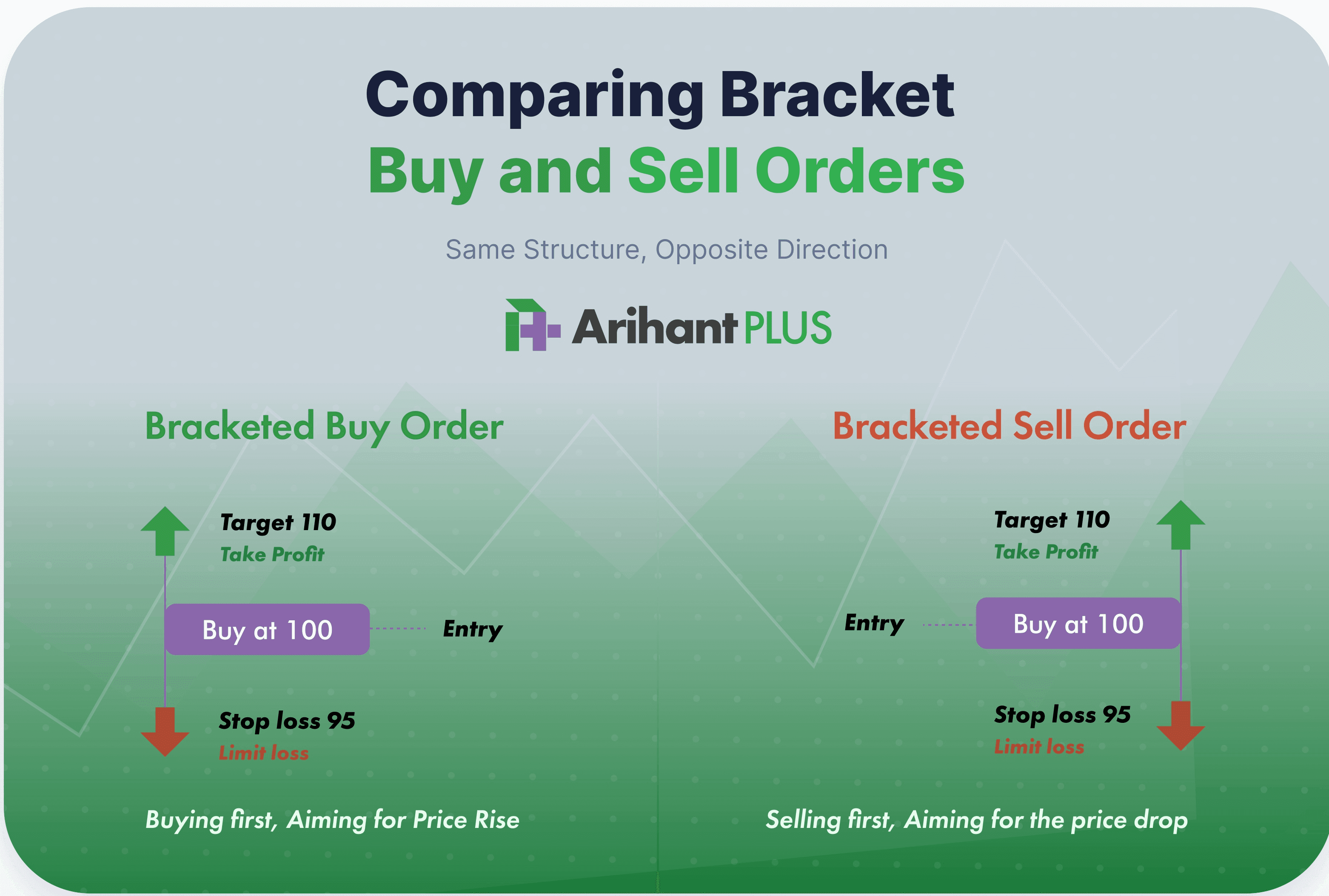
A bracketed buy order is when you buy a stock and at the same time set two automatic exits, one to book profit if the price rises, and one to limit loss if the price falls.
Let’s understand it with an example. Say you buy a stock at ₹100, set your stop loss at ₹95, and your target at ₹105. Once your buy goes through, the system automatically puts in:
- A sell order at ₹95 (your stop-loss)
- A sell order at ₹105 (your target)
Similarly, a bracketed sell order is when you sell a stock and set two exits together, one to book profit if the price drops, and one to limit loss if the price rises. In this setup, the trader:
- Places a sell order at market or limit price
- Sets a buy stop-loss above the selling price to cap losses if the price rises
- Sets a buy limit (target) below the selling price to book profit if the price falls
If the price unexpectedly rises, the stop-loss order triggers and limits the loss. If the price drops as expected, the lower buy limit order executes and locks in profit.
Using the same example as above, if you sell a stock at ₹100, you will set your stop loss in a bracketed sell order at ₹105, and your target at ₹95. This is because you will profit when the stock goes down, while you start making a loss the moment the stock price starts to go up.
How much margin do you need for a bracket order?
One common question is - does a bracket order require higher margin?
The simple answer is - NO.
A bracket order blocks the same margin as your regular intraday order. For example, to buy 100 shares of Reliance, if you need ₹2800 as margin to place an intraday order, you’ll need the same ₹2800 margin to place a bracket order.
There’s no additional margin required yet you get a built-in risk management and profit booking tool with it. In short, same capital but better risk control.
Why should traders use a bracket order?
So, why even bother with bracket orders?
Honestly, it comes down to discipline.
A lot of traders spend time planning their entry but then either skip the stop-loss or start messing with it when the stock price doesn’t move as per their expectations. As they say, the biggest enemy of the trader is himself (or herself). That little slip can turn a small, manageable loss into something ugly.
With bracket orders, you have to set your stop-loss before you even jump in. The system locks it for you, no chance to second-guess yourself when emotions run high.
Then there’s emotional control. When the markets move quickly, fear and greed take over. We’ve all seen it - exiting too early out of panic or holding on to a losing trade in the hope of a miracle. That’s where a bracket order comes in handy - with its in-built discipline. The moment you place a trade, your exit is pre-defined:
- a target price to book profit and not let the greed get the better off you
- a stop-loss to limit downside if the trade goes against you and not let fear let you hold onto a losing bet.
The decision’s already made, so you don’t have to obsess over every tiny move. It keeps emotion out and structure in.
And let’s be real, not everyone can sit in front of charts all day. Maybe you’ve got a job, a business, or a life outside trading. If that’s you, bracket orders save you from constantly checking the screen. Your exit plan is set, even if you’re busy elsewhere.

How to place a bracket order on ArihantPlus
Now let’s make this practical. If you’re using ArihantPlus, placing a bracket order is straightforward.
- First, select the stock you want to trade.
- Click on Buy or Sell depending on your view. Let’s assume we’re placing a buy order.
- On the order pad, you’ll see different order types at the top. Choose “Bracket.”
- Next, enter the price at which you want to buy the stock. You can either enter a specific price or continue with the default market order, if that’s your preference.
- After that, enter your stop-loss price.
- Then enter your target price.
- Finally, click on Buy.
Once your buy order executes, ArihantPlus automatically places your stop-loss and target orders immediately.
At that point, your trade is structured. You don’t need to sit in front of the screen for hours. Your risk and reward are already defined.
Difference Between Cover Order And Bracket Order
A cover order is a trade where you must place a stop-loss along with your entry order. It helps limit your downside risk, but it does not include a target so you need to manually book profits when the price moves in your favour.
A bracket order also requires a stop-loss. However, it goes one step further by adding a predefined target price as well. This means both your risk and your reward are set in advance, and if either the stop-loss or target is hit, the other order is automatically cancelled.
Final Takeaway
At its core, a bracket order lets you enter a trade with your exit plan already in place - one level to book profits and another to limit losses. It builds structure around your position from the very beginning. But remember, bracket order doesn’t guarantee profits and it certainly doesn’t replace proper analysis. But what it does extremely well is bring structure, discipline, and emotional control into intraday trading.
Of course, like any execution tool, it relies on platform efficiency and smooth system functioning. Markets will always be unpredictable. A bracket order simply ensures that you’re not.
FAQs
How is margin calculated in a bracket order?
A bracket order requires the same margin as your intraday order. You can find out how much margin you will need for your intraday trade using the margin calculator here.
Are bracket orders only for intraday trading?
Bracket orders are for intraday trades only and are squared off or cancelled automatically if not closed before market hours end (at 3:15pm).
Can I cancel a bracket order?
Yes, you can cancel a bracket order before the first-leg of the order, i.e. the primary order, is executed. However, once your primary order gets executed, the second leg orders (target and stop-loss orders) remain active and cannot be cancelled.
Also it is important to note that since bracket order is an intraday order, ArihantPlus system automatically squares off your open position of BO at 3:15pm, if neither its stop-loss nor target triggers or it is not cancelled manually by you by then.
What happens if the stop-loss or target is hit?
Since bracket order follows OCO, if the target price is reached, your profit is booked and the stop-loss is cancelled. If the stop-loss is triggered, the position is closed and the target order is cancelled.
Can I place bracket orders for my delivery-based trades?
No. Bracket orders are only applicable for intraday trades and cannot be used for delivery positions.
How to place a bracket order on ArihantPlus App?
Go to ArihantPlus App. Select your stock and tap Buy or Sell. On the order pad, choose Bracket as the order type on. Enter the entry price (or place it at market), then set your stop-loss and target price and Click Buy.
Can I add the disclosed quantity in a bracket order?
Disclosed quantity is not allowed for bracket orders.
Can I place AMO order for bracket orders?
No, bracket orders can only be placed during live market hours. You cannot use the after-market order (AMO) feature for bracket order.
What’re the mistakes to avoid when placing a bracket order on ArihantPlus App?
When placing a bracket order, don’t enter a trade without proper analysis, or set profit targets that are too ambitious, or keep your stop-loss too close, as this can cause unnecessary losses or early exits. Also, keep an eye on important news and events, because sudden market moves can hit your target or stop-loss unexpectedly, leading to an early exit from your trade, sometimes before the price moves in your favor.

Related Topics
Securities Lending and Borrowing (SLB): A smarter way to earn from your shares