

India’s July Factory Growth Hits a 5-Year Low. Should We Be Worried?

By
Arihant Team
India's manufacturing growth cooled to a near five-year low in July, with the PMI slipping to 53.5 from 54.2 in June. Weak domestic demand and a third straight month of slowing hiring dragged on momentum, even as growth stayed intact.
In This Article
- Key Takeaways
- Introduction
- Five Year Low vs Solid Expansion
- Where is the pressure coming from?
- If demand slowed, why are factories buying more?
- Investor Takeaway
Key Takeaways
- India's manufacturing PMI slipped to 53.5 in July from 54.2 in June, the slowest pace of growth in nearly five years, since August 2021.
- Growth is still intact (anything above 50 means expansion), driven mainly by weaker new orders at home.
- Hiring slowed for a third straight month, with job creation at its weakest in the current 29-month growth streak.
- Consumer goods saw the softest month, while intermediate and capital goods makers grew faster.
- Export orders strengthened, with gains from markets like the UAE, Egypt, and Indonesia helping offset the domestic slowdown.
- Manufacturers built up input and finished-goods inventories, partly as a buffer against renewed tensions in West Asia.
- Input costs eased to a five-month low, but firms raised selling prices slightly to protect margins.
Introduction
India’s manufacturing activity expanded at the slowest pace in over five years in July 2026, , going all the way back to August 2021. The HSBC Manufacturing Purchasing Managers’ Index (PMI) dropped from 54.2 in June to 53.5 in July. Still, the reading held above the 50-mark that divides growth from contraction.
PMI index combines several underlying signals including new orders, output, employment, delivery times, and inventory levels into one overall read on business conditions.
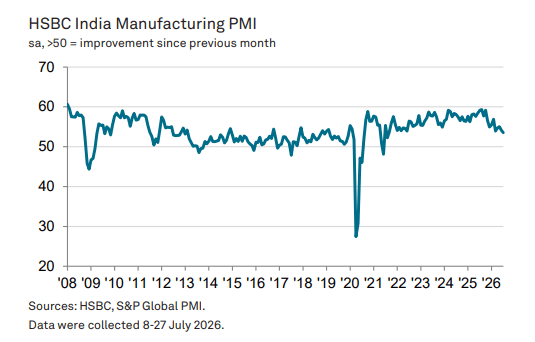
When an indicator drops to a multi year low, the knee jerk reaction is to assume something is broken. But this slowdown is a straightforward story. We are looking at a combination of slowing domestic momentum, aggressive stockpiling, and a surprising export boom.
Open a free account today
Invest in tomorrow with just one click
Five Year Low vs Solid Expansion
Distinguishing between economic deceleration and actual contraction is crucial when analyzing PMI data.
PMI is a diffusion index that measures the direction and monthly speed of change, rather than total output volume. A reading above 50 signifies that industrial activity is expanding. At 53.5, down from 54.2 in June and below the long-run series average of 54.2, the manufacturing sector continues to grow; it is simply doing so at its slowest rate since August 2021.
Nevertheless, the moderation in growth momentum is clear across the data:
- Total New Orders: Growth in overall sales slowed to its second-weakest pace in 4 years (over 48 months).
- Input Purchasing: The rate of increase in raw material purchases retreated to a 31-month low.
- Employment Growth: While job creation expanded for the 29th consecutive month, the pace of hiring dropped to its slowest level in over 2 years.
The factory engine is losing speed, even if it remains comfortably above the 50.0 contraction threshold.
Where is the pressure coming from?
If you look closely at the data, the drag is not spread evenly across the economy:
- Consumer slowdown: Consumer goods makers bore the brunt of the weakness in July, reporting noticeably slower growth in both sales and production. Everyday shoppers are holding back, leaving capital goods and industrial equipment makers to do the heavy lifting.
- Hiring pause: Factories did add jobs for the 29th straight month, but the rate of hiring dropped to the slowest in that entire run. Companies are not firing workers, but they are clearly taking a breath before adding a new headcount.
- Delivery Speed Penalty: Ironically, supply chains improved so dramatically in July that delivery times shortened at a near record pace. In PMI methodology, faster deliveries actually pull the headline number down because the survey assumes it means suppliers have less work to do.
If demand slowed, why are factories buying more?
If sales growth hit a 4 year low and input buying slowed to a 31 month low, why on earth are factory warehouses overflowing?
Here is where corporate strategy takes over. Instead of cutting back production entirely, manufacturers made two decisive moves:
- First, exports rebounded strongly. Overseas demand picked up sharply, driven by strong client interest in markets like the UAE, Canada, Indonesia, South Africa, and Egypt.
- Second, factories are panic buying raw materials. Finished goods inventories surged at the fastest rate in over 11 years. Raw material purchases also kept rising, despite slower production lines.
But why build massive inventories when sales are slowing?
HSBC Chief India Economist Pranjul Bhandari pointed out that renewed Middle East tensions have firms deeply worried about supply chain shocks. Businesses are quietly hoarding stock right now so they do not get caught off guard if global shipping lanes freeze up.

Investor Takeaway
Well, to conclude..this is not a crisis. Operating costs rose at their slowest pace in 5 months, giving margins some breathing room even with higher transport bills. Businesses selectively raised selling prices, and overall business confidence actually picked up compared to June.
Hitting a five year low sounds alarming in a news headline, but Indian manufacturing is simply shifting from an overheated sprint into a cautious, defensive jog. Output is still rising, exports are solid, and firms are smartly buffering themselves against global chaos.

Related Topics

NSE Pre-Open Session Rules Have Changed: Here’s What Traders Need to Know

LIC Gets RBI Nod for 9.99% HDFC Bank Stake: Buy Signal or Market Noise?

Closing Auction Session (CAS) kicks in from 3rd August: Market timing changes

Ethical Investing Gets Real: NSE and BSE Launch Saatvik and Ahimsa Indices


Can REITs and InvITs Become India’s Next Retail Portfolio Essential?

Everyone Knows Bajaj Finance’s Playbook. So Why Can’t Anyone Copy It?


Beyond the Dark Store: Is Advertising Zepto's Real Business?

Vedanta Demerger: Why Aluminium Became the Market’s Favourite/Darling


NSE Extends F&O Market Close to 3:40 PM: What Traders Must Know

Elon Musk’s $119 Billion Terafab Bet: Can It Reshape AI Chips?

Rupee Crashes to ₹96: How Investors Can Profit From the Fall

The Rise of India’s Defence Sector: Stocks, Trends & Opportunities

SEBI introduces Verified Badge for Trading Apps to Curb Fake App Scams

TCS Q4 Concall: AI Infrastructure to Drive the Next Growth Cycle


Rupee Slips Past 95/USD | Factors Driving the Fall Despite RBI Intervention


The Popcorn Trade: How Dhurandhar 2 is driving PVR INOX Stock Higher

Oil Is Surging After The Iran Strikes. So Why Isn’t Gold Following?


What’s Getting Cheaper & Costlier in Budget 2026: A Simple Money Guide


Union Budget Day & Market Behaviour: 15 Year Trend Analysis (2011-2025)

Maruti Q3FY26 Profit Up 4%: Losing Grip on India’s Car Market?


New Year, New Financial Goals: Make SIP Your 2026 Resolution


Infosys ₹18,000 Crore Share Buyback: Record Date & Why Promoters Opted Out?

Nifty 50 Performance Since Last Muhurat Trading: Nifty Top 10 Performers

Diwali Muhurat Trading: Can Nifty’s 7-Year Winning Streak Continue?


Tata Motors Demerger Gets NCLT Nod: What Shareholders Must Know

Muhurat Trading 2025 on 21 Oct: Everything You Should Know



Tuesday is the New Thursday: NSE & BSE Expiry Shift from Sep 2025


How Jane Street Snatched ₹36,500 Crore While India's Youth Lost Everything

Axis Bank Q1FY26 Results: A Mixed Bag, but Long-Term Picture Still Intact

Indian Stock Market Outlook: What Happened And Way Forward