

Budget 2026: Key Sectors & Stocks to Watch

By
Arihant Team
Union Budget 2026 focuses on long-term growth over headlines. From defence and renewables to semiconductors and infrastructure, discover key sector shifts, policy support, and stocks to watch as markets rotate toward structural opportunities.
In This Article
- Introduction
- Sectors in focus | Budget 2026
- Renewables & Energy Transition
- Semiconductors
- EMs & Electronics
- Infrastructure
- Railways
- Capital Goods
- Financial & Banking Sector
- Agriculture
- Healthcare & Pharma
- MSMEs Support
- Education
- Other Sectors
- Key Takeaway
Introduction
As India headed into Union Budget 2026, expectations were grounded rather than euphoric. Investors weren’t looking for flashy tax cuts or dramatic announcements. The real focus was on capital expenditure, structural reforms, and long-term economic strength.
Yet, the market reaction told its own story. Commodities like gold and silver saw sharp declines, defence stocks corrected, while data centre and digital infrastructure plays surged. The moves showed that even a structurally focused Budget can trigger strong sectoral rotations.
For most of us, Budget 2026 became less about the headline and more about positioning. The key was to identify which sectors were aligned with the government’s long-term spending and policy direction because that’s where sustained earnings growth and wealth creation are likely to emerge.
Open a free account today
Invest in tomorrow with just one click
Sectors in focus | Budget 2026
Let’s break down those sectors and understand how you can align your portfolios with the evolving trends.
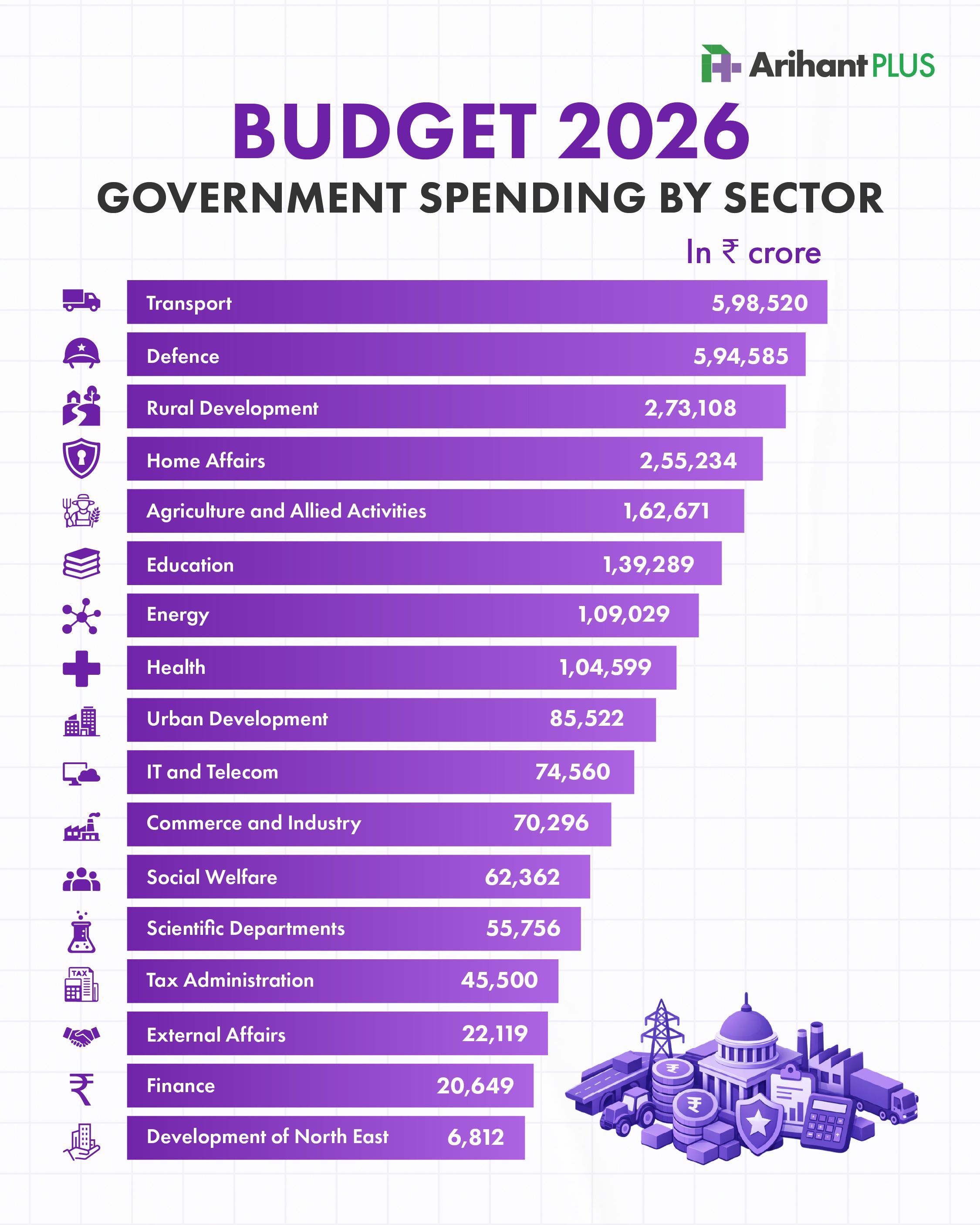
Defense & Aerospace
Budget 2026 gives a strong push to Make-in-India defence manufacturing. Main highlights are as follows:
- The government will remove customs duty on parts and raw materials used to make and repair defence aircraft (MRO: maintenance, repair and overhaul).
- Foreign companies often supply machines, tools, and equipment to Indian manufacturers working in bonded zones. These will now get customs duty exemption.
Stocks in focus: BEL, HAL, Raymond (Defence & Aerospace)
Renewables & Energy Transition
The Government of India has announced a ₹20,000 crore investment in carbon capture (CCUS) to reduce industrial emissions, while also removing import duties on key inputs for clean energy manufacturing.
Import taxes are now waived on:
- Capital equipment for lithium-ion battery cell production
- Sodium antimonate, used to make solar panel glass
These steps lower production costs for battery makers, solar manufacturers, and green tech companies, helping India expand domestic clean energy manufacturing and accelerate its energy transition.
Stocks to watch: Borosil Renewables, Exide Industries, Amara Raja Energy & Mobility Ltd
Semiconductors
The electronics and semiconductor sector gets a major push through ISM 2.0 with ₹40,000 crore, aiming to move beyond assembly toward owning the entire value chain: design, fabrication, and materials.
Stocks in focus: Tata Elxsi, CG Power & Vedanta
EMs & Electronics
The outlay for the Electronics Components Manufacturing Scheme has been increased to ₹40,000 crore, providing a stronger incentive for local component manufacturing.
In addition, a 2% safe harbour profit margin has been introduced for non-residents operating component warehousing in bonded warehouses, which simplifies tax treatment and eases supply chain logistics.
Electronic Manufacturing Services (EMS) players and component manufacturers to benefit, as higher policy support and smoother component sourcing should improve localisation and operational efficiency.
Stocks to watch: Dixon Technologies, Amber Enterprises, Kaynes Technology.
Infrastructure
Infrastructure, predictably, is a major focus of the Budget. Capital expenditure for FY27 has been set at ₹12.2 lakh crore, up around 9%. Roads, railways, metro networks, ports, and logistics are all getting a boost.
To attract private investment, the government is introducing infrastructure risk guarantee funds, designed to reduce uncertainties and encourage participation alongside the public sector. This is important because many infrastructure projects stall not due to lack of demand but because of financing gaps and perceived risks.
Stocks to watch: Afcons Infrastructure, PSP Projects, KNR Constructions, PNC Infratech, Adani Ports
Railways
The government plans to build 7 high-speed train routes between major cities. New freight-only railway lines will also be built to move goods more efficiently, including a route connecting Dankuni to Surat.
Stocks to watch: Titagarh Rail Systems, IRCON, RVNL.
Capital Goods
Here the government plans to strengthen local manufacturing by setting up hi tech tool rooms through public sector companies. An upgraded CIE scheme is introduced to support the production of advanced equipment such as tunnel boring machines and specialized firefighting systems, encouraging companies to move into higher-value manufacturing.
Not just that, a five-year tax exemption for foreign firms supplying capital goods to manufacturers operating in bonded zones, making it cheaper to bring in advanced machinery and technology.
Stocks to watch: Larsen & Toubro, Escorts Kubota Limited, and Action Construction Equipment Limited.
Financial & Banking Sector
A high level committee on banking will align the sector with the Viksit Bharat vision, aiming to make it more robust and forward looking.
Municipal bonds get a boost, with issuances above ₹1,000 crore receiving a ₹100 crore incentive, while existing AMRUT schemes continue to support urban infrastructure. Power Finance Corporation and Rural Electrification Corporation are being restructured, ensuring efficient capital flows to priority sectors.
On the capital markets side, the government is introducing a market-making framework and total return swaps on corporate bonds, alongside a review of FEMA rules on non-debt instruments to offer more flexibility to foreign investors. Traders, however, will face slightly higher costs as STT on futures rises from 0.02% to 0.05% and options from 0.1% to 0.15%, which may weigh on intraday and high-frequency trades.
Stocks to watch: MTAR Technologies Limited and ISGEC Heavy Engineering Limited.
Agriculture
The new Bharat Vistar AI tool will provide farmers with multilingual guidance on crop planning, weather insights, and market linkages. Credit linked subsidies for livestock and rural entrepreneurship aim to diversify rural incomes, making them less seasonal and more resilient. Agri-tech companies, rural credit providers, input suppliers, and startups focused on farm advisory or livestock solutions are positioned to benefit, while mid-sized businesses connected to rural supply chains could see steadier demand.
Healthcare & Pharma
Healthcare and pharmaceuticals received strategic attention. The ₹10,000 crore Biopharma Shakti initiative aims to scale complex manufacturing and improve global quality production, signaling a shift beyond generic drugs toward biologics, clinical trials, and innovation.
Alongside Biopharma Shakti, affordability measures for 17 cancer and diabetes drugs aim to improve public access without undermining the market.
While not headline grabbing, these measures strengthen the healthcare ecosystem, benefiting mid and large cap pharma companies, biotech firms, clinical research outfits, and supply chain players.
MSMEs Support
MSMEs, facing increasing exposure to global trade volatility and tariff uncertainties, have been allocated ₹10,000 crore through the MSME Growth Fund to help them survive shocks, stay connected to supply chains, and continue supplying larger industrial ecosystems.
Education
While manufacturing got a lot of attention this year, the Budget also highlighted a newer area called the orange economy. It includes industries that make money from creativity like music, films, animation, design, gaming, performing arts, and live events.
Budget 2026 proposed supporting the Indian Institute of Creative Technologies (IICT), Mumbai to help set up AVGC (Animation, Visual Effects, Gaming and Comics) Content Creator Labs in 15,000 secondary schools and 500 colleges. Students will get hands-on training in animation, VFX, gaming, and digital storytelling before entering the job market. This builds a pipeline of skilled creative and tech talent early on.
Other Sectors
Consumer Durables: The government has also removed customs duty on some imported parts used to make microwave ovens, lowering costs for kitchen appliance manufacturers and helping improve their profit margins.
Stocks to watch: Whirlpool, Bajaj Electricals Ltd, and IFB Industries
Nuclear: Customs duty exemptions on goods used in nuclear power projects are extended until 2035 and expanded to cover more plants. Nuclear energy is critical for long-term energy security, which also supports defence and strategic industries.
Key Takeaway
The key takeaway is that Budget 2026 chooses subtlety over spectacle. While short term swings can be uncomfortable, they also create opportunities. Sector rotations, particularly in financials, infrastructure, and strategic areas such as manufacturing and semiconductors, could provide tactical trades for those who can distinguish noise from longer term structural signals.

Related Topics



NSE Pre-Open Session Rules Have Changed: Here’s What Traders Need to Know

LIC Gets RBI Nod for 9.99% HDFC Bank Stake: Buy Signal or Market Noise?

India’s July Factory Growth Hits a 5-Year Low. Should We Be Worried?

Closing Auction Session (CAS) kicks in from 3rd August: Market timing changes

Ethical Investing Gets Real: NSE and BSE Launch Saatvik and Ahimsa Indices


Can REITs and InvITs Become India’s Next Retail Portfolio Essential?

Everyone Knows Bajaj Finance’s Playbook. So Why Can’t Anyone Copy It?


Beyond the Dark Store: Is Advertising Zepto's Real Business?

Vedanta Demerger: Why Aluminium Became the Market’s Favourite/Darling


NSE Extends F&O Market Close to 3:40 PM: What Traders Must Know

Elon Musk’s $119 Billion Terafab Bet: Can It Reshape AI Chips?

Rupee Crashes to ₹96: How Investors Can Profit From the Fall

The Rise of India’s Defence Sector: Stocks, Trends & Opportunities

SEBI introduces Verified Badge for Trading Apps to Curb Fake App Scams

TCS Q4 Concall: AI Infrastructure to Drive the Next Growth Cycle

Rupee Slips Past 95/USD | Factors Driving the Fall Despite RBI Intervention


The Popcorn Trade: How Dhurandhar 2 is driving PVR INOX Stock Higher

Oil Is Surging After The Iran Strikes. So Why Isn’t Gold Following?

What’s Getting Cheaper & Costlier in Budget 2026: A Simple Money Guide

Union Budget Day & Market Behaviour: 15 Year Trend Analysis (2011-2025)

Maruti Q3FY26 Profit Up 4%: Losing Grip on India’s Car Market?


New Year, New Financial Goals: Make SIP Your 2026 Resolution


Infosys ₹18,000 Crore Share Buyback: Record Date & Why Promoters Opted Out?

Nifty 50 Performance Since Last Muhurat Trading: Nifty Top 10 Performers

Diwali Muhurat Trading: Can Nifty’s 7-Year Winning Streak Continue?


Tata Motors Demerger Gets NCLT Nod: What Shareholders Must Know

Muhurat Trading 2025 on 21 Oct: Everything You Should Know


Tuesday is the New Thursday: NSE & BSE Expiry Shift from Sep 2025


How Jane Street Snatched ₹36,500 Crore While India's Youth Lost Everything

Axis Bank Q1FY26 Results: A Mixed Bag, but Long-Term Picture Still Intact

Indian Stock Market Outlook: What Happened And Way Forward