


RBI’s June MPC Meeting: Repo Rate Unchanged At 5.25%

By
Arihant Team
The RBI has kept rates unchanged, but the message is not just about EMIs staying steady. Let’s understand what this means for investors as inflation, crude, and currency risks remain in focus.
In This Article
- Introduction
- GDP reduces growth projections for FY27
- Inflation revised up to ~5% for FY27
- RBI’s crude and currency test
- RBI’s push for foreign capital
- How markets read the June MPC
- Investor takeaway
Introduction
The RBI kept the repo rate unchanged at 5.25% on June 5, 2026 and maintained its neutral stance.
Much like April. Your EMIs stay where they are for now. Except a lot has changed since the last MPC meeting. West Asia tensions have added pressure to crude oil, the rupee has weakened, and inflation signals are mixed, with CPI and WPI moving at very different levels.
The RBI’s decision shows that it prefers stability for now, even as global uncertainty continues to cloud the outlook for growth and inflation.
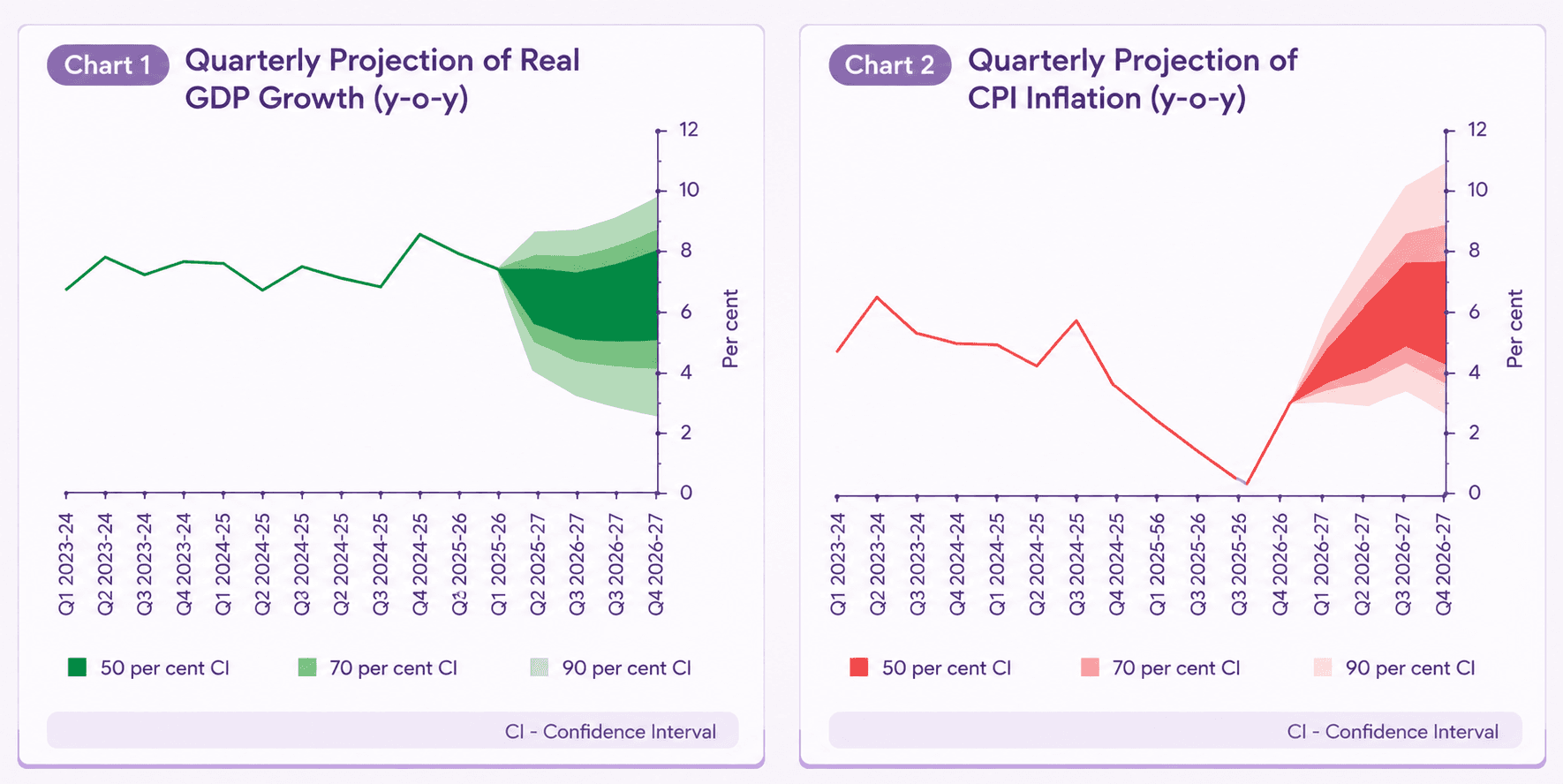
Source: RBI
GDP reduces growth projections for FY27
The RBI has revised India’s FY27 real GDP growth estimate to 6.6%, from 6.9% earlier. India grew at 7.6% in FY26, supported by strong private consumption, fixed investment, and steady growth in manufacturing and services.
The RBI’s concern is more about what could slow growth from here. Higher energy prices, supply chain disruptions, elevated logistics costs, and weak global demand are expected to weigh on activity. A weaker monsoon could also affect agriculture and rural demand.
At the same time, domestic activity remains resilient. Manufacturing and services continue to hold up, private consumption is steady, government capex remains supportive, and services exports are still showing strength.
Growth is expected to remain relatively stable through the year, with quarterly projections of 6.6% in Q1, 6.3% in Q2, 6.5% in Q3, and 6.8% in Q4.
Inflation revised up to ~5% for FY27
Here is the uncomfortable part about India’s inflation story right now. The number consumers see and the pressure building inside the economy are not saying the same thing.
- CPI, which reflects what you and I pay, is at 3.48%. That looks comfortable and sits well within the RBI’s 2% to 6% band.
Part of this comfort comes from the fact that higher crude oil prices have not been fully passed on to consumers at the pump. That has helped cushion retail inflation for now.
- But WPI, which reflects what factories, distributors, and supply chains pay before goods reach consumers, has risen to 8.3%. That is a three and a half year high and here’s the thing about WPI.. it doesn't stay in the wholesale system forever. Over time, it can move through the supply chain and show up in consumer prices.
The RBI is aware of this risk. It has also flagged uncertainty around the conflict, supply chain disruptions, the monsoon outlook, and El Niño.
The RBI now expects inflation to average around 5.1% in FY27, with inflation expected to rise through the year from 4.2% in Q1 to a peak of 5.9% in Q3 before easing slightly in Q4.
RBI’s crude and currency test
Crude is close to $96 and the Indian rupee has fallen roughly 6% since February, adding to the pressure. A weaker currency makes every import: oil, edible oils, fertilisers, electronics more expensive in rupee terms.
The RBI now has to assess how much of this pressure is temporary and how much could stay in the system for longer. For now, it has chosen to remain cautious rather than move in haste.
On the rupee specifically: the RBI is not defending a number. It is not trying to push the rupee back to where it was. What it is doing is using its forex reserves to intervene when needed to prevent sharp, disorderly swings..
RBI’s push for foreign capital
The most interesting move of this MPC was RBI’s push to attract foreign capital into India. Here’s all the measures RBI introduced:
- It is opening up more long term government bonds for foreign investors by adding new 15 year, 30 year, and 40 year G Secs under the Fully Accessible Route.
- It is also removing some investment limits for FPIs under the General Route, which should make government securities easier to access.
- NRIs, OCIs, and other eligible overseas individuals will get more room to invest in Indian listed equities without SEBI registration.
- To support external borrowing, PSUs will get concessional forex swaps on ECBs till September 30, 2026.
- Banks will also get support on hedging costs for fresh 3 to 5 year FCNR(B) deposits till the same date.
- The RBI is also proposing to restore the export proceeds realisation timeline to nine months.
How markets read the June MPC
Markets did not read the June policy the same way they read April.
June felt different because inflation, crude oil, and the rupee have become harder to ignore.
System liquidity is still comfortable, with the banking system seeing an average daily surplus of ₹2.63 lakh crore since the last MPC meeting. The RBI has also said it will keep liquidity adequate to support productive credit and smooth policy transmission.
But bond markets are not fully relaxed. G-Sec yields eased in April after the ceasefire announcement in West Asia, but they firmed up again in May as global risks returned.
Credit conditions also need watching. Overall credit grew 15.4% year on year in FY26, compared with 12.1% a year earlier, and bank credit remains broad based. However, some hardening in deposit and lending rates shows that the cost of money is no longer moving only one way.
Equities stayed steady because the rate pause was expected, but banks, NBFCs, and real estate could remain sensitive to any signs of tighter policy ahead.
The reassuring part is that the financial system remains healthy. Banks continue to show strong capital, liquidity, asset quality, and profitability, even though profitability has moderated from last year. NBFCs also remain sound, with adequate capital and improved asset quality.
Investor takeaway
RBI has held rates steady while growth is being revised lower, inflation is being revised higher, and pressure remains visible in crude, currency, and bonds.
For portfolios, this is a time to stay selective. Shorter duration may help manage rate risk, while domestic demand themes may offer more comfort than export linked names.
The next CPI print will be key before the August policy.
Until then, the RBI is staying cautious, and portfolios may need to do the same.

Related Topics

NSE Pre-Open Session Rules Have Changed: Here’s What Traders Need to Know

LIC Gets RBI Nod for 9.99% HDFC Bank Stake: Buy Signal or Market Noise?

India’s July Factory Growth Hits a 5-Year Low. Should We Be Worried?

Closing Auction Session (CAS) kicks in from 3rd August: Market timing changes

Ethical Investing Gets Real: NSE and BSE Launch Saatvik and Ahimsa Indices


Can REITs and InvITs Become India’s Next Retail Portfolio Essential?

Everyone Knows Bajaj Finance’s Playbook. So Why Can’t Anyone Copy It?


Beyond the Dark Store: Is Advertising Zepto's Real Business?

Vedanta Demerger: Why Aluminium Became the Market’s Favourite/Darling

NSE Extends F&O Market Close to 3:40 PM: What Traders Must Know

Elon Musk’s $119 Billion Terafab Bet: Can It Reshape AI Chips?
Rupee Crashes to ₹96: How Investors Can Profit From the Fall

The Rise of India’s Defence Sector: Stocks, Trends & Opportunities

SEBI introduces Verified Badge for Trading Apps to Curb Fake App Scams

TCS Q4 Concall: AI Infrastructure to Drive the Next Growth Cycle

Rupee Slips Past 95/USD | Factors Driving the Fall Despite RBI Intervention


The Popcorn Trade: How Dhurandhar 2 is driving PVR INOX Stock Higher

Oil Is Surging After The Iran Strikes. So Why Isn’t Gold Following?

What’s Getting Cheaper & Costlier in Budget 2026: A Simple Money Guide


Union Budget Day & Market Behaviour: 15 Year Trend Analysis (2011-2025)

Maruti Q3FY26 Profit Up 4%: Losing Grip on India’s Car Market?


New Year, New Financial Goals: Make SIP Your 2026 Resolution


Infosys ₹18,000 Crore Share Buyback: Record Date & Why Promoters Opted Out?

Nifty 50 Performance Since Last Muhurat Trading: Nifty Top 10 Performers

Diwali Muhurat Trading: Can Nifty’s 7-Year Winning Streak Continue?


Tata Motors Demerger Gets NCLT Nod: What Shareholders Must Know

Muhurat Trading 2025 on 21 Oct: Everything You Should Know


Tuesday is the New Thursday: NSE & BSE Expiry Shift from Sep 2025


How Jane Street Snatched ₹36,500 Crore While India's Youth Lost Everything

Axis Bank Q1FY26 Results: A Mixed Bag, but Long-Term Picture Still Intact

Indian Stock Market Outlook: What Happened And Way Forward