
Oil Is Surging After The Iran Strikes. So Why Isn’t Gold Following?

By
Arihant Team
Markets reacted instantly when strikes hit Iran. Oil surged and volatility spread across global markets. Yet gold, the world’s most famous safe haven, barely moved. The explanation reveals how multiple forces are pulling markets in different directions.
In This Article
- Introduction
- Why Gold Isn't Moving Right Now
- What This Means For You
Introduction
When missiles struck targets in Iran at the end of February, traders around the world expected one very specific reaction from the markets.
Gold, the world’s most famous safe-haven asset, was supposed to surge.
For decades, that has been the typical pattern. When geopolitical tensions rise or conflicts break out, investors tend to move their money into assets that are perceived as stable stores of value. Gold has played that role for centuries, long before modern financial markets existed.
And at first, the market followed the script.
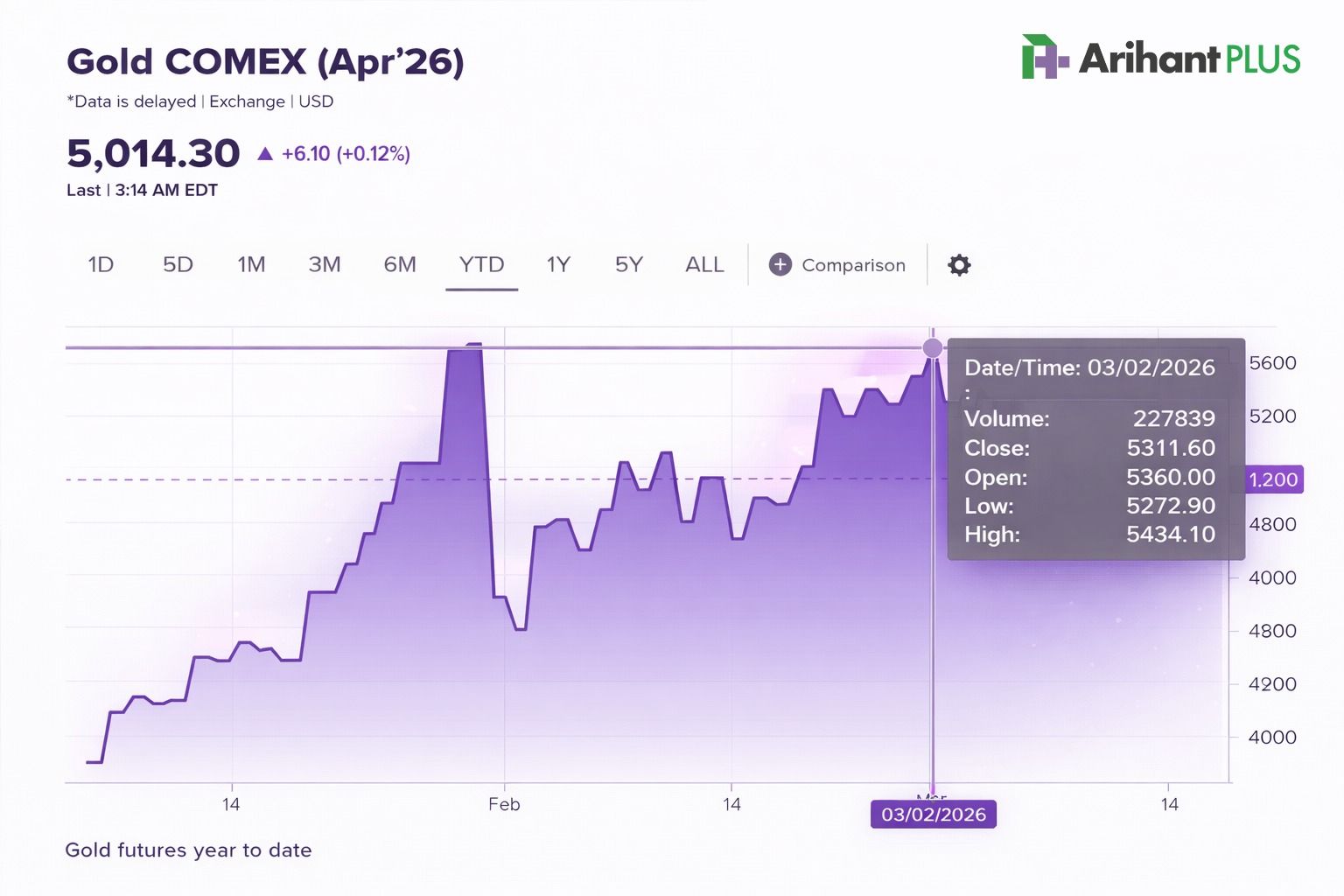
As news spread that the United States and Israel had launched strikes on Iranian targets, investors quickly rushed toward safety. Gold prices jumped sharply, rising from roughly ₹1.63 lakh per 10 grams to around ₹1.73 lakh per 10 grams within a short period of time. Traders interpreted the strikes as the beginning of a potentially serious escalation in tensions across West Asia.
However, what happened next surprised many people watching the markets.
Instead of continuing to climb as the conflict intensified, gold suddenly reversed course. Within days, the metal sold off sharply, dropping more than six percent and falling to around ₹1.63 lakh per 10 grams. After that decline, the price stabilized but remained stuck in a relatively narrow range between roughly ₹1.63 lakh and ₹1.65 lakh.
In other words, gold stopped behaving the way many investors expected it to behave during a geopolitical crisis.
Open a free account today
Invest in tomorrow with just one click
Why Gold Isn't Moving Right Now
At first glance, it may seem strange that gold is not climbing higher during a period of geopolitical instability. However, the same conflict that pushed investors toward gold also triggered forces that limited how far the metal could rise.
One of the biggest influences has been the surge in Crude Oil prices.
Iran sits near the Strait of Hormuz, which is one of the most strategically important shipping routes in the world. A significant share of global oil exports passes through that narrow corridor every single day. Whenever tensions in the region escalate, traders worry that shipments could be disrupted, which would tighten supply and push prices higher.
As those fears spread through the energy market, oil prices surged.
Higher energy costs ripple throughout the global economy. Transportation becomes more expensive, production costs increase, and consumer prices often follow. When inflation risks increase, central banks may be forced to keep interest rates elevated for longer than markets previously expected.
That is where the challenge for gold appears.
Gold does not generate income. It does not pay interest, and it does not provide dividends. When interest rates are high, other assets such as government bonds or savings instruments begin offering attractive returns.
If you hold gold during a period of elevated interest rates, you are effectively giving up the opportunity to earn income elsewhere. That opportunity cost can prevent gold prices from rising even when geopolitical tensions are increasing.
Another factor limiting gold’s momentum has been the strength of the U.S. dollar.
During periods of global uncertainty, capital often flows into the dollar because it remains the world’s primary reserve currency. As the conflict intensified, demand for dollars increased, causing the currency to strengthen.
Because gold is priced globally in dollars, a stronger dollar makes gold more expensive for buyers using other currencies. When gold becomes more expensive internationally, demand can soften, which places additional pressure on prices.
There is also a less obvious market dynamic that sometimes appears during sudden shocks.
When volatility increases across financial markets, you may find yourself needing liquidity quickly. If other assets in your portfolio are falling sharply, the fastest way to raise cash is often by selling assets that are easy to trade.
Gold is one of the most liquid assets in the world.
That means it can sometimes be sold even during crises, not because confidence in gold has disappeared, but because it is one of the few assets that can quickly be converted into cash.
Finally, timing also plays a role.
Gold had already been on an extraordinary rally before the conflict began. Prices were trading near historic highs, meaning many market participants were already holding significant profits. When the strikes on Iran created volatility, some people chose to lock in those gains rather than increase their exposure.
All of these forces combined to create a market where gold remained historically expensive but struggled to move significantly higher.
What This Means For You
The recent behavior of gold offers an important reminder about how financial markets actually work.
It is easy to assume that certain events will always produce predictable market reactions. War should push gold higher. Rising tensions should drive money toward safe-haven assets.
Over longer periods of time, that relationship often holds true.
However, in the short term, markets are shaped by many forces acting simultaneously. Geopolitical risk, oil prices, currency movements, and interest-rate expectations can all influence asset prices at the same time.
During the recent escalation involving Iran, these forces pulled gold in different directions.
Geopolitical fear encouraged demand for gold, while higher oil prices increased inflation concerns. That raised expectations for prolonged high interest rates, which reduced the attractiveness of holding a non-yielding asset like gold. At the same time, a stronger dollar placed additional pressure on demand.
The result was a market that did not follow the simple narrative many people expected.
If you hold gold as part of a diversified portfolio, a few weeks of sideways movement during a complex geopolitical moment does not necessarily signal a problem.
Gold still plays an important role as a long-term hedge against inflation, currency weakness, and financial instability. You should have 5-15% allocation in gold in your portfolio depending on your risk profile. The best way to invest in gold is through exchange traded funds.
Here are some top gold ETFs you can consider for investment:
Source: Tickertape
What the past few weeks demonstrate is something slightly more subtle.
Even the world’s most famous safe-haven asset does not always behave exactly the way you expect in the middle of a fast-moving global crisis. Markets are shaped by multiple competing forces, and understanding those forces is part of becoming more confident when navigating periods of uncertainty.

Related Topics

NSE Pre-Open Session Rules Have Changed: Here’s What Traders Need to Know
LIC Gets RBI Nod for 9.99% HDFC Bank Stake: Buy Signal or Market Noise?
India’s July Factory Growth Hits a 5-Year Low. Should We Be Worried?

Closing Auction Session (CAS) kicks in from 3rd August: Market timing changes

Ethical Investing Gets Real: NSE and BSE Launch Saatvik and Ahimsa Indices


Can REITs and InvITs Become India’s Next Retail Portfolio Essential?

Everyone Knows Bajaj Finance’s Playbook. So Why Can’t Anyone Copy It?


Beyond the Dark Store: Is Advertising Zepto's Real Business?

Vedanta Demerger: Why Aluminium Became the Market’s Favourite/Darling

NSE Extends F&O Market Close to 3:40 PM: What Traders Must Know

Elon Musk’s $119 Billion Terafab Bet: Can It Reshape AI Chips?
Rupee Crashes to ₹96: How Investors Can Profit From the Fall

The Rise of India’s Defence Sector: Stocks, Trends & Opportunities

SEBI introduces Verified Badge for Trading Apps to Curb Fake App Scams

TCS Q4 Concall: AI Infrastructure to Drive the Next Growth Cycle

Rupee Slips Past 95/USD | Factors Driving the Fall Despite RBI Intervention


The Popcorn Trade: How Dhurandhar 2 is driving PVR INOX Stock Higher

What’s Getting Cheaper & Costlier in Budget 2026: A Simple Money Guide


Union Budget Day & Market Behaviour: 15 Year Trend Analysis (2011-2025)

Maruti Q3FY26 Profit Up 4%: Losing Grip on India’s Car Market?


New Year, New Financial Goals: Make SIP Your 2026 Resolution

Infosys ₹18,000 Crore Share Buyback: Record Date & Why Promoters Opted Out?
Nifty 50 Performance Since Last Muhurat Trading: Nifty Top 10 Performers

Diwali Muhurat Trading: Can Nifty’s 7-Year Winning Streak Continue?


Tata Motors Demerger Gets NCLT Nod: What Shareholders Must Know

Muhurat Trading 2025 on 21 Oct: Everything You Should Know

Tuesday is the New Thursday: NSE & BSE Expiry Shift from Sep 2025


How Jane Street Snatched ₹36,500 Crore While India's Youth Lost Everything

Axis Bank Q1FY26 Results: A Mixed Bag, but Long-Term Picture Still Intact

Indian Stock Market Outlook: What Happened And Way Forward