



NSE Extends F&O Market Close to 3:40 PM: What Traders Must Know

By
Arihant Team
NSE will extend F&O market closing time to 3:40 PM from August 3, 2026. The change aligns Equity Derivatives with the new Closing Auction Session in the cash market. The VWAP window will shift to 3:10 PM–3:40 PM. Traders should update alerts, systems, and end-of-day strategies before the change.
In This Article
- Quick takeaways
- Introduction
- What’s changing?
- New Trading Hours at a Glance
- Why is this happening?
- What about price bands and risk controls?
- What does this mean for traders?
- Conclusion
Quick takeaways
- NSE Equity Derivatives will close at 3:40 PM, instead of 3:30 PM
- Effective date: August 3, 2026
- Action needed: Update systems, alerts, and end-of-day strategies
Introduction
If you trade in NSE’s Equity Derivatives segment, this is an update you should not leave for later. From August 3, 2026, the normal market closing time will move from 3:30 PM to 3:40 PM.
Those 10 additional minutes can impact end-of-day trades, position adjustments, and system-based execution.
What’s changing?
NSE is introducing a Closing Auction Session (CAS) in the Equity Cash segment.
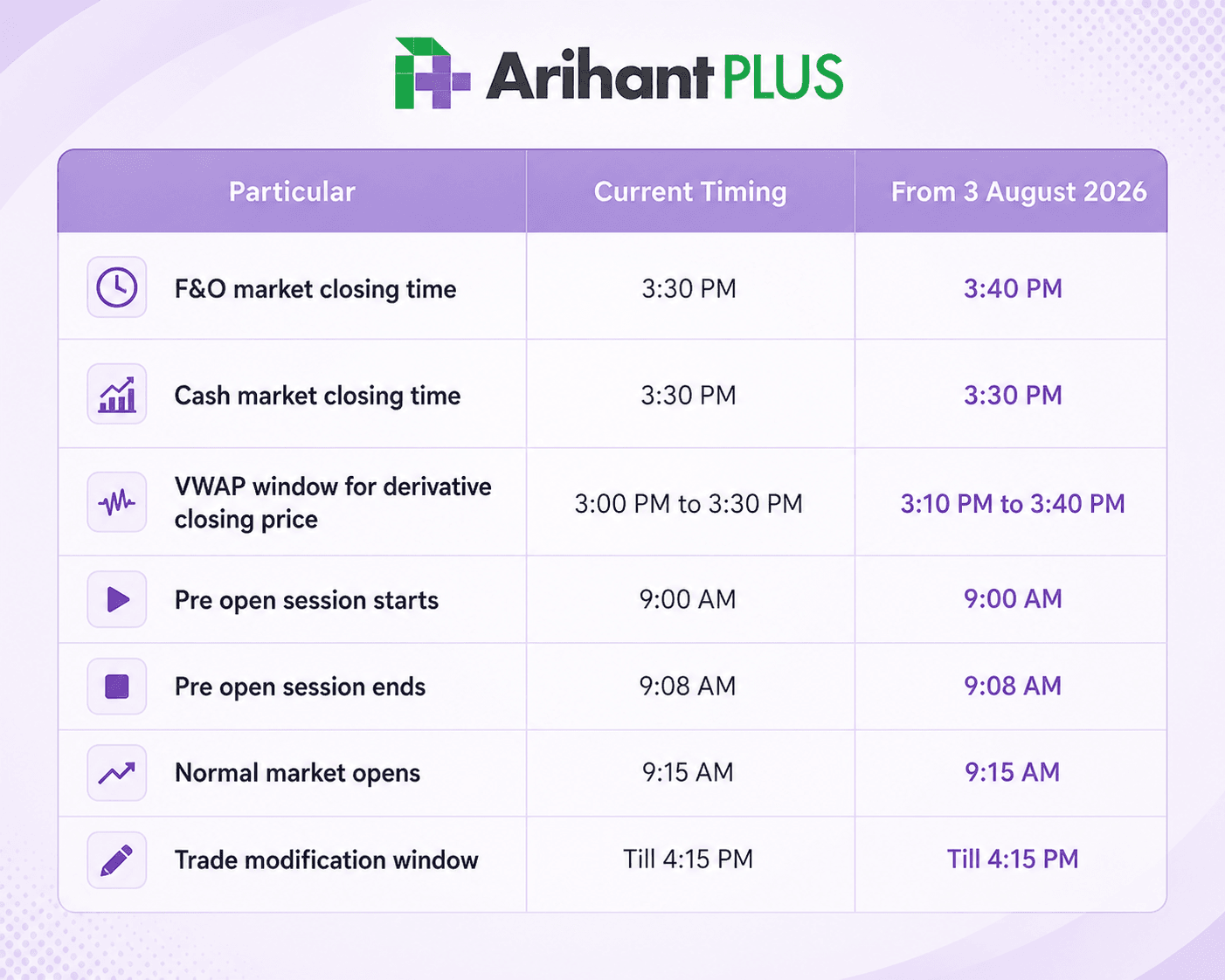
To align with this, the Equity Derivatives market close will move from 3:30 PM to 3:40 PM.
That means traders will get 10 additional minutes for end-of-day trades and position adjustments.
New Trading Hours at a Glance
Here's the updated schedule for the Equity Derivatives segment:
Why is this happening?
NSE is introducing a Closing Auction Session (CAS) in the cash market to make closing price discovery more structured and transparent.
Many global exchanges, including the London Stock Exchange and Hong Kong Exchange, use closing auction mechanisms to support efficient price discovery at the end of the trading day.
Initially, CAS will apply to stocks that have derivatives contracts. This means the closing price of these stocks will be determined through an auction-based process rather than relying solely on the last traded price.
Since F&O contracts derive their value from the underlying cash market, NSE is extending the Equity Derivatives trading session by 10 minutes, from 3:30 PM to 3:40 PM, to keep derivatives pricing aligned with the revised closing price mechanism.
Importantly, the closing price calculation methodology for derivatives is not changing. NSE will continue to use the Volume Weighted Average Price (VWAP) of the last 30 minutes of trading. Only the timing of that 30-minute calculation window will change in line with the extended market hours. ( Earlier, it was 3:00 PM to 3:30 PM. From 3 August 2026, it will be 3:10 PM to 3:40 PM.)
What about price bands and risk controls?
There is no change in the price band and pre-trade risk control framework.
NSE has clarified that the existing framework will continue to apply as per the earlier circular dated March 18, 2026. This means members should follow the same risk control provisions while updating their systems for the revised market timing.
What does this mean for traders?
- Exit timing: If you usually square off F&O positions near market close, review your timing. The normal market close will now be 3:40 PM instead of 3:30 PM.
- Alerts and triggers: Update all time-based alerts, order settings, and internal checks linked to end-of-day trading.
- Algo strategies: Any strategy that uses market close timing should be reviewed to avoid missed executions or unintended open positions.
- VWAP window: Since derivatives closing price calculation continues to use the VWAP method, the relevant 30-minute window will shift with the new closing time.
- Expiry trades: On expiry days, traders should be extra mindful of end-of-day position adjustments and option premium movements.
Conclusion
This 10-minute extension may seem small, but it is an important market structure update. It can affect end-of-day trades, position management, system triggers, and close-based strategies.
With the introduction of CAS in the cash market, NSE is moving towards a more structured closing price discovery process. The derivatives segment is being aligned with this change.
For traders, the action point is clear: update your timings, review your end-of-day strategy, and make sure your systems are ready before the change goes live.

Related Topics

Tech Mahindra Announces 1:1 Bonus Shares: Q2FY27 Profit Jumps 33%

Muhurat Trading 2026: NSE Announces Timings & Date for Stock Markets

RBI Repo Rate Hike October 2026: 10 Takeaways That Matter for Your Money





NSE Pre-Open Session Rules Have Changed: Here’s What Traders Need to Know

LIC Gets RBI Nod for 9.99% HDFC Bank Stake: Buy Signal or Market Noise?

India’s July Factory Growth Hits a 5-Year Low. Should We Be Worried?

Closing Auction Session (CAS) kicks in from 3rd August: Market timing changes

Ethical Investing Gets Real: NSE and BSE Launch Saatvik and Ahimsa Indices


Can REITs and InvITs Become India’s Next Retail Portfolio Essential?

Everyone Knows Bajaj Finance’s Playbook. So Why Can’t Anyone Copy It?


Beyond the Dark Store: Is Advertising Zepto's Real Business?

Vedanta Demerger: Why Aluminium Became the Market’s Favourite/Darling


Elon Musk’s $119 Billion Terafab Bet: Can It Reshape AI Chips?

Rupee Crashes to ₹96: How Investors Can Profit From the Fall

The Rise of India’s Defence Sector: Stocks, Trends & Opportunities

SEBI introduces Verified Badge for Trading Apps to Curb Fake App Scams

TCS Q4 Concall: AI Infrastructure to Drive the Next Growth Cycle

Rupee Slips Past 95/USD | Factors Driving the Fall Despite RBI Intervention


The Popcorn Trade: How Dhurandhar 2 is driving PVR INOX Stock Higher

Oil Is Surging After The Iran Strikes. So Why Isn’t Gold Following?


What’s Getting Cheaper & Costlier in Budget 2026: A Simple Money Guide


Union Budget Day & Market Behaviour: 15 Year Trend Analysis (2011-2025)

Maruti Q3FY26 Profit Up 4%: Losing Grip on India’s Car Market?


New Year, New Financial Goals: Make SIP Your 2026 Resolution


Infosys ₹18,000 Crore Share Buyback: Record Date & Why Promoters Opted Out?

Nifty 50 Performance Since Last Muhurat Trading: Nifty Top 10 Performers

Diwali Muhurat Trading: Can Nifty’s 7-Year Winning Streak Continue?


Tata Motors Demerger Gets NCLT Nod: What Shareholders Must Know

Muhurat Trading 2025 on 21 Oct: Everything You Should Know


Tuesday is the New Thursday: NSE & BSE Expiry Shift from Sep 2025


How Jane Street Snatched ₹36,500 Crore While India's Youth Lost Everything

Axis Bank Q1FY26 Results: A Mixed Bag, but Long-Term Picture Still Intact

Indian Stock Market Outlook: What Happened And Way Forward