
Understanding Margin Trading Facility (MTF): A Detailed Guide

By
Arihant Team
Ever wondered how traders take bigger positions than their capital allows? That's margin trading facility, which allows you to borrow funds from your broker to buy more securities than your own money would permit. It can amplify your gains, but it works both ways, magnifying losses just as easily.
In This Article
- Key takeaways
- Introduction
- What is margin trading and how it works?
- What happens next?
- Step-by-step guide to buying on margin
- Key Elements of Margin Trading
- Why do traders use margin trading?
- What are the risks of margin trading?
- Best practices for margin trading
- To sum up
- FAQs
Key takeaways
Margin trading means borrowing money from your broker to enhance your purchasing power.
It can boost your profits, but it can just as easily amplify your losses.
You need to keep a minimum balance in your account. Fall below it, and you'll get a margin call asking you to add more funds.
Since it's a loan, you'll pay interest on it, which eats into your returns.
Because of the extra risk and cost, margin trading works best for short-term trades, not ideal for long-term investing.
To trade using margin, you need to activate margin reading facility (MTF) with your ArihantPlus (or any other broker you trade with).
- Not all stocks or securities can be bought on margin. You can trade using margin funding only on approved list of securities for MTF.
Open a free account today
Invest in tomorrow with just one click
Introduction
Imagine you've spotted what looks like a great trading opportunity. You've done your research, followed the latest stock market news and trends, and are confident about your decision. There's just one problem- you don't have enough money to buy as many shares as you'd like.
This is where margin trading comes in.
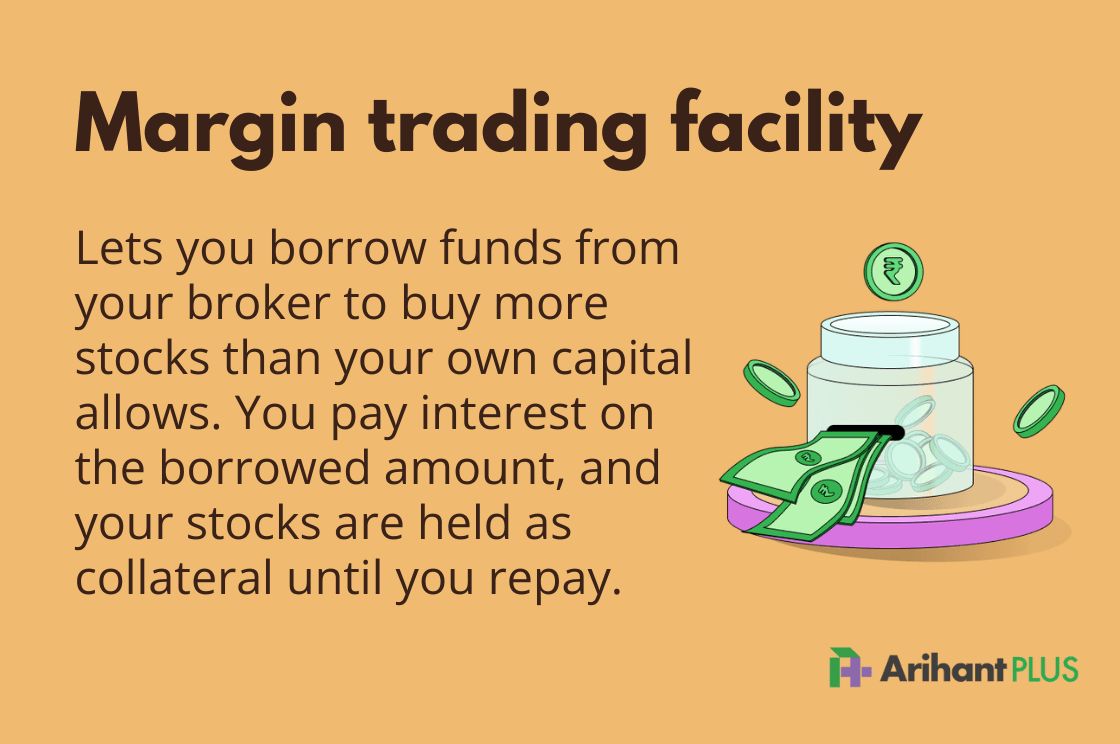
Margin trading allows you to enhance your buying power by borrowing funds from your broker, so you can buy stocks that you otherwise couldn’t afford. When you trade using margin trading facility (MTF), an initial margin is required as a deposit, acting as a safeguard for the broker. You use their existing securities (like stocks or mutual funds) as collateral, enabling you to borrow additional funds from your broker. This allows you to take larger positions in the market. However, it also increases your risk. That's why it's important to understand how it works before using it.
Let’s understand what margin trading is, how it works, its benefits, the risks involved, and the best practices every trader should follow.
What is margin trading and how it works?
Margin trading is a facility that allows traders and investors to borrow funds from their broker to buy more securities than their capital alone would allow. Think of it as taking a loan from your broker. It is commonly called as margin trading facility or MTF. When you buy using MTF you contribute part of the amount towards buying a stock, while your broker finances the remaining amount. The shares you purchase typically serve as collateral to the broker.
One thing to keep in mind: MTF isn't available on every stock. Securities and Exchange Board of India (SEBI) permits MTF only on approved "Group I" securities. These are broadly, the more liquid, actively traded names on the exchange. So before you plan a trade on margin, make sure to check whether the stock actually qualifies.
Let's look at a simple example.
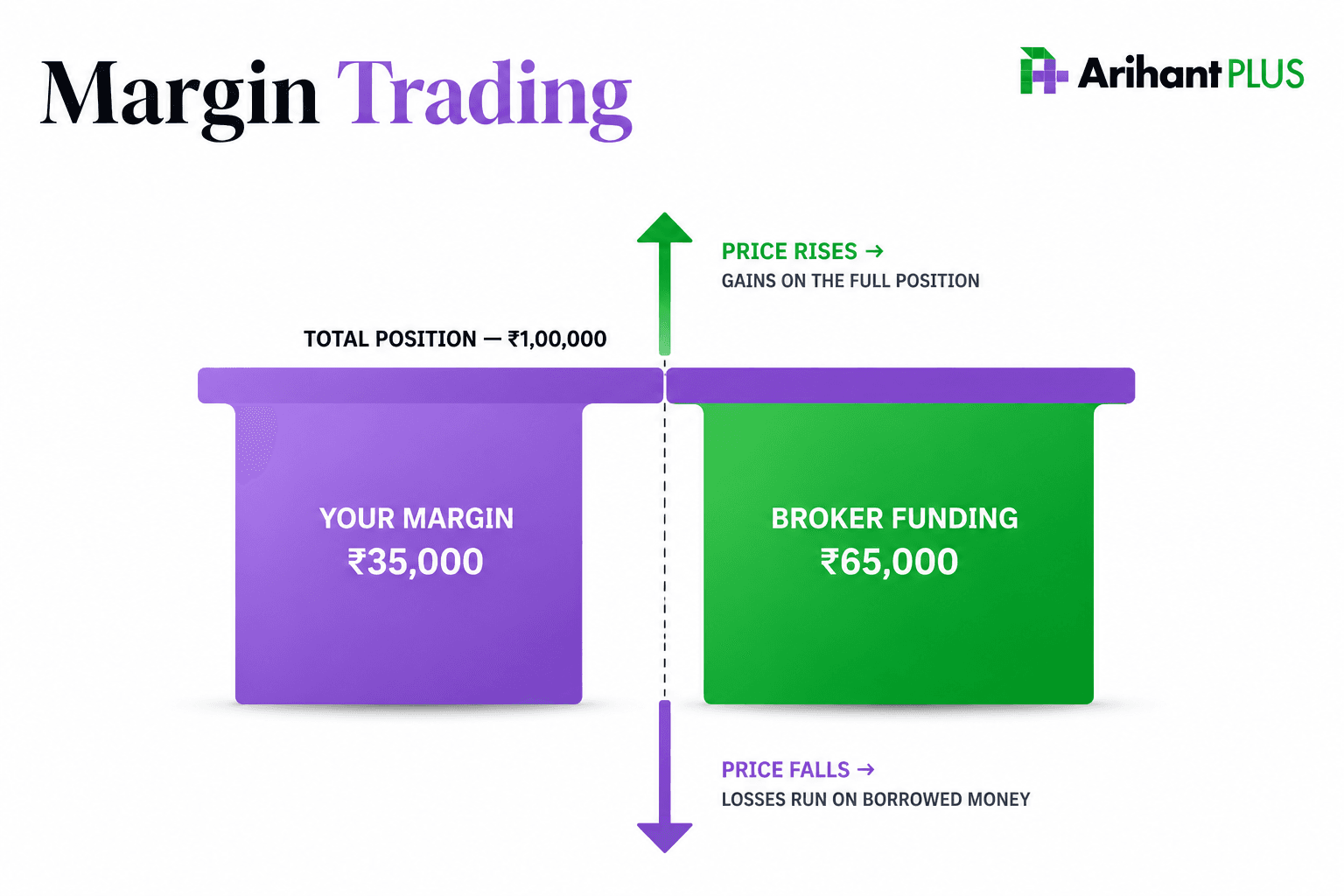
Suppose you want to buy shares worth 1000 shares valued at ₹100 each. If you were to buy them using the conventional method, you’d need to pay the full ₹1,00,000 upfront. But you only have ₹35,000 on hand, so you use MTF to bridge the gap, and use leverage.
Here’s the math:
- Total value of 1000 shares: ₹100 × 1,000 = ₹1 lac
- Your contribution (the margin you pay): ₹35,000
- Amount funded by ArihantPlus: ₹1,00,000 (total) - ₹35,000 (your contribution) = ₹65,000
You pay ₹35,000, and ArihantPlus funds the remaining ₹65,000. You’ll be charged 0.0438% interest per day on this funded amount.
Interest calculation considering you hold the stock for 20 days:
- Daily Interest: ₹65,000 × 0.0438% = ₹28.47 per day
- Total Interest (20 days): ₹28.47 × 20 = ₹569.40
After 20 days, you would pay ₹569.40 in interest for holding these shares using MTF.
What happens next?
If the stock price moves in your favour, your gains are calculated on the full investment value and not just the money you invested. So your profit could well exceed the amount you paid to purchase the stock.
- If the price falls, your losses also increase because you're trading with borrowed money. It’s important to remember that, your losses are calculated on the full market exposure, in the above example full ₹1,00,000 and not just your ₹35,000. So your losses can end up well above what you actually paid in.
That's why margin trading should always be backed by proper planning and disciplined risk management.
Step-by-step guide to buying on margin
Trading using margin on ArihantPlus is very simple. Here's how to trade using margin trading on ArihantPlus.
Step 1 - Login: Once you have opened your ArihantPlus trading account, open the trading app and login.
Step 2 - Deposit the initial margin: Before placing a trade, make sure you have sufficient balance in your trading account to contribute a percentage of the total trade value. This is called the initial margin. Arihant will finance the remaining amount.
Step 3 - Search and choose MTF: Select a stock from the MTF approved list, and tap on the BUY button, the order pad will open. Choose the MTF tab on top to buy on margin. If you do not see the MTF tab, that’s probably because your MTF segment is not activated. Get in touch with our customer care team and they will help you with activation.
Step 4 - Trade with enhanced buying power: Enter the quantity and price at which you want to place your trade and tap on BUY. Since you're using borrowed funds, with MTF you can buy more shares than you could using only your own capital.
Step 5 - Monitor your position: As prices move, you can see the value of your investment changing for the day on the Positions window and in Holdings.
- Step 6 - Interest Charges: Interest will be applied on the borrowed amount and will be charged fortnightly to your account.
Buying using the MTF is pretty simple and easy on ArihantPlus. Earlier, MTF orders required manual pledging and OTP-based verification. But now, the pledging is fully automated in line with the exchange regulations. You just need to choose “MTF” order on the order pad, place your order and you’re done!
Now, if your trade performs well, you may earn higher returns. If it moves against you, your broker may ask you to deposit additional funds to maintain the required margin. This is called a margin call.
Key Elements of Margin Trading
- Minimum Margin: Under SEBI rules, you have to pay at least ~25 percent of a trade’s value with your own money either in cash or approved securities. Although this margin varies from script-to-script, generally the rule for minimum margin is -
MINIMUM MARGIN IS VAR + (3 × ELM)
Your broker can fund the rest, up to 75 percent. This means you cannot trade purely with borrowed money, some skin in the game is mandatory.
Initial Margin: This is the money you pay upfront to take a position - typically minimum 25% (or more depending on the broker’s risk policy). The lower your contribution, the higher leverage you are taking. However, SEBI has put a cap on maximum leverage you can take on a position and you can’t go beyond the permitted limit. You can keep your trade open for upto 90 days, as long as you keep paying interest on the funded amount and stay above the required margin.
- Maintenance Margin and Margin Call: When you open a trade, you need to maintain a minimum margin level - typically around 30-40% of the position’s current value. If the stock price goes down and your margin drops below this level, you will get a margin call. This means you have to add money or sell some of your stocks to restore the required balance. If you do not fund your account on time, with the difference, your broker can sell your stocks to recover the shortfall without needing your approval. They will not even ask which stocks you’d prefer to keep and you may be even charged a fee or penalty for the shortfall. You are responsible for any losses sustained during this process. Hence, its important to always maintain the required balance while trading using MTF.
Why do traders use margin trading?
Margin trading isn't just about borrowing money. Many traders use it strategically to increase flexibility and make better use of their available capital.
Here are some of its key benefits.
- Increases your buying power: You can get upto 4x leverage on over 1600 stocks allowing you to take larger positions without paying the full investment amount upfront.
- Uses your capital more efficiently: Instead of investing all your money in one trade, margin trading allows you to spread your capital across multiple opportunities. This allows you to diversify your trading strategy.
- Ability to act on time-sensitive opportunities: Markets move fast, a strong earnings beat or a big corporate announcement can send a stock up sharply within hours. With MTF you can get upto 4x leverage and take position. Say you have ₹20,000, with MTF you can take upto ₹80,000 position instead. If the stock jumps 15% on the news, you gain on the full ₹80,000 exposure, not just your ₹20,000. MTF lets you size up quickly to capture such moves, rather than waiting to save up enough capital first.
- Potential for higher returns: Because leverage increases your market exposure, your returns can also be higher if the market moves in your favour. This multiplier effect is one of the main reasons why traders use margin trading. It's important to remember, however, that leverage increases losses in exactly the same way.
What are the risks of margin trading?
While margin trading offers opportunities, it isn't suitable for every investor. Understanding the risks is just as important as understanding the benefits.
Leverage magnifies losses: Leverage can work against you just as quickly as it works in your favour. Even a small decline in price can lead to losses that are much larger than your initial investment.
Margin calls: If the value of your investment falls below the required level, your broker may issue a margin call asking you to deposit additional funds. If you don't meet the requirement, some or all of your positions will be closed.
Interest on borrowed funds: Since you're borrowing money, brokers charge interest on the funded amount. Holding leveraged positions for a longer period can increase your overall trading cost. Therefore, buying on margin is mainly suitable for short-term investments.
Liquidation without warning: If your margin falls short, your broker can sell your holdings to cover it, and they don't need to check with you first. That means you could lose stocks you actually wanted to hold on to, sold at a time and price you didn't choose. It's one of the more stressful parts of trading on margin, since the exit isn't in your hands.
- Market volatility: Unexpected events, company announcements, and economic developments can cause sudden price movements. Following reliable stock market news and staying informed can help you react more effectively, but it doesn't eliminate market risk.
Best practices for margin trading
Margin trading can be a useful tool, but it works best when paired with discipline and a clear strategy, not conviction. Here are a few best practices every trader should keep in mind.
- Have a plan before you trade: Know your entry, target, and maximum acceptable loss upfront. It keeps emotions out of volatile moments.
- Don't overuse leverage: It can be tempting to use the maximum leverage available, especially when you're confident about a trade. However, higher leverage means higher risk. Staying moderate gives you room to breathe if the trade goes against you.
- Always use stop-loss orders: They won't eliminate losses, but they cap them and protect your capital.
- Stay updated with the market: Successful traders don't rely on guesses. Track earnings, announcements, and market news. Informed trades beat guesses so you are better prepared to respond to changing market conditions.
- Review your trades regularly: Wins and losses both teach you something. Looking back helps you spot patterns and avoid repeating mistakes.

To sum up
Margin trading can help you increase your market exposure without investing the full amount upfront. It offers greater buying power and the potential for higher returns, but it also comes with higher risk because you're trading with borrowed funds.
The key isn't simply using leverage, it's using it responsibly.
Understanding how margin works, following a disciplined trading plan, staying updated with stock market news, and managing risk effectively can make a significant difference over time.
If you're planning to explore margin trading, start by learning the basics and choosing a trusted platform like ArihantPlus. With the right knowledge, tools, and disciplined approach, you can make more informed trading decisions and build confidence as you grow your market experience.
FAQs
What are the charges for using MTF?
Buying stocks using MTF entails certain charges, listed below:
- Interest: You pay an interest on the amount you take as a loan
- Brokerage: You pay brokerage on any purchase or sale you undertake using MTF
- Pledge and unpledge charges: MTF stocks are pledged automatically when you buy and unpledged when you sell. You pay ₹ 20 per ISIN per pledge request plus GST.
Is margin trading suitable for beginners?
Beginners can use margin trading, but only after understanding how leverage, margin calls, and risk management work. Starting with smaller positions and using stop-loss orders can help reduce risk.
Do I have to apply for margin trading service?
Margin investing access isn’t automatic. You must apply for margin trading facility and will only get access if you meet eligibility requirements. Once your request is approved, you’ll be able to use extra buying power. This additional buying power represents the money that you’re allowed to borrow from us to invest.
Can I use margin trading for long-term investing?
Margin trading is generally more suitable for short- to medium-term trading because borrowed funds attract interest charges. If you are a long-term investor, it is better to invest using your own capital.
How do I start margin trading?
To get started, you'll need to open a trading account and a demat account with ArihantPlus. Make sure to select MTF segment during onboarding process or ask the customer service team to activate it later. Before using leverage, make sure you understand the risks involved and have a clear trading strategy.
What are the risks of margin trading?
The biggest risk with margin trading is that you can lose more than what you actually put in. If the value of your holdings drops, you'll need to add more funds to cover the shortfall. If you don't fund your account, your broker can force a sale of your securities to recover it, which could lead to additional losses.
What are the interest charges for using margin trading facility (MTF)?
Interest varies from broker-to-broker and is usually within a range of 12-18% depending on the level of services and amount offered for margin trading. The interest applicable to you will depend on your plan and volume. But the rate starts from 18% pa.
What happens if the value of the pledged stock decreases?
ArihantPlus collects Mark-to-Market (MTM) margins daily, based on the buy price of your positions. These margins are recalculated every day - new MTM is blocked, and the previous day's is released. MTM is charged only on positions that are currently at a loss; profitable positions aren't affected.
If you've bought the same stock on different days, ArihantPlus calculates MTM separately for each day's average buy price, even though your overall position shows up as one combined total in your account.

Related Topics
Stock Split vs Bonus Shares: What’s the Difference & What It Means For You?

Stock SIP Explained: A Smarter Way to Build Long-Term Wealth

Mutual Funds vs PMS: What’s the difference and which one is right for you?

Inside REITs: India’s Growing Real Estate Income Opportunity

Small Caps Lead Q1 Growth: Truth Behind India Inc’s Q1FY27 Earnings

What is an Offer for Sale (OFS)? A Complete Guide for Investors

Good-Till-Date Orders: A Smarter Way to Invest Without Constant Monitoring

Ethical Investing Gets Real: NSE and BSE Launch Saatvik and Ahimsa Indices


CM Vijay's ₹213 Crore Bank Balance Teaches India's Biggest Investing Mistake

Understanding Bonus Shares and Their Impact on Your Portfolio

Understanding Stock Splits and Their Impact on Your Portfolio



How to Analyse a Stock in 2026: Fundamental + Technical Checklist






Silver vs gold 2025: Why smart investors are choosing silver now