

Share Buyback Explained: Impact on Stock Prices Trends

By
Arihant Team
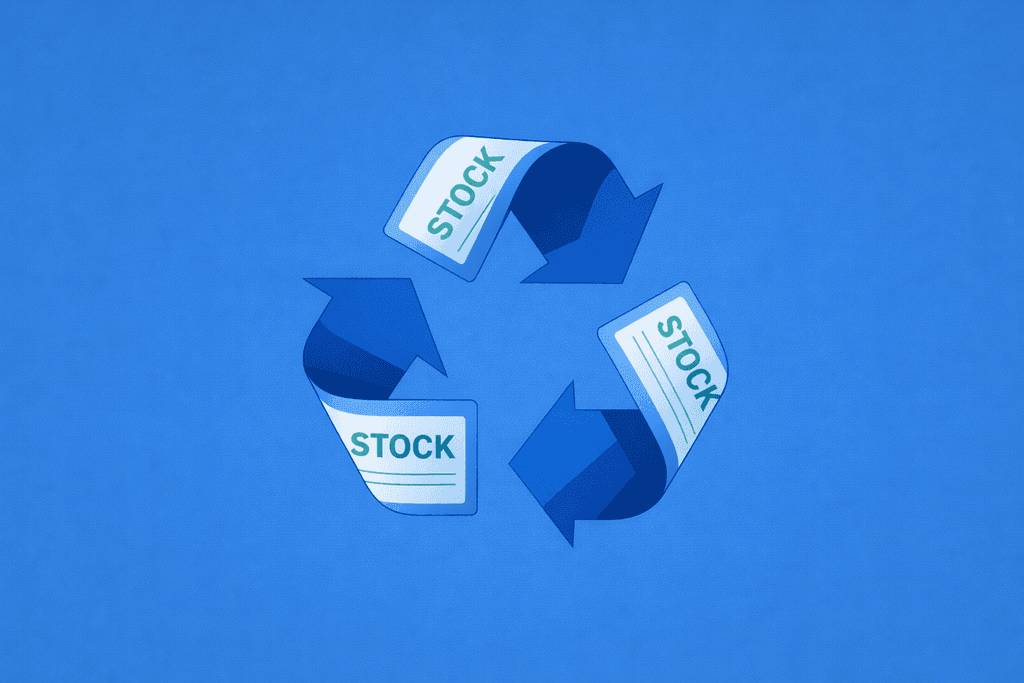
A share buyback occurs when a company purchases its own shares directly from existing investors, usually at a premium. Its often used by the company to return surplus cash to shareholders. But are all share buybacks a good thing? And should you participate in a share buyback?
In This Article
- Introduction
- Key Takeaways
- What is a share buyback?
- Key reasons for share buyback
- How does share buyback impact stock prices
- How does share buyback impact investors
- How are share buybacks taxed?
- Risks and considerations of share buybacks
- Conclusion
- FAQs
Introduction
Imagine this: you purchase a chocolate bar, and 5 of your friends pay you for a piece each. Later, you offer to pay a bit extra to buy back the chocolate piece. Three of your friends sell the chocolate back to you. They receive the money, and the value of the chocolate pieces increases. Now, imagine a company doing the same – but instead of chocolate pieces, it buys back its own shares from existing investors. By repurchasing its own stock, the company returns capital to shareholders and reduces the total number of shares in the market.
Share buybacks are a significant corporate action, and knowing why companies opt for them is crucial.
Here’s a detailed breakdown of share buybacks and how they impact your investments.
Key Takeaways
- A share buyback is a process in which a company purchases outstanding shares from existing shareholders.
- Companies opt for share buybacks to deploy excess cash, improve valuation ratios, and boost investor sentiment.
- A company can do a buyback through tendering an offer to repurchase the shares at a predetermined price.
- Share buybacks can have a positive impact on the stock price in the short as well as long term.
- Buybacks also have certain disadvantages as they may deplete cash reserves and don’t actually improve the profitability of the company. It can also indicate lack of profitable growth opportunities for the company.
- Income distributed through a share buyback is taxed at 20% at the company level.
What is a share buyback?
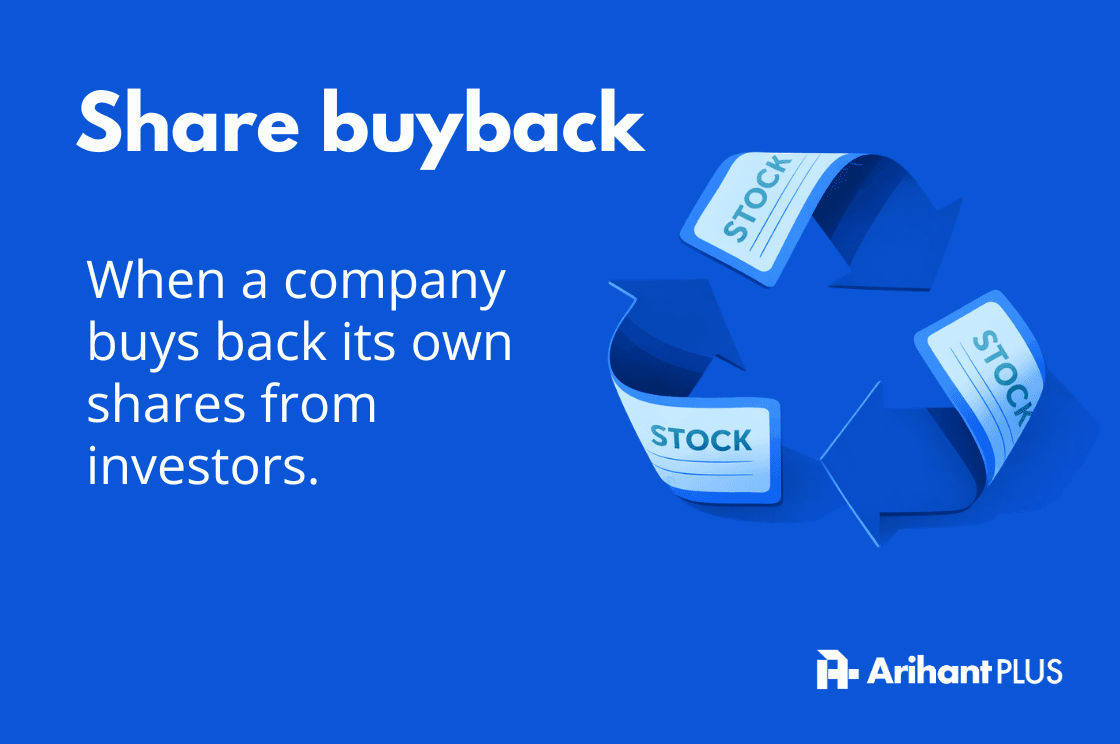
A share buyback is a corporate action that takes place when a company decides to purchase its outstanding shares from its existing shareholders. To put it in simple words, when a company invests in itself by repurchasing its shares from its own shareholders it is called share buyback.
Earlier, a company could earlier carry out a share buyback through two modes —
- Open market (discontinued): Under the open market mechanism, the company repurchases the shares from the secondary market. However, since April 2025, in India buybacks are only allowed through the tender offer route.
- Tender offer: Under this route, the shareholders are invited to sell their shares, by the company, at a fixed price (offer price). A tender offer is usually a premium price, typically higher than the current market price, to attract shareholders to sell. They can apply for more shares than their eligibility, however, the acceptance of these additional shares for buyback is subject to the acceptance ratio determined by the company. Once approved, the amount of sale is credited to their bank account.
Let’s understand this with an example. A company’s shares are trading at ₹100. The company announces that it will buy back its shares through the tender route at ₹110 per share. During the tender period, if you are an existing shareholder, you can sell your shares back to the company at ₹110 and make a ₹10 profit.
Key reasons for share buyback
There are several situations or reasons in which a company may opt to repurchase its shares.
- Utilising excess cash: One of the key goals for many companies is to reward its shareholders. In certain situations, a company might have excess cash and a lack of avenues to deploy or utilise it. In such a scenario, a share buyback allows the company to return the excess cash to the investors, generating value for them.
- Improving financial ratios and valuation: Share repurchases also increase the company’s equity value, and help businesses to look more financially attractive to investors. When a company repurchases shares from its existing shareholders, the number of outstanding shares reduces. This impacts the calculation of key ratios such as earnings per share (EPS) and return on equity (ROE). A buyback improves these ratios which makes the company appear more attractive.
- Enhancing company control: An equity share gives voting rights to the shareholder. A company may use a share buyback as a means to increase its voting rights and control over the company. This is especially helpful to prevent dilution and maintain ownership percentages.
- Company and shareholder confidence: A share buyback is often seen as a sign of confidence. Through a buyback, the company typically signals one of two things: management believes the business has strong future prospects, or they feel the stock is undervalued at current prices. Either way, the message is clear - the company believes in its own value. This confidence can also attract more interest from existing and new investors. Take the example of the chocolate above. If you buy it back from your friends, they will most likely think that it is tasty.
How does share buyback impact stock prices
To break it down clearly, let’s look at how a buyback influences stock prices at different stages.
Short-term price movement
When a company announces a share buyback, it signals that the company is confident. It is like the company is saying, “We want our shares back because we are confident they will be more valuable”.
Moreover, buybacks done through the tender route are often purchased at a premium. These factors boost the demand for the shares and can lead to a short-term increase in the stock price.
For example, on September 8, 2025, Infosys announced that its board will meet to consider a buyback worth ₹18,000 crore. Following this announcement, shares of the company jumped over 5% on the following trading day.
Long-term price movement
A share buyback leads to a reduction in the number of outstanding shares in the market. When the supply of shares is limited compared to the demand, it can drive up the share price. Further, share buybacks improve key financial ratios, which may help a company attain a higher valuation.
How does share buyback impact investors
As an investor, it is vital to know the impact a share buyback has on your investment.
Capital appreciation
A share buyback has the potential to directly impact the stock price in the short-term and have an effect on the long-term stock price as well. A buyback signals that the company is confident in itself and its future trajectory. When the promoters of a business are optimistic about a company, it also boosts shareholder interest and confidence, which is usually positive for its share prices.
Dividend alternative
Share buybacks can be seen as a dividend alternative. When a company opts for a buyback, it returns cash to the shareholders. However, unlike a dividend, a share buyback distributes cash only to the shareholders that tender or sell their shares back to the company.
Enhancing shareholder value
When the company does buyback, the total number of outstanding shares reduces. Fewer shares in circulation increases the company’s EPS, which could boost its share price. A better EPS and ROE ratio can create a better value proposition for new and existing shareholders. Additionally, improved fundamentals can allow the company to justify higher valuations and draw in more interest from potential investors.
How are share buybacks taxed?
From 1st October 2024,, the amount received through buyback is deemed as “dividend” and is taxed as per your income tax slab rate. However, in Budget 2026, the finance minister of India proposed to tax buyback of shares as capital gains in the hands of the investors.
Any money you make from a company buying back its shares will now be treated as capital gains, just like when you sell shares in the market.
Here’s how the tax will work:
- If you held the shares for more than 12 months, the gains will be treated as long-term capital gains and taxed at 12.5%, with an exemption of up to ₹1.25 lakh.
- If you held the shares for 12 months or less, the gains will be taxed as short-term capital gains at 20%.
For promoters, the tax impact is higher. Individual promoters may face an effective tax rate of around 30%, while corporate promoters may be taxed at about 22%.
Risks and considerations of share buybacks
As an investor its important to understand that not all buybacks are smart or investor‑friendly. If a company overpays for its own shares, i.e. buying back at very high valuations, it can destroy value instead of creating it. Similarly, if management uses heavy borrowing to fund buybacks, it may weaken the balance sheet and increase financial risk, especially during downturns.
There is also a risk that buybacks are used mainly to dress up EPS or support the share price in the short term, rather than to genuinely create long‑term value. As an investor, it is important to look beyond the headline and check whether the underlying business is growing, generating healthy cash flows, and maintaining a solid balance sheet. Here are a few things to understand about buybacks:
No real improvement in fundamentals: Essentially, a share buyback does not improve a company’s profitability or financial strength. The improvement in the fundamentals and valuation is a result of a lower number of outstanding shares.
Misappropriation of cash: While a share buyback may be considered as a value-driven and tax-efficient way of distributing cash by the company, some investors may prefer that the cash be used to fuel growth. Using the cash to repurchase shares instead of supporting growth can harm future prospects for the company and investor sentiment.
Poor market timing: Share buybacks done when the stock price is already inflated, and the company is overvalued, can reduce the overall benefit for investors. If the management incorrectly times a share buyback, the repurchased shares may see a decline in value, which can be a disadvantage for investors as well as the company.
Conclusion
Managing your investments is an integral part of maintaining and creating a strong portfolio. Along with tracking the profit and loss of your holdings, it is also important to keep a check on corporate actions such as share buybacks. Understanding the benefits and implications of a share buyback can help you get a more comprehensive view of your investment and the company’s fundamentals.Although a share buyback signals confidence and can be rewarding for investors, it is not a guarantee and may backfire as well. When a company announces a buyback, get a better understanding of why the company opted for it before jumping into it.
Treat any buyback as an invitation to look deeper into the company’s financial health, valuation, and capital allocation discipline before deciding whether to hold on, sell into the buyback, or avoid the stock altogether.
FAQs
What is a share buyback?
A share buyback is the process through which a company repurchases its outstanding shares from existing shareholders.
How does a share buyback impact price?
A share buyback boosts investor sentiment, which can increase the stock price in the short term. A lower number of outstanding shares can also contribute to higher stock prices in the long run.
Can the stock price decline after a share buyback?
If the share buyback is done at higher valuations and the management mistimes the market, it may result in a decline in stock price.
How can I participate in a buyback through tender offer?
If you are an eligible shareholder, you may tender your shares for buyback by contacting our customer service team on 0731-4217003. They will guide you through the buyback process.
Where can I find information about ongoing buybacks?
We update all latest corporate actions, including buybacks on ArihantPlus Bulletin, where you can find all latest buyback information. We also send notifications on your ArihantPlus app about buyback announced by large companies, so keep an eye on your app notifications. If you haven't turned them on, this is your sign to do it right away!
Is the money received through a share buyback taxable?
Yes, any money you make from a company buying back its shares will now be treated as capital gains and taxed at 12.5% or 20% depending on your holding period from 1st April 2026 as per new tax rules announced in Budget 2026.

Related Topics
Stock Split vs Bonus Shares: What’s the Difference & What It Means For You?
Stock SIP Explained: A Smarter Way to Build Long-Term Wealth
Mutual Funds vs PMS: What’s the difference and which one is right for you?
Inside REITs: India’s Growing Real Estate Income Opportunity
Small Caps Lead Q1 Growth: Truth Behind India Inc’s Q1FY27 Earnings
Understanding Margin Trading Facility (MTF): A Detailed Guide
What is an Offer for Sale (OFS)? A Complete Guide for Investors
Good-Till-Date Orders: A Smarter Way to Invest Without Constant Monitoring
Ethical Investing Gets Real: NSE and BSE Launch Saatvik and Ahimsa Indices
CM Vijay's ₹213 Crore Bank Balance Teaches India's Biggest Investing Mistake
Understanding Bonus Shares and Their Impact on Your Portfolio

Understanding Stock Splits and Their Impact on Your Portfolio
How to Analyse a Stock in 2026: Fundamental + Technical Checklist
Silver vs gold 2025: Why smart investors are choosing silver now