


Understanding Stock Splits and Their Impact on Your Portfolio

By
Arihant Team
A stock split is a corporate action wherein a company decreases their share value by increasing the number of its outstanding shares. Infosys, Wipro, HDFC Bank and Reliance Industries have all split their stocks in the past to make their shares more accessible to investors.
In This Article
- Summary
- What is a stock split?
- Key reasons for stock splits
- How does stock split impact stock prices?
- How does stock split impact investors?
- How are stock splits taxed?
- Key risks in stock split
- Conclusion
- FAQs
Summary
- A stock split is a process in which a company increases the number of its shares by dividing existing shares.
- Companies opt for stock splits to improve affordability, increase liquidity, and attract more investors.
- A company can carry out a stock split by issuing additional shares to existing shareholders in a fixed ratio.
- Stock splits can have a positive impact on stock price in the short term due to improved sentiment and liquidity.
- Stock splits also have certain limitations as they do not improve the company’s fundamentals or profitability.
- A stock split itself is not taxable; however, capital gains tax applies when the shares are sold.
Open a free account today
Invest in tomorrow with just one click
What is a stock split?
A stock split is a corporate action that takes place when a company decides to divide its existing shares into multiple shares.
Put simply, when a company increases the number of shares held by its shareholders without changing the total value of their investment, it is called a stock split.
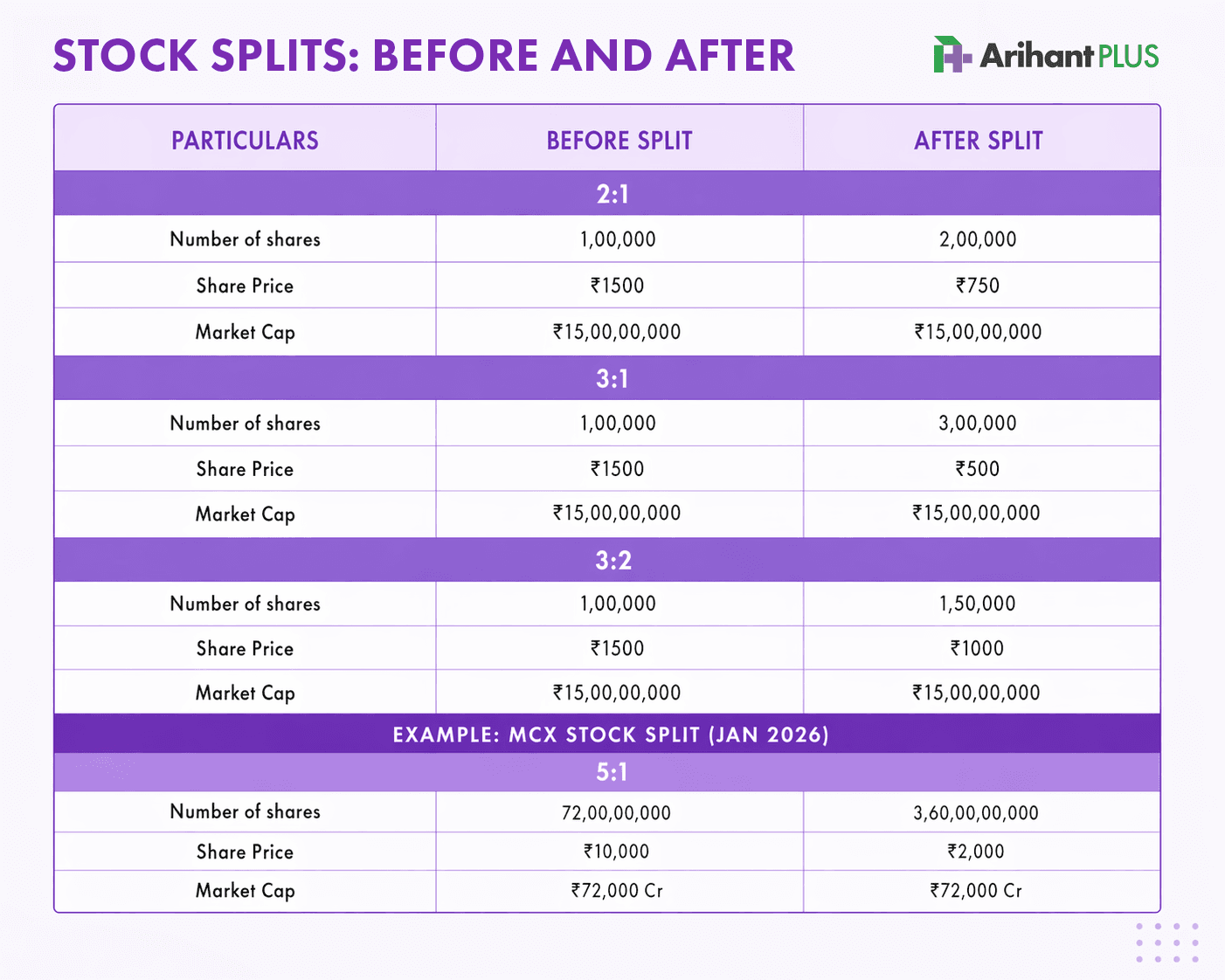
A company carries out a stock split in a fixed ratio, such as 2:1, 5:1, etc. A 2:1 ratio means - for every one stock you hold, you will get 2 shares of the company after the split.
Let’s understand this with an example. A company’s shares are trading at ₹1000. The company announces a 2:1 stock split. After the split, each share will be priced at ₹500, and if you held 1 share earlier, you will now hold 2 shares. And your total value of your investment remains unchanged at ₹1000.
Key reasons for stock splits
There are several situations or reasons in which a company may opt for a stock split.
- Improving affordability: One of the key reasons for a stock split is to make shares more affordable for retail investors. When a stock price becomes very high, it may discourage small investors. A stock split reduces the price per share, making it easier to invest.
- Increasing liquidity: Stock splits increase the number of shares available in the market. This improves trading activity and liquidity, making it easier for investors to buy and sell shares.
- Broadening investor base: Lower share prices attract a wider range of investors, especially retail participants, increasing overall market participation.
- Company and shareholder confidence: A stock split is often seen as a sign of confidence. It usually indicates that the company has performed well and expects continued growth. This positive signal can attract more investors.
How does stock split impact stock prices?
To break it down clearly, let’s look at how a stock split influences stock prices at different stages.
Short-term price movement
When a company announces a stock split, it often creates positive sentiment in the market. It is like the company is saying, “Our stock has grown and we expect continued interest.” Moreover, the reduced share price makes it more accessible to investors. These factors can boost demand and lead to a short-term increase in the stock price.
Long-term price movement
A stock split increases the number of outstanding shares but does not change the company’s valuation. However, improved liquidity and higher participation can support sustained demand for the stock, which may positively influence the price over time.
How does stock split impact investors?
As an investor, it is vital to know the impact a stock split has on your investment.
- No change in investment value: A stock split does not change the total value of your holdings. It only changes the number of shares and the price per share.
- Improved liquidity: With more shares available in the market, trading becomes easier and more efficient.
- Psychological benefit: Lower share prices often appear more attractive to investors, even though the intrinsic value remains unchanged.
- Enhanced participation: Stock splits can attract new investors, which may increase demand for the stock.
How are stock splits taxed?
A stock split is not considered a taxable event because no actual sale or income occurs. However, for taxation purposes, the cost of acquisition is adjusted based on the new number of shares and the capital gains tax applies only when the shares are sold.
For example, if you bought one share at ₹1000 and it is split into two shares, your cost per share becomes ₹500. If you later sell one share at ₹700, the capital gain of ₹200 will be taxed.
Key risks in stock split
As an investor, it is important to understand that not all stock splits indicate strong fundamentals.
- No real improvement in fundamentals: A stock split does not improve a company’s profitability, revenue, or financial strength. The change is purely structural.
- Misleading affordability: Lower prices may give the impression that the stock is cheaper, even if it is overvalued.
- Temporary market reaction: Any price increase after a stock split may be short-lived if not supported by strong business performance.
- Overemphasis on sentiment: Investors should not rely solely on stock splits as an indicator of growth potential. It is important to evaluate the company’s fundamentals.
Conclusion
Keeping track of corporate actions is just as important as monitoring the performance of your investments.
A stock split often reflects a company’s past growth and its intent to make shares more widely available, but it should not be mistaken for a sign of guaranteed future returns.
As an investor, it is important to focus beyond the reduced share price and evaluate the company’s fundamentals, earnings potential, and long-term prospects.
So, instead of reacting to the excitement around a stock split, use it as a moment to reassess the company’s overall quality and your investment strategy before making any decisions.
FAQs
What is a stock split?
A stock split is the process through which a company divides its existing shares into multiple shares, increasing the number of shares while reducing the price per share proportionally.
How does a stock split impact price?
A stock split can improve investor sentiment and make shares more affordable, which may increase demand and lead to a short-term rise in stock price. However, it does not change the company’s intrinsic value.
Can the stock price decline after a stock split?
Yes, if the stock was already overvalued or if the market sentiment weakens, the price may decline after a stock split despite the increased liquidity.
How can I benefit from a stock split?
If you are an existing shareholder, you automatically receive additional shares based on the split ratio. You do not need to take any action. The benefit depends on how the stock performs after the split.
Where can I find information about upcoming stock splits?
Companies disclose stock split announcements through stock exchanges and investor communications. You can also track such updates through your brokerage platform or market apps.
Is a stock split taxable?
No, a stock split itself is not taxable because you are not selling your shares. However, capital gains tax will apply when you sell the shares in the future, based on the adjusted cost of acquisition.

Related Topics




Stock Split vs Bonus Shares: What’s the Difference & What It Means For You?

Stock SIP Explained: A Smarter Way to Build Long-Term Wealth

Mutual Funds vs PMS: What’s the difference and which one is right for you?

Inside REITs: India’s Growing Real Estate Income Opportunity

Small Caps Lead Q1 Growth: Truth Behind India Inc’s Q1FY27 Earnings

Understanding Margin Trading Facility (MTF): A Detailed Guide


What is an Offer for Sale (OFS)? A Complete Guide for Investors

Good-Till-Date Orders: A Smarter Way to Invest Without Constant Monitoring

Ethical Investing Gets Real: NSE and BSE Launch Saatvik and Ahimsa Indices


CM Vijay's ₹213 Crore Bank Balance Teaches India's Biggest Investing Mistake

Understanding Bonus Shares and Their Impact on Your Portfolio




How to Analyse a Stock in 2026: Fundamental + Technical Checklist






Silver vs gold 2025: Why smart investors are choosing silver now