
Understanding Bonus Shares and Their Impact on Your Portfolio

By
Arihant Team
Bonus shares are free shares issued by companies to existing shareholders by converting reserves into equity. While your share count increases, the total investment value remains unchanged as prices adjust. They signal financial strength and can enhance long-term wealth if the company continues to grow.
In This Article
- Summary
- Introduction
- How bonus shares impact share price?
- Why do companies issue bonus shares?
- Dividend vs Bonus Shares
- Advantages and limitations for investors
- Bonus shares vs stock split
- Tax implications
- The bottom line
- FAQs
Summary
- Bonus shares are free additional shares a company gives to its existing shareholders, at no extra cost.
- Bonus shares are issued in a fixed ratio. For example, a 1:2 bonus means for every two shares you hold, you get one bonus share for free. The price of the stock adjusts downward after the issue, so your holding value stays the same even though you now own more shares.
- Bonus shares are funded from the company's accumulated profits or reserves, not from fresh capital.
- A bonus issue increases the company’s share capital, but its total market capitalisation stays unchanged.
- Companies issue bonus shares to reward shareholders, make the stock more affordable for retail investors, and signal financial health.
- A bonus issue doesn't make the company stronger. Fundamentals, earnings, and business performance remain unchanged.
- One downside of bonus is that the reserves used for a bonus issue could have been deployed for business growth, acquisitions, or other value-creating purposes.
- You don’t pay any tax when you receive bonus shares. However, capital gains tax applies only when you sell them.
Introduction
You checked your demat account one morning and noticed something odd. You had more shares than yesterday. Same company. No new purchase. Just… more. If this has happened to you, you've experienced a bonus issue firsthand.
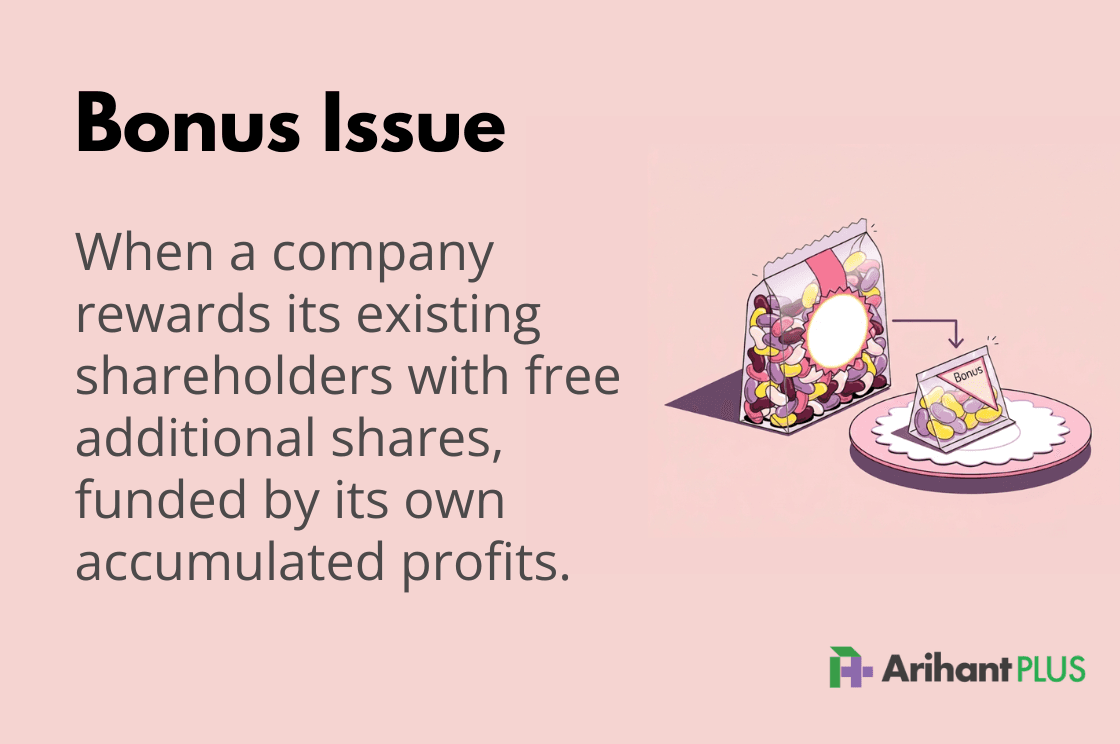
When a company has been consistently profitable, it sometimes rewards its shareholders through a corporate action called a bonus issue - handing out additional shares, free of cost, by converting a portion of its accumulated profits into share capital.
So if you hold 100 shares of a company and it announces a 1:1 bonus (read: one bonus share for every share you hold), you wake up the next morning with 200 shares in your demat account. No payment needed. Nothing to do.
Pretty nice, right?
But here’s the thing, you're not actually richer the moment it happens. While they say you’re receiving “free shares,” that framing only captures part of the picture. Your total holding value of that company doesn't actually change after receiving bonus shares. This is because the stock price adjusts downward to account for the new shares. So, what the company is really doing is changing how your ownership is represented — more shares, yes, but the same underlying stake in the business. Same pie, more slices.
How bonus shares impact share price?
Once a bonus issue is announced and implemented, the share price adjusts in proportion to the ratio of the issue. If the number of shares doubles, the price per share broadly halves, ensuring that the overall market value of your holdings remains unchanged.
For instance, if you held one share at ₹1000 and the company announces a 1:1 bonus, you will end up holding two shares priced at roughly ₹500 each. Your total investment value remains ₹1000, because nothing fundamental about the business has changed.
Then Why Does Everyone Get So Excited about Bonus Issue?
Although the value of your holding stays the same even after bonus, things get slightly more interesting is in the short term.
- It signals confidence. A company announcing bonus shares is essentially saying: "We're doing well enough to reward you, and we believe we'll keep growing." It's a show of strength. Markets tend to read it that way too.
- It makes the stock more affordable. A stock trading at ₹4,000 might feel out of reach for smaller investors. After a bonus issue, if it drops to ₹400, more people can buy in, which can actually push demand (and prices) up over time. However, this is largely a function of sentiment and liquidity rather than any real shift in intrinsic value.
- Long-term holders often benefit. If the company continues to grow after the bonus issue, you now earn more dividends (since dividends are paid per share), and your larger shareholding compounds beautifully.
One small caveat though. The excitement around a bonus announcement can nudge the stock price up in the short term. But that's mostly noise. Over the long run, what moves a stock is the same as it always was: how well the business grows, how wisely it allocates capital, and how strong its earnings are. The bonus issue itself does not alter any of these drivers. It's a reward, not a transformation.
It is also worth noting that after bonus issue, per-share metrics such as earnings per share (EPS) drop simply because the same earnings are now divided across more shares. It can look alarming at first glance, if viewed without context. But when you look closely, you’ll realise that the company’s total earnings hasn’t changed at all. No there’s nothing to worry about.
Why do companies issue bonus shares?
Bonus issues are often framed as a way to reward shareholders without paying out cash. While that is true, it only scratches the surface.
A more accurate way to look at it is that a bonus issue reflects a company’s ability to accumulate profits over time. When reserves build up, management may choose to capitalise a portion of those reserves rather than leaving them idle on the balance sheet.
This is also where bonus shares are often confused with dividends, even though the two serve very different purposes. We will cover it in the next section, but before that let’s see real life examples of bonus shares.
Wipro and Infosys are perhaps the most famous examples in India. The companies have issued bonus shares multiple times over the decades. Investors who held on through all those bonus issues and reinvested saw extraordinary wealth creation, even if each individual bonus didn't "feel" like much at the time.
The most recent example is Trent Ltd (a tata group company), the company announced bonus issue of 1:2 and the record date for that has been set for May 29th, 2026. So if you’re holding shares for Trent in your demat account on May 29th, you will receive 1 share as bonus for every 2 you hold.
Few other recent examples are
- HDFC Bank: 1:1 in Aug 2025 (also 1:1 in 2019)
- BSE: 2:1 bonus in May 2025
- Reliance Industries: 1:1 in September 2024
Dividend vs Bonus Shares
Now let’s understand the difference between dividend and bonus shares.
When a company pays a dividend, it hands out actual cash directly into your bank account. You can spend it, reinvest it, or just let it sit. It's real money, in your hand.
On the other hand, under a bonus issue, the company gives you more shares, not cash. The value stays within the company, just represented differently in your demat account.
As a result, while dividends distribute value, bonus shares only reorganise it within the company’s capital structure.
There is a practical benefit with bonus. Increasing the number of shares improves liquidity and makes trading easier.
However, one is not better than the other. The choice depends on where the company is in its journey. A company with strong growth prospects might prefer to retain cash and issue bonus shares. A mature, stable company might reward shareholders with regular dividends instead. Some, like Infosys, have done both over the years.
The right question isn't which one is better.
Advantages and limitations for investors
From an investor’s perspective, bonus shares come with a mix of practical benefits and conceptual limitations.
Advantages of bonus issue:
- More shares, no extra cost. You're now holding a larger number of shares without spending a rupee. If the company continues to grow, that larger base compounds over time silently building your wealth.
- Better liquidity. A lower share price post-bonus means more investors can participate, making it easier to buy or sell without big price swings.
- Amplified gains over time. If the stock doubles five years from now, you're doubling a much larger number of shares. The percentage return is the same, but the absolute wealth created is significantly higher.
The traps to watch out for:
- More shares ≠ more wealth. It's easy to feel richer when your share count jumps overnight. But in reality your networth hasn’t changed at all (or at least not yet). Don't let the number fool you.
- Don't invest just because of a bonus announcement. A bonus issue can create short-term buzz and price movement. Some investors jump in purely on that excitement. That's sentiment, not strategy.
Bonus shares vs stock split
At first glance, both bonus and stock split may look the same - I am getting more shares but the value of my holdings remain the same, and both bring the share price down proportionally. So, what’s the difference?
In a stock split, the company is simply changing the face value of its shares. Each share is divided into multiple shares, which increases the number of shares without affecting reserves or altering the structure of equity. It is, at its core, a change in denomination aimed at improving affordability and liquidity.
A bonus issue works differently. Here, the company creates additional shares by converting a portion of its retained earnings into share capital. The face value remains the same, but the reserves in the balance sheet goes down and the share capital goes up. Money just moves within the books from one pocket to the other..
A simple way to remember it:
Bonus issue = balance sheet changes. Reserves are converted into share capital.
Stock split = only the face value changes. The balance sheet stays untouched.
For a quick breakdown on stock splits and how to think about them as an investor, you can check our video here:
A stock split reflects a decision to make shares more accessible in the market. A bonus issue, on the other hand, signals that the company has built up sufficient reserves to capitalise, offering a glimpse into its past financial strength.
Table 1: Stock Split 1:2
Face value halved, shares doubled
| Particulars | Before | After |
|---|---|---|
| Face Value | ₹10 | ₹5 |
| Number of Shares | 2Cr | 4Cr |
| Share Capital | ₹20Cr | ₹20Cr |
| Reserve | ₹60Cr | ₹60Cr |
| Total Equity | ₹80Cr | ₹80Cr |
Table 2: Bonus Share Issue 2:1
Free shares from reserves
| Particulars | Before | After |
|---|---|---|
| Face Value | ₹10 | ₹10 |
| Number of Shares | 2Cr | 6Cr |
| Share Capital | ₹20Cr | ₹60Cr |
| Reserve | ₹60Cr | ₹20Cr |
| Total Equity | ₹80Cr | ₹80Cr |
Tax implications
From a taxation standpoint, both actions are treated differently in ways that can materially affect your returns.
In the case of a stock split, there is no tax event at the time of the split. Your original cost of acquisition is simply apportioned across the new shares, and capital gains tax applies only when you eventually sell them.
For bonus shares, there is also no tax at the time of receipt. However, the cost of acquisition for the bonus shares is considered to be zero. This means that when you sell them, the entire sale value is treated as capital gains.
The holding period for bonus shares begins from the date they are allotted, not from the date you acquired the original shares. This creates a clear distinction between the tax treatment of original and bonus holdings.
The bottom line
There are no free lunches. Bonus shares are free shares that don't make you instantly richer on the day they're issued. But they're a signal that the company is in good health, that management wants to reward its shareholders, and that the future looks promising enough to share the pie.
If you're a long-term investor, bonus shares can amplify your wealth quietly and steadily, one extra slice at a time. And who doesn't love an extra slice?
However, investing in a company just because it announced bonus can be a trap. Before you invest, always ask the right questions. Is the company growing its revenues and profits consistently? Is the stock reasonably priced relative to its earnings? Is the management allocating capital wisely? These are the things that will determine your returns five or ten years from now.
The bonus is the wrapping. The business is the gift. Make sure you're buying the right one.
FAQs
What are bonus shares?
Bonus shares are additional shares issued by a company to its existing shareholders by converting a portion of its reserves into share capital. You do not need to invest any additional money to receive them.
How do bonus shares impact the share price?
When bonus shares are issued, the share price adjusts downward in proportion to the bonus ratio. While the number of shares you hold increases, the total value of your investment remains unchanged at that moment.
Can the stock price decline after a bonus issue?
Yes, it can. While bonus issues often create positive sentiment in the short term, the stock price can decline if the company’s fundamentals do not support its valuation or if broader market conditions weaken.
How can I benefit from bonus shares?
As an existing shareholder, you automatically receive bonus shares based on the announced ratio. You do not need to take any action. The real benefit depends on how the company performs over time, as bonus shares themselves do not create additional value immediately.
Where can I find information about upcoming bonus issues?
Companies announce bonus issues through stock exchanges and official investor communications. You can also track these updates through your brokerage platform or market apps.
Are bonus shares taxable?
Bonus shares are not taxable at the time of receipt. However, when you sell them, capital gains tax applies. The cost of acquisition for bonus shares is considered zero, which means the entire sale value is treated as capital gains.

Related Topics

Mutual Funds vs PMS: What’s the difference and which one is right for you?

Inside REITs: India’s Growing Real Estate Income Opportunity

Small Caps Lead Q1 Growth: Truth Behind India Inc’s Q1FY27 Earnings

Understanding Margin Trading Facility (MTF): A Detailed Guide


What is an Offer for Sale (OFS)? A Complete Guide for Investors

Good-Till-Date Orders: A Smarter Way to Invest Without Constant Monitoring

Ethical Investing Gets Real: NSE and BSE Launch Saatvik and Ahimsa Indices

CM Vijay's ₹213 Crore Bank Balance Teaches India's Biggest Investing Mistake

Understanding Stock Splits and Their Impact on Your Portfolio




How to Analyse a Stock in 2026: Fundamental + Technical Checklist




Silver vs gold 2025: Why smart investors are choosing silver now