
What Is a Stop-Loss Order? A Simple Guide

By
Arihant Team
Markets can move unexpectedly, making risk management an essential part of successful trading. This blog explains how stop-loss orders work, the difference between SL and SL-M orders, and when to use each. It also walks you through placing a stop-loss order on ArihantPlus to help protect your trades with greater confidence.
In This Article
- Introduction
- What Is a Stop-Loss Order?
- SL vs. SL-M: Understanding the Difference
- Which One Should You Choose?
- How to Place a Stop-Loss Order on ArihantPlus
- Should You Use a Stop-Loss Order?
Introduction
No investor gets every trade right!
With markets moving sharply on global cues, policy updates and shifting sentiment, we know prices can change when we least expect them to.
We also know that no one can watch their portfolio every minute of the day. That is why having safeguards in place matters. A stop loss order is one of the simplest and most effective ways to manage downside risk when a trade moves against us.
Open a free account today
Invest in tomorrow with just one click
What Is a Stop-Loss Order?
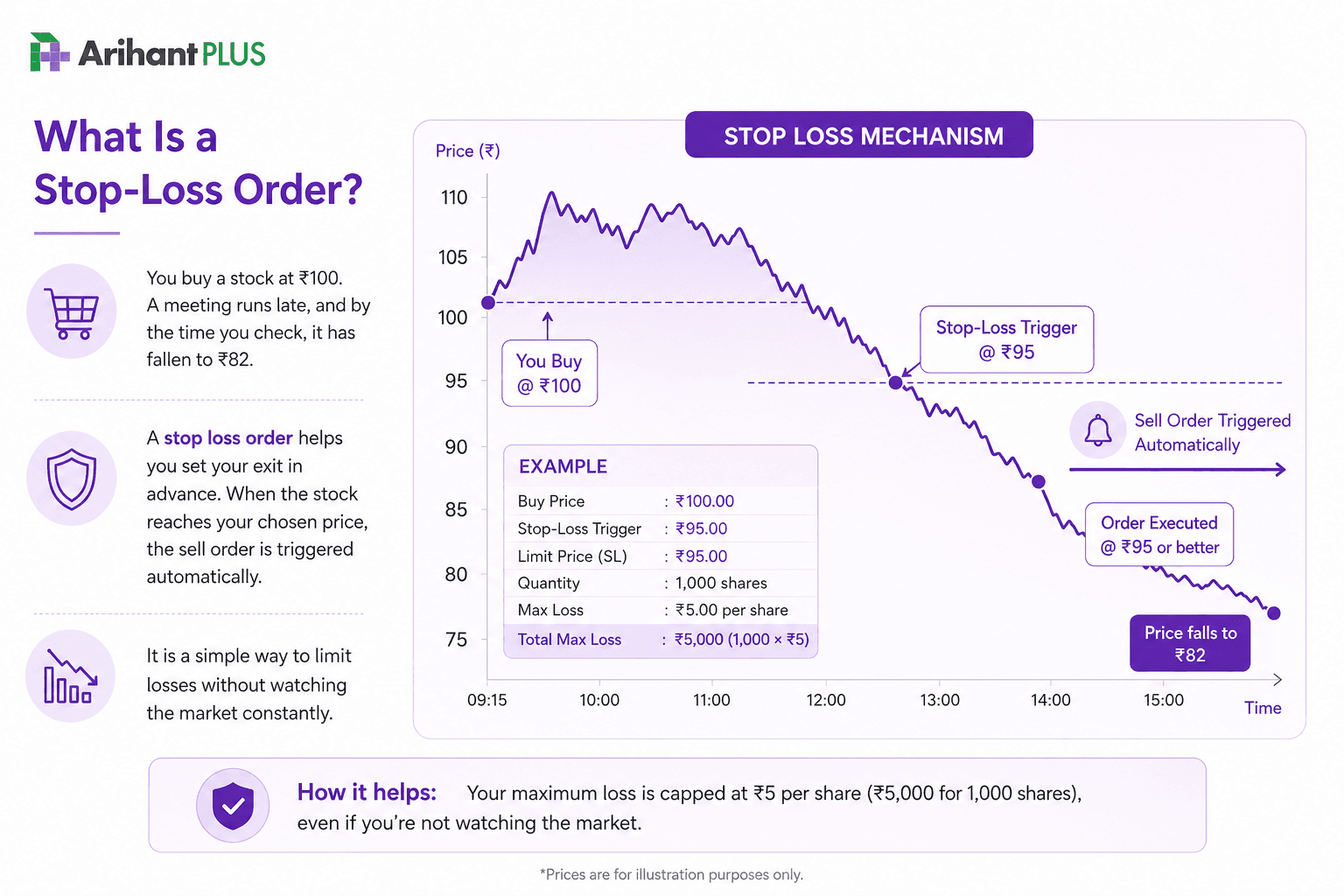
You buy a stock at ₹100. A meeting runs late, and by the time you check, it has fallen to ₹82.
A stop loss order helps you set your exit in advance. When the stock reaches your chosen price, the sell order is triggered automatically.
It is a simple way to limit losses without watching the market constantly.
SL vs. SL-M: Understanding the Difference
Both SL (Stop-Loss Limit) and SL-M (Stop-Loss Market) orders are designed to help manage downside risk, but they differ in how they execute your trade.
Feature | SL (Stop-Loss Limit) | SL-M (Stop-Loss Market) |
Purpose | Gives you control over the minimum price at which your order can be executed. | Prioritises execution once the trigger price is reached. |
Inputs Required | Trigger Price + Limit Price | Trigger Price only |
How It Works | When the trigger price is hit, a limit order is sent to the exchange. | When the trigger price is hit, a market order is sent to the exchange. |
Execution Price | Executes at the limit price or a better price. | Executes at the best available market price. |
Execution Guarantee | Not guaranteed if the market moves below the limit price before the order is matched. | Highly likely to execute since it becomes a market order. |
Best For | Traders who want more control over their exit price. | Traders who prioritise exiting the position over getting a specific price. |
Key Risk | Order may remain unexecuted during sharp price gaps or high volatility. | Final execution price may differ from the trigger price due to market volatility. |
Example
Scenario | SL Order | SL-M Order |
Purchase Price | ₹100 | ₹100 |
Trigger Price | ₹95.50 | ₹95.50 |
Limit Price | ₹95.00 | Not required |
What Happens? | When the stock touches ₹95.50, a sell limit order is placed at ₹95. It executes only if buyers are available at ₹95 or higher. | When the stock touches ₹95.50, a market order is placed and executes at the best available market price. |
Possible Outcome in a Sharp Fall | If the stock gaps to ₹93, the order may not execute. | The order is likely to execute immediately, though possibly around ₹93. |
In short: If price certainty matters more, choose SL. If ensuring your position is exited is the priority, SL-M is generally the better choice.
Which One Should You Choose?
The choice depends on what matters more to you.
- SL orders offer greater control over your exit price but don't guarantee execution.
- SL-M orders prioritise execution, though the final price may vary from your trigger.
For many beginners, an SL-M order is often the more practical option. After all, the primary purpose of a stop-loss is to exit a losing position. An order that doesn't execute may leave you exposed to even larger losses.
How to Place a Stop-Loss Order on ArihantPlus
Setting up a stop-loss on the ArihantPlus app is quick and straightforward.
Open the stock you'd like to trade and tap Buy or Sell, depending on whether you're placing a new order or protecting an existing position. On the order screen, navigate to Advanced Options and select either SL or SL-M.
Next, enter the required details:
- Quantity
- Trigger Price
- Limit Price (for SL orders only)
Stop-loss orders can be used for both intraday and delivery trades, allowing you to manage risk across different trading styles.
If you'd like your stop-loss order to remain active beyond the current trading session, you can choose GTD (Good Till Date). This keeps the order active until it is executed or until your selected expiry date.
Markets change, and so can your trading plan. Until your stop-loss is executed, you can modify the trigger price, limit price, or quantity at any time by opening the order under Trades and selecting Modify.

Should You Use a Stop-Loss Order?
If you cannot monitor the market throughout the day or find it difficult to exit a losing trade, a stop loss order can be a useful tool.
It will not eliminate losses or replace proper research, but it can help prevent a manageable loss from becoming much larger. It can also reduce the impact of emotion on trading decisions.
A stop loss works best when it supports a well planned investment strategy rather than acting as a strategy on its own.
Disclaimer: This article is intended for educational purposes only and should not be construed as investment advice. Please consult a qualified financial advisor before making any investment or trading decisions.

Related Topics

Stock SIP Explained: A Smarter Way to Build Long-Term Wealth

Mutual Funds vs PMS: What’s the difference and which one is right for you?

Inside REITs: India’s Growing Real Estate Income Opportunity

Small Caps Lead Q1 Growth: Truth Behind India Inc’s Q1FY27 Earnings

Understanding Margin Trading Facility (MTF): A Detailed Guide

What is an Offer for Sale (OFS)? A Complete Guide for Investors

Good-Till-Date Orders: A Smarter Way to Invest Without Constant Monitoring

Ethical Investing Gets Real: NSE and BSE Launch Saatvik and Ahimsa Indices


CM Vijay's ₹213 Crore Bank Balance Teaches India's Biggest Investing Mistake

Understanding Bonus Shares and Their Impact on Your Portfolio

Understanding Stock Splits and Their Impact on Your Portfolio




How to Analyse a Stock in 2026: Fundamental + Technical Checklist






Silver vs gold 2025: Why smart investors are choosing silver now