
Good-Till-Date Orders: A Smarter Way to Invest Without Constant Monitoring

By
Arihant Team
Good investing needs patience. But waiting for the right price usually means one thing: constantly checking the market. Miss the moment, and the price runs away from you. GTD or good-till-date orders remove that trade-off. With GTD, you set the price, decide the validity of your order and the order fires the moment the market meets it.
In This Article
- Introduction
- What is a GTD Order?
- Benefits of GTD Orders
- How GTD Orders Work
- GTD vs GTT: What's the Difference?
- Important Points to Remember
- Conclusion
- FAQs
Introduction
Have you ever wanted to buy a stock at a specific price - but buying it meant watching the market all day, waiting for that one moment? What if you could simply set your price, walk away, and let the order take care of itself?
That's what a Good-Till-Triggered (GTD) order does. You place your order at your preferred price, and it automatically gets executed the moment the stock reaches it – in a week, after a month or two months….. whether you're in a meeting, travelling, or asleep.
What is a GTD Order?
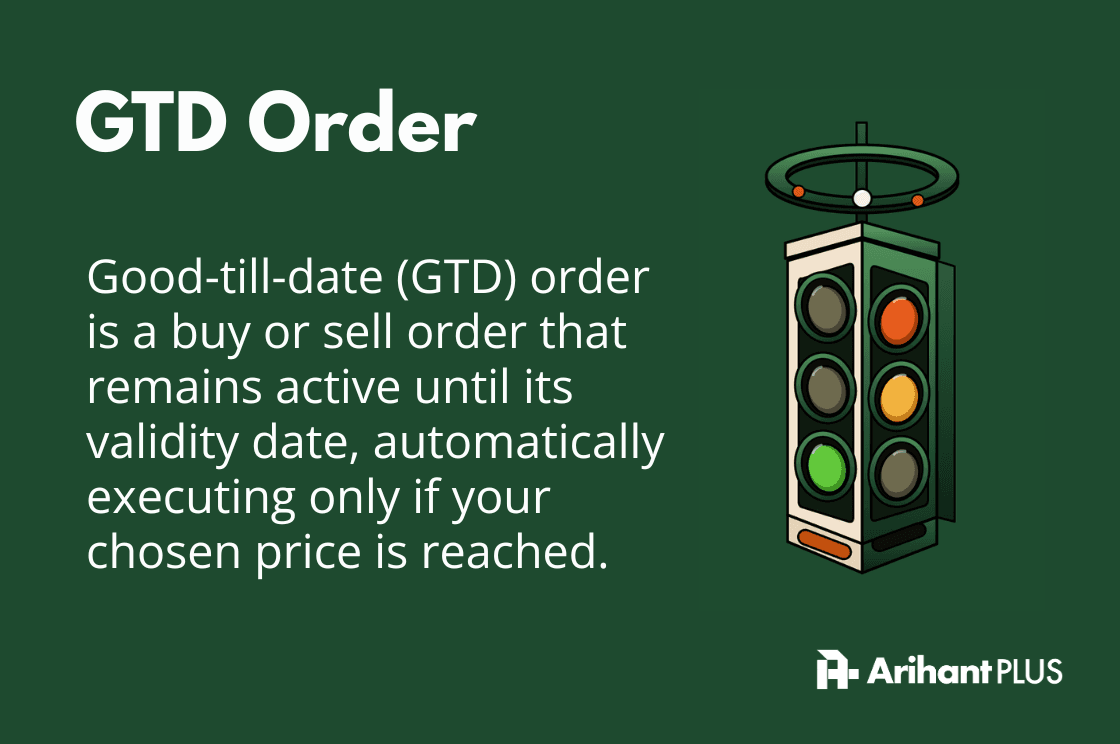
A Good-Till-Triggered (GTD) order is an instruction you give to buy or sell a stock when it reaches a predetermined trigger price, valid until the day you choose. So, your order will remain active until
- the trigger condition is met or
- the validity date expires or
- you cancel the order.
With GTD you don’t need to place your order every morning, or track the market all day. Set your price, place your order once and you're done.
For example, say a stock is trading at ₹1,200 but you only want to buy it if it falls to ₹1,100. Simply place a GTD buy order at ₹1,100 with a validity date of up to 1 year. The moment the stock hits your trigger price, the system automatically sends your buy order to the exchange.
Similarly, if you own a stock and wish to sell it when it reaches a certain target price, a GTD sell order can help automate that process too.
Open a free account today
Invest in tomorrow with just one click
Benefits of GTD Orders
Convenience GTD orders eliminate the need to track stock prices throughout the day. You can set your preferred levels and let the system do the work.
Disciplined Investing Emotional decision-making often affects investment performance. GTD orders help you stick to your predetermined entry and exit levels.
Never Miss an Opportunity Market prices can move quickly. GTD orders ensure that your investment plan is executed when the specified price condition is met.
Time-Saving Even if you cannot actively monitor the markets, you can still participate effectively using GTD orders.
- Better Risk Management By setting predefined buy or sell levels, you can manage your positions more efficiently and follow a structured investment strategy.
How GTD Orders Work
The process is simple:
- Select the stock and press the BUY button
- On the top, tap on GTD option (Regular order pad opens by default)
- Specify the quantity and the trigger price
- Enter the validity date of your order (it can be upto 1 year from now)
- Tap on Buy to place your GTD order.
You’re all set!
Now, when the stock touches your desired price (trigger condition is met), the order is automatically sent to the exchange. However, you need to understand that the success of your order execution depends on -
- market conditions,
- liquidity,
- your fund position, and
- availability of matching orders.
GTD vs GTT: What's the Difference?
Both work on the same idea, you set a trigger price, and the system watches the market for you and places the order when the condition is met. The difference is expiry.
Good till-trigger or GTT order stays active for up to one year, and that validity is fixed. While a good till date or GTD order lets you choose the expiry date, anywhere from tomorrow to a year from now. If the trigger isn't hit by your chosen date, the order simply expires.
That control matters because your investment view usually has a timeline. Want to buy a stock only if it dips this month? With GTD, you set your price and your timeframe.
One thing to keep in mind: the features of GTD and GTT may not be identical across all trading platforms. Validity periods, supported segments, and modification rules can vary from broker to broker, so it's always worth checking how the feature works on the platform you're using.
Important Points to Remember
While GTD orders offer convenience, you should understand that triggering does not guarantee execution. If the market price moves rapidly or sufficient liquidity is unavailable, your order may remain pending or partially executed.
Keep sufficient funds in your trading account for your GTD order to be successfully executed. When the trigger price is hit, and if you will not have the funds, your order will be rejected. Similarly, for a sell GTD order, make sure you hold the stock in your demat account.
- You should also regularly review your GTD orders to ensure they continue to align with your investment objectives and market outlook.
Conclusion
Good-Till-Triggered (GTD) orders are a valuable tool if you're seeking convenience, discipline, and automation in your investment journey. Whether you are waiting for an attractive buying opportunity or aiming to exit at a specific price, GTD orders help ensure that your strategy is executed efficiently, even when you are away from the market.

FAQs
Which securities can I place a GTD order for?
You can place GTD orders across the following segments:
- Equity (Cash Segment) – stocks listed on NSE & BSE
- ETFs – Exchange Traded Funds listed on NSE & BSE
- Equity Futures – F&O Segment
- Equity Options – Index & Stock Options (F&O Segment)
Do I need to allocate funds before placing GTD orders?
Yes. Sufficient funds may be required when the order gets triggered and moves to the exchange for execution. Please ensure adequate funds are available in your demat account.
What is the maximum validity period for a GTD order?
The maximum validity of a GTD order varies from broker to broker. Some trading platforms cap the GTD at 40 days while others have a validity of upto 1-year. On the ArihantPlus trading platform you can place your GTD order with a validity of upto a year.
Can I place a GTD stop loss order?
Yes, you can. Normally, stop loss orders are for intraday trades only. This means, if the trigger isn't hit, they expire at market close, and you'd have to place them again the next morning.
A GTD stop loss solves this for your longer-term holdings. Set your stop loss once, as stop loss market (SLM) or stop loss limit (SL), and it stays active until your chosen validity date, protecting your position from downside day after day, automatically. On ArihantPlus, you can place GTD order with both stop-loss market and stop-loss limit options. View this video to learn how to place stop loss order.

Related Topics




Stock Split vs Bonus Shares: What’s the Difference & What It Means For You?


Stock SIP Explained: A Smarter Way to Build Long-Term Wealth

Mutual Funds vs PMS: What’s the difference and which one is right for you?

Inside REITs: India’s Growing Real Estate Income Opportunity

Small Caps Lead Q1 Growth: Truth Behind India Inc’s Q1FY27 Earnings

Understanding Margin Trading Facility (MTF): A Detailed Guide


What is an Offer for Sale (OFS)? A Complete Guide for Investors

Ethical Investing Gets Real: NSE and BSE Launch Saatvik and Ahimsa Indices

CM Vijay's ₹213 Crore Bank Balance Teaches India's Biggest Investing Mistake

Understanding Bonus Shares and Their Impact on Your Portfolio

Understanding Stock Splits and Their Impact on Your Portfolio




How to Analyse a Stock in 2026: Fundamental + Technical Checklist





Silver vs gold 2025: Why smart investors are choosing silver now