
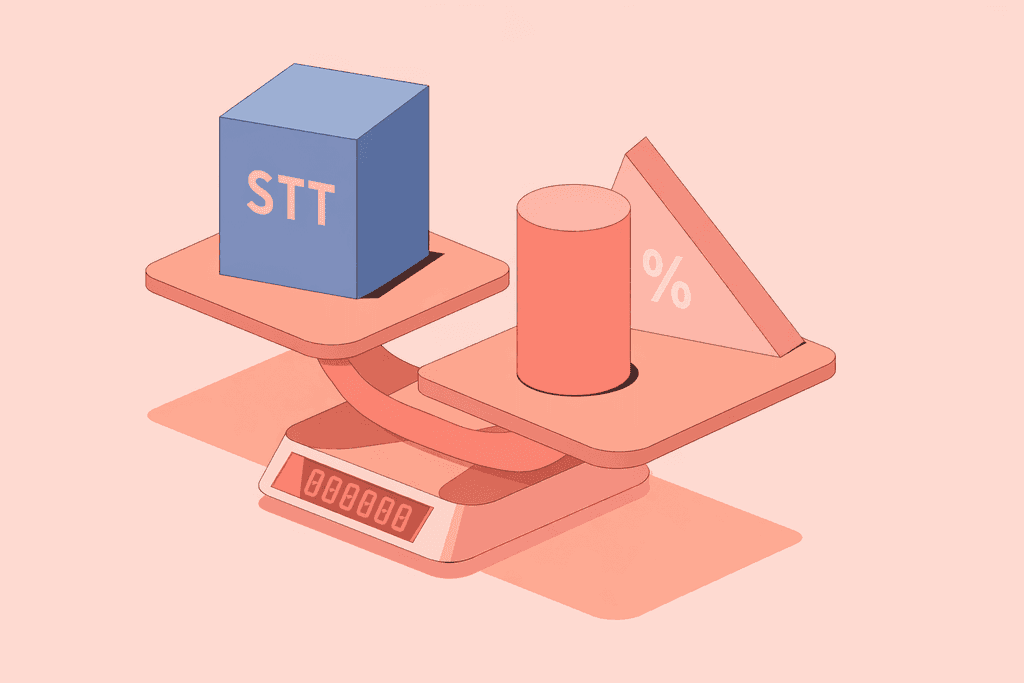
What is STT & How it impacts traders and investors

By
Arihant Team
Securities Transaction Tax (STT) is quietly deducted from every stock and derivatives trade in India, regardless of profit or loss. As rates rise again, F&O traders face increasing friction on turnover. The question is, will higher costs curtail speculation or simply deepen retail capital erosion?
In This Article
- Introduction
- First: What STT actually is (and what it is not)
- STT is just one of many costs you pay
- How much STT do you actually pay?
- How is STT charged?
- To sum up
- FAQs
Introduction
Every time you trade in the Indian stock market, the government of India charges a small tax whether you make a profit or a loss. This tax is higher than the brokerage you pay and is automatically charged on every transaction, quietly and consistently.
Yes, we are talking about the Securities Transaction Tax, or STT.
With the latest Finance Minister increasing STT rates again yet again in Union Budget 2026, it’s worth understanding what this tax really does, why it keeps rising, and what it signals about the government’s view on retail trading.
Open a free account today
Invest in tomorrow with just one click
First: What STT actually is (and what it is not)
Securities Transaction Tax (STT) is a direct tax by the government of India applied to the value of your trade. This tax is levied on the purchase and sale of stocks and other securities on Indian stock exchanges irrespective of whether you make a profit or loss. It is automatically deducted by your broker at the time of trade execution on stocks, ETFs, derivatives, equity-oriented mutual funds and other securities.
STT was introduced in 2004 to tackle tax evasion, particularly capital gains tax. To keep the market balanced and curb speculation, the government periodically reviews and adjusts the STT rate.
To understand STT clearly, it helps to keep a few simple points in mind.
- STT is not another form of brokerage. While your broker collects it and displays it in your contract note, the amount is passed on entirely to the government. The broker is only an intermediary in the collection process.\
- STT is not refundable. Once it is deducted at the time of the transaction, it cannot be recovered simply because the trade resulted in a loss.
- STT does not replace capital gains tax. The two operate independently. STT is charged when you execute the trade, whereas capital gains tax is charged later based on your net profits when you file your tax return.
- Most importantly, STT is outcome-agnostic. It applies to the transaction value itself, not to your profit. Whether you earn ₹50,000 or lose ₹50,000 on a trade, STT is deducted all the same. That is what makes it structurally different from taxes that are linked to income or gains.
STT is just one of many costs you pay
Most traders obsess over brokerage because that’s the visible charge but the cumulative drag from the other five is often larger and far less understood, especially STT.
Here’s a look at what charges do you pay every time you “Buy” or “Sell” a security:
Of these, STT is unique because it is charged on transaction value, not on profits.
How much STT do you actually pay?
STT rates vary depending on the security you trade and also the type of trade.
In the latest union budget, while the STT rates remained unchanged for equity delivery and intraday, the Finance Minister increased the STT on futures and options, effective April 1, 2026.
Find below the STT you will pay for every transaction you will make.
Here’s a breakdown of what you will pay for each transaction with example:
Equity Delivery
If you buy ₹1 lakh worth of shares and later sell them, you pay ₹100 when you buy and ₹100 when you sell, a total of ₹200. This applies regardless of whether you made a profit or a loss.
Intraday Equity
Intraday trades attract STT only on the sell side. The rate is lower than delivery, but it still applies automatically on every executed trade. And is calculated on the average price.
Futures & options
This is where active traders feel the most impact, especially those with high turnover. Here are the latest STT rates on F&O transactions (effective April 1, 2026):
With the rise in retail participation in the futures and options trading and growing speculation in the market, the government made two major hikes in STT on F&O trades in the last two years in order to protect the interest of retail traders.
First there was ~60% F&O STT increase made in Budget 2024 and the second (and most recent) hike in STT was announced in Budget 2026 between 50-150% on options and futures.
STT on exchange traded funds
STT applies only to equity ETFs, and it is charged when you sell them on the stock exchange.
- If you sell an equity ETF as a delivery trade (including BTST), STT is 0.001% on the sell value, which is equivalent to ₹1 per lakh.
- If you sell it as an intraday trade, STT is 0.025% on the sell value, which is equivalent to ₹25 per lakh.
You do not pay STT when buying any ETF. And there is no STT on gold ETFs, debt ETFs, liquid/gilt ETFs, and most international ETFs.
Securities exempt from STT
Some securities are exempt from STT, they are listed below:
- Unlisted Securities
- Commodity derivatives (gold, silver, other commodities)
- Currency futures and options
- Off-market transactions
- Debt securities & debt mutual funds.
You can download the STT Non-applicability Report from NSE's website to get the complete list of instruments on which STT is not applicable.
How is STT charged?
STT is applicable in the following cases:
- Delivery-based equity trades: On both buy and sell transactions
- Intraday equity trades: On the sell side only
- Futures & Options (F&O): On the sell side only
- Equity mutual funds: On the selling and repurchase of mutual fund units
Let’s understand from examples on how the STT is charged:
Delivery-Based Equity Trades
Delivery trades refer to buying shares and holding them beyond the same trading day. In such trades, STT of 0.1% is charged on both the buy value and the sell value, regardless of profit or loss.
Example: You buy shares worth ₹5,00,000 and later sell them for ₹5,50,000.
- STT on buy = 0.1% × ₹5,00,000 = ₹500
- STT on sell = 0.1% × ₹5,50,000 = ₹550
- Total STT payable = ₹1,050
Intraday Equity Trades
Intraday trades are those where shares are bought and sold on the same trading day.
Here, STT of 0.025% is charged only on the sell value.
Example: You buy shares worth ₹5,00,000 and sell them the same day for ₹5,10,000.
- STT = 0.025% × ₹5,10,000 = ₹127.50
- STT payable = ₹128 (rounded off)
Futures
For equity and index futures, STT of 0.01% is charged only on the sell-side turnover.
Example: You sell futures contracts worth ₹5,00,000.
- STT = 0.01% × ₹5,00,000 = ₹50
- STT payable = ₹50
Options
For options, STT is charged only on the sell side.
- On option premium (when selling) → 0.1% of premium
- On exercised options → 0.125% of intrinsic value
Example (premium sale): You sell option premium worth ₹50,000.
- STT = 0.1% × ₹50,000 = ₹50
- STT payable = ₹50
Equity Mutual Fund
- Equity mutual funds are those that have equity exposure of above ~65%.
- When you sell units of an equity mutual fund, STT of 0.001% is charged on the sale price and paid by the seller regardless of capital gains.
- Suppose you sell equity mutual fund units worth ₹5,00,000, then you will pay STT of ₹5 (0.001% of ₹5,00,000)
To sum up
STT is a meaningful revenue stream for the government, but for investors, it adds to overall trading costs. Because it is charged on transactions, frequent trading can become relatively more expensive, especially for short-term participants.
The actual impact depends on what you trade and how often you trade. Long-term investors feel it less, while active traders experience it more directly. Many traders do not consider the STT charges when trading. So make sure you calculate your overall cost, including STT, when placing trades.
FAQs
When is STT charged?
STT is charged at source. Every time you make a transaction, the STT is automatically charged by the broker at the time of transaction and built into your contract note. You do not have to separately pay STT
Do I have to pay STT with my taxes?
No, STT is charged automatically when you make a transaction, hence you do not have to pay it with your taxes. However, how you report it depends on your trading profile:
- As a Trader (Business Income): You can claim STT as a business expense to reduce your taxable profit. You can do this only if your trading income is classified as a business income and reported under ITR-3 or ITR-4.
- As an Investor (Capital Gains): You cannot claim STT as an expense or add it to your acquisition cost.
Where can I find STT charges for my trades?
You receive a contract note from us, or your other broker, on your email at the end of each trading day. That contract note has a complete breakdown of all your trades including charges like STT, brokerage, exchange charges and taxes. The exact amount of STT charges for your trades on that day will be listed in the contract note.
Will I have to pay STT if I make a loss on my trades?
Yes, you will have to pay STT even if your trade results in a loss. Unlike income tax, which is charged on your profit, STT is charged on the transaction value. It is calculated on the total value of the trade (turnover) at the moment you buy or sell, regardless of whether you end up making or losing money.
Related Topics
New Features Live: ArihantPlus Mobile App just got an upgrade!

Mastering Swing Trading: Top Strategies for Short-Term Stock Picks