



Is India's Water Crisis An Opportunity? Top Water Stocks

By
Arihant Team
India just committed ₹8.69 lakh crore to bring clean water to every rural home and some water stocks soared over ~16% on the news. But not every "water stock" wins equally. The money flows through layers: builders, pipe suppliers, pump makers. Each layer benefits differently, at different times. The real edge? Knowing which companies turn government promises into actual earnings.
In This Article
- Introduction
- The Story Behind the Jal Jeevan Mission
- Why Not Every “Water Stock” Benefits the Same Way
- From Policy Announcement to Earnings - The Missing Link
- Why the Market Still Reacted Positively
- The Forces That Could Limit the Upside
- What This Means for Investors
Introduction
When the government approved the extension of the Jal Jeevan Mission in March 2026, the market reacted almost immediately.
Water-linked stocks surged. Some water stocks soared over 16% within a single trading session, even as the broader market remained weak.
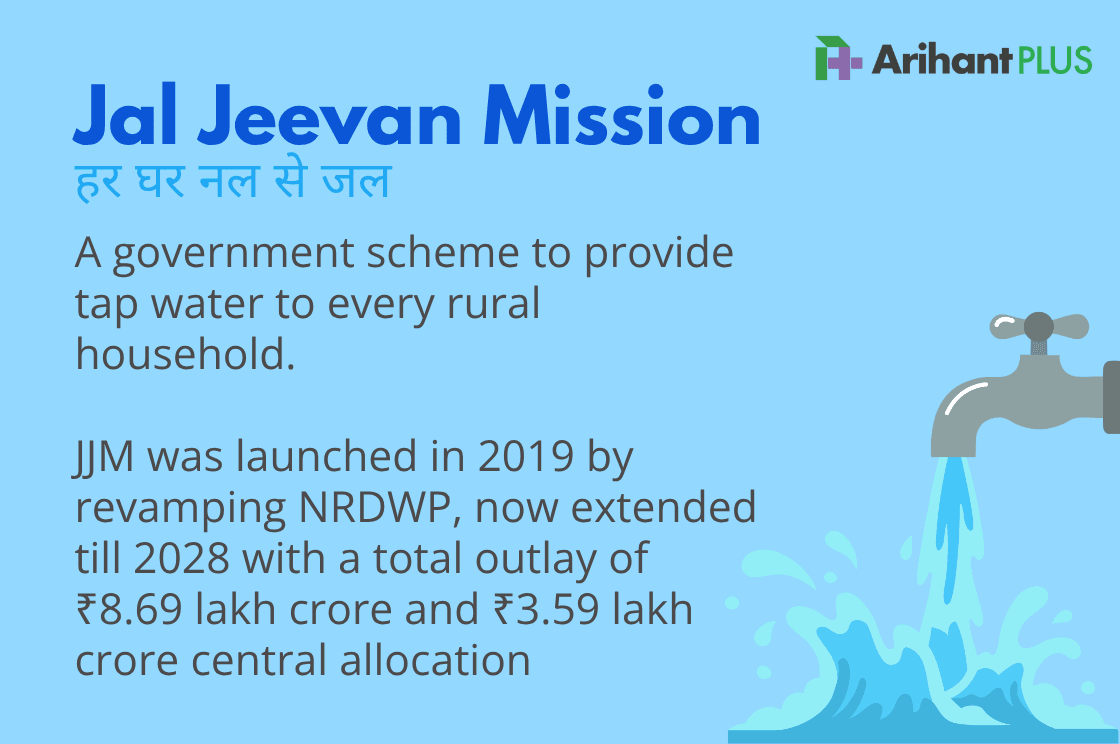
At first glance, the reaction seemed obvious. A massive government program had just been extended with a significantly higher financial commitment..₹8.69 lakh crore in total, with a fresh annual allocation of ₹67,670 crore.
For many investors, the conclusion felt straightforward. More spending should mean more business for companies connected to the water sector.
But as with most large policy-driven themes, the reality is more layered than it appears. Because while the opportunity is undeniably large, the way that money actually moves through the system and eventually into corporate earnings is neither immediate nor uniform.
The Story Behind the Jal Jeevan Mission
To understand why this program matters, it helps to go back to where things stood just a few years ago.
In 2019, when the Jal Jeevan Mission was first launched, only about 17% of rural households in India had access to tap water. The majority of the country’s rural population depended on wells, tankers, or other unreliable sources.
Over the next 6 years, that number improved dramatically. Today, more than 80% of rural households are connected.
However, roughly 3.5 crore households are still without reliable access.
More importantly, even where connections exist, ensuring that water flows consistently and safely remains a challenge. This is where Jal Jeevan Mission 2.0 comes in.
The extension is not just about completing the remaining connections. It reflects a broader shift from building infrastructure to maintaining functionality. In other words, the focus is moving from “creating assets” to “delivering a service.”
That shift has important implications for how different companies participate in this opportunity.
Open a free account today
Invest in tomorrow with just one click
Why Not Every “Water Stock” Benefits the Same Way
It is tempting to treat the water sector as a single theme. But in reality, it is better understood as a chain where different types of companies participate at different stages.
Layer 1
At the beginning of this chain are the companies that build the infrastructure. These are the engineering and construction firms that win government tenders and execute large projects like water treatment plants and pipeline networks.
When government spending increases, these companies are usually the first to see order inflows. However, those orders do not translate into immediate earnings. Revenue is recognized gradually, as projects are executed, often over multiple years. Delays in approvals, payments, or on-ground execution can slow this process down significantly.
Stocks in focus:
VA Tech Wabag, NCC, PNC Infratech, KEC International, Kalpataru Projects, Welspun Enterprises, Enviro Infra Engineers & SPML Infra
Layer 2
Once projects move from approval to execution, demand shifts to materials, especially pipes. These companies supply the physical network that carries water from the source to households.
Pipe companies do not benefit from announcements. They benefit from actual execution. If work on the ground is delayed, demand for pipes remains subdued, regardless of how large the budget allocation may be.
Stocks in focus:
Jindal Saw, Welspun Corp, Astral, Prince Pipes, Supreme Industries, Finolex Industries & Ratnamani Metals & Tubes
Layer 3
The final layer consists of pumps, motors, valves, and treatment systems, the components that ensure water actually flows through the system.
Under the earlier phase of the mission, this layer was important but not central. Under JJM 2.0, it becomes far more significant.
Because once infrastructure is built, the real challenge is keeping it operational.
This introduces a new type of revenue: operations and maintenance. Unlike construction projects, which are one-time in nature, maintenance contracts can continue for years. For companies operating in this segment, this creates a more stable and predictable earnings profile.
Stocks in focus:
Kirloskar Brothers, KSB, Shakti Pumps, Ion Exchange, Jash Engineering & WPIL
From Policy Announcement to Earnings - The Missing Link
One of the most common assumptions investors make is that government spending directly translates into company revenue. However, in reality, the process is more complex.
Funds are first allocated at the central level. These funds are then released to states, which are responsible for tendering and execution. Companies bid for these tenders, convert them into orders, and then execute projects over time. Revenue is recognized only as this execution progresses.
At each stage, delays can occur.
In fact, recent years have shown that budget allocations and actual spending can diverge significantly. Large headline numbers often create optimism, but actual fund disbursement tends to follow a slower and more uneven path.
This gap between allocation and execution is one of the key reasons why stock prices in this sector can move ahead of earnings.
Markets react to expectations. Earnings depend on delivery.
Why the Market Still Reacted Positively
Despite these complexities, the market’s initial reaction to JJM 2.0 was not misplaced. The extension of the mission provides something investors value highly, visibility.
It signals that government spending in this space will continue for several years. It increases the likelihood of sustained order inflows. And it expands the overall opportunity size for companies operating across the water infrastructure chain.
But visibility is not the same as certainty.
The companies that ultimately benefit the most will be those that can execute efficiently, manage their balance sheets through long payment cycles, and adapt to the shift toward service-oriented revenue.
The Forces That Could Limit the Upside
Even within a strong structural theme, there are factors that can limit how quickly benefits translate into earnings.
Delays in fund release can slow project execution. Payment cycles in government projects can stretch working capital, particularly for smaller companies. Large order books may take years to convert into revenue. And fluctuations in raw material prices, especially steel and polymers can impact margins for suppliers.
There is also the question of valuation.
When stocks move sharply on the back of policy announcements, part of the future opportunity often gets priced in early. If earnings take longer to materialize, that gap between expectation and reality can lead to periods of underperformance.
What This Means for Investors
The recent reaction to Jal Jeevan Mission 2.0 offers a useful reminder about how large infrastructure themes play out in financial markets.
It is rarely a straight line.
The opportunity itself is real. The need for water infrastructure in India is structural and long-term. Government commitment to this sector is unlikely to reverse.
But within that opportunity, outcomes will vary.
Some companies will convert policy tailwinds into steady earnings growth. Others may struggle with execution delays, cash flow pressures, or over-optimistic expectations.
For investors, the key is to look beyond the headline.
Instead of asking whether the sector will benefit, it is more useful to ask how and when a specific company participates in that benefit.

Related Topics





LIC Gets RBI Nod for 9.99% HDFC Bank Stake: Buy Signal or Market Noise?



Has Bandhan finally become a real bank? l Q1FY2027 Results Analysis

Bajaj Auto vs TVS Motor Q1FY27 | Beyond profits, whose quarter was stronger?


Wipro Q1 FY27 Results | 7 Key Takeaways Every Investor Should Know




Tata Motors Demerger Gets NCLT Nod: What Shareholders Must Know
ICICI Lombard Q1FY26 Result: Profit jump 28.7%, Strong Margin & Digital Momentum