

Iran-Israel War Impact: Guide for Indian Investors Now

By
Arihant Team
Geopolitical conflicts like the Iran–Israel crisis can shake global markets, push oil prices higher, and trigger sharp volatility in Indian equities. But history shows markets eventually recover. Here’s how such wars impact India’s economy, key sectors, and what smart investors should do to protect and position their portfolios.
In This Article
- Introduction
- Why did a war in Eastern Europe affect us so much?
- How did the market react?
- Now Fast-Forward to 2026
- Why is this war harder for India than the last one?
- The sectors feeling it now
- So, what's the pattern here?
- Here’s what smart investors do during uncertain times
Introduction
Picture this: you wake up, check your phone, and the first headline screams - 'War breaks out.' Before you've even had your morning chai, your portfolio is already bleeding.
It happened in February 2022 when Russia marched into Ukraine. And it happened again in February 2026, when the US and Israel launched strikes on Iran. Different wars, different continents - but if you're an Indian investor, the pain is remarkably similar.
So, let's have an honest conversation about what these wars actually did to your money, why India keeps getting caught in crossfire it didn't start, and most importantly what you should do when the world is on fire.
Let’s rewind to February 2022
Russia called it a 'Special Military Operation.' The rest of the world called it an invasion. Whatever the label, the moment Russian tanks crossed into Ukraine, financial markets everywhere went into shock.
India was no exception. The Sensex and Nifty 50 crashed nearly 5% that day. It was the biggest single day fall in nearly two years. Most portfolios were bleeding, including yours too.
Open a free account today
Invest in tomorrow with just one click
Why did a war in Eastern Europe affect us so much?
Fair question. Ukraine and Russia aren't exactly our neighbours. But here's the thing, in a globalised world, energy connects everyone.
India imports over 85% of the crude oil it needs. The moment war broke out, traders globally started panicking about supply disruptions and Brent crude crossed $100 per barrel for the first time in years. And when oil gets expensive, everything gets expensive. Your petrol. Your cooking gas. Even the paint on your walls - because paint companies use crude derivatives as raw materials. The guy selling you the chai outside your office was eventually affected too, because milk gets transported in trucks that run on diesel.
Oil is the hidden ingredient in almost everything we buy. When its price spikes, inflation follows like a shadow.
Wheat was another story nobody saw coming. Russia and Ukraine together supply nearly 30% of the world's wheat. When the war disrupted those shipments, wheat prices hit a 13-year high. Atta, bread, biscuits - the ripple was felt right in Indian kitchens.
And let us not forget gold. Whenever the world gets scary, investors run to gold. It's been that way for centuries and 2022 was no different. Gold prices jumped sharply. If you were holding Sovereign Gold Bonds or a Gold ETF, that was your portfolio’s silver (or golden) lining.
Now here is what India could do differently (and smartly) last time. As Western nations piled sanctions on Russia, Moscow was desperate for buyers for Russian Urals. It was suddenly available at a $20-$30 discount per barrel.
India found a great bargain and said yes. Russia's share in India's crude imports jumped from just 2% in 2021 to nearly 40% by 2023-24. Indian refiners like Reliance and Nayara were buying cheap Russian crude, refining it, and selling the products worldwide (including to Europe). This middleman, India saved approximately $7 billion or more.
Economically, this move was a masterclass in turning someone else's crisis into your own advantage.
How did the market react?
Not all stocks fell equally. Here's how it played out across sectors:
- Auto: Sales of 2-wheelers started slowing as fuel prices climbed. On top of that, the global semiconductor shortage and it was a rough time.
- Paints & Tyres: Asian Paints, Berger, Apollo, MRF - all dependent on crude-based raw materials. Their margins came under pressure.
- Aviation: Jet fuel is basically refined crude. IndiGo and others were staring at a massive cost increase.
- ONGC & Oil India: Higher crude prices are actually great news for companies that pump oil out of the ground. They sell at market rates — so a price spike means fatter profits.
- Metals: Russia is a big exporter of metals. So naturally, when it faced sanctions, Indian metal companies suddenly had less competition worldwide. Tata Steel, Hindalco — they quietly benefited.
- Defense: War always makes people wonder if India needs to spend more on its military. HAL, BEL, and Bharat Forge started getting attention.
Now Fast-Forward to 2026
Late February 2026. US and Israeli forces launched coordinated strikes on Iran. The Iranian Supreme Leader was killed. Tehran's response came quickly, Iran announced the closure of the Strait of Hormuz.
If you don't know what the Strait of Hormuz is, imagine a narrow bottleneck — just 33 kilometres wide at its narrowest - through which over 20% of the world's daily oil supply flows. For India specifically, roughly 35-50% of our crude imports and nearly 85% of our LPG passes through it.
When Iran threatened to close that bottleneck, the reaction was instant and brutal.
What happened to Indian markets?
On 2nd March 2026, the Sensex opened and almost immediately crashed over 2,700 points, that’s a 3.37% fall in a single session. Nifty 50 dropped over 530 points. Over the next 2 days, Brent crude had already surged to nearly $82 a barrel and the rupee fell to a record low of ₹92.18 against the dollar. (March 4th)
It didn't stop there. The selling continued the next trading session too. The Sensex shed another roughly 1,800 points in the morning alone. Estimates suggested Indian investors collectively lost around ₹16 lakh crore in market value in just a few days. The India VIX, which measures how fearful the market is, jumped over well 15% even touching 21%.
To put ₹16 lakh crore in perspective — that's more than the annual GDP of most countries on earth. That's how much paper wealth evaporated in a few days of selling.
Airlines got hit first and fastest
IndiGo, SpiceJet, travel stocks — down 7-11% in a single session. It makes sense if you think about it. Airlines were already dealing with high jet fuel costs. Now add airspace closures over the Middle East disrupting routes, and it's a nightmare scenario for them.
Why is this war harder for India than the last one?
In 2022, India had an escape route - discounted Russian oil. This time, the problem is different and it hits closer to home.
Let's start with the numbers. India imports 88% of its crude oil, which is just over 5 million barrels every single day. Of that, 2.6 million barrels per day flow through the Strait of Hormuz, sourced from Iraq, Saudi Arabia, Kuwait, and the UAE. That's roughly half of our daily crude supply!
But crude oil is actually the easier problem to manage. According to the Hindu, we hold about 25 days of crude inventory, 25 days of petrol, diesel (energy products). Apart from this, India also has strategic petroleum reserves for another week.
93% of India's LPG imports - totalling 23.3 million tonnes a year, come from West Asia. (Business Standard)
According to the Hindu Business Line India's Liquefied Petroleum Gas (LPG) storage provides approximately 25–30 days of supply coverage. While India lacks dedicated, long-term strategic underground LPG reserves, its current commercial stocks are considered comfortable by government sources despite potential supply disruptions. But, when that supply chain breaks, it breaks fast and it breaks at the dinner table.
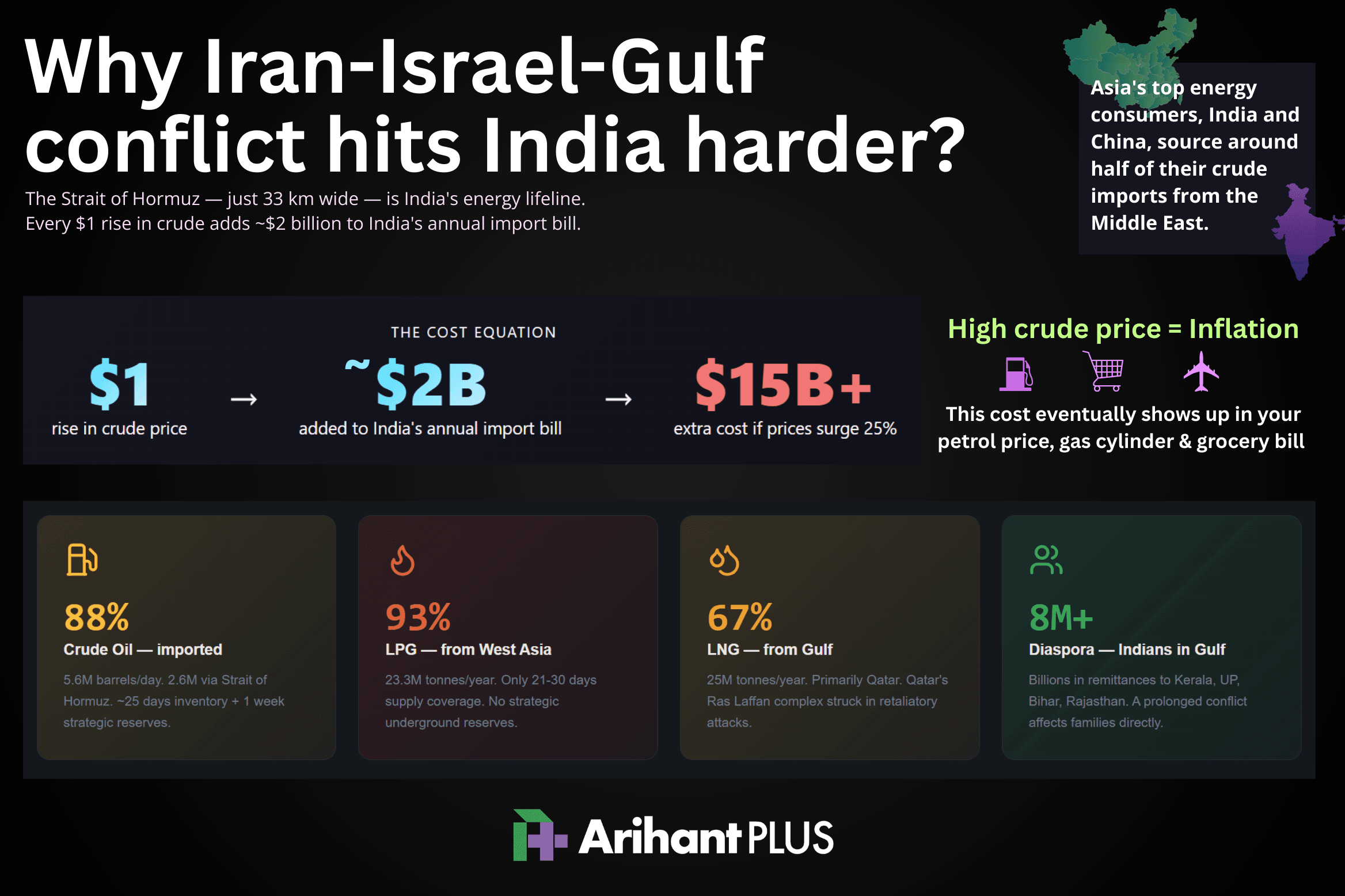
Natural gas tells a similar story - 67% of India's 25 million tonnes of annual LNG imports come from the Gulf, primarily Qatar. And Qatar's Ras Laffan LNG complex was struck in Iranian retaliatory attacks, halting production. There's no underground gas storage in India the way China has it. When LNG supply tightens, there's no buffer to draw from.
Every $1 rise in crude oil prices adds roughly $2 billion to India's annual import bill. A sustained 25% price surge, already within analyst forecasts, could cost India an extra $15 billion. That's not a number that stays on paper. It eventually shows up in your petrol price, your gas cylinder, and your grocery bill.
If the crisis heightens, India will again need to turn to Russia for crude oil but now the tables have turned. In 2022, Russia was a willing seller and India was a bargain buyer. In 2026, Russian leverage has shifted as it is one of the few options available so Russian crude will not come cheap!
To add to this, the Strait of Hormuz doesn't just supply oil to India. It supplies the Gulf region's labour market, which employs over 8 million Indians who send home billions in remittances. A prolonged conflict in the Gulf doesn't just affect your fuel bill, it affects families across Kerala, UP, Bihar, and Rajasthan whose income depends on jobs there.
The sectors feeling it now
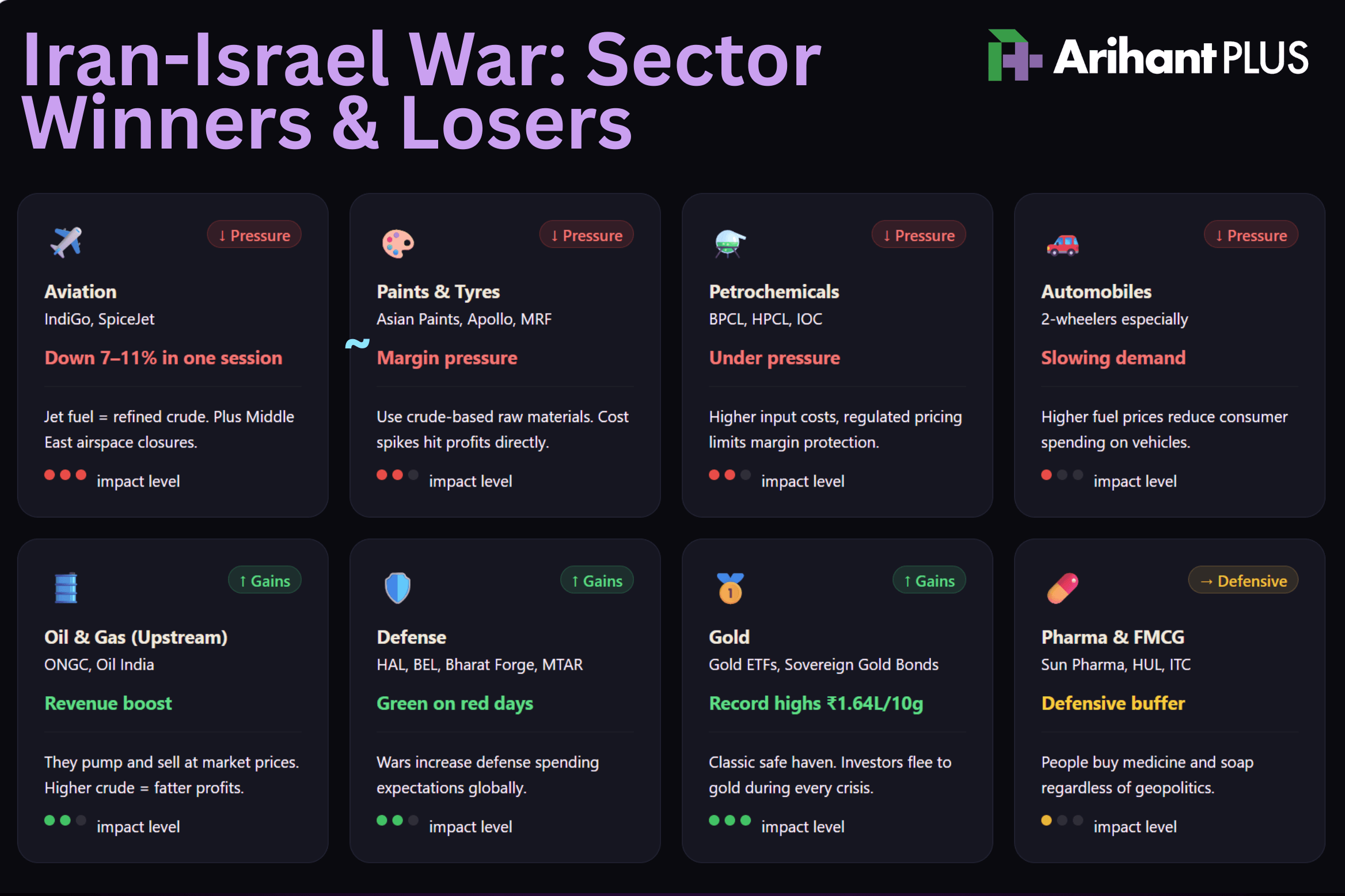
Same story, slightly worse. Oil-linked companies are under pressure. But a few are holding up or even gaining:
- ONGC & Oil India: Again, higher crude prices will boost their revenue.
- Gold: Gold has already hit record highs around ₹1.64 lakh per 10 grams. If you hold gold in your portfolio, you're cushioned.
- Defense: BEL was among the few green stocks on the worst crash days. Defense always finds buyers when the the world is at war.
- Pharma & FMCG: People still buy medicines and soap regardless of geopolitics. Defensive sectors are doing their job — defending your portfolio.
So, what's the pattern here?
Look at these two wars and you notice the same script playing out, almost beat by beat.
A war breaks out somewhere that matters for energy. Oil prices spikes. Markets panic. The Sensex falls in the first session, Rupee weakens and foreign investors pull money out of India.
Then, a few weeks or months later, markets stabilize and recover. The investors who stayed put are better off than those who sold in fear.
The same story has played out time and again in Kargil, 9/11, the 2008 financial crisis, and even COVID. After Russia-Ukraine, the pattern is almost predictable.
The market has a short memory for geopolitical events, but a long memory for earnings and growth. India's fundamentals don't change because of a war in the Middle East.
One genuine difference this time: in 2022, India was a bystander who found a clever angle. In 2026, the Middle East, which is India's biggest oil source, biggest remittance market, and a key export destination is the actual conflict zone. The stakes are closer to home.
Here’s what smart investors do during uncertain times
Let's be real. Reading about geopolitics is one thing. Figuring out what to do with your own money is another. Here's how to think about it.

First — don't sell in panic
Seriously. The worst financial decisions in history have been made in the first 48 hours of a crisis. If your portfolio is down 5-8% right now, that feels terrible, but it's temporary. The investors who sold everything when COVID hit in March 2020 and then watched the market recover 80% in 12 months. They learned this the hard way.
Check what you own
Not all stocks are equally exposed. If your portfolio is heavy in aviation, paint companies, tyre makers, or petrochemicals, those are the ones facing real near-term pressure because their costs are going up. Worth reviewing. Not necessarily selling everything but knowing why they're falling and whether the business is fundamentally fine.
Gold is your friend right now
If you don't have any gold in your portfolio, this might be a good moment to add some. Not by going out and buying jewellery. That's expensive and illiquid. Gold ETFs give you clean exposure. Gold has historically done well during every major conflict of the last century.
Defense stocks - interesting, but don't chase them
HAL, BEL, Bharat Forge, MTAR Technologies. Yes, these tend to do well when defense spending goes up. But they've already had a big run-up, and valuations at these levels need to be respected. If you want exposure, small and steady is better than chasing a 10% pop.
Keep your SIPs running. Please.
This one is important. If you invest via SIPs in mutual funds, a market crash is actually good news for you - your fixed amount buys more units at lower prices. Stopping your SIP during a crash is like not buying mangoes because they've gone on sale. Let the SIP do its job.
Think about what you'd regret more
In five years, will you regret holding through a few weeks of volatility? Or will you regret selling quality businesses at distressed prices because a war 3,000 kilometres away made you anxious? Most experienced investors, if they're honest, will tell you the second kind of regret is far worse.
There's an old saying in markets: 'Time in the market beats timing the market.' Wars are not a reason to exit. They're usually a reason to stay put - or even add positions strategically.
Wars are devastating. The human suffering they cause is real and heartbreaking. But as investors, we can't afford to be paralysed by fear every time the world goes through one of its crises. What we can do is understand the pattern. Oil-sensitive India will always feel the heat when the Middle East burns. But India's growth story - the demographics, the domestic consumption, the digital economy, the manufacturing push - none of that changes because of a war we didn't start.
Stay informed. Stay invested. And maybe, just maybe, stay away from your trading app for the next few days. Unless it's for smart buying.

Related Topics

Tech Mahindra Announces 1:1 Bonus Shares: Q2FY27 Profit Jumps 33%

EGR vs Gold ETF: Key differences, taxation & which should you choose?


Canara Robeco AMC IPO: Should You Apply for MF Giant’s Public Debut?

Dematerialisation of Mutual Funds: Complete Guide, Process & Benefits

What Is an Equity Fund? Types, Benefits & How to Invest in Equity Funds







Demystifying Demat Accounts: Meaning, Benefits, and How to Open One in India