


Bajaj Auto vs TVS Motor Q1FY27 | Beyond profits, whose quarter was stronger?

By
Arihant Team
Bajaj Auto vs TVS Motor Q1 FY27 results: TVS sold nearly 1.9 lakh more vehicles during the quarter, but Bajaj reported a much higher net profit of ₹2,983 crore compared with TVS Motor’s ₹1,174 crore. So, which company really had the stronger quarter?
In This Article
- Introduction
- Product portfolio
- International business
- Inside EV strategy
- Capacity expansion
- Q1FY27 Management Guidance
- Cost and margin outlook
- Conclusion
Introduction
Two of India’s largest two-wheeler makers reported their Q1 FY27 results within days of each other. The headline contrast is striking: TVS Motor sold nearly 190,000 more vehicles than Bajaj Auto, yet earned ₹1,809 crore less in profit.
Most people while reading results stop at revenue, margins and profit growth. But I feel the more interesting story lies in what management is saying about exports, EVs, capacity, products and future growth.
So, we will first look at the numbers and then at the 6 signals that could matter far more from here.
Snapshot of FY27 Q1 numbers | Bajaj Auto vs TVS Motor
Source: Company Filings
Open a free account today
Invest in tomorrow with just one click
Product portfolio
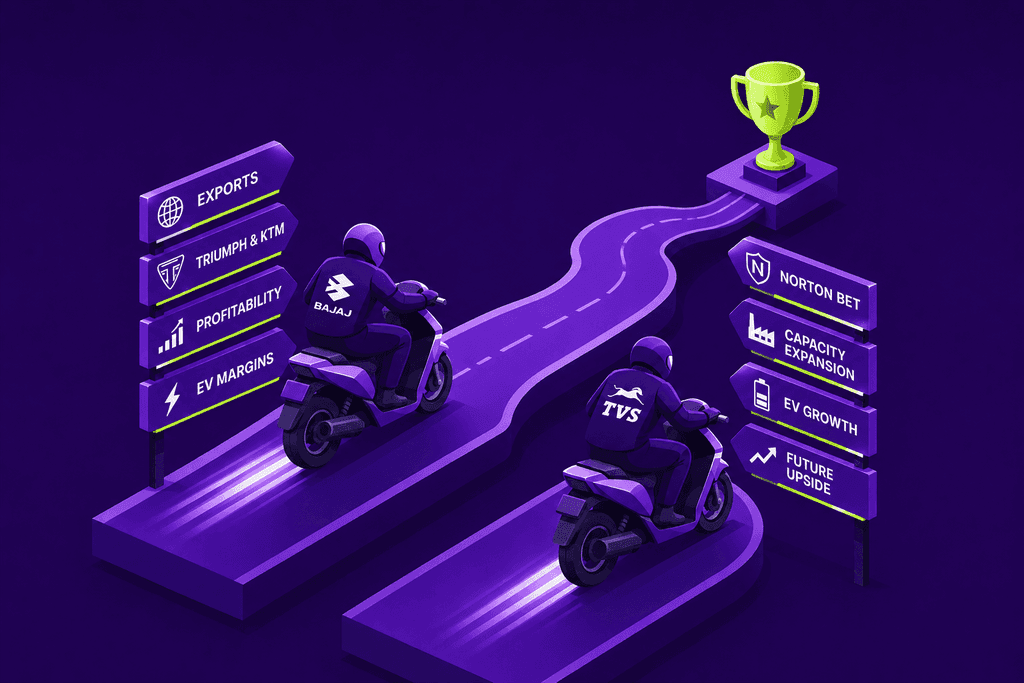
Bajaj and TVS are both using premium global brands to move beyond mass-market motorcycles, but they are at different stages.
For Bajaj, Triumph is already scaling, with export volumes up 40% YoY and domestic demand holding firm. KTM, meanwhile, is still in turnaround mode, with production being ramped up gradually as retail demand improves.
TVS is making a longer-term bet through Norton. After investing about ₹25 billion over the past 4–5 years, it has begun a phased rollout across the UK, Europe, the US and India, starting with four premium motorcycles across superbike, naked, adventure and sport-touring segments.
So, Bajaj has stronger near-term traction through Triumph and a recovering KTM, while TVS is still building Norton’s brand, distribution and customer acceptance before chasing volumes.
International business
Bajaj has the stronger export base today, with international sales contributing 40% of revenue and quarterly volumes at 732,000 units, led by Africa and Latin America. Its near-term growth remains tied to the Boxer platform, geographic expansion and a diversified overseas portfolio.
TVS is less export-dependent at 26% of revenue, but has a wider growth pipeline across premium motorcycles, scooters, iQube and electric three-wheelers. Norton also gives it a route into developed markets.
Inside EV strategy
Bajaj and TVS are both scaling their electric vehicle businesses, but they are at different stages of the journey.
Bajaj’s Chetak franchise continues to gain momentum, while its combined electric 2 wheeler and 3 wheeler business is already generating double-digit EBITDA margins. This suggests that Bajaj’s EV operations are not only growing but have also begun contributing meaningfully to profitability.
TVS, meanwhile, is taking a broader, investment-led approach. The company expects EV penetration to rise beyond the current 10.6% in FY27 and plans to expand its product portfolio across battery-electric and flex-fuel technologies.
Capacity expansion
Bajaj is increasing capacity from 7 million to 9 million units, with most of the addition directed toward EVs, premium motorcycles and three-wheelers. This should ease supply constraints while improving exposure to faster-growing, higher-margin categories.
TVS is pursuing a broader expansion, taking total capacity to 10.3 million units by Q4FY27 through a ₹35 billion investment in two-wheelers, three-wheelers and new products.
Q1FY27 Management Guidance
TVS expects to outgrow the industry in FY27, supported by premiumisation, higher production, cost efficiencies and a diversified ICE-EV portfolio.
With domestic two-wheeler growth seen in double digits and EV penetration at 10.6%, management expects Q2FY27 to improve over Q1FY27 on normalised production, stronger exports and better operating leverage, while margins expand gradually.
Bajaj, in contrast, is prioritising profitability over entry-level market share. Its focus remains on the faster-growing 150cc+ segment, supported by 10 new variants, including two Pulsars in the next six weeks and two new 125cc brands by FY27-end.
Cost and margin outlook
TVS faced nearly 4% commodity inflation in Q1FY27, but expects pricing, a better product mix and productivity gains to absorb most of the pressure.
Bajaj is taking a more cost-led approach, aiming to protect EBITDA margins through disciplined cost control rather than depending heavily on price increases.
TVS is using multiple levers to offset inflation, while Bajaj is placing greater emphasis on structural cost discipline.

Conclusion
Bajaj’s exports, premium portfolio and EV business are already contributing to earnings. TVS is still investing in Norton, capacity and EV growth, giving it more upside but also more execution risk.
The challenge for Bajaj is finding the next meaningful growth engine beyond its established strengths. At TVS, the focus is on scaling these investments quickly enough to narrow the profitability gap.
Over the next quarters, clearly the decisive factor will be how effectively each strategy translates into profit.

Related Topics





LIC Gets RBI Nod for 9.99% HDFC Bank Stake: Buy Signal or Market Noise?



Has Bandhan finally become a real bank? l Q1FY2027 Results Analysis


Wipro Q1 FY27 Results | 7 Key Takeaways Every Investor Should Know




Tata Motors Demerger Gets NCLT Nod: What Shareholders Must Know
ICICI Lombard Q1FY26 Result: Profit jump 28.7%, Strong Margin & Digital Momentum