

Why are Gold ETF inflows rising?

By
Arihant Team
Gold and equities generally move in opposite directions. Investors may be looking at Gold ETFs to diversify their portfolio against stock market volatility because of US-Iran tensions.
In This Article
- Key Takeaways
- Introduction
- What are Gold ETFs?
- Why are people chasing Gold ETFs?
- Why have AMCs stopped accepting fresh Gold ETF FoF investments?
- Are AMCs restricting fresh investments in Gold ETFs?
- Investor Takeaways
- FAQs
Key Takeaways
- Geopolitical tensions have led to rising crude oil prices impacting the Indian stock markets.
- Gold ETF inflows are rising because investors want to protect their portfolio against stock market crashes.
- AMCs have temporarily restricted fresh investments in Gold ETF FoFs.
- Ongoing Gold ETF FoF SIPs continue uninterrupted and redemptions stay open.
- Mutual Fund Houses have not restricted investments in Gold ETFs.
Introduction
Did you know Gold ETF inflows surged 71% in September 2026 to ₹4,451 crores?
Why are so many investors chasing gold ETFs? Is it because gold prices dipped in September 2026 by 3.5% or is there another reason for this sudden interest in gold ETFs?
Lets go behind the scenes
Open a free account today
Invest in tomorrow with just one click
What are Gold ETFs?
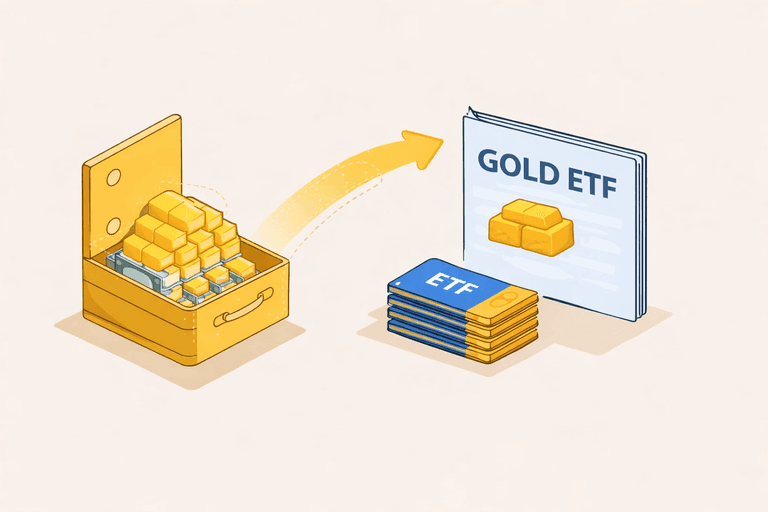
Gold Exchange Traded Funds or Gold ETFs are funds that passively track domestic physical gold prices. Each Gold ETF unit represents a fractional amount of gold and units can be bought and sold on stock exchanges.
When you and other people invest in Gold ETFs the fund manager pools this money and buys physical gold of very high purity. This gold is stored in highly secure vaults managed by SEBI-registered vault managers.
Your investment in Gold ETFs are backed by actual physical gold stored in these vaults. So, if you buy 1 unit of Gold ETF you are the owner of a fractional piece of the physical gold stored in the vaults.
Each unit represents a specified quantity of gold, which varies across fund houses. For some ETFs, one unit may represent 0.01 gram of gold; for others, it may represent a different quantity. You can check the scheme's documents to know exactly how much gold each unit represents.
And because Gold ETFs are listed on stock exchanges, you can buy or sell their units through a demat and trading account, much like shares.
Why are people chasing Gold ETFs?
Source: AMFI
If you look at Gold ETF inflows in January 2026 they were a massive ₹24,039 Crores. What’s surprising is gold prices were close to ₹1.75 Lakhs per 10 grams in late January. This shows that many investors were probably chasing higher returns from gold ETFs with the hope that gold prices would rise even higher.
Even though gold prices fell across September 2026 by 3.5% averaging around ₹1.5 Lakhs per 10 grams, many investors continued to chase returns from gold ETFs. It is because gold prices had risen a few months back and a fall in prices could be seen as an opportunity to accumulate Gold ETFs at lower price levels. This is a behaviour called recency bias where you assume that whatever is happening right now will continue indefinitely into the future.
Another reason why you could look at Gold ETFs is because gold protects your equity portfolio against stock market falls. US-Iran tensions and Houthis attacks on Saudi Arabia have increased geopolitical uncertainty.
As most of the world's crude oil comes from the Middle East, tensions in this region disrupt the supply of crude oil pushing up its price. India imports most of its crude oil and prices above $100 per barrel leads to rising inflation in the country. Higher crude oil prices are one of the main reasons why Foreign Institutional Investors (FIIs) heavily exited the Indian stock markets in 2026.
For example, FIIs have sold ₹3.1 Lakh crore of Indian equities so far in the calendar year 2026. So, many investors are switching to Gold ETFs to protect their equity portfolio against weak Indian stock markets and rising inflation in the country.
Why have AMCs stopped accepting fresh Gold ETF FoF investments?
Many Asset Management Companies (AMCs) stopped accepting fresh subscriptions into their gold ETF Fund of Funds (FoFs) from October 16, 2026. Now, Gold ETF FoFs are mutual fund schemes that invest their assets in Gold ETFs. Several AMCs have also temporarily stopped fresh lump sum, fresh SIP (Systematic Investment Plans), fresh STP (Systematic Transfer Plans), SIP Top-up and switch-in for their Gold ETF Fund of Funds from October 16, 2026.
However, your existing SIPs and STPs in Gold ETF FoFs will continue and your applications will be processed at applicable net asset values (NAVs). AMCs will allow redemptions, switch-outs and SWPs (Systematic Withdrawal Plans) in their Gold ETF FoFs.
While the AMCs have not yet given any reason for restricting fresh investments in Gold ETF FoFs, it's most due to the fall in Indian rupee. It has corrected almost 7% against the US Dollar year-to-date in 2026. Also, this could be a precaution to avoid a surge in gold imports in October during the upcoming festive season and prevent the rupee from falling further against the US Dollar.
Are AMCs restricting fresh investments in Gold ETFs?
No blanket restriction on exchange trading in Gold ETFs has been announced as such. You can still buy and sell listed Gold ETF units through your trading platform.
However, check a Gold ETF's indicative net asset value (iNAV) before buying.
Gold ETFs have two relevant prices:
- Market price: The price at which units trade on the exchange, determined by demand and supply.
- Net asset value (NAV): The per-unit value of the scheme's assets minus its liabilities, calculated using the applicable valuation method.
NAV is generally calculated at the end of the trading day. The iNAV provides an estimate of the fund's per-unit value during market hours.
If a Gold ETF trades above its iNAV, it is trading at a premium. If it trades below its iNAV, it is trading at a discount. A large premium means you could pay more than the fund's estimated underlying value.
You can compare iNAVs through exchange or AMC websites. Also compare expense ratios and tracking errors before choosing a Gold ETF.

Investor Takeaways
While gold ETFs can help you diversify your portfolio, they shouldn't be bought simply because prices have risen or markets look uncertain.
Decide how much gold your portfolio needs, then invest in line with your financial goals and risk tolerance. A 10–15% allocation is sometimes used as a broad portfolio guideline, but the appropriate allocation depends on your circumstances.
Remember, gold can reduce some portfolio risks, but it cannot eliminate them.
FAQs
What is the expense ratio in Gold ETFs?
Expense ratios are the annual fees charged by the fund for managing your investment in Gold ETFs and are deducted from the fund's assets. The Gold ETF expense ratio ranges from 0.3%-0.8% per year depending on the AMC.
What is tracking error in Gold ETFs?
Tracking error shows you by how much a Gold ETFs actual performance deviates from the price movements of physical gold in India. You can check Gold ETFs tracking error on the AMFI website.
Source: AMFI
Related Topics

Everyone Bought Gold ETFs in January. Here's Why They're Selling Now


EGR vs Gold ETF: Key differences, taxation & which should you choose?

Electronic Gold Receipts Explained: A Smarter Way to Invest in Gold?


Oil Is Surging After The Iran Strikes. So Why Isn’t Gold Following?


Physical Gold vs Gold ETFs: Which investment is best for Indian investors?

How Your Gold Profits Are Taxed And Budget 2026 Expectations For Gold

Gold & Silver Rally Amid US–Venezuela Conflict: What Should Investors Do?


Silver vs gold 2025: Why smart investors are choosing silver now