
Electronic Gold Receipts Explained: A Smarter Way to Invest in Gold?

By
Arihant Team
NSE launched its latest product - the EGR. Short for Electronic Gold Receipts, EGR is NSE’s latest attempt to modernize gold investing in India by combining the convenience of digital investing with the backing of physical gold.
In This Article
- Key Takeaways
- Introduction
- What is an EGR (Electronic Gold Receipts)?
- The EGR Ecosystem: Who Does What
- How to buy and sell EGRs
- Charges Involved in Buying and Holding EGRs
- How to convert your physical gold into EGR
- Benefits of Electronic Gold Receipts (EGRs)
- How are EGR taxed?
- Gold Investing: EGRs vs ETFs vs SGBs vs Physical Gold
- Investor Takeaway
- FAQs
Key Takeaways
- EGRs are exchange-traded digital securities backed by physical gold, launched by NSE.
- When you buy an EGR, you own actual physical gold sitting in a secure Sebi-approved vault, while the EGR is held in your demat account.
- You can trade in EGR like stocks with registered brokers. They are available in multiple denominations starting from as low as 100 milligrams and as high as 1 kg.
- EGR eliminates issues like storage, purity verification, and locker costs.
- EGR is traded at a unified price across the country with transparent, exchange-driven price discovery. No regional markup, no jeweller-discretion pricing.
- Its settlement cycle is T+1.
- Profits on EGR are treated as capital gains and taxed accordingly.
Introduction
Gold has always been India’s favorite investment and safety net. From festivals and weddings to uncertainty, Indians have always trusted gold for generations. India is also one of the world’s largest consumers of gold, yet a large part of the market remains fragmented and informal.
To address this issue, on May 4, the National Stock Exchange (NSE) introduced: Electronic Gold Receipts, or EGR. Think of it as gold ownership that actually makes sense in 2026 - exchange-traded, vault-backed (SEBI regulated), physically redeemable, and cheaper than almost every alternative on the market. This will be a game changer, making gold investing more transparent, standardized, and convenient for modern investors.
But how exactly do EGRs work, how are they different from physical gold or Gold ETFs, what are the tax implications, and should you actually consider investing in them?
Let’s understand these one by one!
What is an EGR (Electronic Gold Receipts)?
An Electronic Gold Receipt, or EGR, is simply a digital form of owning gold. Instead of buying physical gold and storing it yourself, the gold is kept safely in regulated vaults, while you receive an electronic receipt in your demat account as proof of ownership.
Each EGR is backed by actual physical gold of standardized purity, which means you can buy, hold, sell, or even convert it into physical gold whenever needed.
You can buy EGR through your existing trading and demat account. Since it was launched less than a week back, it is not yet enabled by most brokers. ArihantPlus also currently does not support the EGR segment. We are in the process of enabling this product, and it will be available soon.
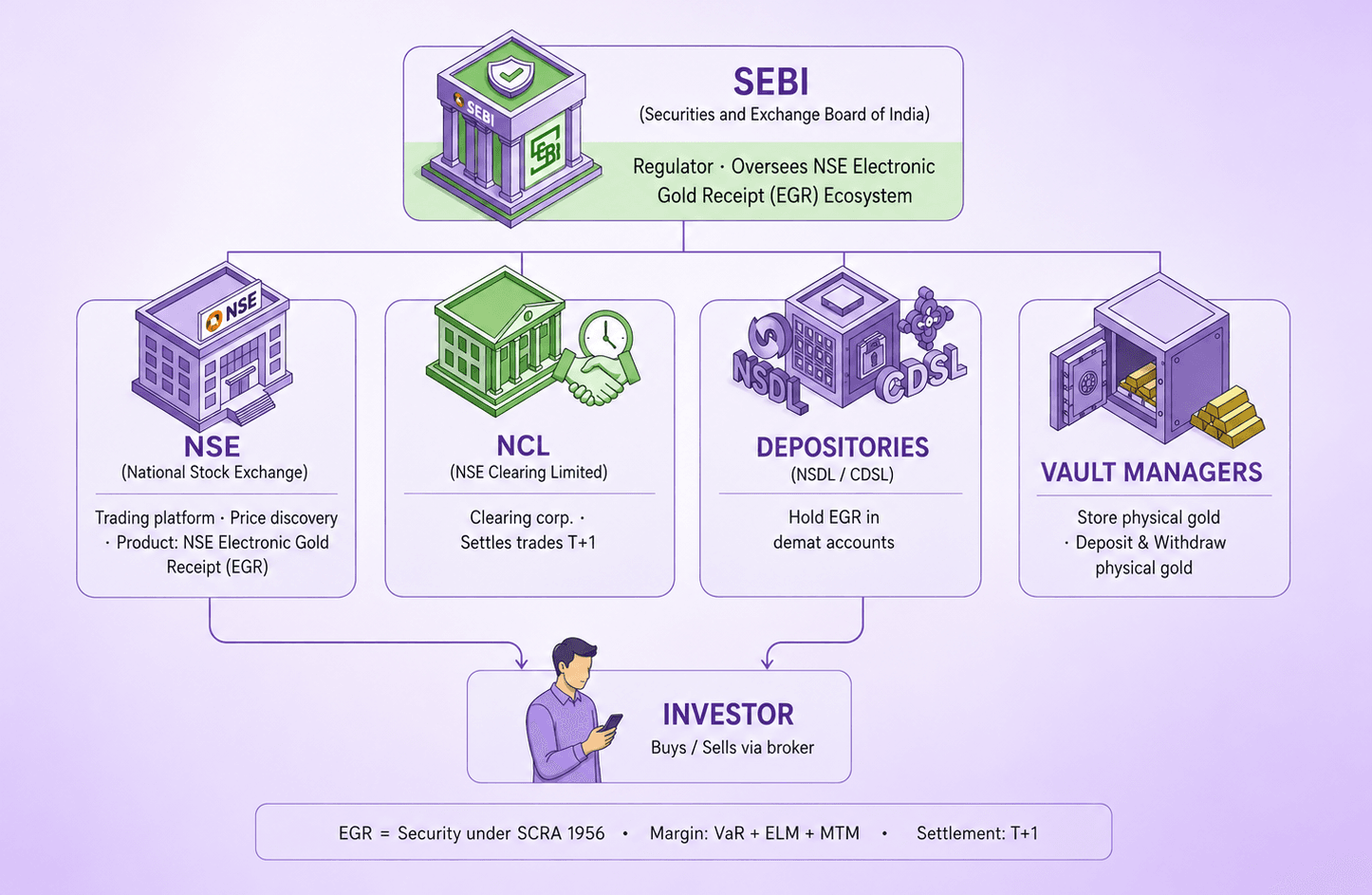
The EGR Ecosystem: Who Does What
Five key entities make the EGR system work together seamlessly:
Key points to know for trading in EGR
How to buy and sell EGRs
You can buy or sell EGRs just like stocks or ETFs through your trading and demat account. For this you need:
- A trading and a demat account
- A broker offering EGR trading access.
Once you have all the above in place, you can buy and sell them using the following steps:
- Log into your broker platform
- Search for the EGR symbol
- Choose the desired quantity
- Place a buy order
- EGR units are credited to your demat account after settlement (T+1)
- You can thereafter sell anytime after market hours.
The EGR will appear in your holdings just like shares or ETFs.
The EGR is currently offered in EGR 999 Purity and EGR 995 Purity, with denominations starting from as low as 100 milligrams and going up to 1 kilogram. This flexibility allows investors to buy gold in extremely small denominations, even as low as 100 milligrams, ~₹1,500. Here’s a snapshot of EGR product variants:
Every EGR is backed by actual physical gold stored in SEBI regulated vaults, with the electronic receipt issued by the Vault Manager.Take your 999 purity gold to a SEBI-registered vault manager (e.g., Brinks India). Acceptable forms: standard gold bars and investment coins — not jewellery.
You can either continue holding EGRs digitally for trading purposes or choose to convert them into physical gold (minimum qty 10gm). However, storage, redemption, and delivery charges may apply.
Charges Involved in Buying and Holding EGRs
Investing in EGRs may involve certain charges and fees, including:
- Brokerage fees charged by your stockbroker for buying or selling EGRs
- Depository charges for holding EGRs in your demat account
- Vault storage charges payable to authorised vault managers
- Gold purity testing and transportation charges if you choose physical gold delivery
How to convert your physical gold into EGR
One of the most unique aspects of EGRs is two-way convertibility. You can buy EGR online and later convert it into physical gold (or simply continue holding it in your demat account). Similarly, if you already own physical gold, you can convert it into EGRs and hold or trade it digitally.
Here’s how you convert your physical gold into EGR:
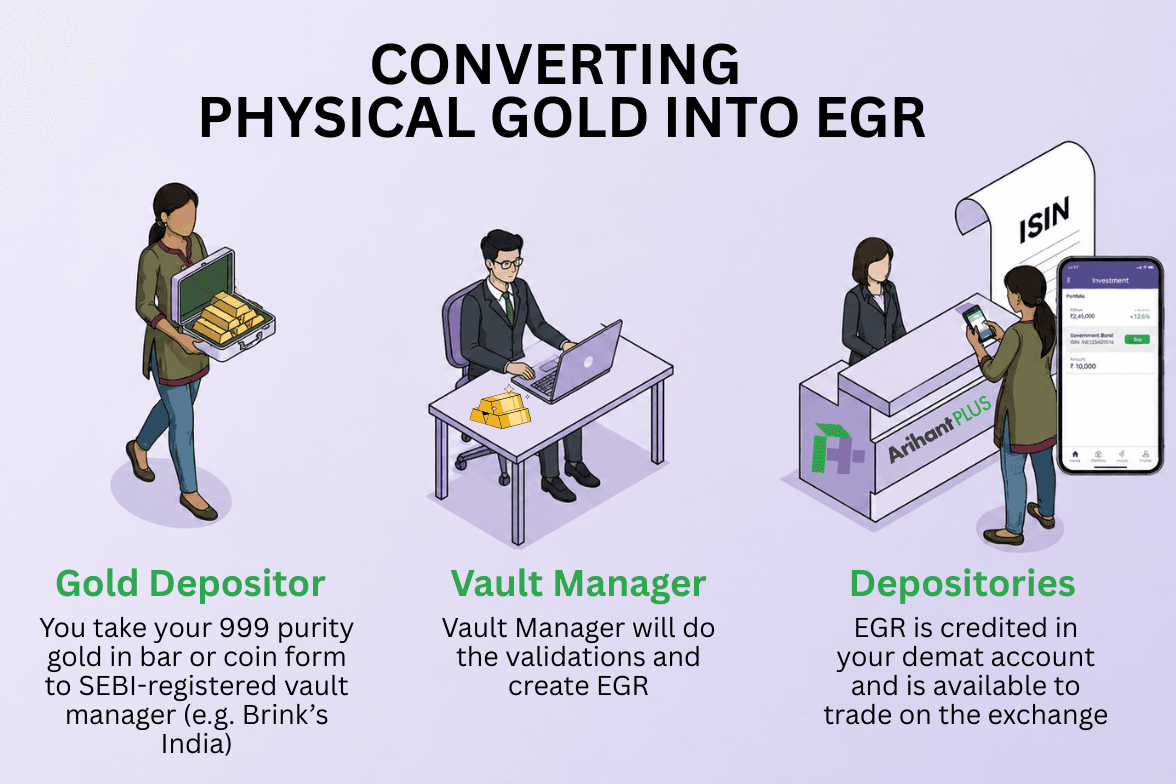
This mechanism effectively turns physical gold into a tradable electronic asset.
Benefits of Electronic Gold Receipts (EGRs)
Not only is EGR a smarter and safer way to invest in gold, they also offer other benefits.
- Unified Pricing: “One nation, one price” that’s what EGR offers. You can buy EGR at the same price no matter where you are.
- Digital Convenience: You do not have to worry about storage, theft, or locker related hassles.
- Purity Assurance: Since EGRs are backed by standardized gold stored in SEBI regulated vaults, you get quality assurance along with easier liquidity.
- Gold Fungibility: Standardized gold allows seamless exchange and redemption without quality discrepancies.
- Settlement Security: You benefit from exchange backed settlement mechanisms that reduce transaction and counterparty risks.
- Portfolio Diversification: EGRs give you another regulated way to add gold exposure to your portfolio.
- Flexible Denominations: You can trade in smaller quantities like 100 milligram or larger denominations depending on your investment needs.
How are EGR taxed?
EGRs on the NSE are taxed as securities, offering tax efficiency similar to listed equities.
Treatment is well-defined and investor-friendly relative to alternatives. Profit on EGR is treated as capital gain and taxed accordingly. You don’t pay GST when you buy EGR, however its, its applied when selling at 3% rate.
Here is an overview of taxes applicable in buying and selling EGR:
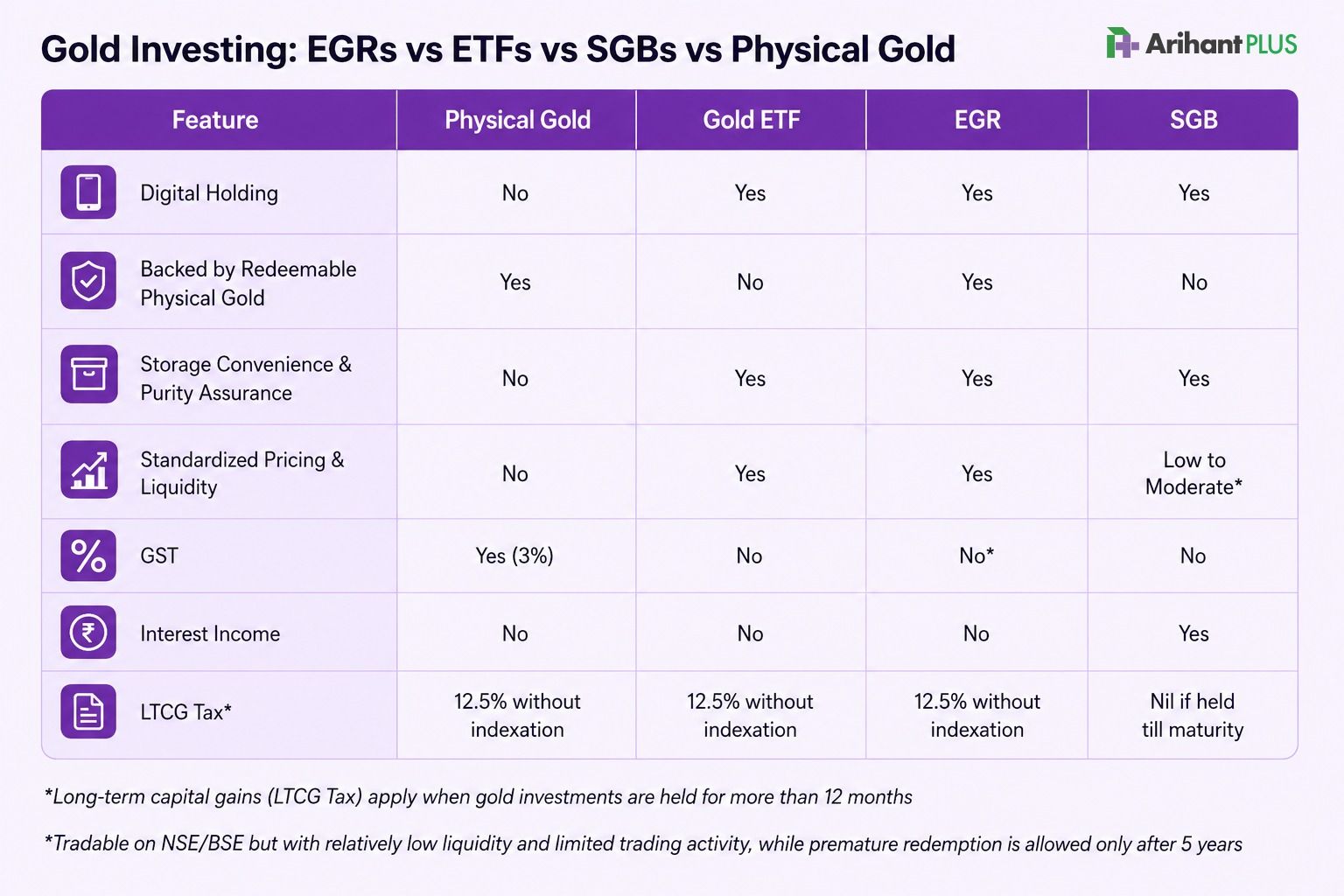
Gold Investing: EGRs vs ETFs vs SGBs vs Physical Gold
Owning physical gold has never been the ideal way to invest in this precious metals - there are concerns around purity, storage, making charges, theft, and resale value.
To solve that problem, Gold ETFs were introduced in early 2000. Better, sure, but you are still paying a fund manager 0.5–1% a year to essentially babysit your metal, and you can never touch the actual gold. That’s where EGR fills the gap.
Here is a quick look at the difference between EGR and other forms of investing in gold.
Investor Takeaway
India’s gold market has traditionally been dominated by physical buying, despite challenges such as storage risks, purity concerns, and pricing inefficiencies.
EGR represents India's most mature, most regulated, and most flexible way to invest in gold today. It bridges the gap between the emotional satisfaction of 'owning real gold' and the practical superiority of a digital, exchange-traded instrument. You get 999 purity, real-time pricing, exchange liquidity, no making charges, no locker fees, no purity anxiety. Plus, if you ever want the physical gold, you can convert them anytime.
While the ecosystem is still evolving, EGRs have the potential to emerge as an efficient middle ground between physical gold and Gold ETFs for long-term investors.
FAQs
What is an Electronic Gold Receipt (EGR)?
An Electronic Gold Receipt (EGR) is a digital security backed by physical gold stored in SEBI approved vaults. It allows investors to buy, sell, and hold gold electronically through a demat account.
How is EGR different from Gold ETFs?
EGR represents direct ownership of physical gold, while Gold ETFs are fund-based products managed by AMCs. EGRs also offer physical redemption options and transparent exchange pricing.
Is EGR backed by real gold?
Yes, every EGR is backed by actual physical gold stored securely in regulated vaults. The gold is audited, standardized, and linked directly to the electronic receipt.
Can EGR be converted into physical gold?
Yes, investors can convert EGRs into physical gold subject to minimum redemption quantity and charges. This makes EGR a flexible mix of digital investing and physical ownership.
What are the tax implications of EGR?
Profits from EGRs are taxed as capital gains similar to physical gold investments. No GST is charged on exchange trading, but GST (3%) applies on physical withdrawal.
How do I buy EGR on NSE?
You can buy EGRs through a trading and demat account with brokers that have enabled the NSE EGR segment. Since the product launched only recently, EGR access is currently limited and may not yet be available on all brokerage platforms.
Related Topics

Everyone Bought Gold ETFs in January. Here's Why They're Selling Now

EGR vs Gold ETF: Key differences, taxation & which should you choose?


Oil Is Surging After The Iran Strikes. So Why Isn’t Gold Following?

Physical Gold vs Gold ETFs: Which investment is best for Indian investors?

How Your Gold Profits Are Taxed And Budget 2026 Expectations For Gold

Gold & Silver Rally Amid US–Venezuela Conflict: What Should Investors Do?
Silver vs gold 2025: Why smart investors are choosing silver now