



Investing Abroad? Tax Rules Indians Must Know

By
Arihant Team
International investing is no longer limited to large investors or finance professionals. Today, Indian investors can buy global stocks, international ETFs, and overseas mutual fund exposure more easily than before.
In This Article
- Introduction
- How to invest in global markets?
- Important international investing rules
- How are foreign stocks taxed in India?
- How are dividends from foreign stocks taxed?
- Do you need to report foreign assets in ITR?
- Investor takeaway
- FAQs
Introduction
Think about the companies you interact with almost every day.
You connect with people on Meta’s platforms. You use Microsoft tools at work. You search on Google. You watch global content on streaming platforms. You read about Tesla changing mobility and NVIDIA powering the AI wave.
These companies may be listed outside India, but they are already a part of our lives.
So, naturally, many Indian investors are now asking: if we use these businesses, believe in their growth, and see more people adopting them, should we also consider investing in them?
The numbers show that this interest is already growing. India’s outward remittances under LRS stood at $28.98 billion in FY2025-2026, faltering a little though after touching $31.73 billion in FY2023-2024. Equity and debt investments through LRS rose sharply by 56.1 percent YoY to $2.65 billion in FY2025-26, compared to nearly $1.7 billion in the previous fiscal.
Clearly, global investing is no longer just a metro trend. More Indians are looking abroad for diversification, global growth and access to companies they already understand.
But while buying a global stock may be easy, understanding the rules, taxes and disclosures is where most investors get stuck.
So, let us simplify it step by step.
Open a free account today
Invest in tomorrow with just one click
How to invest in global markets?
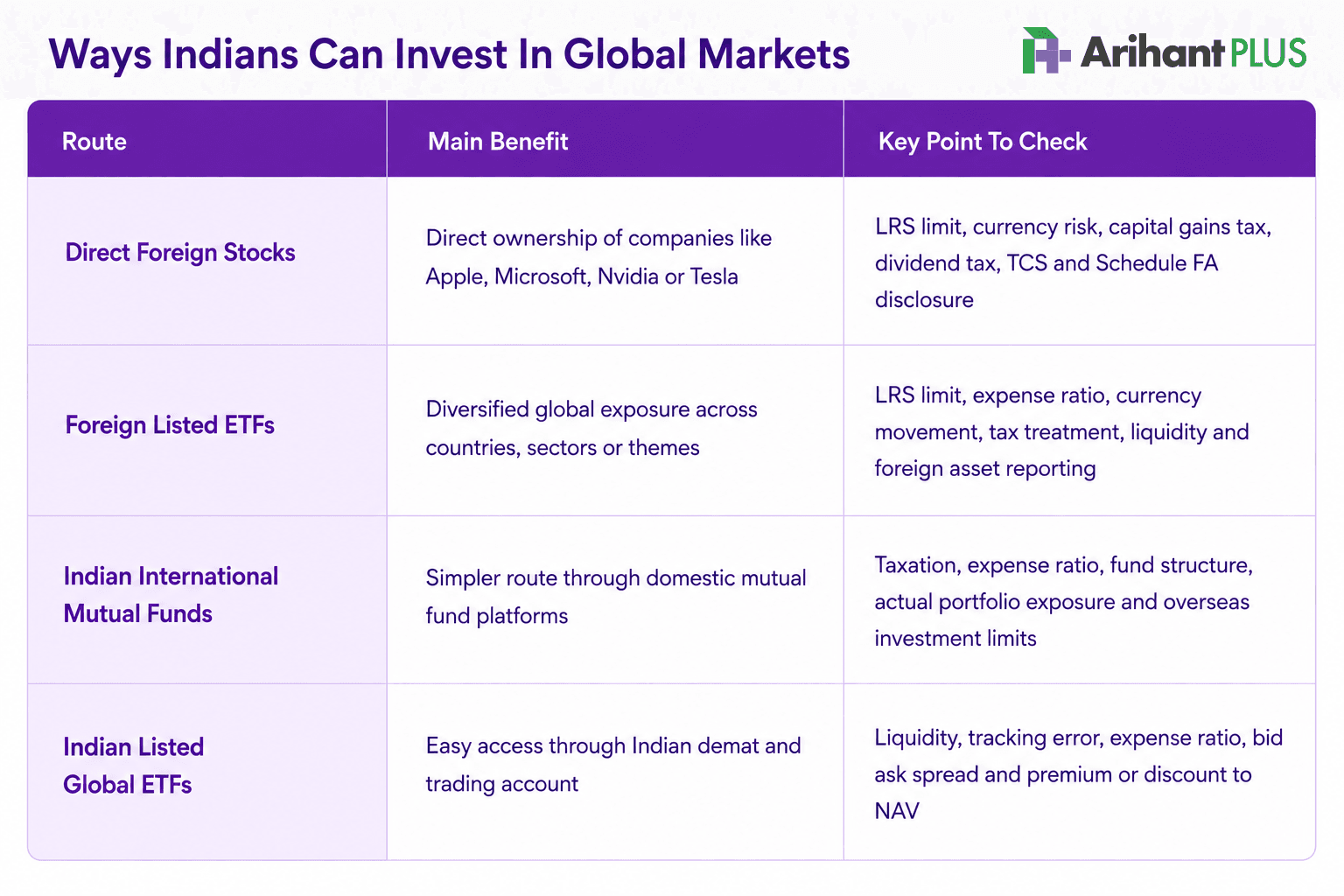
You can access global markets through four broad routes. The right choice depends on how much control, diversification, paperwork and tax complexity the investor is comfortable with.
- Direct foreign stocks: You can directly buy shares of companies listed outside India, such as US listed stocks. This gives direct ownership, but also requires more research, currency awareness, tax understanding and foreign asset reporting.
- Foreign listed ETFs: You can buy ETFs listed overseas to get exposure to a global index, sector, theme or geography. This reduces single stock risk, but if bought directly abroad, it may still come under LRS and foreign reporting rules.
- Indian mutual funds investing overseas: These are domestic mutual funds that invest in foreign stocks, funds or indices. They are easier to access operationally, but you should check taxation, expense ratio, portfolio exposure and any overseas investment limits.
- Indian listed ETFs or funds with global exposure: These can be bought through a regular Indian trading and demat account. They offer convenient access, but investors should check liquidity, tracking error and whether the product is trading close to its fair value.
Important international investing rules
Liberalised Remittance Scheme (LRS)
The first question in your mind would be what is LRS? Think of it as the official route through which resident Indians can send money abroad for permitted purposes. These purposes include travel, education, medical treatment, gifts, maintenance of relatives, and overseas investments.
Under the current framework, resident individuals can remit up to USD 250,000 per financial year under LRS. This limit applies across permitted purposes and not just investments. In rupee terms, this limit changes with the USD INR exchange rate, but at current levels of 96, it is roughly ₹2.4 crore.
If you’re already spending money on foreign education, travel, or other overseas expenses in the same year, those amounts may also count toward the same overall LRS limit. So, your international investments must be planned along with your overall foreign spends for the year.
Tax Collected at Source (TCS)
Now comes the part most investors do not like discussing but cannot ignore: Tax Collected at Source, or TCS.
This is why investors should not only ask how much they want to invest abroad. They should also ask how much money will actually get invested after charges, currency conversion, and possible TCS impact.
When you remit money abroad under LRS, TCS may apply once your total remittance crosses the applicable annual threshold. Earlier, this threshold was ₹7 lakh, but from FY25 onwards, it has been increased to ₹10 lakh. For overseas investments and most other non education or non medical remittances, TCS is generally 20 percent on the amount exceeding ₹10 lakh. The government had increased this rate from 5 percent to 20 percent from October 2023 for many LRS categories, including overseas investments (Source).
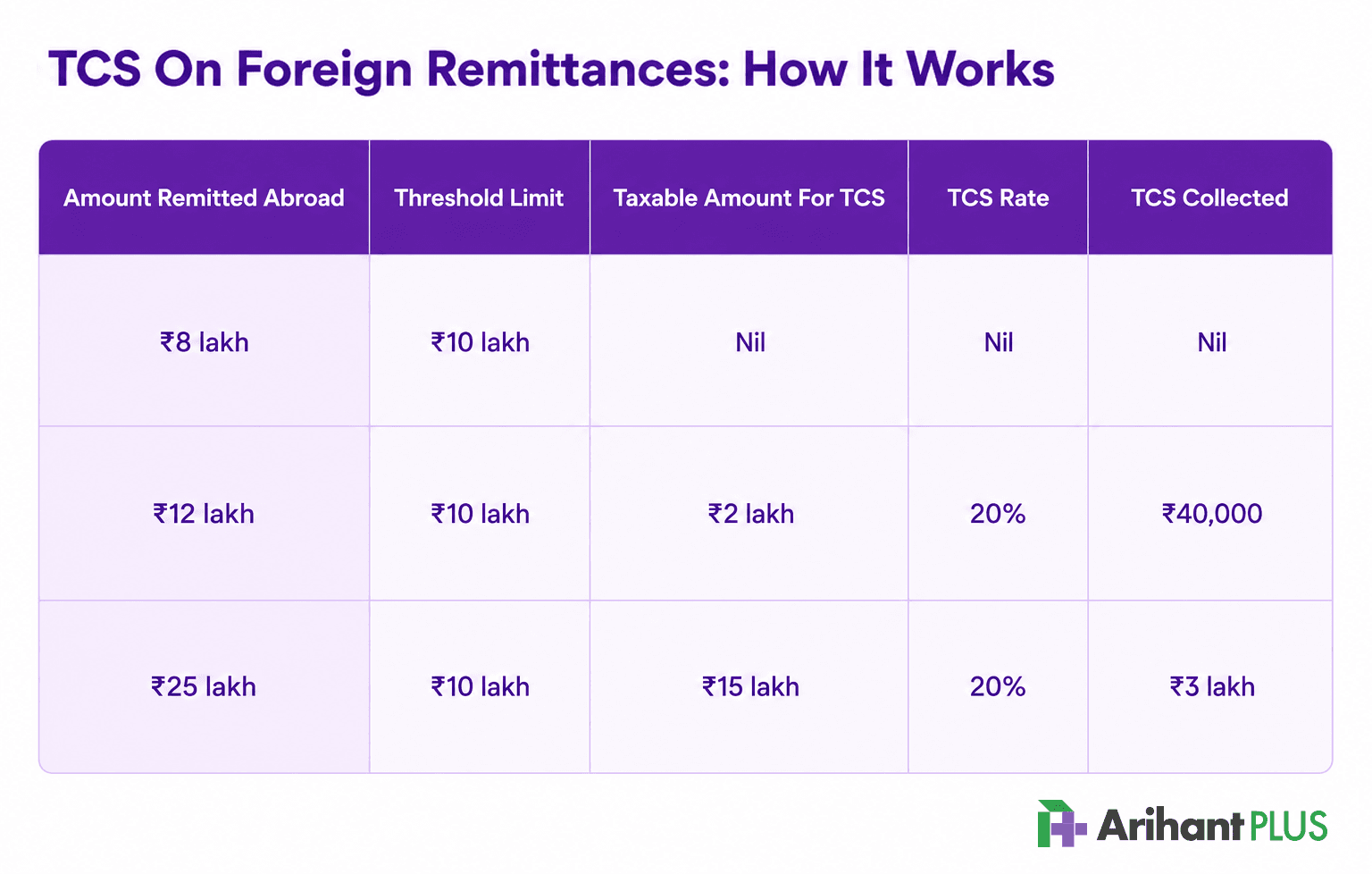
Example: If you remit ₹12 lakh abroad for investment, TCS will not apply on the first ₹10 lakh. It will apply only on the excess ₹2 lakh. At 20 percent, the TCS amount would be ₹40,000.
So, out of a planned remittance of ₹12 lakh, you need to account for an additional upfront cash flow impact of ₹40,000. This amount is not necessarily your final tax cost. It can generally be adjusted against your total tax liability or claimed as a refund while filing your income tax return.
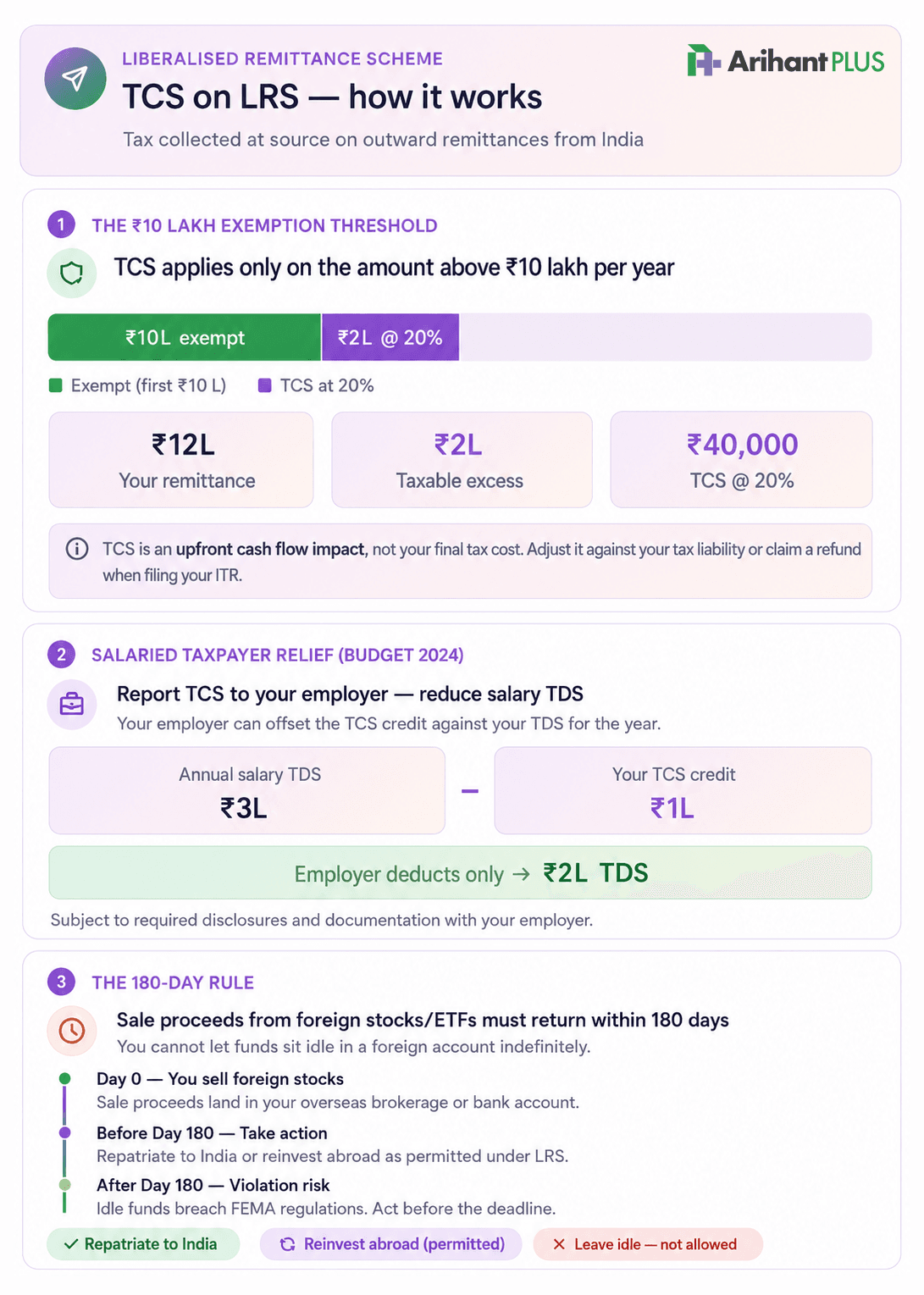
However, there is some relief for salaried taxpayers. Budget 2024 allowed employees to report TCS details to their employer so that it can be considered while calculating salary TDS. For example, if your TCS credit is ₹1 lakh and your annual salary TDS is ₹3 lakh, your employer can adjust this credit and deduct only the balance ₹2 lakh as TDS during the year, subject to the required disclosures and documentation.
Next, remember that your money cannot just remain parked abroad forever.
If you sell your foreign stocks or ETFs, the sale proceeds must generally be brought back to India within 180 days, unless you reinvest that money abroad as permitted. In simple terms, you cannot let the funds sit idle in a foreign bank or brokerage account indefinitely.
How are foreign stocks taxed in India?
If you are an Indian resident, your global income is taxable in India. This includes income from foreign stocks, foreign ETFs, foreign bank accounts, and other overseas assets.
For foreign stocks, there are usually two types of income to consider.
- Capital gains: The profit made when you sell a foreign stock at a higher price than your purchase price.
- Dividend income: The income received when a foreign company distributes part of its profits to shareholders.
For direct foreign company shares, the tax treatment of capital gains depends on the holding period.
- Shares held for >24 months: If foreign company shares are held for more than 24 months, the gains are treated as long term capital gains and taxed at 12.5 percent plus applicable surcharge and cess.
- Shares held for ≤24 months: If they are held for up to 24 months, the gains are treated as short term capital gains and added to income, where they are taxed as per your individual tax slab.
There is also one important detail many investors miss.
The purchase and sale values have to be converted into Indian rupees for tax calculation. You must use the exchange rate on the last day of the month prior to the month in which the sale happened. This means your final tax calculation can be affected by both stock movement and currency movement.

How are dividends from foreign stocks taxed?
Dividends from foreign stocks are taxable in India.
For Indian resident investors, dividend income from foreign companies is generally added to total income and taxed according to the applicable slab rate.
But there can also be tax in the foreign country.
For example, dividends from United States companies may face 25 percent withholding tax in the United States. This means tax may be deducted before the dividend reaches the investor. The gross dividend still needs to be reported in India, but the investor may be able to claim credit for the tax paid abroad under the relevant Double Taxation Avoidance Agreement, subject to proper documentation and filing requirements.
This is where Form 67 becomes important. If an investor wants to claim foreign tax credit in India, the required form and supporting details may need to be filed correctly.
Do you need to report foreign assets in ITR?
Now coming to one of the most important compliance points.
If you are an Indian resident and you hold foreign stocks, foreign bank accounts, foreign depository accounts, or other foreign assets, you may need to disclose them separately in your income tax return.
Any non-reporting of foreign assets while filing the ITR is considered a willful evasion of tax, and the defaulter may have to face imprisonment of up to 7 years.
International investing requires more documentation than domestic investing. You should maintain purchase records, sale records, dividend statements, withholding tax details, remittance documents, broker reports, and exchange rate details.
Note: These rules mainly apply when you invest directly in foreign stocks or foreign listed ETFs. If you do not want to manage LRS, TCS, remittance timelines, foreign asset disclosure, and related paperwork, you can also consider Indian mutual funds or ETFs that invest in international markets. That route may be operationally simpler, but you should still check taxation, costs, liquidity, and portfolio exposure before investing.
Investor takeaway
Global investing is not just about buying popular names. It comes with LRS rules, possible TCS impact, capital gains taxation, dividend taxation, foreign tax credit requirements, currency risk, and ITR disclosure obligations.
This does not mean international investing is too complicated or unsuitable. It simply means you should not enter it casually.
FAQs
What is international investing?
International investing means investing in assets listed outside India. This can include foreign stocks, foreign ETFs, international mutual funds, or Indian listed funds that give exposure to global markets.
Can Indian residents invest in foreign stocks?
Indian resident individuals can invest in foreign stocks through permitted routes, usually under the Liberalised Remittance Scheme, subject to the applicable annual limit and rules.
What is the LRS limit for Indian residents?
The LRS limit for resident individuals is USD 250,000 per financial year for permitted purposes. This includes investments, travel, education, medical treatment, and other permitted remittances.
Is income from foreign stocks taxable in India?
Yes, if you are an Indian resident, your global income is taxable in India. This includes capital gains and dividends from foreign stocks.
Are dividends from United States stocks taxable in India?
Yes, dividends from United States stocks are taxable in India. They may also be subject to withholding tax in the United States. Investors may be able to claim foreign tax credit in India, subject to DTAA rules and filing requirements.

Related Topics


EGR vs Gold ETF: Key differences, taxation & which should you choose?





Canara Robeco AMC IPO: Should You Apply for MF Giant’s Public Debut?

Dematerialisation of Mutual Funds: Complete Guide, Process & Benefits

What Is an Equity Fund? Types, Benefits & How to Invest in Equity Funds







Demystifying Demat Accounts: Meaning, Benefits, and How to Open One in India