



SIP vs Step Up SIP : How to build your portfolio?
SIP and Step Up SIP are one of the best ways of investing in mutual funds. SIP requires regular contributions across the investment tenure. Step Up SIP has the potential to match contributions with the rise in salary or income.
In This Article
- Key Takeaways
- Introduction
- What is a regular SIP?
- Why invest through SIPs?
- What is Step Up SIP?
- How to build your portfolio with SIP and Step Up SIP?
- Regular SIP or Step-Up SIP: Which Should You Choose?
- Investor Takeaways
- FAQs
Key Takeaways
- Regular SIPs encourage you to invest without worrying about stock market movements.
- Step Up SIPs help you accumulate wealth faster as you are contributing more money over the investment tenure.
- Regular SIP suits you if you have unpredictable income.
- Step Up SIP works well if your income is expected to grow.
- SIP and Step Up SIP works well if you choose the right mutual funds, understand risk and inflation and review your investments
Introduction
Systematic Investment Plan (SIP) is a good way to build wealth with discipline and letting the power of compounding work for you. No wonder they’ve become super popular among Indian investors.. According to AMFI data, SIP inflows reached a record ₹32,490 crore in September 2026.
Source: AMFI
However, a regular SIP does not account for your income growth. Your first salary might be ₹30,000 a month. A few years later, it could be ₹50,000 or ₹70,000 a month. As our income grows, we tend to spend more on rent, travel, dining out and other lifestyle upgrades.
But what about the SIP amount?
If you started a mutual fund SIP of ₹5,000 a month and never increased it, you would continue investing the same amount even as your ability to save improved. Over time, inflation could also reduce what that fixed investment can buy.
This is where a Step-Up SIP comes into the picture.
A regular Systematic Investment Plan (SIP) lets you invest a fixed amount in a mutual fund at regular intervals. A Step Up SIP lets you increase that amount periodically, usually once a year. Both can help you build wealth over the long term, but they approach your growing investment capacity differently.
So the important question is not which is better - SIP or Step Up SIP. It is how much should you invest today, and how can you increase that amount over time without putting pressure on your finances?
Open a free account today
Invest in tomorrow with just one click
What is a regular SIP?
Systematic Investment Plan (SIP) is a way of investing fixed amounts regularly in mutual fund schemes. Instead of investing a large sum at once, you spread your investments over time. You can start your SIP with just ₹100 per month.
Think of it as paying yourself first. Every month, a portion of your income goes towards your investments before it gets absorbed by your regular spends like food, travel, rent, etc.
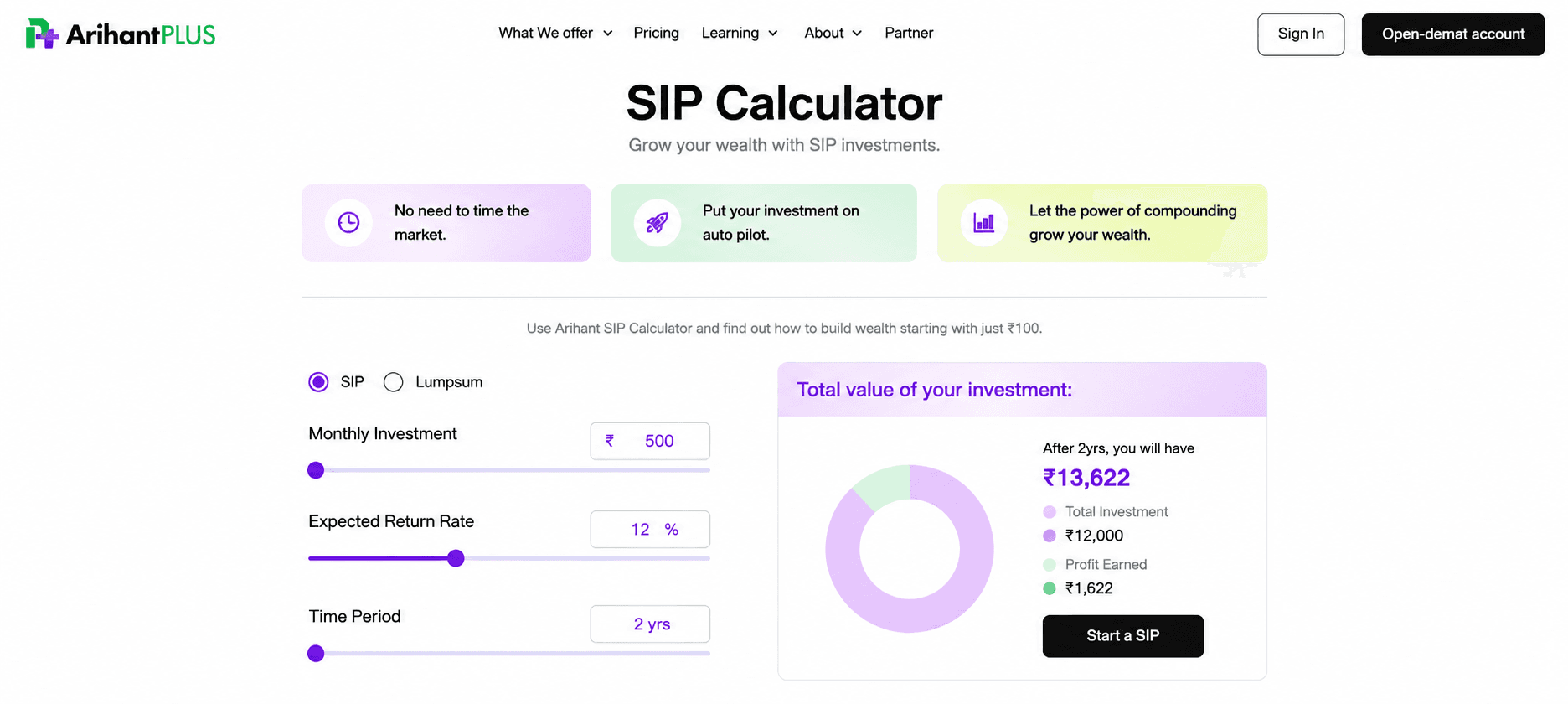
Let’s understand with an example how an SIP can build wealth over time. Suppose you invest ₹10,000 every month in an equity mutual fund through a regular SIP.
Assume the investment earns an illustrative annualised return of 12% over 10 years. At the end of the period, your investment could grow to approximately ₹23 lakh.
Here's how the numbers could look:
Your ₹12 lakh in contributions could grow to approximately ₹23 lakh, with the difference coming from investment gains and compounding.
Note: The 12% return is an assumption for illustration, not a prediction. Mutual fund returns are market-linked, and actual returns may be higher or lower. You may even lose money, particularly over shorter periods.
Why invest through SIPs?
Rupee cost averaging:
You invest a fixed amount every month in mutual funds through SIP. When stock markets fall that fixed amount buys more units and when it rises fewer units. Your average purchase price evens out over time called rupee cost averaging.
Disciplined Investing:
SIP automatically invests your money in mutual funds. You don’t have to time the stock market by guessing its peaks or lows.
Power of Compounding:
It is a concept where the returns from your mutual funds earn their own returns over time. So, even small, regular investments can grow into a big corpus if you stay invested for the long term.
What is Step Up SIP?
A Step Up SIP works like a regular SIP, with one important difference: you increase your contribution periodically instead of keeping it fixed. You can choose to increase your SIP by a fixed amount or by a percentage, depending on the facility offered by your mutual fund platform.
For instance, you might begin with a monthly SIP of ₹10,000 and increase it by 10% every year.
Your contributions would then look something like this:
The increases may look modest initially. But over several years, they can make a meaningful difference to the total amount you invest.
So how much difference does the Step Up SIP really make?
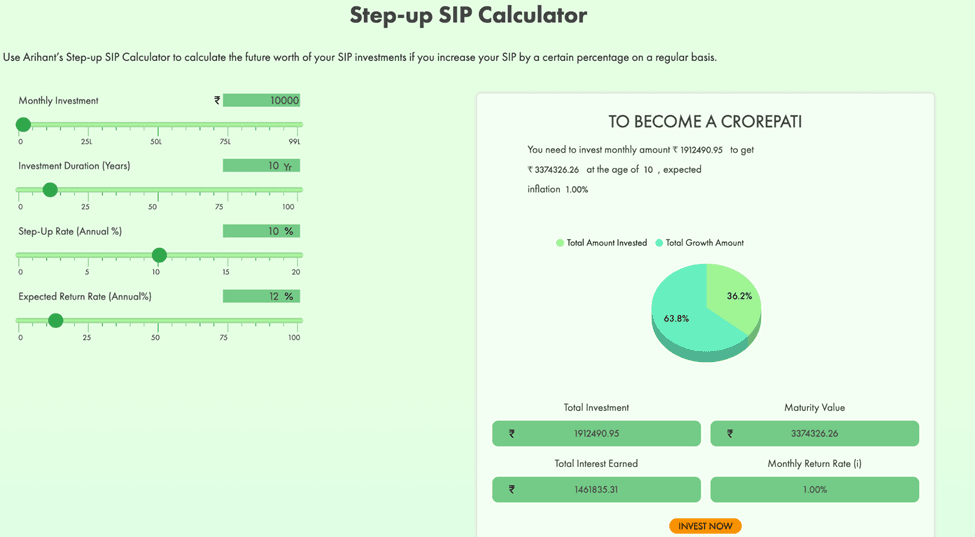
Taking the same investment numbers from the regular SIP example above and increasing SIP investment (stepping-up) by 10% every year, the comparison could look like this:
With the Step Up SIP, your final corpus could be around ₹10.5 lakh higher in this illustration.
But notice something important: you also contributed approximately ₹7.1 lakh more.
The larger corpus does not come from the Step-Up SIP earning a higher rate of return. It comes primarily from investing more money over time, giving those additional contributions an opportunity to grow.
That is the real advantage of a Step Up SIP. It helps you increase your investments gradually instead of requiring you to commit to a larger monthly amount from day one.
Step Up SIP ensures that you invest more money as your income rises and you reach your major financial goals faster.
Source: Arihant Step Up SIP Calculator
How to build your portfolio with SIP and Step Up SIP?
Choosing between a regular SIP and a Step Up SIP is only one part of investing. You also need to decide what you are investing for, how much risk you can take and which types of mutual funds fit your needs.
Here’s a practical way to approach it.
Start with your financial goals
You must first set your financial goals like buying a car or a house. It gives you an idea on how much money you must invest to achieve these goals.
Decide on how much you can invest comfortably
If you set aside too high an amount you may struggle with your SIP installments. Investing lower amounts mean you may not reach your financial goals in time.
Choose an appropriate asset allocation
You must fix your asset allocation in equities, debt (fixed income) and gold depending on your financial goals, risk tolerance and time horizon.
Select the mutual funds to fit your goals
You must select mutual funds based on your short, medium and long term financial goals. You could divide your mutual fund portfolio into the core and satellite portion. The core stabilizes your portfolio and the satellite which is a small part of your portfolio enhances overall returns.
Review your portfolio periodically
You could review your mutual fund portfolio at least once every year to ensure that it stays aligned with your financial goals and risk tolerance. Reviewing your portfolio regularly helps you identify underperforming investments and you can take corrective action in time.
Increase your investments when your finances allow
If you get regular salary hikes you could increase your SIP installments. Increasing your investments helps you reach your financial goals faster.
Regular SIP or Step-Up SIP: Which Should You Choose?
There is no one-size-fits-all approach. Choosing between SIP and Step Up SIP depends on your income and ability to invest.
You could opt for a regular SIP if:
- You are starting your investments.
- You are comfortable with smaller amounts.
- You don’t have a regular income.
- You are close to your financial goal and you want to make predictable contributions.
You could opt for a Step-Up SIP if:
- You get regular salary increments.
- You can invest comfortably without compromising on your lifestyle.
- You have long-term financial goals and you want to slowly increase your investments.
You can combine SIP and Step Up SIP to reach your financial goals. Start with the regular SIP and then Step Up your installments if you get regular salary hikes or your income rises.

Investor Takeaways
Don’t wait for the perfect time or try to predict the stock market to start investing. Consistency and choosing the right investment to suit your goals are the key pillars of building wealth.
With a regular SIP you build the discipline of investing while a Step Up SIP builds on that habit by increasing your contributions as your income grows. The difference can become meaningful over a long period.
Start with an amount that fits your budget. Increase it when you can, keep your financial goals realistic and remember that market-linked investments carry risk.
FAQs
Why should you invest in mutual funds through Step Up SIP?
If you expect your income to grow regularly then you could invest in mutual funds through the Step Up SIP. It has the potential to help you reach your financial goals faster. You could start with a lower amount than a regular SIP and still reach your financial goals.
When should you opt for regular SIP or Step Up SIP?
You could choose the regular SIP if your income is irregular or you are close to your financial goals. However, if you get regular salary increments and your financial goals are far away you could choose the Step Up SIP.
How can Arihant SIP Calculator and Arihant Step Up SIP Calculator help you reach your financial goals?
You could enter your monthly investment amount in the Arihant SIP Calculator, choose an expected rate of return and the investment period to determine the amount you need for your financial goals. You could follow the same approach with the Arihant Step Up SIP Calculator. The only difference is you must choose the annual Step Up Rate like 10% per year in the Step Up SIP Calculator.
Related Topics




Why International ETFs Trade at a 30–56% Premium, and Why Funds Keep Closing

Mutual Funds vs PMS: What’s the difference and which one is right for you?


Energy Funds Deliver 12% Returns in 3 Months: Invest Now or Wait?

Sensex down 8% due to Iran war: Should you pause SIP or buy the dip?