



Best Mutual Funds for Lump Sum Investment in 2026

By
Arihant Team
Investing a lump sum when markets are down involves market timing. Some mutual funds handle market volatility better than others which is the key to earning higher returns over time.
In This Article
- Key Takeaway:
- Introduction
- Which are the right equity funds for lump sum?
- Which are the right hybrid funds for lump sum investments?
- Investor takeaway
Key Takeaway:
Stock markets are falling and investors who want to invest a lump sum may view this as an opportunity.
- Investing in mutual funds which have built-in mechanisms to capture opportunities in falling markets while offering protection against market volatility may be suitable for lump sum investments.
Open a free account today
Invest in tomorrow with just one click
Introduction
Do you want to invest a lump sum in equity funds because the stock markets have fallen? To be successful with this approach you have to time the stock market which is very difficult. But, what if you don’t have the necessary skills to invest a lump sum in mutual funds? There is a way around this problem. You could invest in certain mutual fund categories that are suitable for lump sum investments. Let's look at some of them.
Which are the right equity funds for lump sum?
Flexi cap funds may be suitable for lump sum investments because they have a unique advantage over many equity funds.
Flexi cap funds according to SEBI rules must invest at least 65% of their assets in equity and equity-related instruments. However, they are free to allocate their holdings in large, mid and small cap stocks without any restrictions.
How does this approach help flexi cap funds? These funds invest in large cap companies which may be relatively stable as compared to mid and small cap companies during market crashes. They also hold mid and small cap stocks which could outperform large cap stocks in bull markets.
However, even though flexi cap funds can invest in stocks across market capitalization, many of them have higher holdings in large cap companies. For example, according to Value Research flexi cap funds have nearly two-thirds of their assets in large cap stocks.
A higher allocation towards large cap stocks may protect their portfolio during stock market crashes as compared to mid and small cap stocks which makes them suitable for lump sum investing.
Now, let's understand why large cap funds could be suitable for lump sum investments. These funds must invest at least 80% of their assets in large cap companies. These large, well established companies are stable as compared to mid and small cap companies during stock market crashes.
Investors who have a long time horizon of at least 3 to 5 years could look at investing a lump sum amount in flexi cap funds and large cap funds to achieve their financial goals.
Now, there is another mutual fund category called hybrid funds that invest your money in a mix of asset classes mainly stocks (equity) and debt (bonds). Debt protects your portfolio during stock market crashes whereas stocks have the potential to generate inflation-beating returns over time.
Some hybrid funds like balanced advantage funds and multi asset allocation funds may be suitable for lump sum investments.
Which are the right hybrid funds for lump sum investments?
You may struggle to time the stock market because you don’t know when it's cheap or costly. Balanced advantage funds have a solution for this problem.
These funds follow a model based on valuation indicators like the price-to-earnings and the price-to-book ratio which shows if stock markets are cheap or costly.
Balanced advantage funds then automatically allocate your money between equity and debt, depending on stock market conditions.
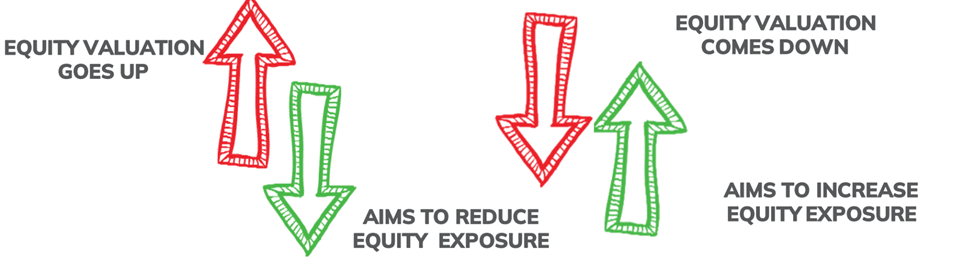
The idea is very simple. Balanced advantage funds systematically reduce their exposure to stocks and increase their allocation to debt when stock markets are at higher levels. It helps them manage downside risk if stock markets were to crash.
Source: ICICI Prudential Mutual Fund
Balanced advantage funds increase their exposure to stocks when markets are down. It helps them buy stocks at lower prices. In a nutshell, balanced advantage funds time the stock market making them suitable if you are a first timer in stock markets or if you struggle to rebalance your portfolio.
Another hybrid fund, the multi asset allocation fund invests your money in many different asset classes. According to SEBI rules it must have a minimum of three asset classes with at least 10% each in all three asset classes. A multi-asset allocation fund diversifies your portfolio across asset classes like equity, debt, and gold making it a suitable option for lump sum investments.
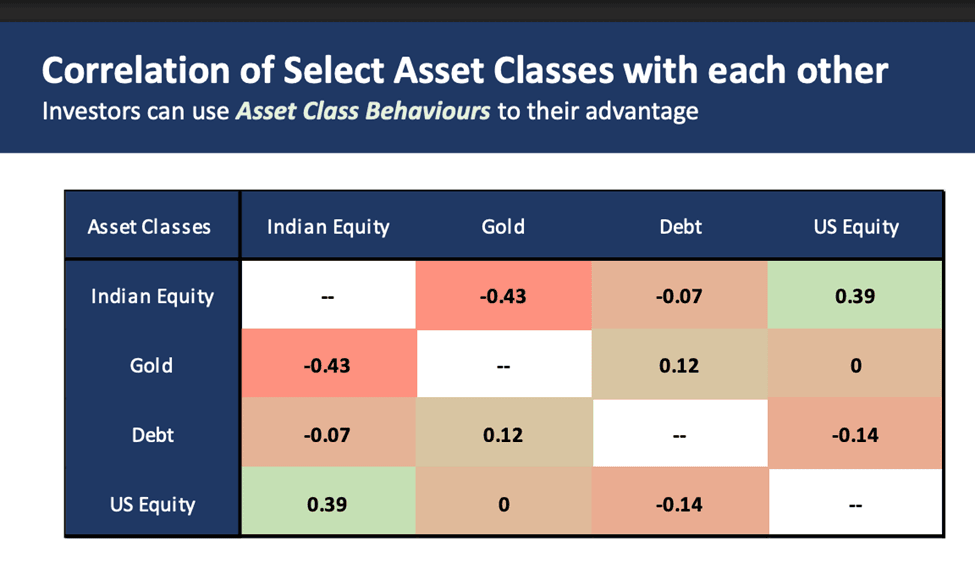
For example, gold and equities are negatively correlated which means that when gold prices go up stock markets generally go down and vice versa.
Source: WhiteOak Mutual Fund
Similarly equity and debt are negatively correlated. Multi asset allocation funds invest your money across these asset classes to protect your portfolio from market crashes.
Multi asset allocation funds also have another ace up their sleeve. No single asset class performs well all the time. Sometimes, equity does well and sometimes its gold or debt.
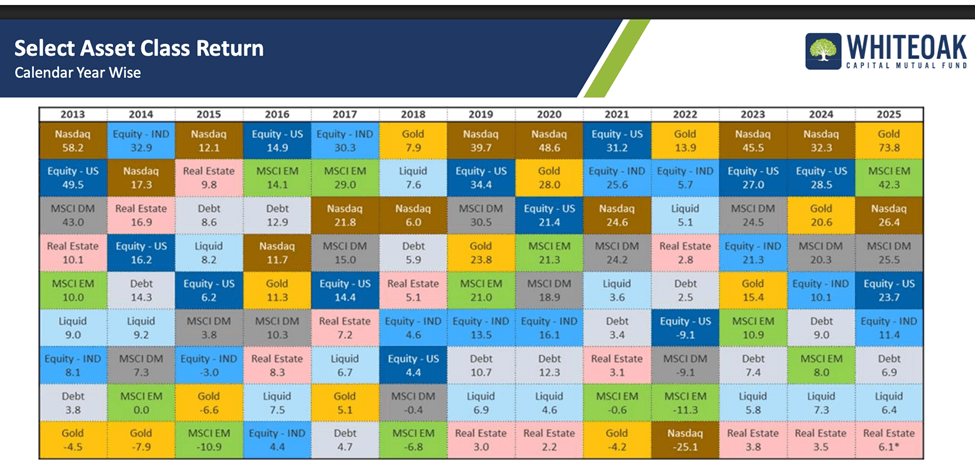
Multi asset allocation funds spread your investment across different asset classes capturing the performance of whichever asset class has done well in that year.

Investor takeaway
Stock markets have fallen recently, and many investors have panicked.
However, some investors view this as an opportunity to invest lump sum amounts and possibly earn higher returns over time.
- Instead of waiting for the markets to bounce back, investing in mutual funds which have mechanisms to protect your portfolio like automatic rebalancing or diversification across asset classes could help you reach your financial goals.
Related Topics


Why International ETFs Trade at a 30–56% Premium, and Why Funds Keep Closing

Mutual Funds vs PMS: What’s the difference and which one is right for you?


Energy Funds Deliver 12% Returns in 3 Months: Invest Now or Wait?

Sensex down 8% due to Iran war: Should you pause SIP or buy the dip?