

Equity Funds vs Index Funds: What Should You Pick?

By
Arihant Team
Equity and index funds are two different ways to participate in stock markets. Equity funds aim to outperform the market through active management, while index funds track a market index at a lower cost. Understanding their differences can help you make informed investment decisions.
In This Article
- Introduction
- What are equity funds?
- What are Index Funds?
- Equity Funds vs Index Funds: What's the difference?
- Why do investors choose equity funds?
- Why do investors choose Index Funds?
- Which one should you pick?
- Conclusion
- FAQs
Introduction
You have been planning for a long time to start investing. After doing all your basic research, you are now stuck between two investment options that seem to be the right fit: equity funds and index funds.
At first, the difference between index funds and equity funds might not seem to be too much. . Both funds invest in stocks yet they work differently.
When investing in equity funds, your fund manager decides which stocks to buy, hold or sell. However, index funds follow a different approach - they track a stock market index, like the BSE Sensex and the Nifty 50, and replicate its holdings.
So, which one is better for you?
Both are good options, depending on your financial goals. Hence, the right investment decision depends on how you want your money to be managed, the amount you are willing to pay for managing your money and if you’re looking for market-matching returns or the possibility to beat the markets through active investing.
Table of Contents:
- What Are Equity Funds?
- What Are Index Funds?
- Equity Funds vs Index Funds: What's the Difference?
- Why Do Investors Choose Equity Funds?
- Why Do Investors Choose Index Funds?
- Which One Should You Pick?
- Conclusion
- FAQs
What are equity funds?
Equity funds pool money from multiple investors and invest in stocks. Depending on their investment strategy, they may focus on a specific sector or theme or spread investments across companies from different sectors. An important part in equity investing is that stocks are not chosen randomly but guided by research and analysis.
Fund managers evaluate companies, study financial performance, track industry trends, and assess economic and market conditions to decide where to invest.
For instance, if a fund manager believes banking companies have strong growth prospects over the next few years, the fund may increase its allocation to banking stocks. Conversely, if another sector shows signs of slowing growth, the manager may reduce its exposure to that sector.
These decisions are backed by research into company fundamentals, valuations, earnings, and economic indicators, often supported by detailed equity research reports. This style is called active fund management.
The goal of an actively managed equity fund is to identify promising investment opportunities and outperform its benchmark. However, the results depend on the strategy of the fund, the decisions of the manager and the market conditions.
Not all equity funds aim to beat the market; some are designed to track a market index. These are called index fund.
Open a free account today
Invest in tomorrow with just one click
What are Index Funds?
Index funds are mutual funds that aim to replicate the performance of a specific market index rather than actively select stocks to outperform the market. The Nifty 50 and BSE Sensex are common examples of market indices that index funds track.
Consider a Nifty 50 index fund. It invests in the same companies that make up the Nifty 50, in exactly the same proportion.
Unlike actively managed equity funds, index funds do not aim to identify the next big-winning stock or outperform the market. Instead, their objective is to track the chosen index as closely as possible. This makes them a straightforward option for investors seeking market exposure without relying on a fund manager's active stock-selection decisions.
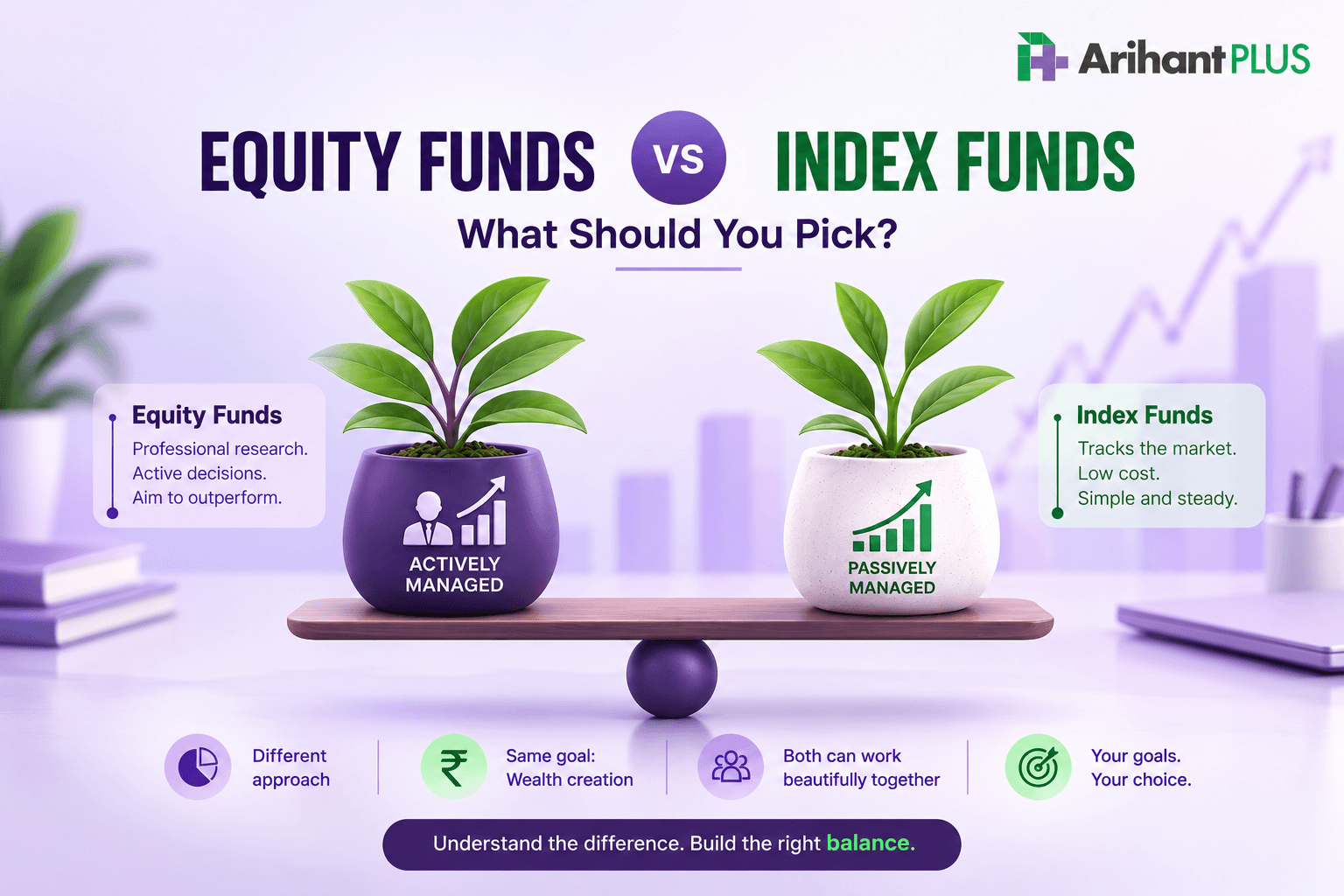
Equity Funds vs Index Funds: What's the difference?
Both invest in equities, but their investment approaches are different.
When investing in an equity fund, you pay for active management and research. However, with index funds, you choose to follow the market instead of trying to stay ahead of it.
Why do investors choose equity funds?
Investors choose actively managed equity funds for the potential to outperform the market and create long term wealth. Here are some key reasons why are they popular:
- Potential to outperform the benchmark: An active fund does not aim to replicate the index; instead it researches hidden opportunities and fast-growing companies to beat the market. The goal is to generate returns that exceed the fund's benchmark, although outperformance is never guaranteed.
- Professional research and management: Fund managers analyse company financials, industry trends, and market conditions to make informed investment decisions. This benefits investors who prefer professional stock selection over conducting their own research. Its hard for an individual to keep track of equity recommendations, markets and news. Hence handing the job to a professional, who’s an expert, is a smarter choice.
- More room to respond to market conditions: Markets do not stay the same always. Active fund managers can adjust their portfolios based on changing market trends, economic conditions, and sector performance. Index funds, on the other hand, continue to track their chosen benchmark.
Why do investors choose Index Funds?
Index funds appeal to investors for a different set of reasons. They are a popular choice because:
- Lower costs: Index funds have lower cost structure as they don't require the same level of active research and stock selection as actively managed funds. That difference in cost may seem small when you're looking at one year of investing. However, over a long investment period, it can make a big difference in returns.
- A simple investment approach: You don't need to figure out which fund manager will make the best stock picks. If you've chosen a stock market index fund tracking the Nifty 50, for example, you know that your investment is designed to follow that index, giving you a straightforward way to participate in the market.
- Broad market exposure: An index fund gives you exposure to multiple companies through a single investment, making diversification easier. However, your investment can still lose value when the overall market declines.
- Less dependence on fund manager decisions: Index funds follow a benchmark rather, unlike an active fund that relies on a fund manager's stock-picking skills. This makes them appealing to investors who prefer a rules-based approach over active management.
Which one should you pick?
An equity fund can be a good investment option if you:
- Want the possibility of outperforming the markets.
- Prefer professional stock selection.
- Are comfortable with active management.
- Understand that higher potential returns don't come without investment risk.
An index fund may align with your financial goals if you:
- Prefer a relatively simple investment strategy.
- Want a broader market exposure.
- Are conscious of investment costs.
- Don't want your returns to depend on a fund manager's stock-picking ability.

Conclusion
Equity funds and index funds offer two ways for investors to participate in the equity market. Equity funds aim to outperform the market through active management, while index funds track a market index, usually at a lower cost.
So, what should you pick?
The right choice depends on your financial goals, risk tolerance, and investment horizon. You can choose either approach or combine both to diversify your investment strategy.
Before investing, look beyond recent returns and compare the fund's costs, strategy, and risk level.
You can buy both actively managed equity funds and index funds via an equity trading app with UPI in a few clicks!
FAQs
1. What is the difference between equity funds and index funds?
Equity funds are generally actively managed, with fund managers selecting stocks based on their research and investment strategy. Index funds follow a passive approach and aim to track a specific market index, such as the Nifty 50 or Sensex.
2. Are index funds safer than equity funds?
Both types of funds are linked to the equity market and carry market risk. An index fund may provide broad exposure through its benchmark, while the risk of an equity fund can also depend on its specific strategy, portfolio, and stock selection.
3. Which is better for long-term equity investing?
Neither is automatically better for every investor. Index funds can appeal to investors looking for a simple, lower-cost way to participate in the market. Equity funds may suit those who prefer active management and the potential to outperform a benchmark. Your goals, risk tolerance, and investment horizon should guide the decision.
Related Topics



Why International ETFs Trade at a 30–56% Premium, and Why Funds Keep Closing

Mutual Funds vs PMS: What’s the difference and which one is right for you?


Energy Funds Deliver 12% Returns in 3 Months: Invest Now or Wait?

Sensex down 8% due to Iran war: Should you pause SIP or buy the dip?