
Cheapest Low-Cost ETFs to Buy in India (2026) Strategy

By
Arihant Team
Looking for the cheapest ETFs to buy in India in 2026? This guide explains ETFs in simple terms, highlights why low expense ratios matter, and lists the most affordable gold and index ETFs. It also covers key factors like tracking error, liquidity, and AUM for better long-term outcomes.
In This Article
- Introduction
- Why ETFs make sense as an investment product
- What makes an ETF “cheap”?
- 5 low-cost ETFs for your portfolio by asset class
- 5 Cheapest Gold ETFs in India
- 5 Cheapest Equity Index ETFs in India
- How to evaluate an ETF beyond its cost
- Bottom Line
Introduction
Exchange-Traded Funds (ETFs) have quietly become one of the most popular ways to invest in India and for good reason. What started as a niche product a decade ago is now a mainstream investment choice for lakhs of Indian investors.
So, what exactly is an ETF?
Think of an ETF as a ready-made basket of assets like stocks, bonds or commodities that you can buy and sell just like individual stocks. Instead of choosing one stock or bond, an ETF lets you invest in an entire index or asset class at once — such as the Nifty 50, gold, government bonds or even invest in international index like Nippon India ETF Hang Seng BeES (Hong Kong).
When you buy an ETF, you’re not betting on a single company; you’re buying a tiny slice of everything that ETF holds. That’s why ETFs are popular with investors who want diversification without the headache of picking and tracking multiple stocks. And more Indians are catching on.
Over the last five years, the assets under management (AUM) of ETF in India have jumped more than five times — from about ₹1.5 lakh crore in 2020 to over ₹8 lakh crore by 2025. What’s interesting is that this growth isn’t just driven by big institutions anymore. Individual investors are stepping in too, turning ETFs into everyday investment tools rather than niche products.
This shift says a lot about how investors' thinking is changing. People are looking for ways to invest that are simple, low-cost, and easy to understand.
Open a free account today
Invest in tomorrow with just one click
Why ETFs make sense as an investment product
ETFs combine the best features of stocks and mutual funds:
- Low cost: Most ETFs charge much lower fees than actively managed funds.
- Diversification: One ETF can give exposure to dozens or even hundreds of securities.
- Liquidity: They trade on the stock exchange like shares — you can buy or sell during market hours.
- Transparency: Holdings are usually disclosed daily.
- Flexibility: You can invest in equity, gold, bonds, or even specific sectors using ETFs.
What makes an ETF “cheap”?
When we talk about “cheap ETFs,” it means ETFs with a low expense ratio.
The expense ratio represents the annual cost of operating the fund, expressed as a percentage of assets. In simple words, this is the money the fund charges you to manage your money on your behalf.
Why is it important? Bigger expense ratios can take a substantial bite out of your long-term returns in the long run.
The good news is, in India, you can find affordable ETFs that charge as little as 0.04%–0.10% per year. That means on ₹1 lakh invested, you pay only ₹40–₹100 annually.
Lower fees = higher long-term returns
5 low-cost ETFs for your portfolio by asset class
To help you get the most out of your money, we’ve put together a list of the cheapest Indian ETFs across every asset class.
5 Cheapest Gold ETFs in India
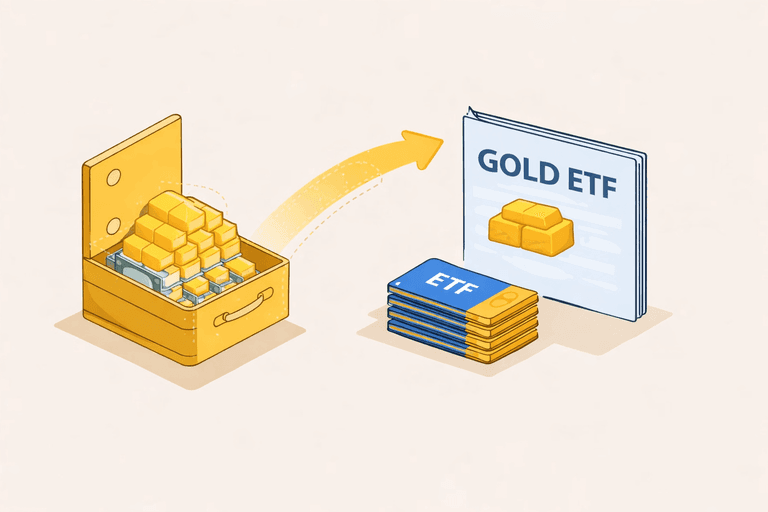
Gold ETFs let you invest in gold without the hassle of storage or physical coins. These funds hold physical gold and trade on the NSE/BSE.
ETFs have become a popular way for Indians to buy gold because of the convenience they offer. India also saw strong inflows into gold ETFs, driven by rising gold prices and demand for safer assets. This shows that gold ETFs are no longer just tactical tools, they are becoming core portfolio components.
Here is a list of top 5 cheapest Gold ETFs in India, which means they have the lowest expense ratio.
ETF Name | Expense Ratio |
Zerodha Gold ETF | 0.30% |
Mirae Asset Gold ETF | 0.35% |
Angel One Gold ETF | 0.35% |
Tata Gold Exchange Traded Fund | 0.40% |
LIC MF GOLD ETF | 0.41% |
*Expense ratio as of 31st December. They can vary over time.
5 Cheapest Equity Index ETFs in India
These ETFs track popular Indian market benchmarks like the Nifty 50 or Sensex.
ETF Name | Tracked Index | Approx. Expense Ratio |
ICICI Prudential | Nifty 50 ETF
| 0.02% |
Kotak | Nifty 50 ETF | 0.03% |
Aditya Birla Sun Life | Nifty 50 ETF | 0.04% |
Axis | Nifty 50 ETF | 0.04% |
Nippon India ETF | Nifty 50 BeES | 0.04% |
Other ETF categories worth considering
- Debt ETFs: Offer exposure to government bonds or money-market rates with low cost and low volatility — suitable for conservative investors.
- Sector & Thematic ETFs: More niche and usually slightly higher cost but good for targeted exposure (e.g., banking, IT).
How to evaluate an ETF beyond its cost
While expense ratio is an important parameter to choose an ETF, that is not enough. When comparing similar ETFs, look beyond just expense ratios to tracking error, trading volume, their assets under management and tax efficiency.
Let’s understand key things to evaluate an ETF beyond expense ratio.
1. Tracking Error
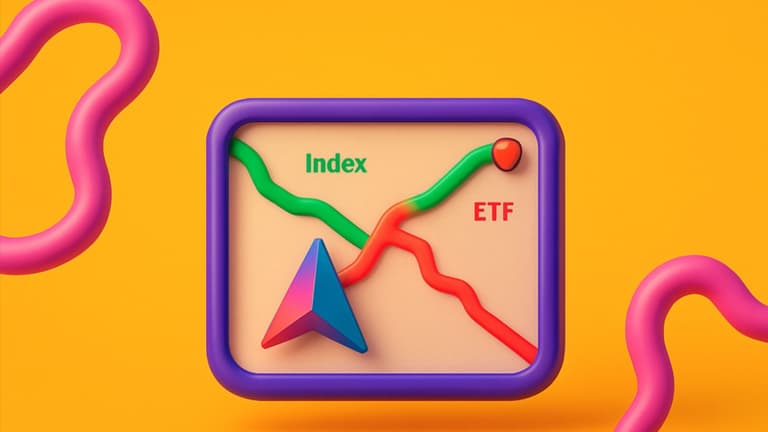
While lower fees are great, it is also important to ensure your ETF closely follows its target index. That’s why you need to check your ETF’s tracking error.
The goal of an ETF is to deliver returns closer to its benchmark. However, even the best ETFs, which are designed to perfectly copy a market index, will rarely have the same returns. There will always be a tiny difference.
Tracking error is simply the number we use to measure that difference. E.g., if the gold gives a 10% return and your gold ETF gives 9.8%, the difference of 0.2% is the tracking error.
- Lower tracking error = better ETF
- Higher tracking error = inefficient ETF
2. Liquidity & Bid-Ask Spread
Liquidity, measured through trading volume, tells you how easy it is to buy and sell the ETF. Higher trading volume usually means:
- Better prices
- Smaller gap between buy and sell price (tighter gap between bid-ask spread)
- Lower hidden costs
An ETF may look cheap on paper, but poor liquidity can make it expensive in practice.
4. Assets Under Management (AUM)
Higher AUM typically leads to narrower bid-ask spreads, meaning you can buy or sell units at prices closer to the actual NAV without losing money to "impact costs." It also helps minimize tracking error, as larger funds can replicate the index more efficiently. You don't need the biggest fund, but it must be large enough to trade easily without moving the market price against you.
Larger AUM may also means more investor confidence
5. Replication Method
Some ETFs buy all index stocks (full replication), while others use a sample. Full replication usually gives better accuracy. So if your goal is to get the exact returns of the given index, then make sure the ETF mirrors the index in terms of stock allocation.
Bottom Line
ETFs have moved from being “new and unfamiliar” to becoming one of the most practical investment tools for Indian investors.
Low-cost ETFs give you efficient and diversified exposure to markets without the heavy price tag. However, expense ratios don't tell the whole story. Before you buy, look at the fund’s tracking error, trading volume and fit with your investment goals and risk tolerance. Cost is important, but strategic fit is what actually wins the long game.

Related Topics

Everyone Bought Gold ETFs in January. Here's Why They're Selling Now

Why US ETFs Are Expensive for Indian Investors And How It Impacts Your Returns
Physical Gold vs Gold ETFs: Which investment is best for Indian investors?
How Your Gold Profits Are Taxed And Budget 2026 Expectations For Gold