


Monsoon 2026 and the Auto Sector: Who Actually Gets Hurt
A weak Monsoon 2026 could impact auto sector demand through rural income. Two-wheelers and tractors may face the most pressure, while passenger vehicles and global auto players remain relatively stable due to urban demand and diversification.
In This Article
- Introduction
- Two wheelers and tractors feel it first
- Passenger vehicles have less to worry about
- Commercial vehicles sit somewhere in between
- For ancillaries, it comes down to who buys from them
- What this actually means for Investors
- Investor Note
Introduction
A weak monsoon does not affect auto companies directly, but it can have a meaningful impact on demand.
The 2026 outlook points to a below normal monsoon, but that does not mean every auto stock should worry equally, since some segments sit right at the end of that rural chain while others are barely connected to it at all. This piece is really about telling the two apart, so that the read through on any individual stock becomes a little easier.
Two wheelers and tractors feel it first
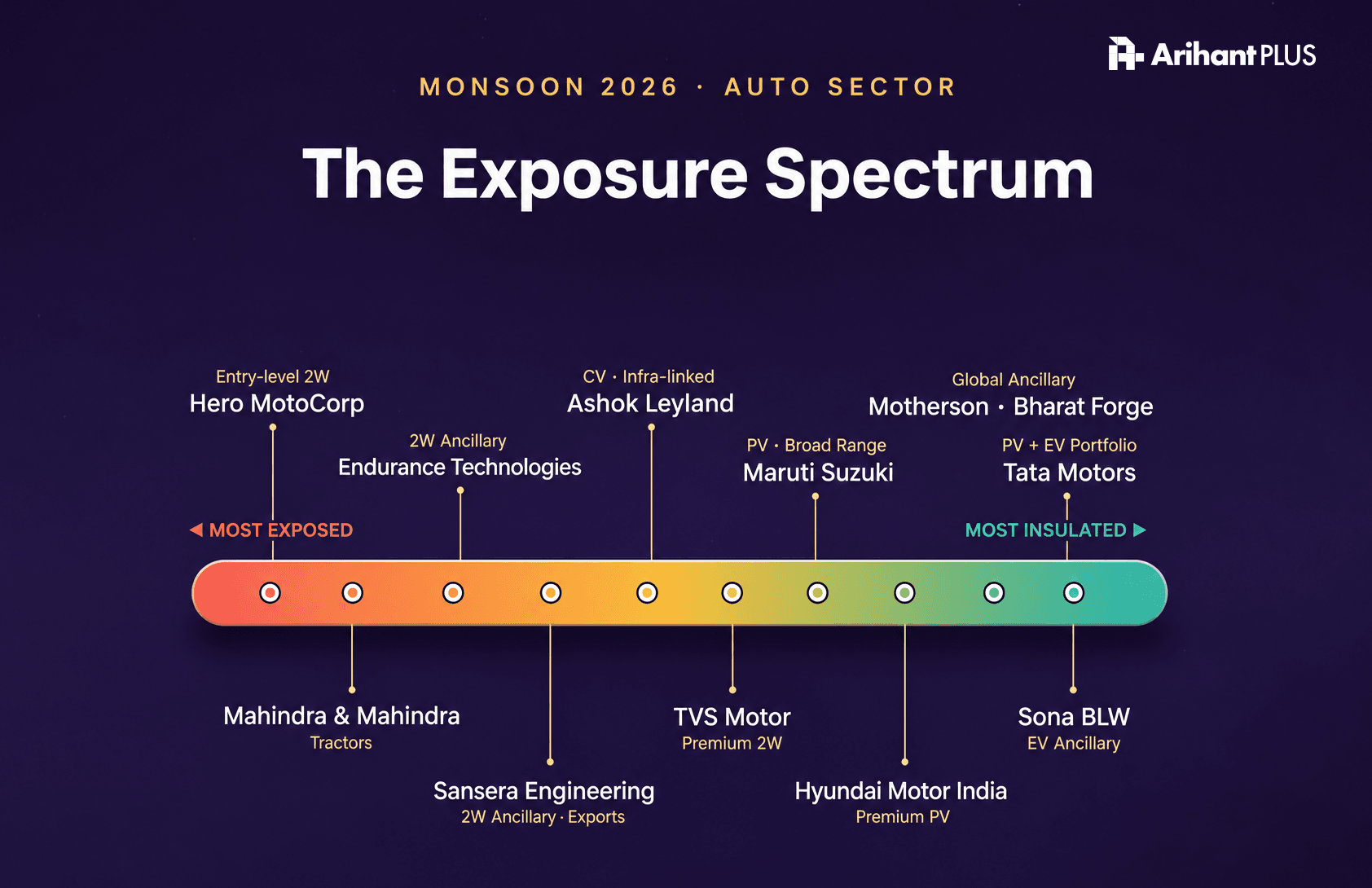
If you had to rank every auto segment by how sensitive it is to the monsoon, two wheelers and tractors would sit right at the top and it would not even be close, because both depend on rural cash flow in a way that few other categories do.
Within two wheelers, the split is fairly stark.
- Entry-level motorcycles: Most exposed, as demand depends heavily on rural incomes.
- Premium motorcycles & scooters: More resilient, with demand driven primarily by urban buyers.
Hero MotoCorp carries the heaviest rural motorcycle exposure among listed players, which makes it one of the more closely watched names whenever monsoon forecasts start looking uncertain. TVS Motor also leans rural to a meaningful degree, though its steady push toward premium models over the last few years has given it a bit more room to absorb any softness.
Tractors do not really need the full chain to play out before the impact shows up, since sowing activity and expected crop realisation translate almost directly into purchase decisions, because a tractor is typically bought with next season's harvest already in mind.
Mahindra and Mahindra, being the clear market leader in this category, is the name investors tend to watch most closely here, and while its broader auto business does offer some balance, tractors still sit close to the centre of how the stock trades through a monsoon story like this one.
Passenger vehicles have less to worry about
Passenger vehicles are much less affected by the monsoon, as demand is driven mainly by urban buyers, replacement purchases and financing. Only entry-level hatchbacks with stronger rural exposure may see some weakness.
Among automakers, Maruti Suzuki's rural presence is cushioned by its broad product range. Hyundai Motor India is premium-focused and sees little impact, while Tata Motors, with its premium and EV portfolio, is the most insulated.
Commercial vehicles sit somewhere in between
A weaker monsoon can slow rural freight, weighing on smaller commercial vehicles. But demand for medium and heavy trucks depends far more on infrastructure spending and fleet replacement.
Tata Motors and Ashok Leyland remain the key names to watch, with strong infrastructure spending likely to cushion any rural weakness.
For ancillaries, it comes down to who buys from them
Component makers never sell directly to farmers, they sell to vehicle manufacturers instead, so their exposure to the monsoon really just becomes a reflection of which manufacturers and which end segments they happen to supply into.
Endurance Technologies and Sansera Engineering have higher exposure through two-wheelers, although Sansera's exports provide some cushion. Motherson Group, Bharat Forge and Sona BLW are better insulated thanks to their global customer base, exports and EV focus.
What this actually means for Investors
The filter here turns out to be fairly simple once the pattern becomes clear. Companies with lower rural exposure, a premium product mix, strong exports and higher EV content are better insulated from a weak monsoon.
That leaves two-wheelers, tractors and their suppliers as the most exposed, while premium passenger vehicle makers, EV-focused players and globally diversified ancillaries are better positioned to weather any weakness.
Investor Note
Everything above is a framework rather than a prediction, and the actual outcome will depend on how rainfall behaves through August and September and and its effect on the Kharif harvest, which matters more than current seasonal forecasts.
Rural demand has surprised markets before, so these trends are best treated as a watchlist until clearer data emerges.
Related Topics


Vedanta Demerger: Why Aluminium Became the Market’s Favourite/Darling
Rupee Slips Past 95/USD | Factors Driving the Fall Despite RBI Intervention



The Popcorn Trade: How Dhurandhar 2 is driving PVR INOX Stock Higher

Sensex down 8% due to Iran war: Should you pause SIP or buy the dip?

What’s Getting Cheaper & Costlier in Budget 2026: A Simple Money Guide

Maruti Q3FY26 Profit Up 4%: Losing Grip on India’s Car Market?


Gold & Silver Rally Amid US–Venezuela Conflict: What Should Investors Do?

New Year, New Financial Goals: Make SIP Your 2026 Resolution


How Jane Street Snatched ₹36,500 Crore While India's Youth Lost Everything
