


The Popcorn Trade: How Dhurandhar 2 is driving PVR INOX Stock Higher

By
Arihant Team
Dhurandhar 2 is doing more than just pulling crowds for PVR INOX, and the market seems to be catching on. There’s a hidden driver behind the surge that most of y’all are missing! Let’s find out what’s really moving the needle at PVR INOX.
In This Article
- Introduction
- A Four Hour Film Changes Behaviour
- Why Popcorn Matters More Than Tickets
- Timing..Why This Film Matters Right Now
- The Hidden Power of Operating Leverage
- What the Market Is Actually Pricing In
- The Lipstick Effect in Action
- What Really Matters Now
Introduction
Over the past few trading sessions, something unusual has been happening.
While broader markets have been shaky, PVR INOX has been holding up , even inching upward. At first glance, the explanation seems obvious. A big film has been released, theatres are full, and the box office is booming.
But that explanation is incomplete. Because if you follow the money closely, you realize something more interesting: PVR’s fortunes are not being driven by ticket sales alone. In fact, the most important revenue driver right now isn’t even visible on the box office tracker.
To understand what’s really happening, you have to step inside the theatre and stay there a little longer than usual.
Open a free account today
Invest in tomorrow with just one click
A Four Hour Film Changes Behaviour
When you walk in to watch Dhurandhar: The Revenge, you expect scale. You expect spectacle. What you don’t consciously expect is how long you’re going to be there.
And that changes things.
A typical film keeps you occupied for two to two-and-a-half hours. You might grab a quick snack, maybe a drink, and that’s about it. But a film that stretches close to four hours does something else. It slows you down. It makes the theatre feel less like a stop and more like a space you’re inhabiting.
Halfway through, you step out. Not because you planned to spend more, but because staying that long almost demands it. Hunger kicks in, boredom nudges you, habit takes over. You buy something again.
That small behavioural shift is where the economics begin to change.
Why Popcorn Matters More Than Tickets
In the cinema business, not all revenue is equal.
When you buy a ticket, a significant portion of that money flows back to producers and distributors especially in the first few weeks of release. The exhibitor, in this case PVR, keeps only a part of it.
But when you buy food or beverages, that equation flips.
F&B gross margins for PVR sit at approximately 75%, with some industry analysis placing cinema popcorn margins as high as 80%. The cost of goods is negligible compared to the selling price, you already know this, you've paid it.
This is why the industry tracks something called Spend Per Head (SPH). It’s a simple metric, but it captures something powerful: how much each viewer spends beyond the ticket.
During the first Dhurandhar, this number behaved in a way that caught even PVR off guard. SPH jumped sharply, moving from its usual levels of ₹130 to nearly ₹190 with weekend evening shows crossing ₹200. A ~50% jump over the annual average, attributable almost entirely to the runtime not pricing.
People stayed longer. And because they stayed longer, they spent more.
Now, with Dhurandhar 2, that same dynamic is playing out again, only this time, at a much larger scale. The film is longer, the anticipation is higher, and the audience walking in already knows what they’re signing up for.
So the spending isn’t accidental anymore. It’s almost built into the experience.
Timing..Why This Film Matters Right Now
If this film had arrived in a strong quarter, it would still have been a hit. But it wouldn’t have mattered as much.
The difference this time is context.
The weeks leading up to the release had been underwhelming for the industry. Films had failed to generate momentum, footfalls were inconsistent, and overall box office collections were trailing behind last year’s numbers. As of March 18, industry-wide box office collections for Q4FY26 stood at roughly ₹1,500 crore, dramatically below the ₹2,190 crore clocked in Q4FY25 and a world away from the ₹3,290 crore in Q3FY26.
And then came Dhurandhar 2.
Not just as a successful film, but as a concentrated burst of performance. High occupancy, premium pricing, and crucially, long runtime, all arriving within a narrow window when it was needed the most.
And that is precisely why the stock reacted before the full numbers showed up. Advance bookings, early occupancy trends, and strong opening collections gave the market something it values deeply..visibility. The kind that allows investors to start pricing in earnings even before they are reported.
The Hidden Power of Operating Leverage
Multiplex economics have a quiet advantage.
Most of their costs don’t change much with footfall. Whether seats are half full or nearly packed, expenses like rent, staffing, and maintenance remain largely fixed.
So when occupancy jumps as it has with Dhurandhar 2, the additional revenue flows through with disproportionate impact.
Now add the F&B effect on top of that.
Every extra rupee spent at the counter carries significantly higher margins than a ticket. So you’re not just seeing more people in theatres. You’re seeing each person contributing more profit than usual.
That combination: higher occupancy and higher SPH is what turns a blockbuster into a financial event.
But to be fair.. while a film like this can lift a quarter meaningfully, it cannot carry an entire year on its own. Multiplex businesses still depend on a steady pipeline of releases to keep screens occupied week after week.
What the Market Is Actually Pricing In
This is why the market reaction in PVR INOX is more nuanced than “hit film equals higher stock.”
In the three sessions leading up to Dhurandhar 2's March 19 release, PVR INOX shares rose for three consecutive days, reaching ₹1,040 on the NSE..a notable move given that Nifty 50 itself was down over 2% on release day due to global selloff pressures from the prolonged US-Iran conflict and rising oil prices. PVR holding firm and running against the index was a signal in itself.
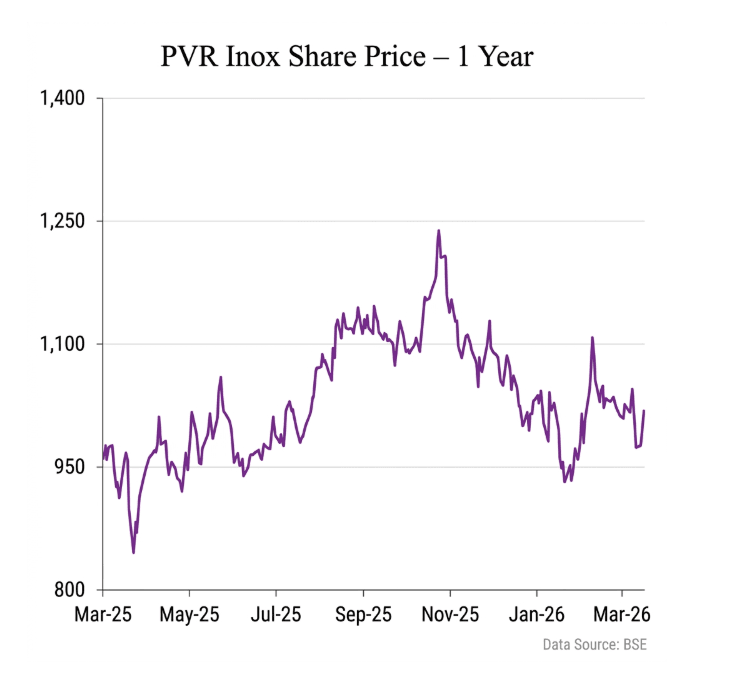
On release day, the stock opened up 2% before briefly dipping to negative territory, a 3% intraday swing triggered by news of show cancellations in Kannada and Malayalam dubbed versions due to technical difficulties, which director Aditya Dhar publicly apologised for. Once the clarity emerged that Hindi, Telugu, and Tamil shows were running smoothly and Malayalam/Kannada would resume from the next morning, the panic was short-lived.
But the bigger takeaway here is, investors aren’t just looking at box office collections. They’re asking deeper questions:
- How much of this footfall converts into F&B revenue?
- How sustainable is the SPH jump?
- Can one film meaningfully shift quarterly earnings?
And in this case, the answer is leaning toward yes.
Because the scale is large enough, and the timing is precise enough, for this film to influence not just sentiment but actual reported numbers.
The Lipstick Effect in Action
Now India entered 2026 with sluggish consumer sentiment, credit growth near 10%, and a central bank that has had to cut rates to sustain domestic demand. In such phases, consumer behaviour tends to shift in subtle ways.
People postpone big purchases. But they don’t stop seeking experiences.
Instead, they turn to smaller, more affordable indulgences, things that deliver a sense of escape without requiring a large financial commitment.
This is exactly what the Lipstick Effect describes.
And a film like Dhurandhar 2 fits perfectly into that pattern. It offers scale, emotion, and immersion.. the kind of experience people might otherwise seek through more expensive forms of leisure. But it does so at a price point that feels accessible. So demand doesn’t just sustain. It intensifies.And when that demand flows through a system like PVR’s with its high-margin F&B engine, the financial impact becomes amplified.
What Really Matters Now
Everyone tracking this story is watching the ₹542 crore gross in four days. That is the right headline. But the number that will matter most to PVR's Q4FY26 results when they report is quieter and more unglamorous.
It is the SPH: the Spend Per Head at the F&B counter. And if Part 1 pushed it from ₹132 to ₹190, Part 2, releasing into higher-anticipation audiences, a solo window, a festive period (Gudi Padwa, Eid), and a more premium pricing structure, has every structural condition in place to match or exceed that.
At ~80% gross margins on every incremental rupee, with 1.29 crore footfalls in four days and counting, the popcorn counter is doing serious, serious work right now.
Hamza is back. And PVR's balance sheet is very glad he is.
Related Topics
Rupee Slips Past 95/USD | Factors Driving the Fall Despite RBI Intervention


Sensex down 8% due to Iran war: Should you pause SIP or buy the dip?

What’s Getting Cheaper & Costlier in Budget 2026: A Simple Money Guide

Maruti Q3FY26 Profit Up 4%: Losing Grip on India’s Car Market?


Gold & Silver Rally Amid US–Venezuela Conflict: What Should Investors Do?
New Year, New Financial Goals: Make SIP Your 2026 Resolution


How Jane Street Snatched ₹36,500 Crore While India's Youth Lost Everything
