

India-EU Trade Deal: Which Sectors Will Win Big?

By
Arihant Team
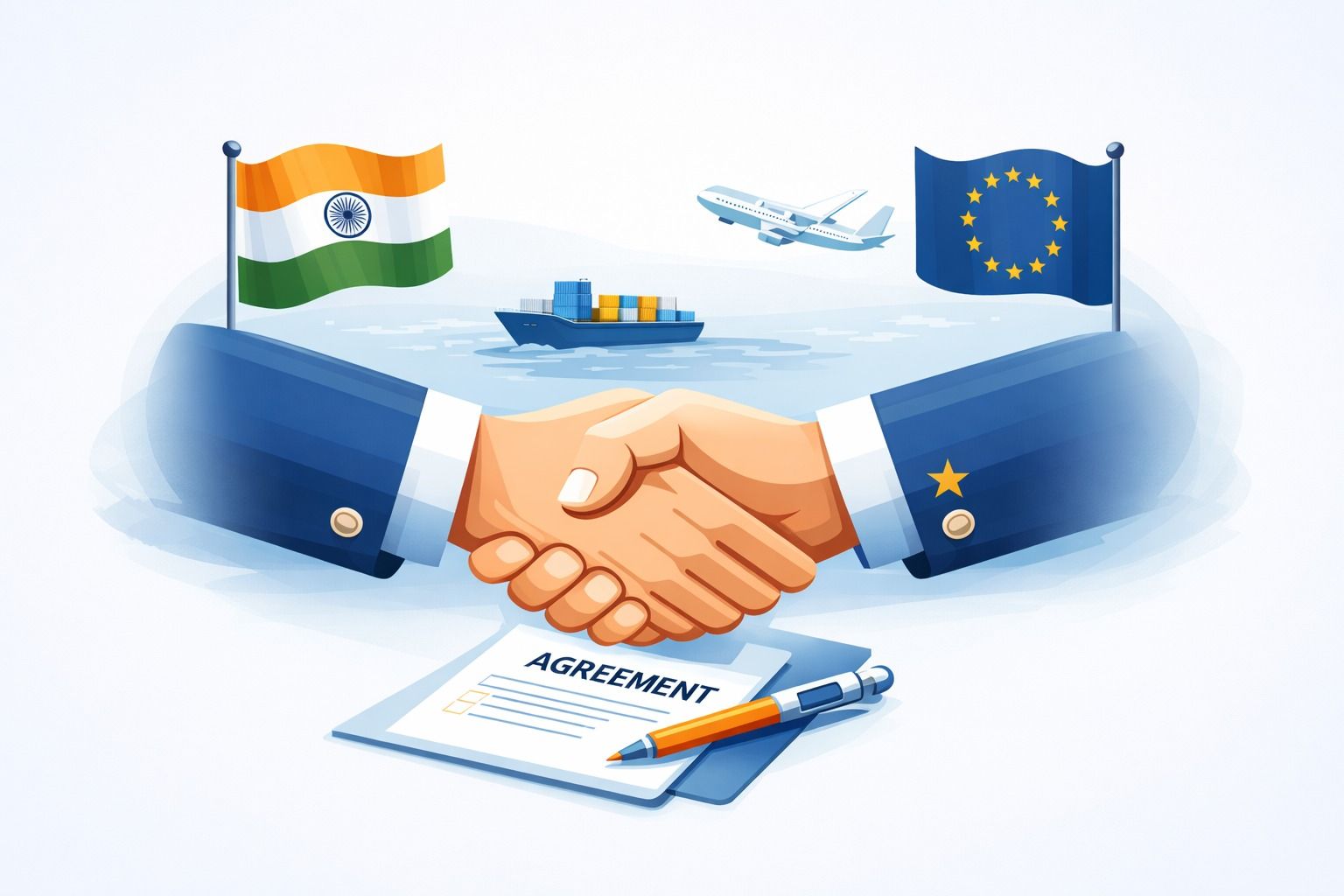
The India–EU Free Trade Agreement could reshape export economics as tariffs drop to zero across key sectors. Textiles, IT services, pharma, chemicals, auto components and footwear stand to gain, while carbon-heavy industries face pressure from Europe’s green rules.
In This Article
- Why This Deal Matters Now: The GSP Cliff
- Why Europe and India Suddenly Found Urgency
- Sectoral Impact: Who Wins From the India EU FTA
- EU Deal Favors Green: Who Loses Out?
- The Final Take: Timing and Geopolitics
Two billion people. Nearly a quarter of global GDP. And a trade agreement that’s already being called the “mother of all trade deals.”
But here’s the part most headlines skip, this deal didn’t happen in a vacuum. In many ways, it’s a by-product of a world that’s become more fractured, more protectionist, and far less predictable.
The US turning inward over the past few years, beginning with the Trump administration and continuing in different forms since, quietly reshaped global trade incentives. As tariffs rose and geopolitical risk became harder to ignore, European Union found themselves nudging closer to India. And on 27 January 2026, after years of stalled negotiations and strategic hesitation, the two sides finally concluded talks on a long-awaited Free Trade Agreement (FTA).
While on paper, it looks like just another FTA in reality, it could quietly reset India’s export economics in Europe.
Open a free account today
Invest in tomorrow with just one click
Why This Deal Matters Now: The GSP Cliff
To see why, you need to understand something called the GSP cliff.
At the start of 2026, the EU suspended Generalised System of Preferences benefits for India. The impact was immediate and brutal. Nearly 87% of Indian exports to Europe suddenly faced higher duties. Textile tariffs jumped from around 9% to 12%. Specialty chemicals saw duties rise to about 6.5%. Marine products faced levies going as high as 18%.
Exporters felt the pain almost instantly. Q3 earnings calls turned cautious, margins came under pressure, and guidance softened.
That’s where this FTA changes the narrative.
Because the deal is actively reversing the damage done after January. Many of those recently increased duties go straight to zero. What looked like a structural margin hit a few months ago could now flip into a margin surprise. And because this reversal happened quickly, much of the market hasn’t fully priced it in yet.
Why Europe and India Suddenly Found Urgency
So why did both sides suddenly find urgency now?
For Europe, India is already too big to ignore. They already trade over €180 billion worth of goods and services per year, supporting close to 800,000 EU jobs. Link
The total goods trade (merchandise trade) between the European Union (EU) and India was approximately US $136.5 billion (about €117 billion) for the fiscal year ending March 2025.. And with India projected to become the world’s third-largest economy by 2030, Europe sees this as more than just trade..it’s a chance to lock in early access to the next major growth engine.
For India, the world has become a lot less friendly. The US has tightened the screws on exports, especially in labour intensive sectors like garments. Trade with China has shifted from economics to geopolitics. Reliable partners are harder to come by.
Europe, in contrast, offers stability: clear rules, fewer sudden shocks, and the ability to plan long term. In a volatile global setup, that predictability is valuable.
And that’s why this deal matters.
Sectoral Impact: Who Wins From the India EU FTA
Textiles and apparel
Nowhere is this clearer than in textiles and apparel.
For years, Indian garments entered the EU at a disadvantage. Duties of 9 - 12% meant Indian exporters were competing with one hand tied behind their backs, especially when rivals like Bangladesh and Pakistan enjoyed zero duty access under preference schemes.
In a sector as price-sensitive as textiles, tariffs don’t just nibble at profits; they decide who survives. Studies consistently show that even small tariff cuts can lead to outsized jumps in exports, production, and employment. And Europe isn’t some fringe market either, it’s India’s second-largest apparel destination after the US.
The factories already exist. The labour is available. Export ecosystems are globally compliant. All that was missing was competitive access. With tariffs now dropping to zero, exporters can either enjoy fatter margins or price aggressively and win volumes. Either way, the economics improve meaningfully.
Stocks to watch: Home textile players such as Welspun Living and Indo Count also stand to benefit as European buyers look to diversify sourcing away from China. Even Raymond, better known domestically, could see renewed interest from European buyers in fabrics and suitings as Indian supply becomes easier to access.
IT services & tech
India’s IT services sector, for instance, doesn’t suffer from tariffs as much as it suffers from rules. Europe is a fragmented market when it comes to work visas. Data regulations like GDPR are among the strictest in the world. Compliance costs are high, and in some cases Indian firms are forced to set up local offices or meet salary thresholds even when services are delivered digitally.
Yet despite all this friction, India EU services trade crossed €66 billion in 2024, with Europe importing more than €37 billion worth of services from India. If this FTA smoothens mobility rules, clarifies data flows, and reduces regulatory noise, the impact on IT services could be larger than any tariff cut on goods.
Stocks to watch: TCS, Infosys, and Wipro, all of which already operate sizable European delivery centres, stand to gain disproportionately. More interestingly, L&T Technology Services could benefit from rising engineering and R&D outsourcing demand from Europe’s automotive and industrial companies.
Pharmaceuticals & Specialty Chemicals
A similar story plays out in pharmaceuticals and specialty chemicals. India is the world’s third largest drug producer by volume, but more than a third of its pharma exports still depend on the US. That concentration creates vulnerability. Europe offers a natural counterbalance, already absorbing about 20% of Indian pharma exports. Better access helps rebalance trade and reduce policy risk tied to a single geography. Companies such as Divi’s Labs, and Syngene, could see stronger order flows as European customers look to deepen relationships.
In specialty chemicals, the math is even simpler. When GSP benefits were withdrawn in January, import duties jumped to around 6.5%. The FTA takes those duties to zero. That’s either a straight margin expansion or a pricing edge that can unlock volumes. In a business where scale and consistency matter, that shift is meaningful.
Stocks to watch: Companies like SRF and Navin Fluorine stand to gain.
Auto components
Auto components tell an even more underappreciated story. While headlines focus on European cars entering India, Europe itself has become structurally uncompetitive in energy-intensive manufacturing like forging and casting due to high power costs.
India already supplies precision auto components to Europe, and with tariffs of 4-10% removed, companies like Motherson and Bharat Forge become even more attractive suppliers under the China +1 strategy.India, meanwhile, already supplies precision components to European OEMs.
Footwear
Footwear, too, sees a quiet revival. Europe and the UK still consume large volumes of premium and institutional leather footwear. Indian exporters with deep legacy relationships had lost ground due to high duties and cheaper Chinese alternatives. Zero-duty access changes that.
Stocks to watch: Mirza International, with its long-standing UK relationships, could revive white-label exports, while Superhouse may regain competitiveness in safety and institutional footwear across Europe.
EU Deal Favors Green: Who Loses Out?
That said, not every sector wins.
Europe’s Carbon Border Adjustment Mechanism is a real headwind for carbon-intensive industries. Steel and aluminium producers that rely on coal based processes could see their exports become 20 - 35% more expensive despite tariff cuts. Companies like JSW Steel, Jindal Steel & Power, Hindalco, and Vedanta face pressure here. Tata Steel is relatively better positioned due to its European footprint, but even that only softens the blow.
In this new world, environmental compliance matters as much as price. And that might be the biggest takeaway of all.
The Final Take: Timing and Geopolitics
One important reality check: trade deals take time.
India signed an FTA with the UK last year, and it’s still moving through regulatory approvals in the UK Parliament. The India–EU deal will likely follow a similar path, with 6–9 months before any meaningful impact shows up in exports or earnings.
That said, the direction of travel matters more than the timeline.
The global backdrop is turning decisively in India’s favour. The US has already warned that countries entering FTAs with China could face punitive tariffs (even up to 100%). That hard stance is pushing more countries and companies to rethink their China exposure.
India stands out as a natural alternative.
With preferential access to the UK already in motion, the EU next in line, and growing geopolitical alignment with the West, India is becoming less of a fallback option and more of a default supply chain choice.
Related Topics
Rupee Slips Past 95/USD | Factors Driving the Fall Despite RBI Intervention



The Popcorn Trade: How Dhurandhar 2 is driving PVR INOX Stock Higher

Sensex down 8% due to Iran war: Should you pause SIP or buy the dip?
What’s Getting Cheaper & Costlier in Budget 2026: A Simple Money Guide

Maruti Q3FY26 Profit Up 4%: Losing Grip on India’s Car Market?
Gold & Silver Rally Amid US–Venezuela Conflict: What Should Investors Do?

New Year, New Financial Goals: Make SIP Your 2026 Resolution


How Jane Street Snatched ₹36,500 Crore While India's Youth Lost Everything
