
Beginner’s Guide to Advanced Algo Backtesting

By
Arihant Team
Algo trading can feel like a black box, but at its core, it relies on one central premise: using data to verify an idea before risking real money.
In This Article
- Key takeaways
- Introduction
- Backtest Your Algo Before You Deploy
- Investor Takeaway
Key takeaways
Backtesting helps you evaluate a trading strategy on historical market data before risking real capital.
A profitable backtest should build confidence in a strategy’s robustness, not simply produce impressive past returns.
Reliable backtests account for different market conditions, trading costs, slippage, and performance on unseen data.
- The biggest mistakes traders make in backtesting is testing on poor-quality or unadjusted data and optimizing endlessly until the chart looks perfect.
- You should not judge a strategy only by returns
Introduction
If you've been exploring algo trading, you've almost certainly come across the term backtesting. And for good reason. It's the foundation of every systematic trading strategy.
Backtesting is the process of taking a clear set of trading rules and testing them on historical market data to see how the strategy would have performed. For example, a simple rule could be: buy when the 50-day moving average crosses above the 200-day moving average, and sell when it crosses below.
The goal isn't to prove that a strategy is profitable. It's to answer a much more important question: Would this idea have survived real market conditions?
The truth is, many strategies look brilliant on paper, only to fall apart in live markets. That's why a good backtest isn't about chasing the highest returns, it's about building confidence that your strategy is robust.
To build a system you can actually trust, you need to understand how backtesting works from the ground up, step by step. So, if you’re a beginner starting with algo trading, consider this your backtesting starter pack.
Before we start let’s see how a a backtest really works
Every backtest follows the same four-step framework:
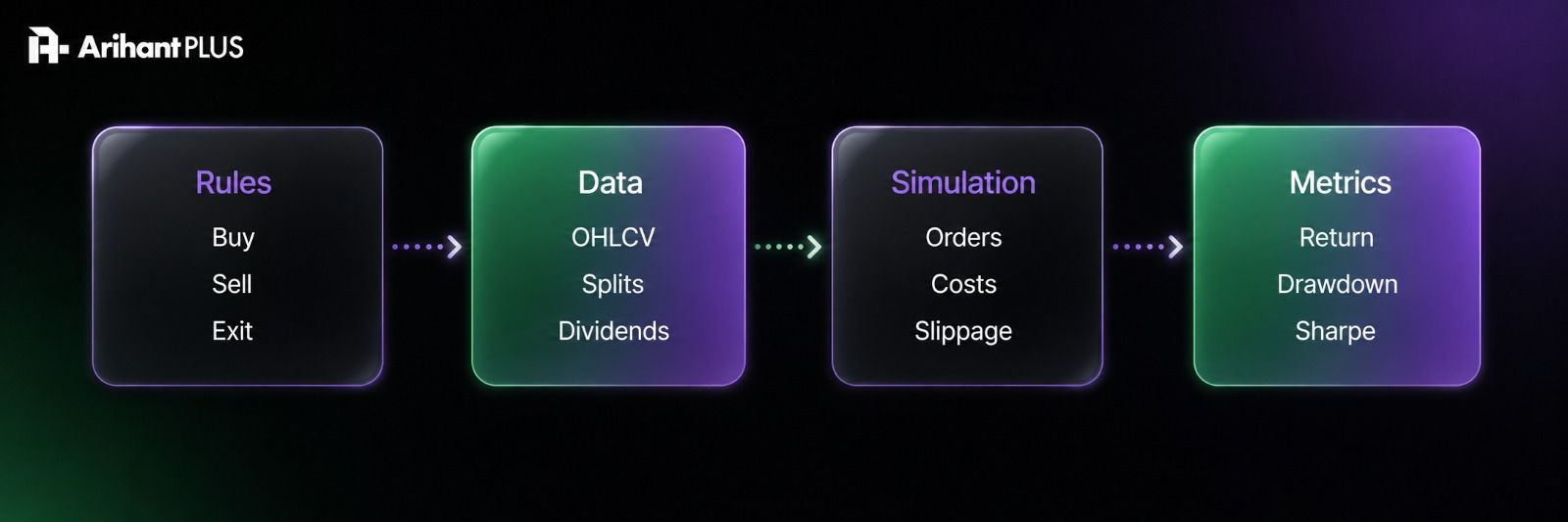
If any one of these four components is flawed, your results become unreliable. Let's build each one properly.
Step 1: Cleaning and Preparing Your Foundation Data
Before writing a single line of strategy logic, you have to look at the data you are feeding your algorithm. If your historical data is faulty, your backtest results will be meaningless.
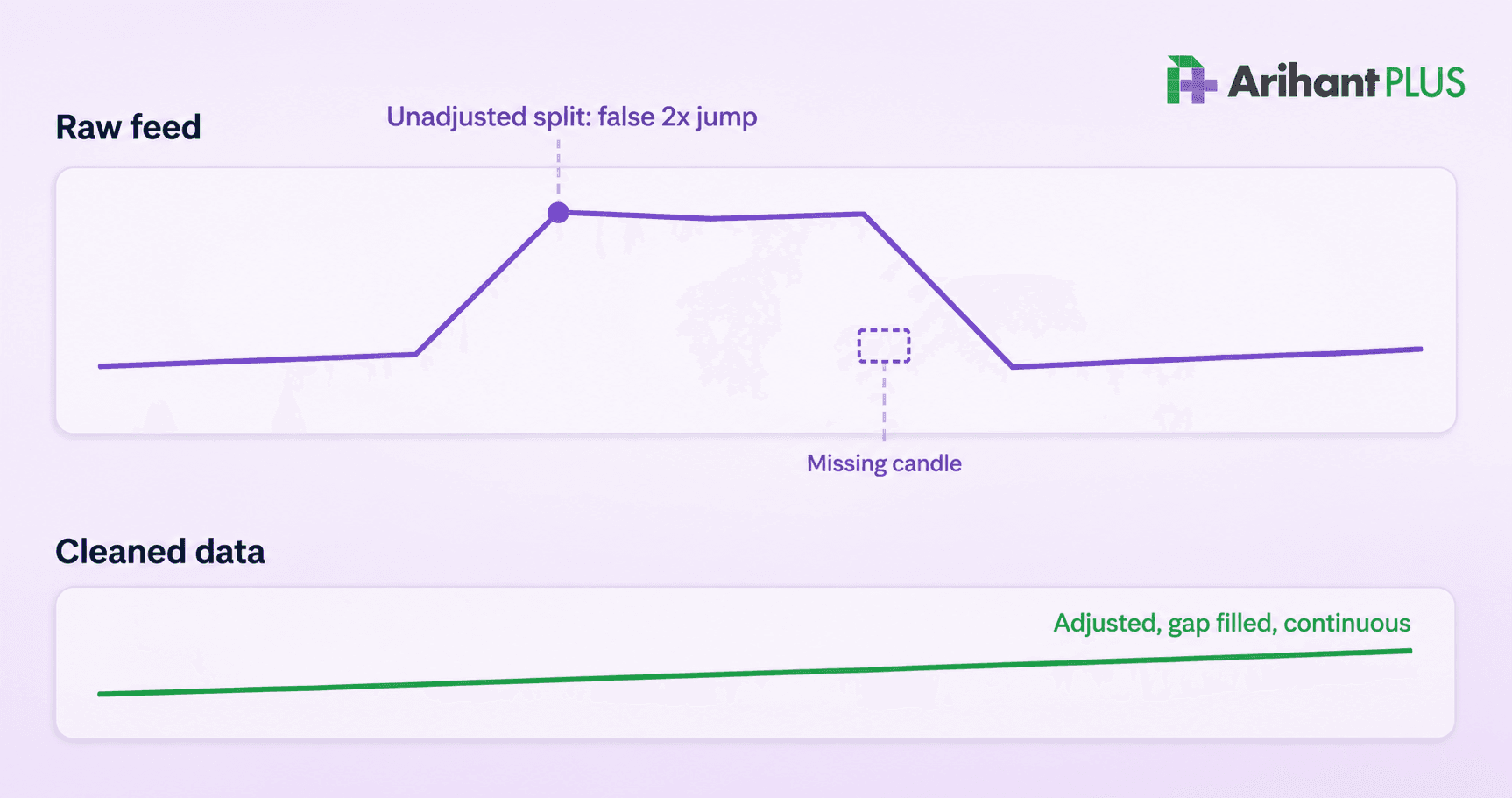
Historical price feeds directly from exchanges often contain hidden glitches: missing minute candles, unadjusted stock splits, or incorrect dividend payouts. Imagine a stock goes 2:1 stock split and its price falls overnight due to the split - not because something went wrong with the company. If your data isn't adjusted, the price shows a 50% drop. Your algorithm may incorrectly think it found an incredible buying opportunity when, in reality, nothing changed.
So how to prepare your data?
Fix missing values: Fill in data gaps or remove corrupted time intervals where exchange feeds dropped out.
Adjust for corporate actions: Ensure historical prices account for stock splits, dividends, rights issues, and mergers.
- Align timeframes: Match your testing data precisely to your trading style. If you plan to trade intraday, test on 5-minute candles, not daily summary candles.
Step 2: Avoid Overfitting
This is where most beginners make their biggest mistake.
After seeing an average strategy, they keep tweaking parameters until the backtest looks perfect. This is the single biggest danger in algorithmic trading, called overfitting.
What is overfitting?
Think of it like memorizing last year's exam paper.
If the exact same questions appear, you score 100%. However, the moment the paper changes you’re in deep trouble. An overfitted strategy behaves exactly the same way: it memorizes historical data instead of discovering a genuine market edge.
How to avoid overfitting?
Split your data into two parts:
Split your historical data into two parts.
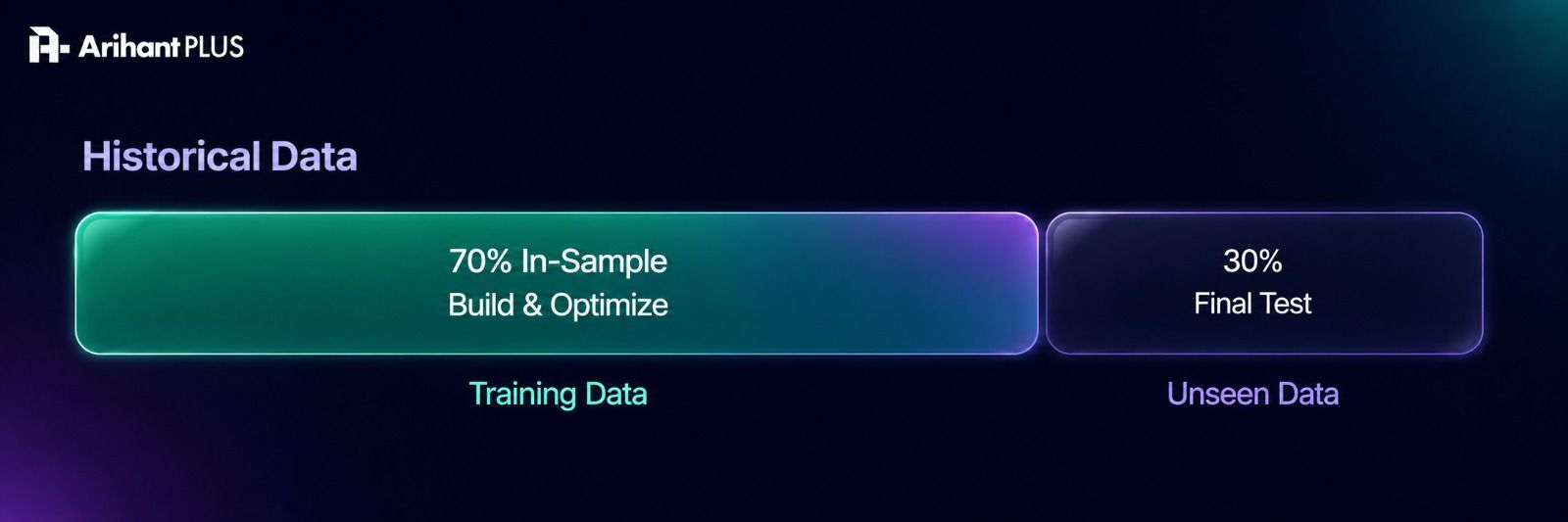
- In-sample (70%) → Build and optimize the strategy
- Out-of-sample (30%) → Test it only after you're done
If the strategy performs well on the first dataset but collapses on the unseen one, it wasn't robust. It was overfitted.
Keep Rules Simple:
Avoid adding dozens of indicators and hyper-specific conditions (e.g., "only buy if RSI is exactly 34.5 on a Tuesday"). Simple, broad rules hold up far better in real life.
Penalize Complexity:
If two versions of a strategy deliver similar results, choose the one with fewer rules and parameters. Simpler strategies are generally more robust and less likely to be overfitted.
Step 3: Making Your Backtest Look Like Real Trading
A profitable backtest can still fail in live markets because real execution is messy.
Once your strategy is lean and avoids overfitting on static data, you have to transition from a fixed test to a dynamic test that mirrors real market execution. There are two things every realistic backtest should include.
i) Walk-Forward Analysis: Testing for Adaptation
Markets change over time. Bull markets, bear markets and sideways markets behave differently. A setup that dominates in a bull market might fail in a sideways market. Instead of running one static test across five years, walk-forward analysis tests how your strategy adapts dynamically over time:
- Segment your data into sequential blocks (e.g., 6-month windows).
- Optimize your rules on the first block.
- Test execution on the immediate next block.
- Roll the windows forward and repeat the process across the entire dataset.
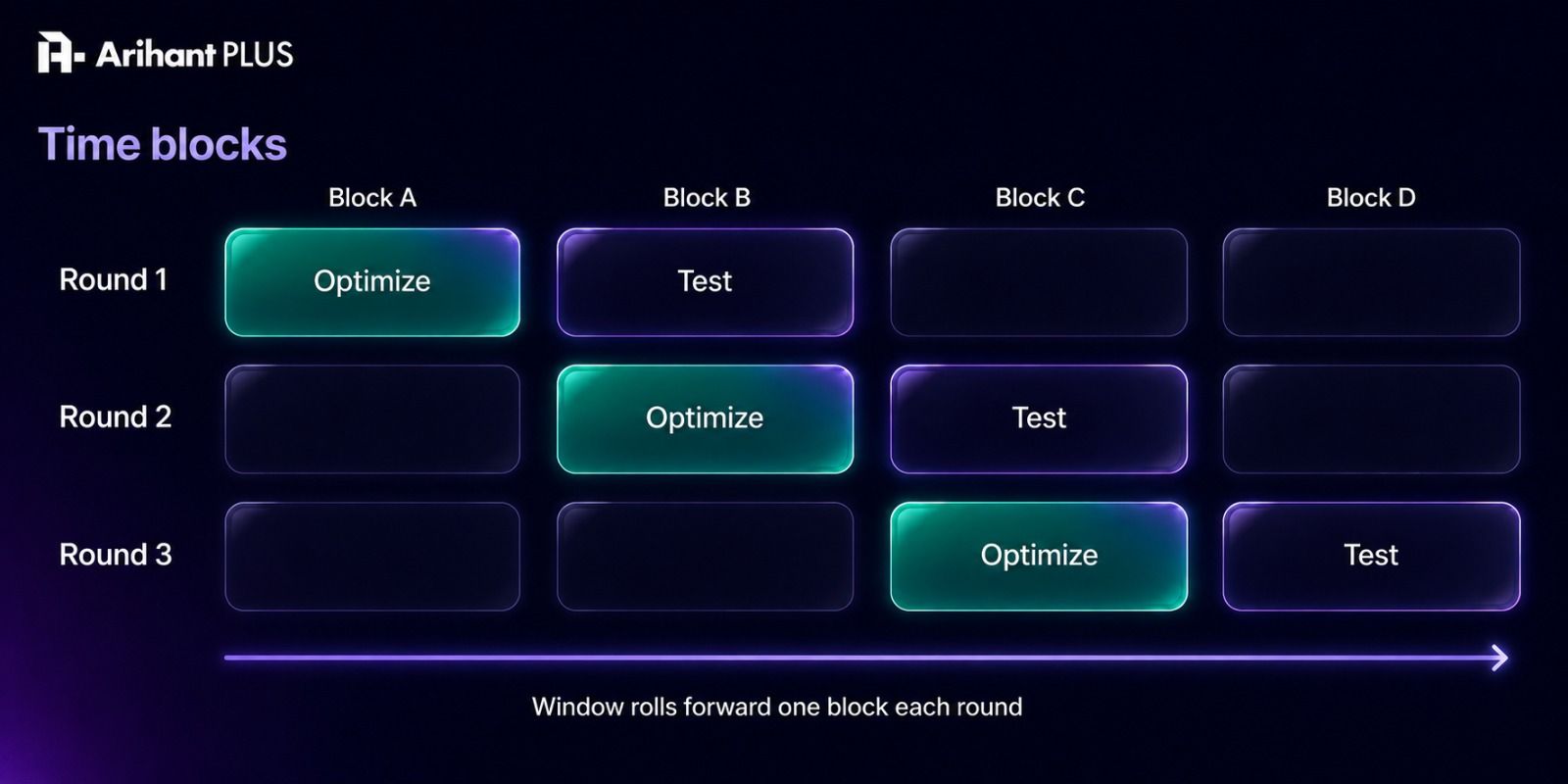
This tells you whether the strategy adapts consistently instead of succeeding in one lucky period.
ii) Factoring in Real-World Trading Costs
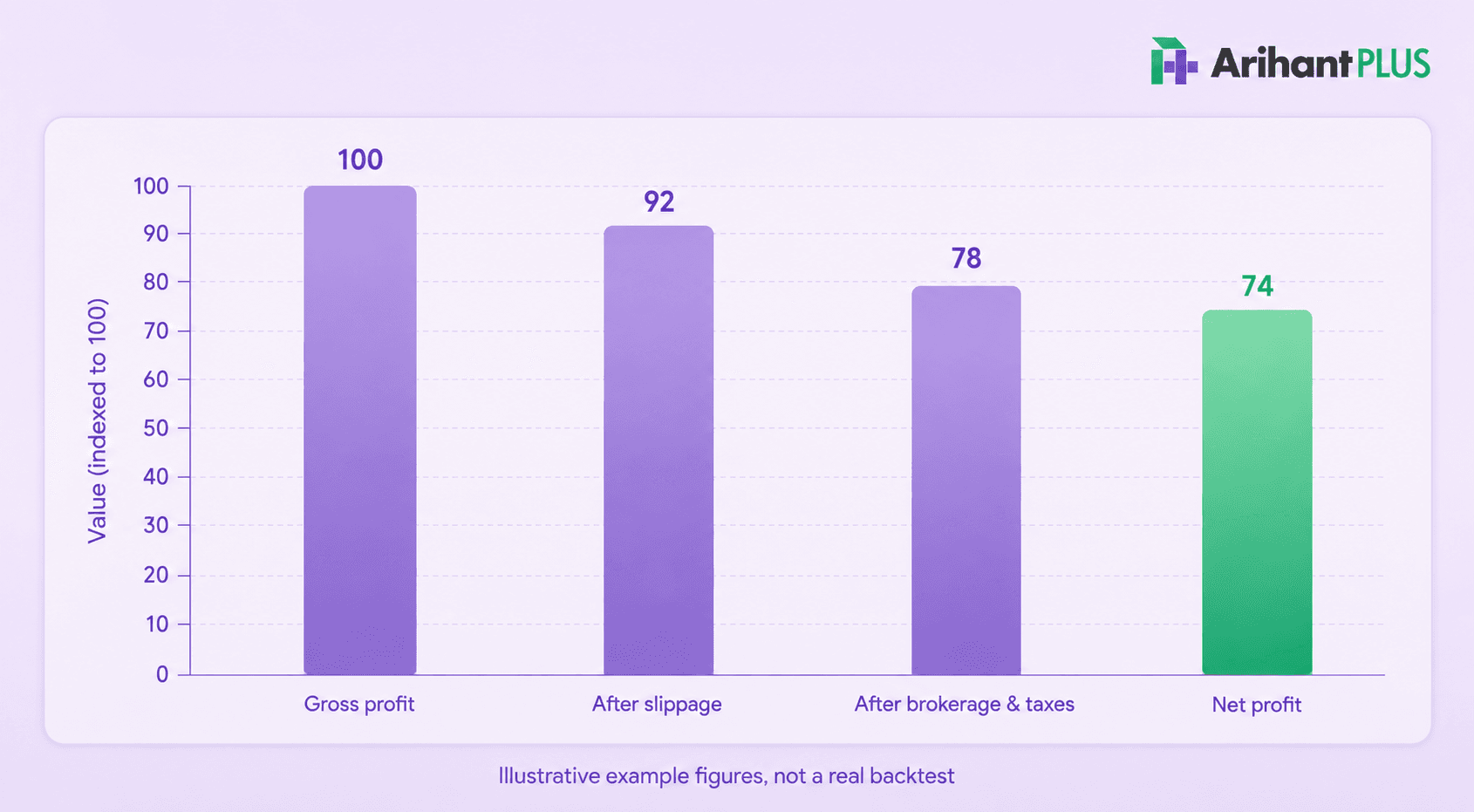
In a basic backtest, the computer assumes every trade executes instantly at the exact price requested, with zero costs. In real trading, that never happens.
To make your test realistic, you must subtract market frictions:
Slippage: The difference between the price you wanted and the price you actually got because the market moved mid-second.
Brokerage & Taxes: Transaction fees, exchange charges, and taxes eat into profits rapidly over hundreds of trades.
- Execution Latency: Even milliseconds of delay can affect fills in fast-moving markets.
Step 4: Evaluate the Right Performance Metrics
The biggest mistake beginners make is judging a strategy using only total profit.
Professional traders focus on risk-adjusted evaluation metrics. A strategy generating high returns is impractical if it risks losing half your capital along the way. Here are the four metrics that matter most:
Annualized Return & Volatility: The average yearly return, making different strategies easier to compare.
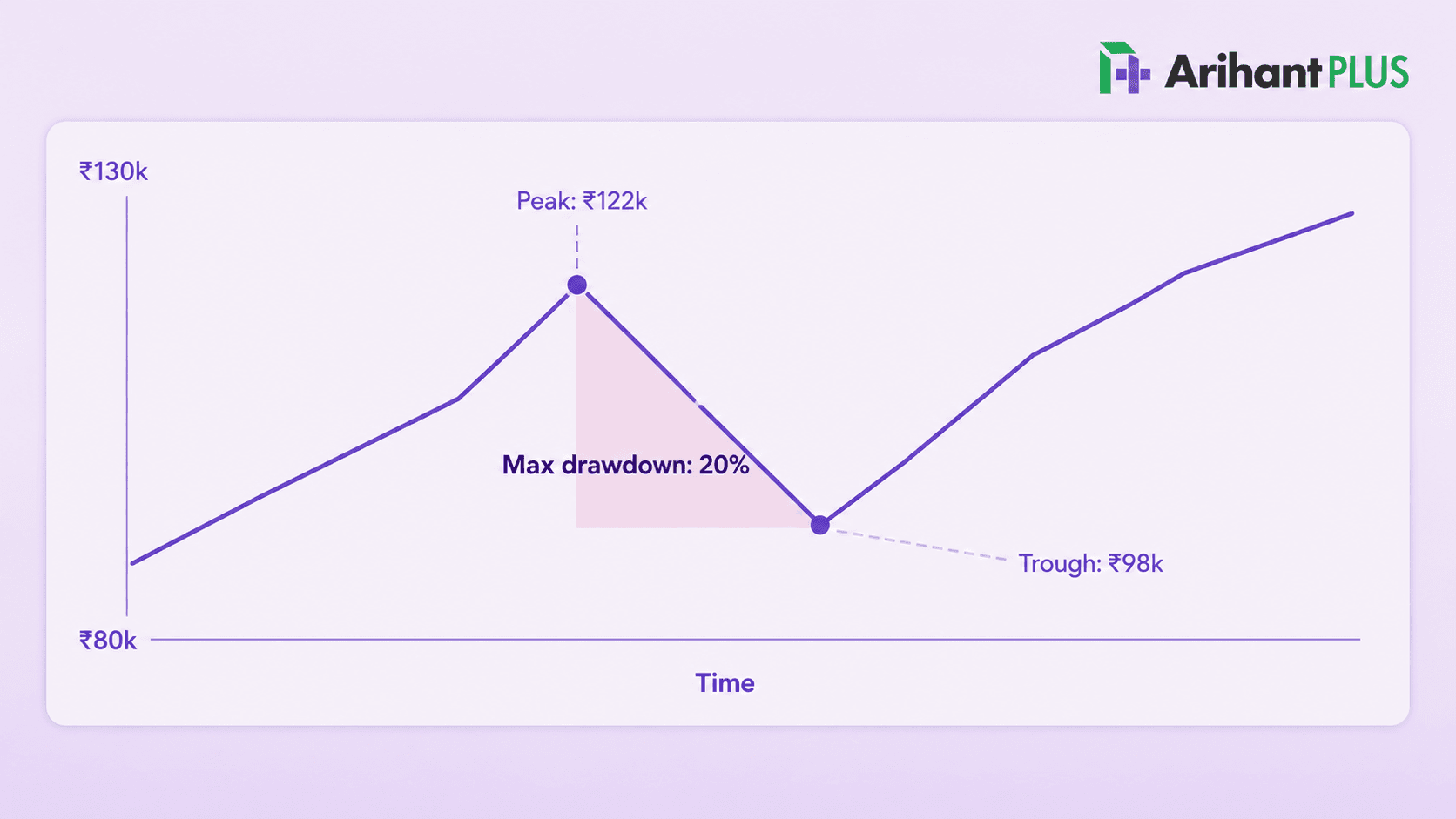
Maximum Drawdown (MDD): The largest peak-to-trough fall in your portfolio - this measures the worst historical loss your strategy experienced.
Sharpe Ratio: Shows how much return you're earning for each unit of risk. A higher Sahrpe ratio generally means smoother, more consistent performance.
- Win Rate & Profit Factor: Win rate tells you how often you win; profit factor tells you whether your winners are large enough to outweigh your losers. A strategy with a 45% win rate can still be highly profitable.
Note: Don't chase the highest win rate. A lower win rate with disciplined risk management often outperforms a strategy that wins frequently but suffers occasional massive losses.
Backtest Your Algo Before You Deploy
Once you've built your strategy, you don't have to jump straight into live trading. With ArihantPlus Algo, you can create your strategy, backtest it on historical market data, analyse its performance and validate the logic before deploying it to the live market. The platform lets you build algos without coding, making it easier to turn your trading rules into a systematic strategy and test them before putting real capital at risk.
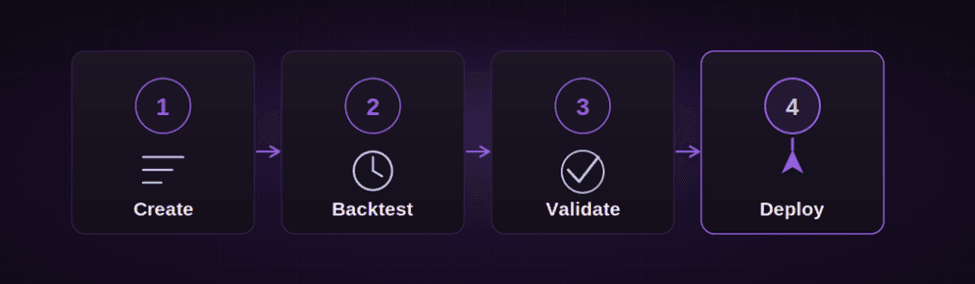
The idea is simple: test your strategy first, understand how it behaves, and only then consider taking it live.
Explore ArihantPlus Algo & Backtest Your Strategy
Investor Takeaway
By now, you should have a good idea of what backtesting really does. It’s not about proving your strategy right, but testing where it could go wrong before you risk real money.
And for first time algo traders, remember: your backtest is only as good as the data you feed it. So always check your entry data, costs, drawdowns and performance on unseen data before trusting the results.
Related Topics

How to Start Algo Trading on ArihantPlus: From No-Code to Advanced API Trading

Manual vs Algorithmic Trading: Which One Suits Your Style?


How is Algo Trading Beneficial for F&O Traders? Overview & FAQs
The Rise of Algo Trading Among Retail Investors in the Indian Stock Market