

Manual vs Algorithmic Trading: Which One Suits Your Style?

By
Arihant Team
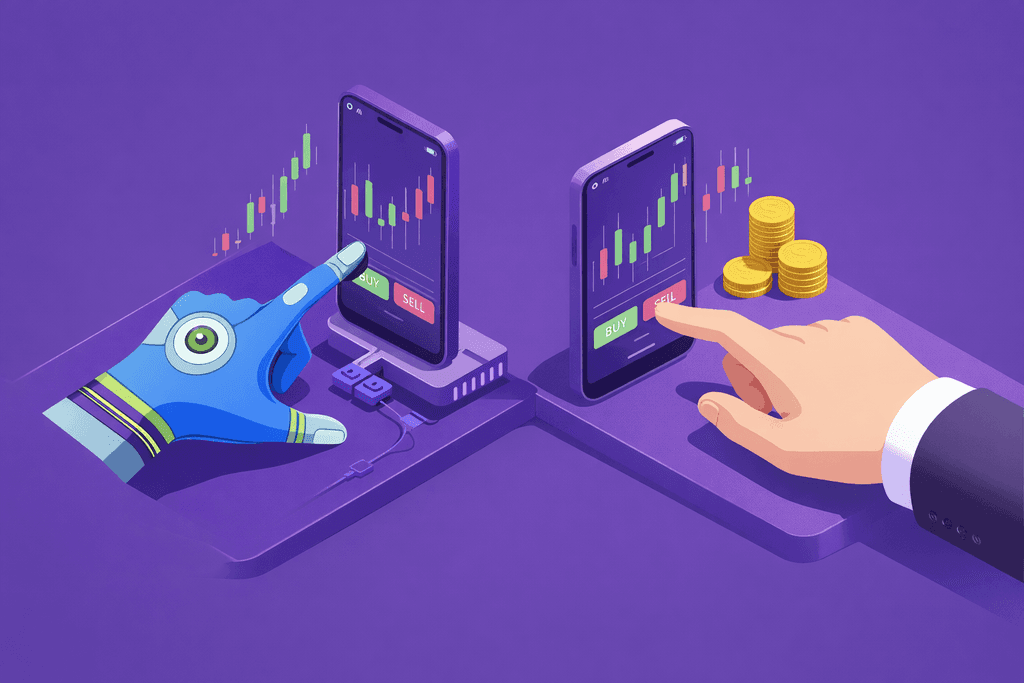
Should you trust your instinct or let the computer make the trades for you? Do you want to keep control or give absolute control to computer for your trading? In today’s time, one of the big questions almost every trading is facing is – should they continue their traditional way of trading or switch to algo trading. One gives you control and uses your experience, while the other makes lightning-fast decisions based on data, logic, and predefined rules with zero human intervention.
In This Article
- Introduction
- What is manual trading?
- What is algo trading?
- Manual Trading vs Automated Trading: A Side-by-Side View
- Automated vs manual trading in India: Which should you choose?
- Which style should you choose?
- Conclusion: Finding Your Trading Style
- FAQs
Introduction
Trading is not one-size-fits-all. Some traders prefer watching charts, making decisions themselves, and relying on instinct. Others choose automation, computer programs executing trades based on predefined rules. Whether you're a retail trader, a newbie trader, or a pro, choosing between manual trading and algorithmic trading (or automated trading) could significantly impact your returns and risk exposure.
In India, both styles are widely practiced. In August 2025, markets regulator SEBI opened doors for retail investors to participate in algo trading by introducing a revamped regulatory framework, which was previously limited to institutional investors. So, as a trader, you now have the option to trade manually or use automation. Platforms such as ArihantPlus provide access to APIs and market data, giving you the chance to explore algo trading in an affordable way.
The choice between manual vs algorithmic trading depends on your goals, personality, and resources.
What is manual trading?
Manual trading means you, the trader, are responsible for analysing the market, placing orders, and managing trades. Every decision is made by you, in real time. This style requires strong focus, discipline, and a deep understanding of the markets. Many traders enjoy manual trading because it gives them full control and the satisfaction of making decisions themselves.
Manual trading advantages
- Full control: Every decision is yours.
- Flexibility: You can adapt instantly to news, emotions, or changing market conditions.
- Simplicity: No coding or technical setup is required.
Challenges of manual trading
- Slower execution: Humans can’t react as fast as computers.
- Time-consuming: Inability to watch markets continuously can lead to missed opportunities and decision fatigue.
- Emotions: Fear, greed and cognitive bias can affect decisions.
- Scalability: Challenging to analyse multiple securities and strategies at the same time, limiting scale.
What is algo trading?
Algo trading, short for algorithmic trading, combines trading expertise with programming skills. It uses computer programs to place trades based on predefined set of rules such as volume, price movements, value, time, or any other mathematical or statistical models. Once you set the strategy, the system monitors the market, and when your rules or criteria are met, it executes the trades automatically without any human intervention.
Think of it as robotic trading systems that never sleep, continuously analysing market trends and making trades in the blink of an eye. This style removes emotions and speeds up execution. Over the last few years, algo trading systems have grown increasingly sophisticated, utilizing artificial intelligence (AI) techniques like machine learning and deep learning.
Until recently, algo trading was only for the big boys – the institutional investors. However, since SEBI permitted algo trading for everyone, it is now becoming popular among retail traders too. With ArihantPlus Trading APIs, Indian you can access automation, live market feeds, and historical data for testing strategies.
Pros and cons of algorithmic trading
Advantages:
- Speed: Trades are executed in milliseconds.
- Consistency: Zero emotional intervention and trades are made purely on logic.
- Efficiency: Handles multiple trades at once.
- Backtesting: Strategies can be tested with historical data.
- Scalability: System can handle several strategies and asset classes at the same time.
Disadvantages:
- Technical knowledge needed: Some coding skills may be required.
- Setup costs: Advanced systems may need investment.
- System risks: Internet outages or coding errors cannot just disrupt trades but be catastrophic. A bug can pile up losses in seconds.
- Risk of losses: It can lead to quick gains, but rapid losses also pile up quickly, especially in volatile market conditions.
- No context: Algorithms have limitations in terms of deciphering the impact of breaking news, earning surprises or political events like humans can.
Manual Trading vs Automated Trading: A Side-by-Side View
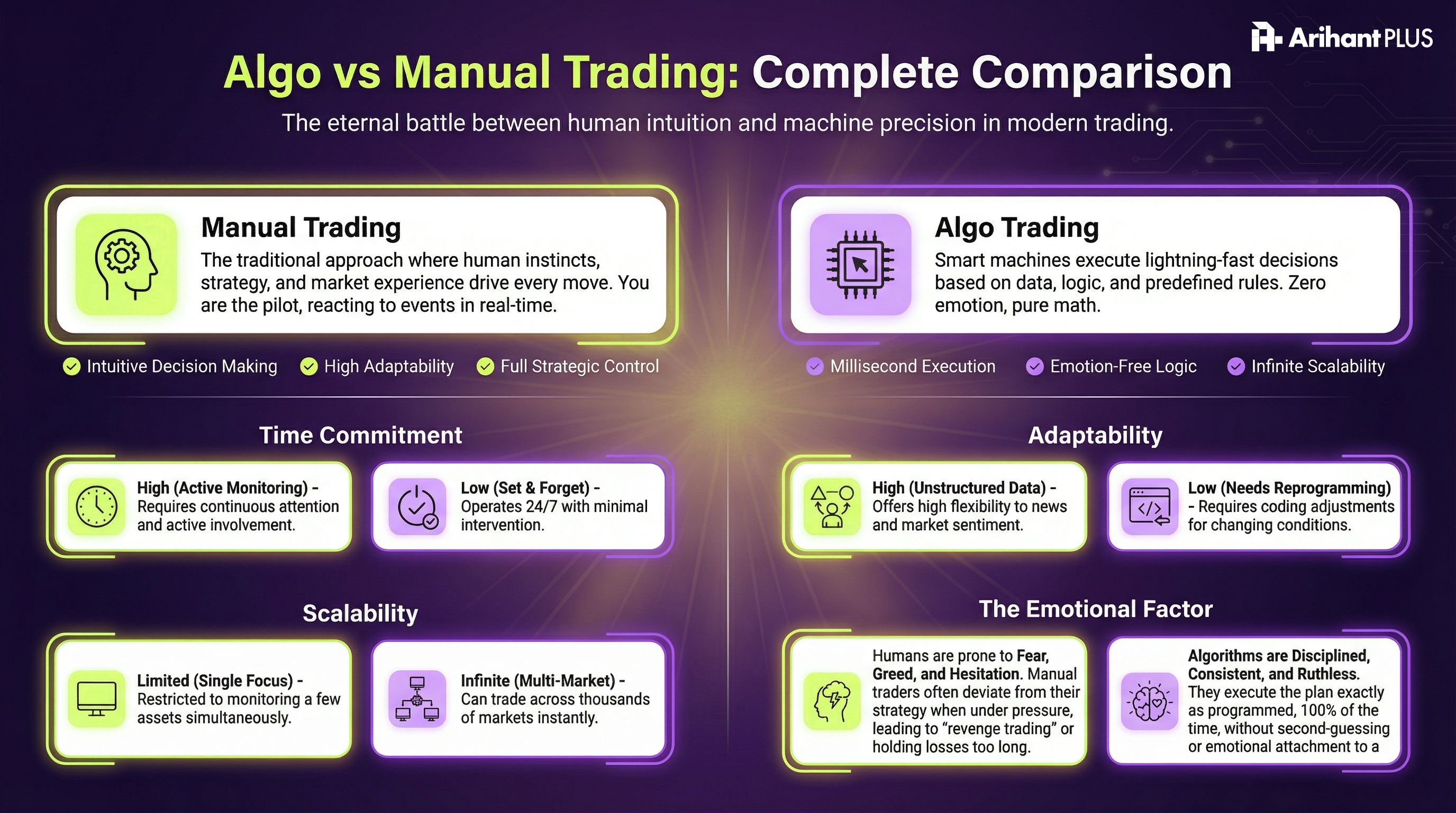
Which trading style is right for you depends on whether you prefer control and flexibility (manual) or speed and discipline (algorithmic). Here is a quick comparison of both trading styles:
Feature | Manual Trading | Algorithmic Trading |
Execution Speed | Slower, depends on human reaction | Instant, in milliseconds |
Emotions | Can affect decisions | Rules-based, no emotions |
Control | Full personal control | Automated, based on set rules |
Flexibility | Adapt to sudden news/events | Needs reprogramming for changes |
Execution Time | High - must monitor markets closely | Low, orders placed in milliseconds and system monitors markets continuously |
Accessibility | Easy to start, no coding required | Requires APIs and setup |
Automated vs manual trading in India: Which should you choose?
In India, both manual and automated styles are common. Day traders often prefer manual trading because they like making decisions directly. On the other hand, automation is growing quickly especially with the precision it offers and easy access.
Markets are very dynamic. Manual trading allows you the flexibility to switch strategies instantly in response to any sudden news or shift in market trends. Experienced trades also use their intuition to adapt to any uncertain market conditions, helping them to mitigate their losses and profit from such opportunities, something that computers cannot replicate. However, despite this it is a time-consuming process that comes with emotion-driven errors, limited scalability and slow execution.
This is where algo trading scores. It allows super-fast execution, efficiency and scale with complete precision.
What makes algo trading so popular?
Trading is not a battle against markets but against ourselves. We can be our worst enemies because our biases and emotions take control of us while trading. Yes, even professional traders are not immune to this.
With algo trading, removes the weakest link in trading – the trader. It follows rules and executes trades when the conditions are met with super-fast speed and precision. No second guessing, no cognitive biases, no mistakes.
Which style should you choose?
- Choose manual trading if you enjoy analysing charts, making decisions yourself, and want full control. It is also a good starting point for complete beginners.
- Choose algorithmic trading if you prefer speed, discipline, and automation. If you have limited time to monitor markets, automation can save effort while still following your rules.
Some traders even combine both - they use manual analysis to design strategies and then automate execution with APIs.
Conclusion: Finding Your Trading Style
So, is it better to let computer take control or does manual trading still have a place in this tech-driven world of trading?
Truth is that both the traders are chasing the same thing: consistent profits.
Both manual trading and algorithmic trading have their own strengths – there's no right or wrong style. Its about what suits your trading journey.
Manual trading is simple, flexible, and beginner friendly. Algorithmic trading is faster, disciplined, and efficient for handling multiple trades.
For Indian investors, this decision also depends on time and comfort with technology. If you enjoy hands-on control, manual trading may suit you. If you are data-driven, prefer automation and speed, and are looking to scale your strategy then algo trading can be a better fit.
With platforms such as ArihantPlus, you can now explore automated trading in a simple and affordable way. The key is to start small, understand the pros and cons, and choose the style that matches your goals.
We would love to know -
Are you trading the traditional way - fully manual?
Are you taking a hybrid approach?
Or are you already building systems and using algo trading?
FAQs
Which is better: manual trading or algorithmic trading?
It depends on your style. Manual trading gives control and flexibility, while algorithmic trading offers speed and discipline. Many traders use a mix of both.
Is algorithmic trading legal in India?
Yes, it is legal and regulated by SEBI. In August 2025, SEBI introduced new regulations allowing retail investors to use algo trading. APIs from brokers like ArihantPlus make automation possible for retail investors.
Is algo trading profitable?
Yes, but only if it’s done properly. Whether you’re using an algorithm for stocks or options, long-term success depends on a few essentials: testing your strategy on past data, managing risk carefully, regularly improving the system as markets change, and monitoring it for errors or failures.
In fact, this isn’t very different from manual trading. Human traders also need discipline, emotional control, and continuous learning. In both cases, profits don’t come from the method alone. They come from preparation, adaptability, and consistent execution.
What are the pros and cons of algorithmic trading?
Pros: speed, efficiency, no emotions, backtesting. Cons: technical setup, coding needs, and system risks.
Can beginners do algorithmic trading?
Yes, beginners can start small with simple strategies and APIs, testing with historical data before going live. Our algo trading experts can assist you in your setup and algo trading journey.
Why do some traders still prefer manual trading?
Because it gives them control, flexibility, and the ability to adapt instantly to market events without relying on systems.
With ArihantPlus, you can now use institutional-grade APIs free of cost and set up automated trades without heavy investment.

Related Topics

How to Start Algo Trading on ArihantPlus: From No-Code to Advanced API Trading

How is Algo Trading Beneficial for F&O Traders? Overview & FAQs
The Rise of Algo Trading Among Retail Investors in the Indian Stock Market