


Kajaria Ceramics Stock Outlook and Q3FY26 Results Analysis

By
Arihant Team
Markets often misprice companies during phases of change. Kajaria Ceramics Limited is down nearly 30% from its highs. Revenue looks flat. Institutional ownership has reduced. But profits are rising, margins are improving, and major expansion spending is largely behind the company. Is the market seeing weakness or missing a turnaround in progress? And what if the real story is hiding beneath the headlines?
In This Article
- Introduction
- Financial Resilience Amidst Flat Revenue
- Strategic Restructuring: Kajaria 2.0
- Management Discipline and Capital Allocation
- Sector Tailwinds: Morbi Exports and Energy Costs
- To sum up
- Research Disclaimer & Disclosures
Introduction
There is a very specific kind of market phase that separates investors who compound wealth from those who merely participate in headlines.
It is the phase where a fundamentally strong business looks optically uncomfortable. Where numbers appear mixed, sentiment turns cautious, institutions trim exposure, and the stock price begins to reflect doubt rather than data.
That is exactly where Kajaria Ceramics finds itself today.
The stock closed at ₹937 as of 2 March 2026, nearly 30% below its 52-week high of ₹1,322. Over the last six months alone, it has corrected more than 26%.
Foreign institutional ownership has declined from 18.33% in December 2023 to 11.66% in December 2025 over three years and witnessed a decline in the last three quarters as well. Mutual fund holdings have also seen trimming. It appears as if the smart money is slowly stepping away.
Kajaria Ceramics shareholding pattern:
Source: Company
Beneath the price correction and the institutional churn, the business is not deteriorating. In fact, the core economics are strengthening in ways that are easy to miss if one is only scanning revenue growth headlines.
Financial Resilience Amidst Flat Revenue
In Q3 FY26, consolidated revenue stood at ₹1,168 crore, largely flat YoY. That is the number most participants focused on. Flat revenue in a consumption-linked business during a soft demand environment is rarely exciting. Add to that a ₹20 crore embezzlement incident at its subsidiary, Kajaria Bathware, disclosed proactively by the company, followed by a forensic audit conducted by Ernst & Young, and the narrative almost writes itself. Markets do not like the word “fraud,” regardless of scale or response speed.
Here is a snapshot of Kajaria Ceramics Q3FY26 results:
Source: Company
And yet, while revenue remained flat, EBITDA margins expanded to 17.20%, up 442 basis points from 12.78% in the corresponding quarter last year. When margins expand meaningfully in a flat revenue environment, it tells you something important is happening beneath the surface. It tells you that the company is re-engineering its cost structure and operating model, not merely riding a demand wave.
Over the first nine months of FY26, consolidated net profit grew 30.95% year-on-year to ₹329.66 crore. Profit growing at over 30% while revenue remains largely flat is not financial noise. It is operating leverage being rebuilt.
To understand this properly, one must understand what Kajaria is actually doing.
Strategic Restructuring: Kajaria 2.0
For years, the company operated three separate tile divisions:
- Ceramic
- Polished Vitrified Tiles
- And Glazed Vitrified Tiles
Each has its own sales teams, discount structures and dealer engagement processes. A single dealer could have three different representatives visiting him from the same company, each pushing a different product category with different pricing logic. It worked in a growth cycle, but it was inefficient.
Kajaria 2.0 dismantles that fragmentation. The company has unified its sales architecture so that one representative now carries the full basket. Pricing structures have been standardised. Effective January 1, 2026, pricing unification across segments was completed.
This kind of restructuring is never smooth. Dealers need to adjust. Inventory gets recalibrated. Some churn is inevitable. Volumes temporarily stall as the distribution engine realigns itself. The market sees this short-term disruption and assumes structural weakness.
But what is actually happening is something far more deliberate. Kajaria is voluntarily absorbing short-term volume pressure to build a cleaner, more scalable operating framework.
Management Discipline and Capital Allocation
The confidence behind this shift is not verbal alone. Promoters have chosen to forgo their compensation, which stood at approximately ₹17 crore in FY25, until the company achieves ₹1,000 crore in annual EBITDA, compared to ₹620 crore in FY25. When founders tie their own paycheque to a significantly higher profitability milestone, it signals conviction that cannot be easily manufactured.
Second, and equally important, the company has shut down its loss-making plywood business. Kajaria had entered plywood as a diversification attempt, but the segment never achieved scale, contributed less than 2% to revenue, and remained persistently loss-making. Many companies cling to underperforming verticals for the sake of optics or ego. Kajaria did the opposite. It exited.
Closing the plywood division demonstrates management discipline and clarity of focus. Instead of funding a low-return, margin-dilutive business, capital and bandwidth are now fully directed toward tiles, bathware under the Kerovit brand, and adhesives. The revenue impact of shutting plywood is negligible, but the profitability impact is positive because it removes a structural drag on consolidated margins. That decision alone tells you that management is optimizing return on capital, not chasing revenue vanity.
Meanwhile, an unified sales force reduces duplication. SKU rationalisation lowers working capital drag and manufacturing complexity. Capacity optimisation, including conversion of facilities toward higher realisation segments like glazed vitrified tiles, improves blended margins. Management has guided for sustainable EBITDA margins in the ~18% range, with incremental upside beyond that reinvested into brand building rather than extracted as short-term profit.
Kajaria sells under three primary brands:
- Kajaria for tiles
- Kerovit for sanitaryware and bathware solutions
- And tile adhesives under ‘GresBond’ position the company firmly in the aspirational segment.
To reinforce that positioning, the company has appointed leading Bollywood celebrities such as Akshay Kumar, Ranveer Singh, and Anushka Sharma as brand ambassadors.
The bathware segment, though currently smaller relative to tiles, represents an underappreciated lever. Quarterly revenue from bathware stood at ₹103 crore in Q3 FY26, growing 9% year-on-year despite the subsidiary fraud noise.
Price increases have been implemented across faucet and sanitaryware categories, and management has guided for double-digit volume growth ahead. With over 1,900 exclusive tile dealers across the country, Kajaria’s distribution network becomes a natural cross-selling engine. The customer buying tiles is often the same customer finalising sanitaryware. The distribution cost advantage is quite often ignored by the markets.
Now, let us layer in something equally important that most miss!
Sector Tailwinds: Morbi Exports and Energy Costs
The Morbi export cycle is turning and that changes domestic pricing power. Morbi in Gujarat is one of the largest tile manufacturing clusters in the world and accounts for over 80% of India’s tile production. Installed capacity there exceeds 1,200 million square meters, while domestic demand in India is materially lower. When exports slow, excess Morbi supply gets redirected into India, triggering aggressive price competition. That is exactly what happened when freight costs spiked and geopolitical tensions disrupted global trade flows. Export realizations fell, and domestic pricing pressure intensified.
But freight rates are now moderating, Red Sea tensions are easing, and export markets across the Middle East, North America and Africa are gradually stabilizing. As Indian tile exports recover toward the ₹200 billion range, Morbi manufacturers are likely to refocus on international markets rather than flooding domestic channels. When export demand improves, domestic oversupply reduces. When oversupply reduces, price wars soften. And when price wars soften, organized leaders like Kajaria regain pricing discipline.
That directly supports average selling price expansion. Even a gradual increase in ASP over FY27 and FY28, combined with stable input costs, can materially expand margins for Kajaria.
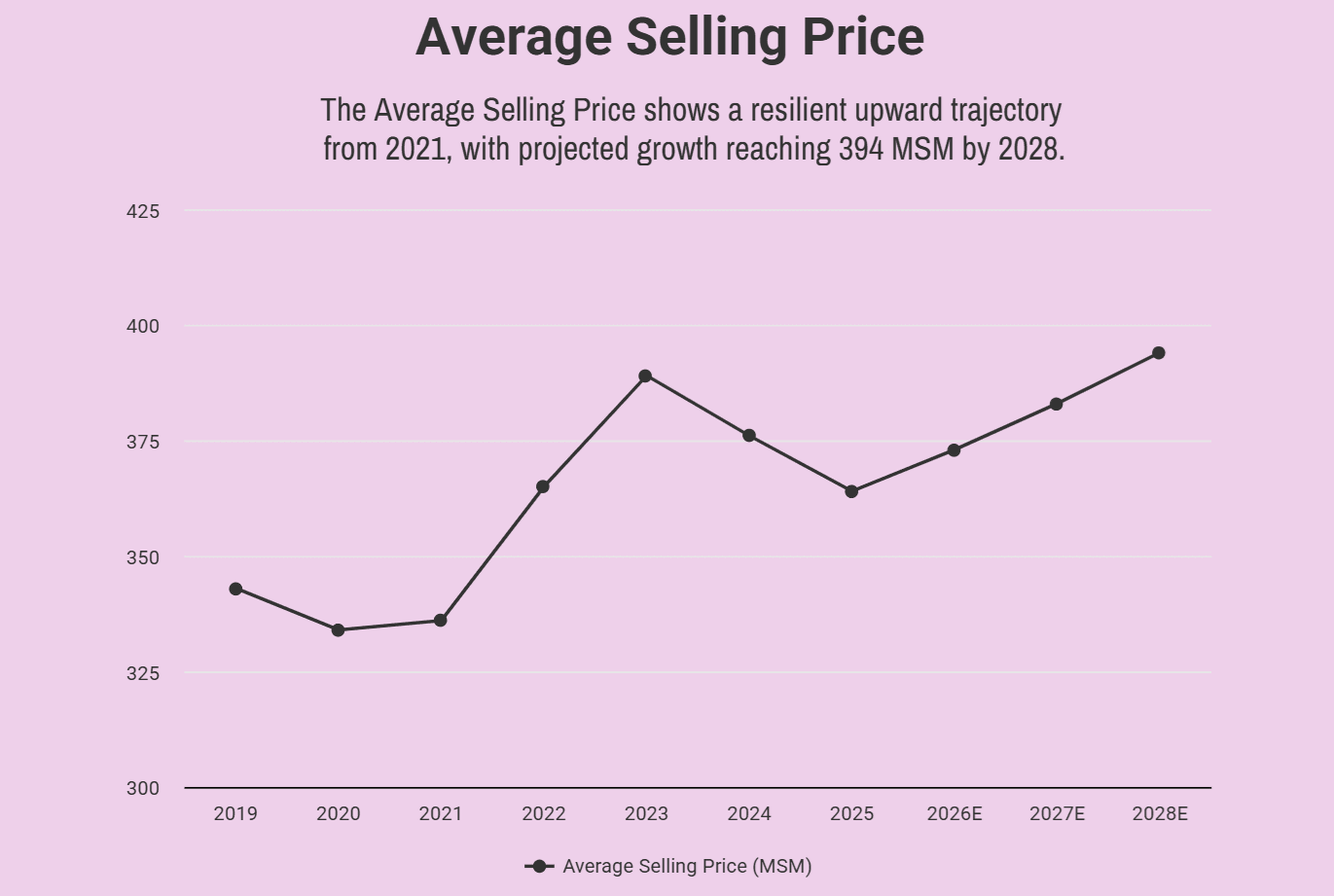
Which brings us to the second lever..natural gas!
Natural gas prices, a critical input for tile manufacturing, have softened meaningfully. Gas is especially important in energy-intensive segments like GVT and PVT. Kajaria’s average gas cost has declined from around ₹41 per SCM in FY24 to nearly ₹37 per SCM in Q3 FY26. This easing, driven by improved LNG supply dynamics, directly lowers production costs. If realizations inch upward while gas remains stable, EBITDA margins expand without requiring big volume growth.
This is the part the market is underestimating. You have structural internal efficiency improvements, improving external export dynamics, and easing energy costs all aligning at the same time.
Add to this the fact that the heavy capex cycle is largely behind the company. Between FY22-25, KJC undertook significant capex of INR 12bn adding ~31 MSM of captive capacity, a +57% growth over its base. With minimal major additions required in FY26, incremental revenue growth now flows through an already-built asset base. Lower capex combined with improving margins naturally translates into stronger free cash flow generation. And free cash flow, not accounting profit, is what ultimately drives long-term equity value.
There are, of course, risks. Governance perception must be monitored until the forensic audit concludes. Volume recovery is guided from Q4 FY26 onward, but any unexpected slowdown in real estate momentum could delay that rebound. Competitive intensity from organised peers and regional players remains real, particularly in price-sensitive markets.
To sum up
Markets often misprice businesses in transition because ambiguity is uncomfortable. Once clarity emerges, repricing tends to be swift.
Kajaria today is not a company in decline. It is a company in the middle of a transformation. The stock is down 30% from its highs. Nine-month profits are up nearly 31%. Margins are at multi-year highs. Sales architecture is unified. Brand investment is intensifying. Promoters have deferred compensation. Free cash flow visibility is improving.
At ₹956, the market is pricing hesitation. It is not fully pricing the structural improvements underway.
And that gap between perception and reality is where long-term returns are usually born.
Research Disclaimer & Disclosures
Investment in securities market is subject to market risks. Read all the related documents carefully before investing. This report is published by Mr. Abhishek Jain (RA).
- Personal Views: The views expressed accurately reflect the analyst’s personal opinion and are for educational purposes only. This is not a "Buy/Sell" recommendation. Please do your own research before making any investment.
- Registration Status: Arihant Capital Markets Limited] is a SEBI Registered Research Analyst ((Reg. No. - INH000002764)
- Conflict of Interest: The author/entity or relatives do not have any financial interest or beneficial ownership (1% or more) in Kajaria Ceramics Ltd. as of the date of publication.
Compensation Disclosure: No compensation has been received from the subject company in the past 12 months for any services. - No Guarantee: Registration granted by SEBI and certification from NISM in no way guarantee performance of the intermediary or provide any assurance of returns to investors.