


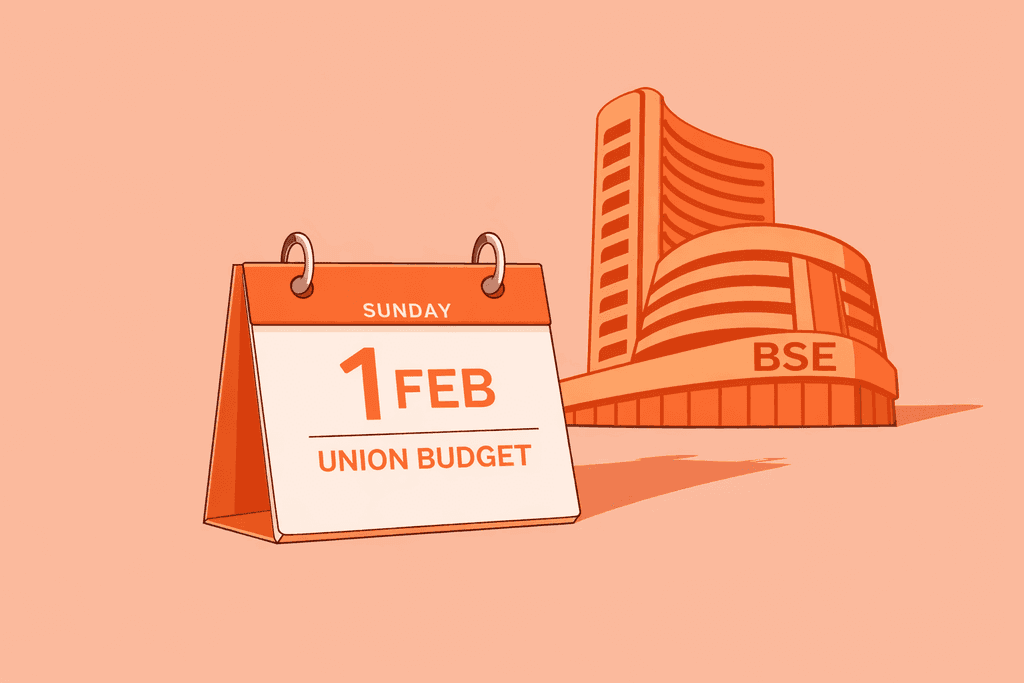
Stock Markets to Open on Sunday, Feb 1 for Union Budget 2026

By
Arihant Team
Stocks markets will be open on 1 Feb Sunday for Union Budget 2026 as per circulars issued by NSE and BSE on Friday. Exchanges will be conducting special live market sessions as per regular market hours.
In This Article
- Introduction
- NSE Official Confirmation: What the Circular Says?
- Budget 2026: A Historic Sunday Event
- Why Sunday Trading Matters on Budget Day
- What to Expect During Sunday’s Trading Session
- Have Indian stock markets stayed open on Sunday in the past?
- What should investors do now?
- Final Word
Introduction
Indian stock markets are set to open on Sunday, February 1, 2026, on account of the Union Budget 2026. It will be a rare working Sunday for Dalal Street, which enjoyed an unplanned holiday on 15th Jan, on account of Maharashtra elections.
There were speculations about it, and finally the National Stock Exchange (NSE) and Bombay Stock Exchange (BSE) have officially confirmed that equity markets will remain fully functional on Budget Day, even though it falls on Sunday.
The market timings will remain the same, with a pre-market session from 9 am to 9:08 am, and the normal market session from 9:15 am to 3:30 pm.
The decision to keep markets open for the budget aligns with historical precedent, and underlines how significant the Budget’s impact can be on investment sentiment and market direction.

NSE Official Confirmation: What the Circular Says?
According to the NSE Circular (Ref No: 11/2026, dated January 16, 2026), the exchange will conduct live trading on Sunday, February 1, 2026, following standard market timings.
NSE Trading Schedule — Sunday, February 1, 2026
Sunday, Feb 1 2026 | Timing |
Pre-Open Session | 🕘 09:00 AM – 09:08 AM |
Normal Market Session | 🕘 09:15 AM – 03:30 PM |
Block Deal Session 1 | 🕘08:45 AM – 09:00 AM |
Special Pre-Open Session (IPO & Relisted Securities) | 🕘 09:00 AM – 09:45 AM |
Block Deal Session – 2 | 🕘02:05 PM – 02:40 PM |
Post-Closing Session | 🕘03:40 PM – 04:00 PM |
Trade Modification Cut-off | 🕘04:15 PM |
In addition to the capital market, the futures and options (F&O) and commodity derivatives segments will also remain open on Sunday, as per standard market timings.
The exchanges have confirmed that T+0 settlement sessions and auction sessions for settlement defaults will not be conducted on that day.
Budget 2026: A Historic Sunday Event
The Union Budget 2026 will be presented by Finance Minister Nirmala Sitharaman at 11:00 AM on Sunday, February 1. This will mark her ninth Union Budget, a rare milestone in India’s fiscal history.
Official Budget Timeline
- January 28: President’s Address to Parliament
- January 29: Economic Survey release
- February 1 (Sunday): Union Budget at 11:00 AM
- February 13: First phase of Budget Session concludes
- March 9: Second phase begins
- April 2: Budget Session ends
Parliament working on a Sunday is unusual—but not unprecedented. What stands out this time is the decision to keep the stock markets open on a Sunday, ensuring immediate price discovery during the Budget presentation.
Why Sunday Trading Matters on Budget Day
The Union Budget is the single biggest market-moving event of the year with big bang announcements by the government related to key things, that impact the economy, sectors and companies. These announcements include:
- Capital gains taxation
- Government capital expenditure
- Infrastructure and manufacturing incentives
- Fiscal deficit targets
- Sector-specific allocations
These announcements often trigger sharp and immediate market reactions. Allowing markets to trade during the Budget presentation ensures:
- Real-time price discovery
- Controlled volatility
- Better execution for retail investors
- Effective risk management for institutions
If markets were to remain closed and reopen only on Monday, the reaction to two days of information would get compressed into a single session—often leading to large gap openings, erratic price action, and poor execution quality. A live Sunday session avoids this bottleneck.
What to Expect During Sunday’s Trading Session
- Higher volatility, especially during and immediately after the Finance Minister’s speech
- Sector-specific movements as policy announcements unfold
- Increased margin requirements and tighter risk controls
- Active participation from institutions, traders, and investors
- Volatility is inevitable on Budget Day—but a live session ensures it remains structured rather than chaotic.
Have Indian stock markets stayed open on Sunday in the past?
Yes. Indian markets have opened on non-working days for major Budget events in the past. The last Sunday Budget before this was in 2000. And the markets were open on Saturdays too for:
- Budget 2025 (Saturday session)
- Budget 2016 & 2015 (Saturday sessions)
While rare, such special sessions are well within operational precedent.
Open a free account today
Invest in tomorrow with just one click
What should investors do now?
Now that it is confirmed that markets will be open on Sunday for Budget session, make sure you follow a smart approach.
Here are some key tips:
- Plan in advance — do not trade impulsively
- Keep liquidity available
- Avoid chasing sharp moves
- Focus on policy substance, not headline noise
- Monitor sectoral cues, not just index movement
- Budget-day trading rewards discipline over excitement.
Final Word
With BSE and NSE officially confirming live trading on Sunday, February 1, 2026, Budget Day is set to be an eventful and historic session for Indian markets.
Whether markets trade on a Sunday or Monday is secondary. What truly matters is what the Budget delivers:
- Policy clarity
- Fiscal discipline
- Growth-oriented reforms
These factors determine medium- to long-term market direction, far more than the timing of the trading session itself.
Quick Reminder: Budget days are volatile. Don’t trade on hype or panic. Stick to your strategy, understand the real policy impact and make sure you make any investment decision keeping a long-term view.

Related Topics

Muhurat Trading 2026: NSE Announces Timings & Date for Stock Markets

NSE Holiday Calendar 2026: Complete List of Trading Holidays in India

NSE revised lot sizes for major Nifty index derivatives from October 28, 2025