


Can REITs and InvITs Become India’s Next Retail Portfolio Essential?

By
Arihant Team
This blog examines whether these instruments genuinely deserve a place in an Indian retail investor's portfolio in 2026, what to look for before investing, and where caution remains warranted
In This Article
- Introduction
- What are REITs and InvITs?
- What kind of returns do they offer?
- Why Are REITs and InvITs Relevant in India Right Now?
- Should Conservative Investors Adopt REITs and InvITs as a Strategy?
- Valuation and Tracking Framework of REITs and InvITs
- REIT & InvITs Taxation
- Investor Takeaway
Introduction
India’s investment landscape is undergoing a quiet but important shift. Bank FD rates are gradually falling, and after the RBI’s interest rate cuts in 2025, many fixed deposits are earning less than they used to. The change has not happened dramatically or overnight, but it is enough to make investors rethink whether the old approach of “park it in an FD and forget it” still works the way it once did.
So investors are doing what they usually do when one door starts closing. They are looking for the next one.
That is where Real Estate Investment Trusts and Infrastructure Investment Trusts are entering the conversation.
So, let’s understand what they actually are, why they are gaining attention, and where investors need to be careful.
Open a free account today
Invest in tomorrow with just one click
What are REITs and InvITs?
Think about this. You want to own a piece of a Grade A office tower in Bengaluru, the kind that Google or HSBC rents out for crores a month. But you don't have crores lying around. What do you do?
That's the problem REITs solve.
A REIT, short for Real Estate Investment Trust, is a listed trust that owns and operates income-generating commercial real estate assets such as office parks, shopping malls, and logistics parks. In simple words, a REIT pools money from thousands of investors, buys large commercial properties and passes the rental income back to you. You buy units on the stock exchange, just like you'd buy a share of Infosys.
An Infrastructure Investment Trust, or InvIT, does the same thing but for infrastructure assets such as toll roads, power transmission lines, gas pipelines, renewable energy projects, and data centre networks.
Both are regulated by SEBI. And both are legally required to distribute at least 90% of their cash flows to investors. That last part is important, it's not a promise, it's a rule. Distributions occur at least once every six months, with most listed trusts choosing a quarterly payout cycle. The underlying assets in a REIT and InvIT are typically held through Special Purpose Vehicles (SPVs), which are owned by the trust.
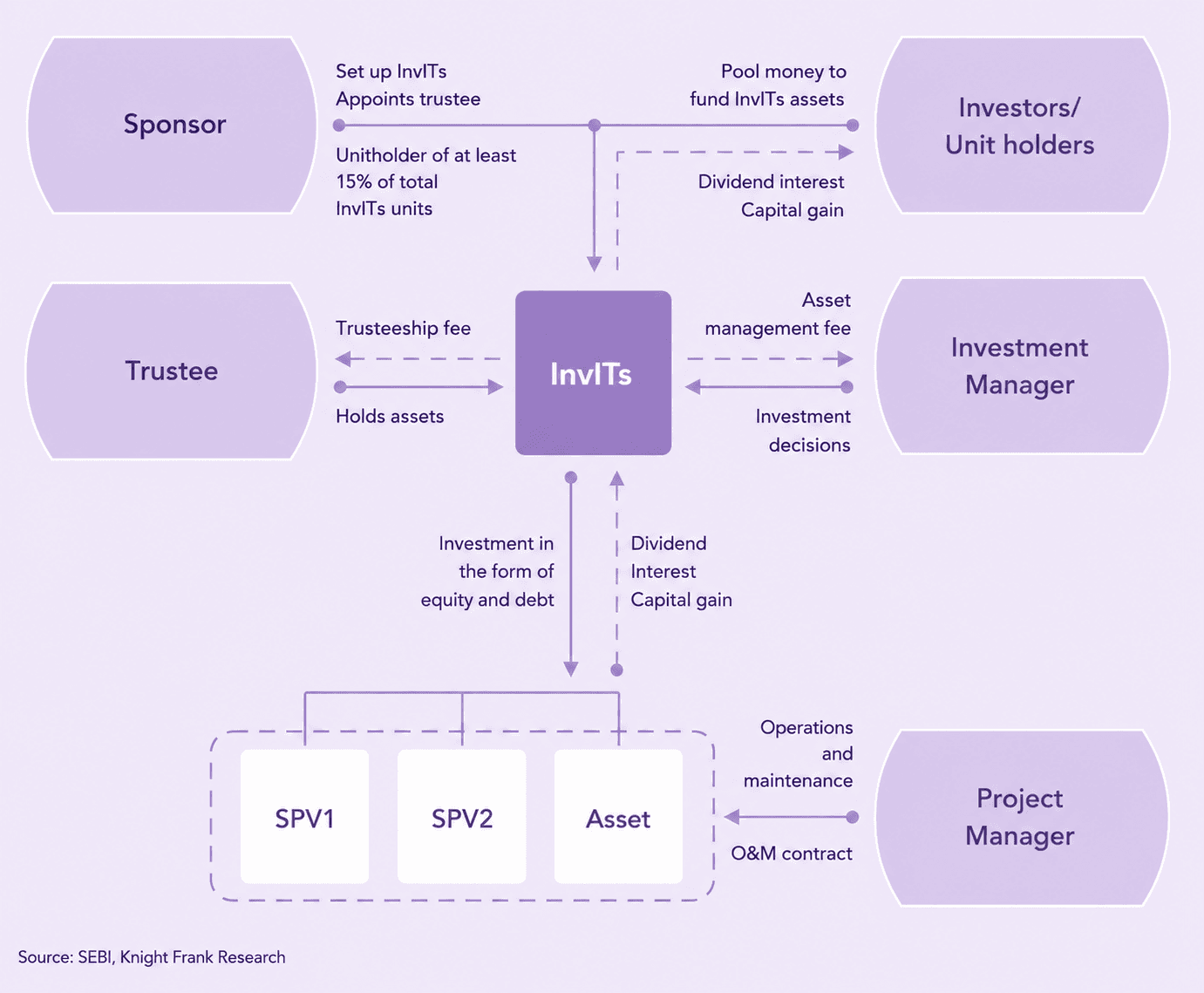
What makes them different from direct real estate or infrastructure ownership is access.
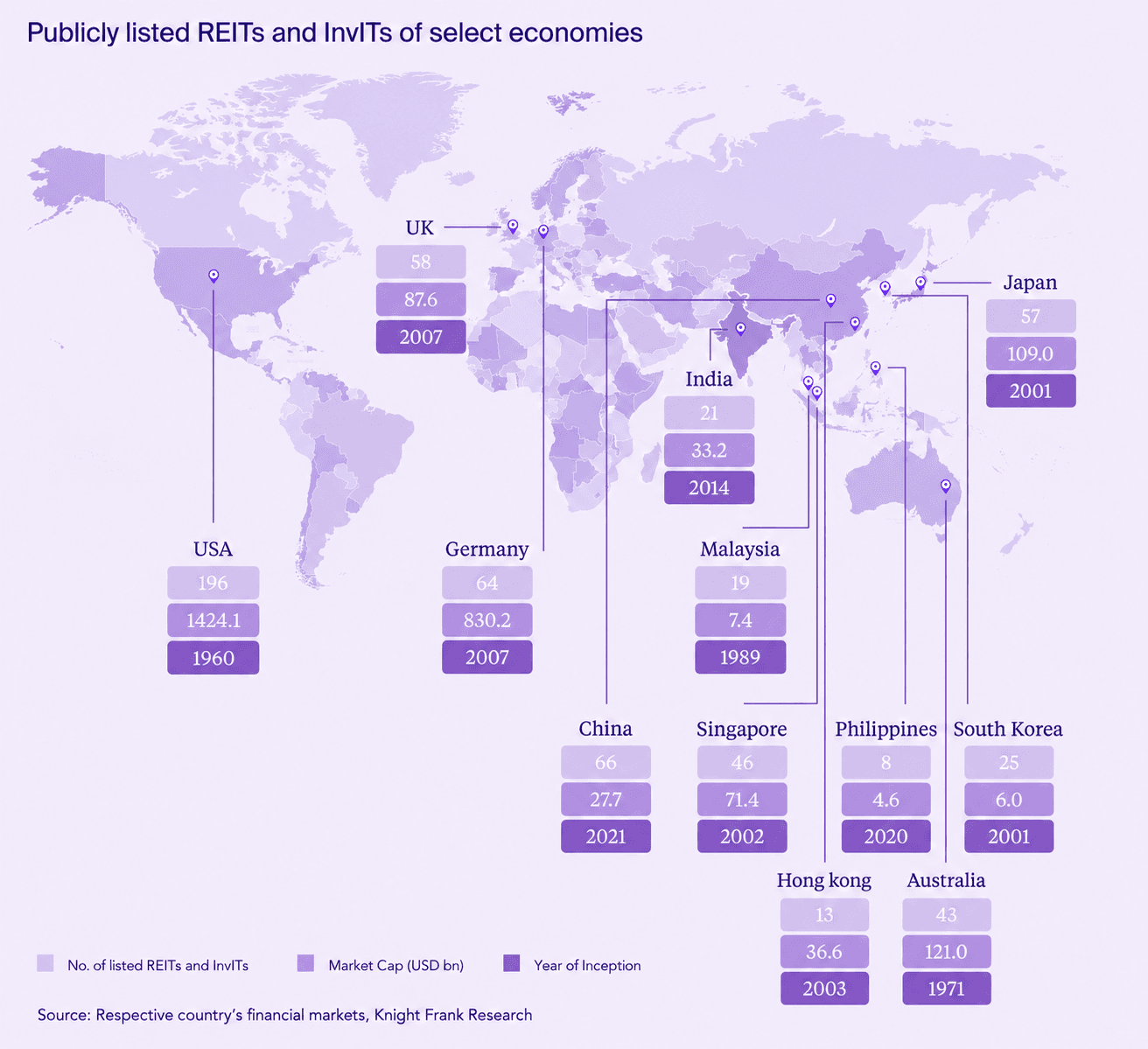
As of early 2026, India has five publicly listed REITs spanning commercial offices and retail malls, and multiple publicly listed InvITs covering roads, power transmission, and renewable energy.
What kind of returns do they offer?
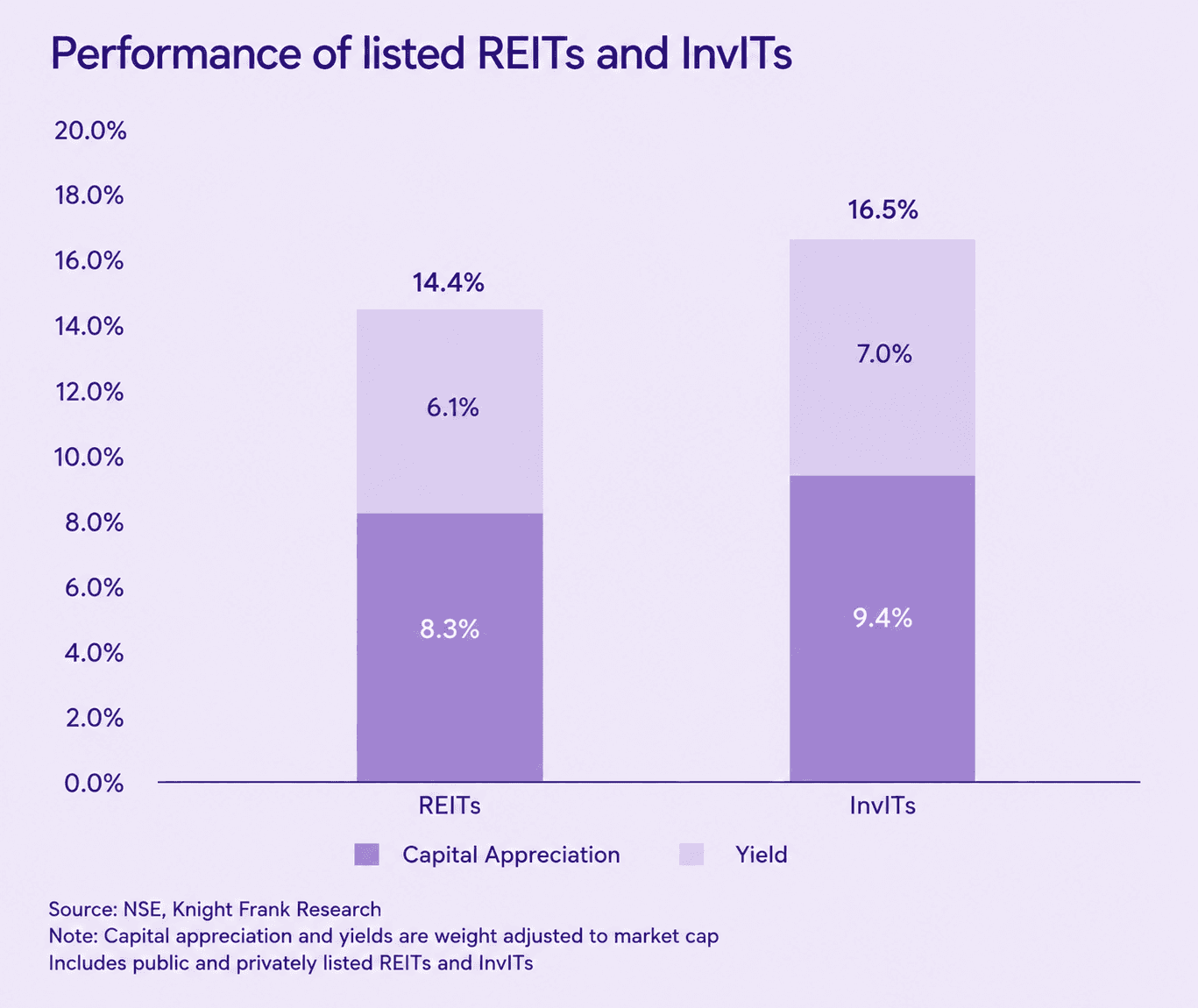
Listed Indian REITs are currently yielding ~6-7% annually, higher than those in developed markets such as the United States, Singapore, and Japan. Power transmission InvITs like IndiGrid are offering closer to 9-10%.
Compare that to where we are today:
- FD rates have drifted to roughly 6.5-7% for 1-3 year tenures,
- AAA corporate bonds yield about 7-7.5%, and
- the Nifty 50 dividend yield? Under 1.5%.
So REITs and InvITs sit in an interesting middle ground, better income than equities, comparable to or better than FDs, with the added possibility of capital appreciation if the underlying assets grow in value.
Embassy Office Parks REIT, for example, has seen net operating income grow as lease renewals are executed at significantly higher rents than expiring leases, a tailwind sometimes called mark-to-market rental upside.
The payout structure also matters. Distributions from REITs and InvITs are not simple coupon payments. They typically contain a mix of interest income, dividend income, rental income, and in some cases, amortisation of the debt extended by the trust to its SPVs.
There's also a tax angle worth knowing. More than 65% of REIT distributions have historically been tax-exempt in investors' hands. FD interest, by contrast, gets taxed at your full income slab. So the post-tax comparison often favours REITs more than the headline numbers suggest.
Why Are REITs and InvITs Relevant in India Right Now?
Several converging trends make the 2026 context particularly relevant for evaluating these instruments.
- Structurally strong commercial real estate: Office leasing continues to hold firm. Large deals made up 65% of leasing in Q1 2026, and Grade A office stock has crossed 1 billion sq. ft. This supports rental growth and REIT cash flows.
- Growing distribution: Indian REITs distributed over ₹8,900 crore in FY2026, up from ₹6,070 crore in FY2025. This reflects stronger rentals, renewals, and portfolio expansion.
- Supportive interest rate cycle: RBI rate cuts have improved the outlook for REITs and InvITs. Lower borrowing costs can support cash flows, valuations, and NAV growth.
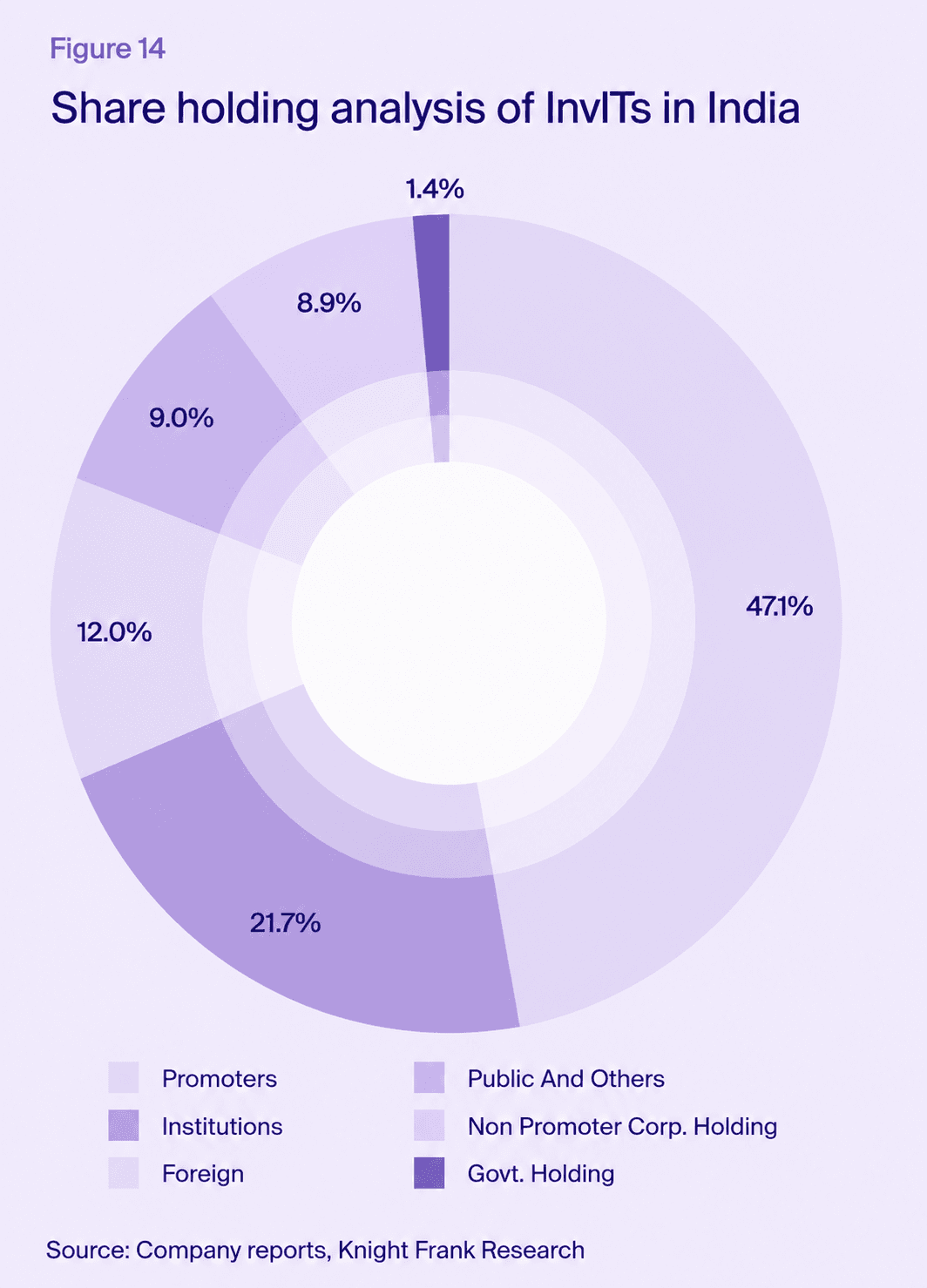
- Expanding listed universe: Knowledge Realty Trust, backed by Blackstone and Sattva Group, listed in August 2025 as the fifth Indian REIT and also the largest by market capitalization at listing. India now has five listed REITs and a growing InvIT universe across roads, power, renewables, logistics, and telecom. SM REITs may further widen retail participation.
- Rising Institutional participation: Mutual fund investments in REITs and InvITs have grown sharply, reaching nearly ₹20,000 crore by April 2025. Proposed SEBI limit changes could deepen flows further.
Should Conservative Investors Adopt REITs and InvITs as a Strategy?
If you’re a conservative investor, REITs and InvITs have genuine attributes that you might value. They offer regular income distributions, regulated minimum payout requirements of 90 percent of distributable cash flows, professional asset management, SEBI-mandated governance standards, and public market transparency through listed instruments on NSE and BSE. These are meaningful structural strengths that distinguish them from, say, unlisted real estate or alternate investment funds.
However, you must understand what these instruments are not. They are not capital-protected. Their market prices fluctuate with interest rates, occupancy levels, global risk appetite, and liquidity conditions.
When the RBI was in a rate-hiking cycle in 2022 and 2023, REIT unit prices in India came under meaningful pressure.
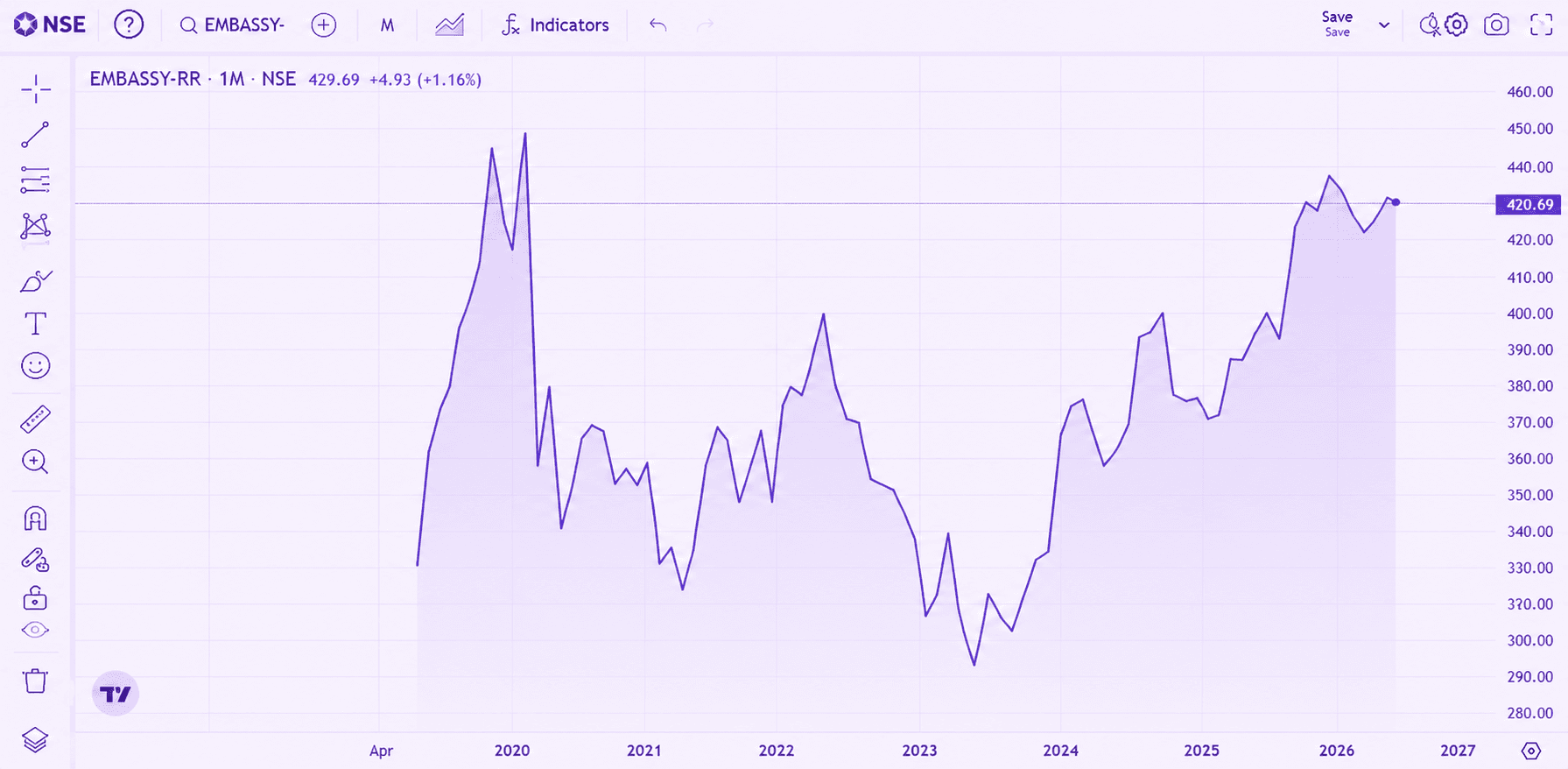
Embassy Office Parks REIT Historical Performance
They are not as simple as an FD in terms of monitoring requirements. If you park money in a REIT and forget about it, you’re taking risks you may not fully appreciate.
Valuation and Tracking Framework of REITs and InvITs
Investing in REITs and InvITs without a basic evaluation framework is inadvisable. Here is what you should examine before and after investing.
- Market Price vs NAV: Check whether the unit price trades at a premium or discount to NAV. This helps assess entry valuation and return expectations.
- Distribution yield: This is the annualised distribution per unit divided by the current market price. A distribution yield of 6 to 7 percent for an office REIT or 8 to 9 percent for a power transmission InvIT is broadly the range seen in the current market. Comparing this yield with your alternatives in FDs or bonds, on a post-tax basis, is the most important starting point.
- Occupancy levels for REITs. For office REITs, high occupancy, generally above 88 to 90 percent of leasable area, is a sign of income reliability. Watch for trends in occupancy over multiple quarters, the proportion of leases up for renewal in the near term, and the weighted average lease expiry, or WALE, which indicates how long existing leases are contracted to run.
- Toll collections and asset availability for InvITs. For road InvITs, quarterly toll revenue and traffic volume growth are the primary operating metrics. For power transmission InvITs, asset availability percentages and CERC regulatory compliance determine whether the trust earns its full tariff.
- Leverage and debt-to-asset value. REITs and InvITs carry debt at the trust or SPV level. Higher leverage amplifies both returns and risks. You should examine the debt-to-asset value ratio, the maturity profile of existing debt, and the interest cost relative to the overall distribution yield.
- Sponsor quality. The sponsor is typically the entity that created the trust and may continue to manage and sometimes source new assets for it. Sponsors like Blackstone, Brookfield, Embassy Group, and KKR bring institutional-grade asset management credentials. Sponsor quality, track record, and the presence of potential conflict-of-interest in related-party transactions are significant governance considerations.
- Asset quality and diversification. A REIT with a concentrated portfolio in one geography or one tenant type carries more risk than one with diverse grade-A assets across multiple cities and a broad tenant base of Global Capability Centres, BFSI firms, and technology companies.
- Liquidity on NSE and BSE: Adequate daily trading volumes are essential for investors who may need to exit positions. Some listed InvITs, particularly privately placed ones, have limited secondary market liquidity. This is a meaningful risk for investors with any near-term liquidity requirement.
REIT & InvITs Taxation
REIT and InvIT payouts are taxed component-wise. You must check the distribution breakup before calculating post-tax returns.
- Interest and rental income: Taxed as per the investor’s income tax slab
- Dividend income: Taxable or exempt depending on the tax regime chosen by the underlying SPV.
- Capital gains: Units held for over 12 months qualify for long-term capital gains treatment.
- Debt repayment component: May reduce cost of acquisition and increase capital gains tax at the time of sale.
Investor Takeaway
India’s REIT and InvIT market is at an inflection point, supported by regulation, institutionalisation of real assets, and demand for inflation-beating income. These instruments offer regular payouts, professional asset management, liquidity, and portfolio diversification.
They can be a useful middle path between low-yield fixed deposits and volatile equities, especially for income-focused investors.
However, you must track valuation, yield, leverage, asset quality, tax treatment, and liquidity before investing.

Related Topics

Everyone Knows Bajaj Finance’s Playbook. So Why Can’t Anyone Copy It?


Beyond the Dark Store: Is Advertising Zepto's Real Business?


NSE Extends F&O Market Close to 3:40 PM: What Traders Must Know

Elon Musk’s $119 Billion Terafab Bet: Can It Reshape AI Chips?

Rupee Crashes to ₹96: How Investors Can Profit From the Fall

The Rise of India’s Defence Sector: Stocks, Trends & Opportunities

SEBI introduces Verified Badge for Trading Apps to Curb Fake App Scams

TCS Q4 Concall: AI Infrastructure to Drive the Next Growth Cycle


Oil Is Surging After The Iran Strikes. So Why Isn’t Gold Following?



Union Budget Day & Market Behaviour: 15 Year Trend Analysis (2011-2025)

Infosys ₹18,000 Crore Share Buyback: Record Date & Why Promoters Opted Out?

Nifty 50 Performance Since Last Muhurat Trading: Nifty Top 10 Performers

Diwali Muhurat Trading: Can Nifty’s 7-Year Winning Streak Continue?


Tata Motors Demerger Gets NCLT Nod: What Shareholders Must Know

Muhurat Trading 2025 on 21 Oct: Everything You Should Know



Tuesday is the New Thursday: NSE & BSE Expiry Shift from Sep 2025


Axis Bank Q1FY26 Results: A Mixed Bag, but Long-Term Picture Still Intact